Arounddeal vs Quickenrich 2026: B2B Data Tools Compared
AroundDeal and QuickEnrich both promise accurate B2B contact data and enrichment. Here is an honest, side-by-side breakdown of coverage, accuracy, pricing, and the best fit for cold outreach in 2026.
Choosing a B2B data provider usually comes down to one question that marketing pages refuse to answer plainly: will the contacts actually be reachable? AroundDeal and QuickEnrich both sell themselves on accurate emails, enrichment, and a database that covers your target accounts. This guide compares them the way a RevOps lead would — on coverage, accuracy, workflow fit, and total cost — and shows where a focused email-finder like Tomba quietly beats both for cold outreach.
TL;DR — Arounddeal vs Quickenrich at a glance#
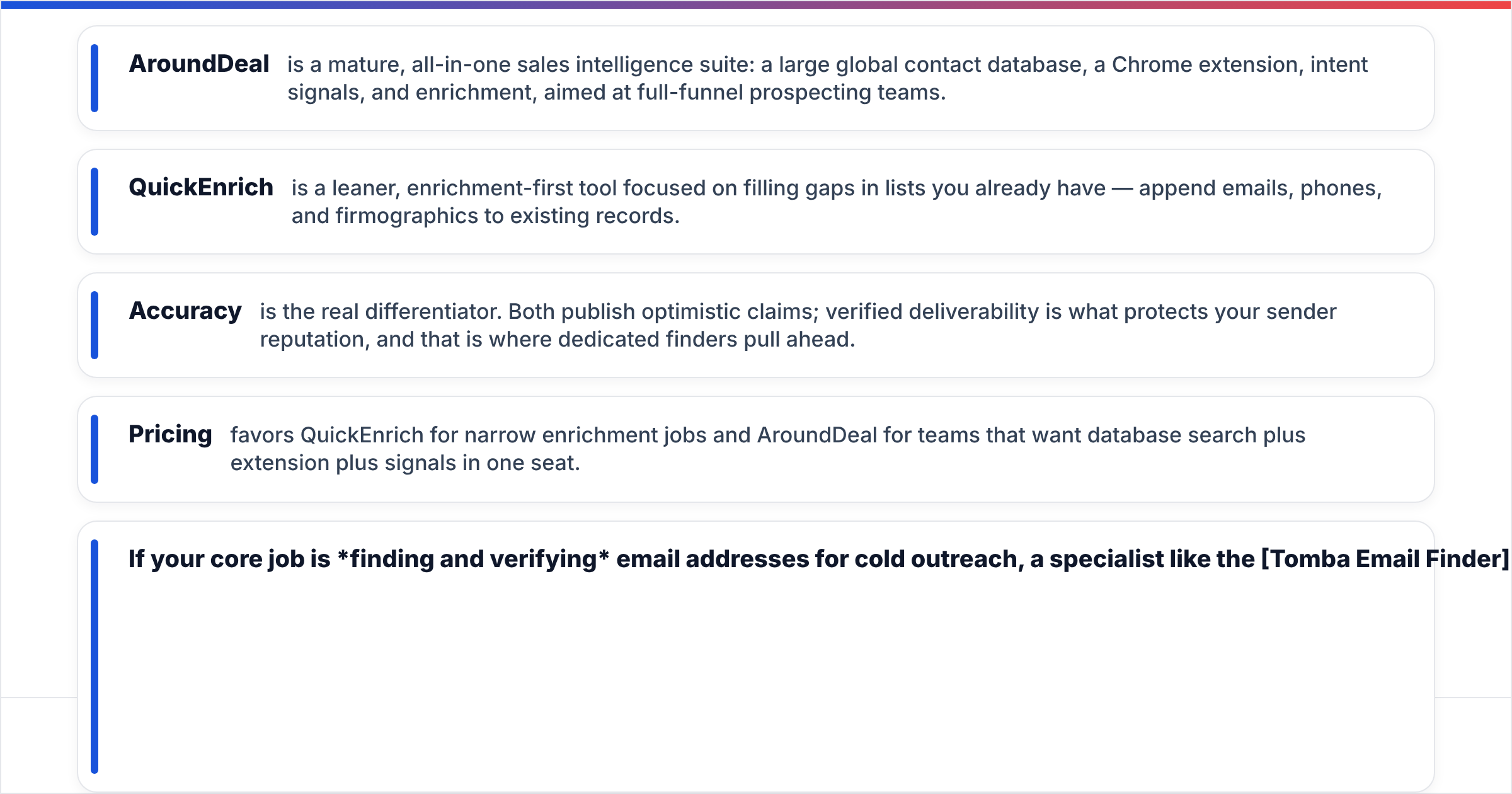
- AroundDeal is a mature, all-in-one sales intelligence suite: a large global contact database, a Chrome extension, intent signals, and enrichment, aimed at full-funnel prospecting teams.
- QuickEnrich is a leaner, enrichment-first tool focused on filling gaps in lists you already have — append emails, phones, and firmographics to existing records.
- Accuracy is the real differentiator. Both publish optimistic claims; verified deliverability is what protects your sender reputation, and that is where dedicated finders pull ahead.
- Pricing favors QuickEnrich for narrow enrichment jobs and AroundDeal for teams that want database search plus extension plus signals in one seat.
- If your core job is finding and verifying email addresses for cold outreach, a specialist like the Tomba Email Finder is cheaper and more accurate than paying suite pricing for features you won't use.
What are AroundDeal and QuickEnrich?#
AroundDeal is a B2B sales intelligence platform built around a global contact and company database. It bundles database search, a browser extension for scraping prospects off LinkedIn and company sites, data enrichment, and buyer-intent signals. The pitch is "one platform for the whole prospecting motion." You can read their feature list on the AroundDeal website and cross-check user sentiment on G2.
QuickEnrich sits in a different lane. It is an enrichment-first service: you bring a list of names, domains, or partial records, and it appends the missing fields — work email, phone, title, company size, and so on. It is less about open-ended prospecting and more about cleaning and completing data you already collected from forms, events, or a CRM export. That focus makes it simpler to learn but narrower in what it replaces.
The distinction matters because it changes who each tool is for. AroundDeal wants to be your prospecting home base. QuickEnrich wants to be the step that runs after lead capture. Neither is wrong — but if you buy the wrong shape, you either overpay for unused modules or bolt on a second tool anyway.
)
How do they compare on features and pricing?#
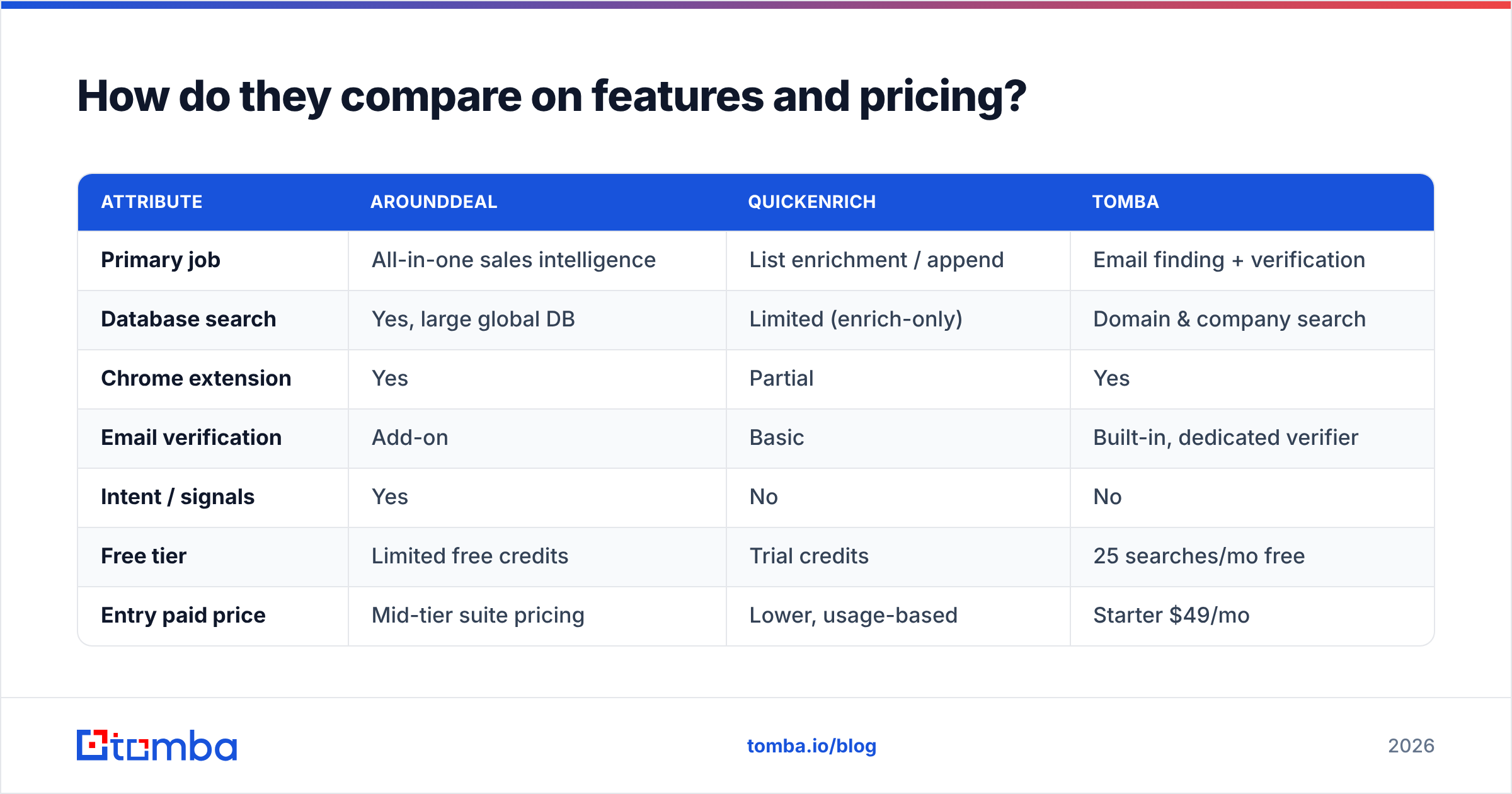
Here is the practical side-by-side. Treat pricing as directional — both vendors change tiers and gate credits differently, so confirm current numbers on their own pages before you commit.
| Attribute | AroundDeal | QuickEnrich | Tomba |
|---|---|---|---|
| Primary job | All-in-one sales intelligence | List enrichment / append | Email finding + verification |
| Database search | Yes, large global DB | Limited (enrich-only) | Domain & company search |
| Chrome extension | Yes | Partial | Yes |
| Email verification | Add-on | Basic | Built-in, dedicated verifier |
| Intent / signals | Yes | No | No |
| Free tier | Limited free credits | Trial credits | 25 searches/mo free |
| Entry paid price | Mid-tier suite pricing | Lower, usage-based | Starter $49/mo |
| Best for | Full-funnel prospecting teams | Cleaning existing lists | Cold-outreach accuracy |
| API access | Yes | Yes | Yes (Tomba API) |
A few honest takeaways from the table. AroundDeal gives you the widest surface area, which is great if you genuinely use database search, the extension, and intent in one workflow — and wasteful if you only need emails. QuickEnrich is the more economical pick when you already have a steady inbound list to enrich and don't need open-ended search. Both, however, treat verification as a secondary concern, and that is the gap worth examining closely.
For teams comparing the broader market, it's worth noting these aren't your only two options — see how the category stacks up in our roundup of Apollo alternatives and the wider field of data enrichment tools before locking in.
Which has better data accuracy?#
Accuracy is the metric that actually decides outcomes, because a bounced send costs you twice — once in wasted effort and once in damaged sender reputation. A database that's 90% complete but unverified can sink your inbox placement faster than a smaller, verified list.

AroundDeal's coverage is genuinely broad, especially for APAC and global mid-market accounts, which is one of its strongest selling points. The trade-off is that broad databases accumulate stale records, and AroundDeal's built-in verification is lighter than a dedicated verifier. QuickEnrich, being enrichment-first, returns fewer "found-but-wrong" results because it works from records you already partly trust — but its raw coverage for net-new contacts is thinner.
The reliable pattern, regardless of which provider you pick, is to treat finding and verifying as two separate steps. Run your discovered or enriched emails through a real-time email verifier that checks MX records, catches invalid mailboxes, and flags risky catch-all domains before you ever load them into a sequence. This is exactly where Tomba's architecture differs: verification isn't an afterthought bolted onto a database, it's a first-class product.
If you want a sense of how dedicated finders benchmark against suite tools on accuracy and price, this comparison breaks it down:

When should you choose AroundDeal?#
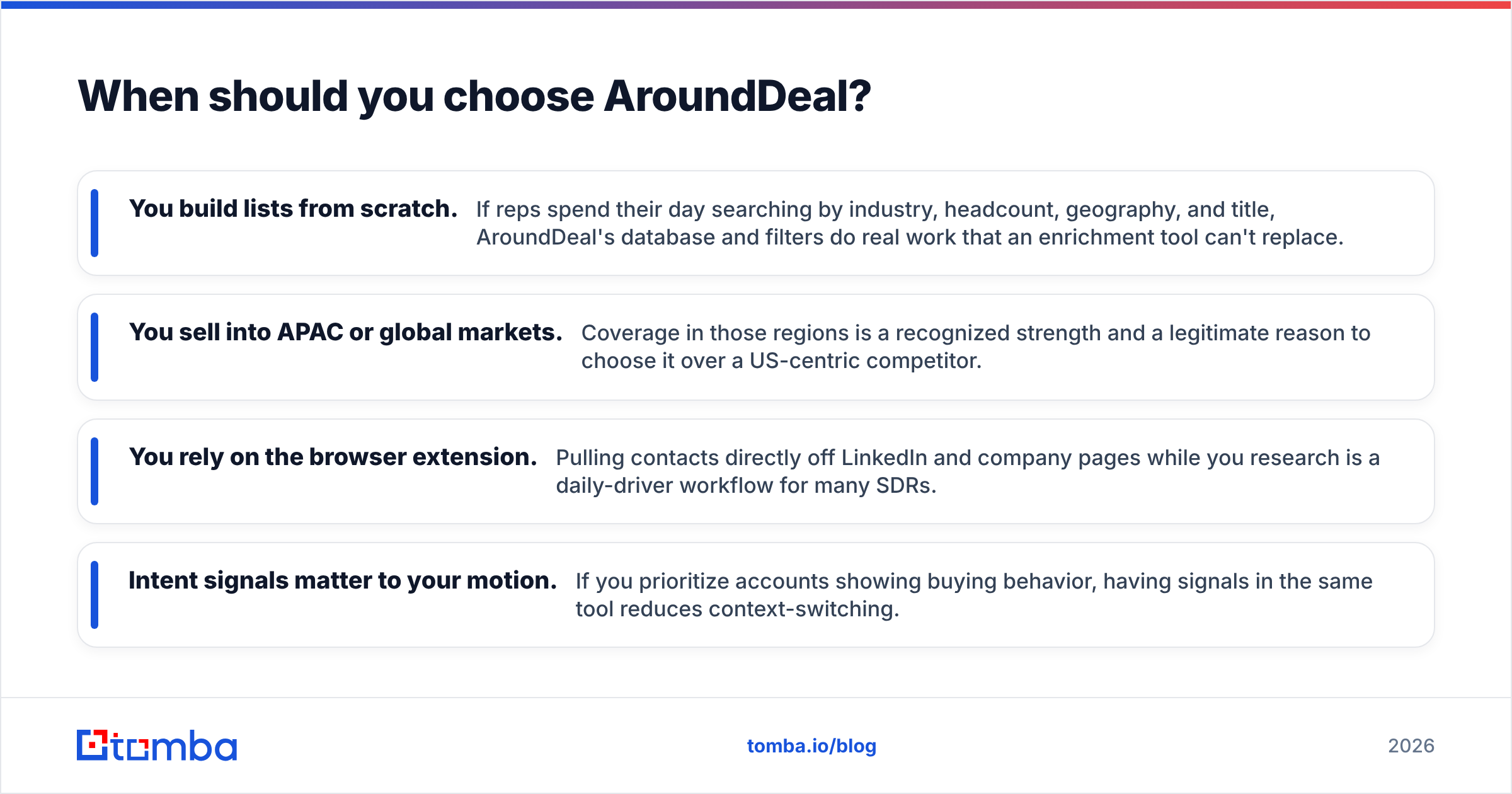
Pick AroundDeal when prospecting is a team sport and you want one platform instead of three. Specific scenarios where it earns its price:
- You build lists from scratch. If reps spend their day searching by industry, headcount, geography, and title, AroundDeal's database and filters do real work that an enrichment tool can't replace.
- You sell into APAC or global markets. Coverage in those regions is a recognized strength and a legitimate reason to choose it over a US-centric competitor.
- You rely on the browser extension. Pulling contacts directly off LinkedIn and company pages while you research is a daily-driver workflow for many SDRs.
- Intent signals matter to your motion. If you prioritize accounts showing buying behavior, having signals in the same tool reduces context-switching.
The caution: you pay suite pricing whether or not you use every module. If your team only touches the email-finding 20% of the platform, you're subsidizing features that sit idle. Audit actual usage after 60 days.
)
When should you choose QuickEnrich?#
Pick QuickEnrich when your problem is incomplete records, not missing prospects. It shines in these cases:
- Inbound-heavy funnels. Form fills and event scans arrive with a name and company but no work email or phone. QuickEnrich fills those fields without you running a full prospecting search.
- CRM hygiene projects. When half your Salesforce or HubSpot records are missing firmographics, a focused enrichment pass is cheaper than a full intelligence seat.
- Usage-based budgets. If your enrichment volume is spiky, paying per credit beats committing to a flat suite subscription you can't fully consume.
The caution runs the other way: QuickEnrich is not built to discover net-new contacts at scale, and its verification depth is basic. If you need both discovery and clean deliverability, you'll likely pair it with a second tool — at which point the combined cost can exceed a single specialist.
Where does Tomba fit in this comparison?#
Tomba is the answer to a more specific question: "I need accurate, verified business emails for outreach, and I don't want to pay for a database suite to get them." It's not trying to be AroundDeal's intent platform or QuickEnrich's full enrichment pipeline — it's a focused email-finding and verification engine that does that one job exceptionally well.
What that looks like in practice:
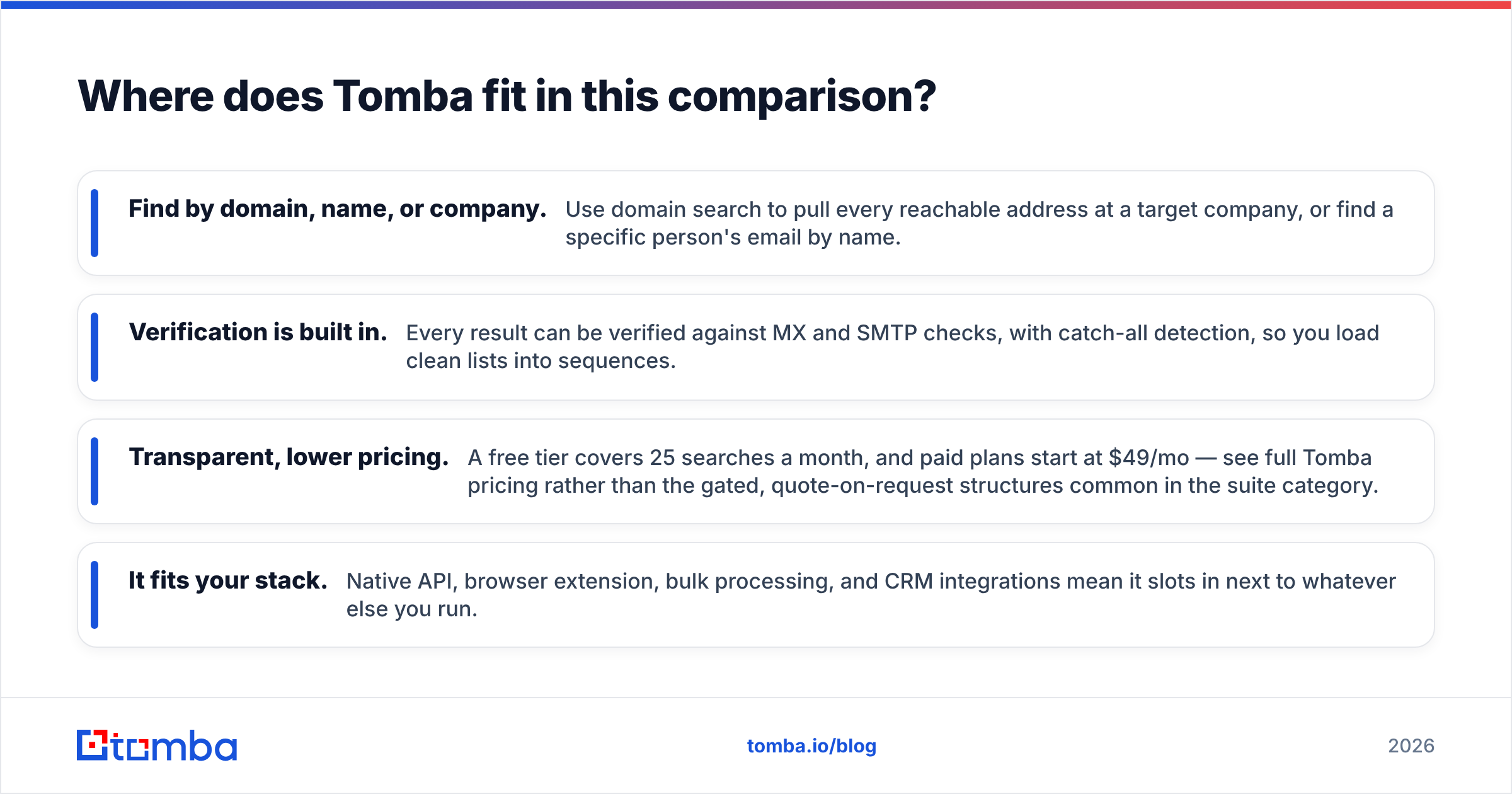
- Find by domain, name, or company. Use domain search to pull every reachable address at a target company, or find a specific person's email by name.
- Verification is built in. Every result can be verified against MX and SMTP checks, with catch-all detection, so you load clean lists into sequences.
- Transparent, lower pricing. A free tier covers 25 searches a month, and paid plans start at $49/mo — see full Tomba pricing rather than the gated, quote-on-request structures common in the suite category.
- It fits your stack. Native API, browser extension, bulk processing, and CRM integrations mean it slots in next to whatever else you run.
Here's the honest framing: if you genuinely need intent data and a global prospecting database, AroundDeal is the more complete platform and you should consider it. If you mainly clean inbound lists, QuickEnrich is a sensible, economical fit. But the majority of teams comparing these two are really trying to solve "get me reachable emails for cold outreach" — and for that exact job, a specialist is faster, cheaper, and more accurate than buying a suite.
How do you decide between the three?#
Run your decision through three questions in order:
- What is the dominant job? If it's discovery and intent, lean AroundDeal. If it's appending to existing records, lean QuickEnrich. If it's reachable emails for outbound, lean Tomba.
- How do you pay for accuracy? Whatever you pick, budget for a real verification step. A tool that treats verification as core (rather than an add-on) saves you reputation damage later.
- What will you actually use? Map features to your real weekly workflow, not the demo. Pay for the 80% you'll touch, not the 20% that looks impressive in a sales call.
A common, cost-effective pattern is to use a focused finder as the backbone and add a heavier platform only when a specific gap — like intent signals — proves it pays for itself. Starting narrow and expanding beats starting broad and rationalizing the spend.
The bottom line#
AroundDeal wins on breadth and global coverage; QuickEnrich wins on simplicity and enrichment economics; both treat verified deliverability as a secondary feature. For the most common reason people compare these tools — building accurate, low-bounce lists for cold email — a dedicated finder is the better-fit, lower-cost choice.
If that's your situation, start with the Tomba Email Finder. Find verified business emails by domain, name, or company, check them against built-in verification before you send, and keep your sender reputation intact — on a free tier that lets you test the accuracy yourself before paying a cent. When email reachability is the real goal, buy the tool built for it, not the suite that happens to include it.
// get started
Find, verify and enrich your first contacts today
Start on the free plan with 25 searches a month, then scale when your team is ready.
Free plan · No credit card required · GDPR & CCPA
// about the author