Arounddeal vs Smarte: B2B Data Tools Compared (2026)
Arounddeal vs Smarte compared on data accuracy, coverage, pricing, and compliance — plus where a focused email finder beats both for outbound teams in 2026.
You are choosing between two B2B data platforms and you want the version without the marketing gloss. Here it is.
TL;DR#
- Arounddeal leans on a large global contact database with a Chrome extension and intent signals, strongest for prospecting volume across APAC and EMEA.
- Smarte (SMARTe) positions itself as a data-enrichment and revenue-intelligence layer, strongest for cleaning and completing records you already own.
- Both bundle "contact + company + intent" data, so the real decision is accuracy in your territory, export limits, and price per usable record — not feature lists.
- Neither is a dedicated email-finder. If your core need is verified emails on demand, a focused tool like the Tomba Email Finder usually returns a higher rate of deliverable addresses per dollar.
- Run a 50-contact sample through both before you commit. Database marketing claims of "95% accuracy" rarely survive contact with your actual ICP.
What are Arounddeal and Smarte?#
Both are B2B contact-data and sales-intelligence platforms. They sell access to a database of business contacts — names, job titles, company emails, phone numbers, and firmographic data — and wrap it in tools to find, enrich, and export those records into your CRM or outreach sequence.
Arounddeal markets itself as a global prospecting platform: search the database, install a browser extension to pull contacts off LinkedIn, layer on intent data, and push leads into your pipeline. Its coverage is often cited as strong outside North America, which matters if you sell into Asia-Pacific or Europe.
SMARTe (written "Smarte") frames itself more as a data-enrichment and go-to-market intelligence engine. The pitch is less "discover net-new names" and more "take the incomplete records you have and complete them with verified mobile numbers, emails, and account context" — with a heavy emphasis on compliance-aware data for regulated markets.
In practice the two overlap heavily. Both will find you contacts and both will enrich a list. The difference is one of center of gravity: Arounddeal pulls you toward discovery and volume, Smarte pulls you toward enrichment and data hygiene.
How accurate is the data, really?#
This is the only question that matters, and it is the one vendors are vaguest about.
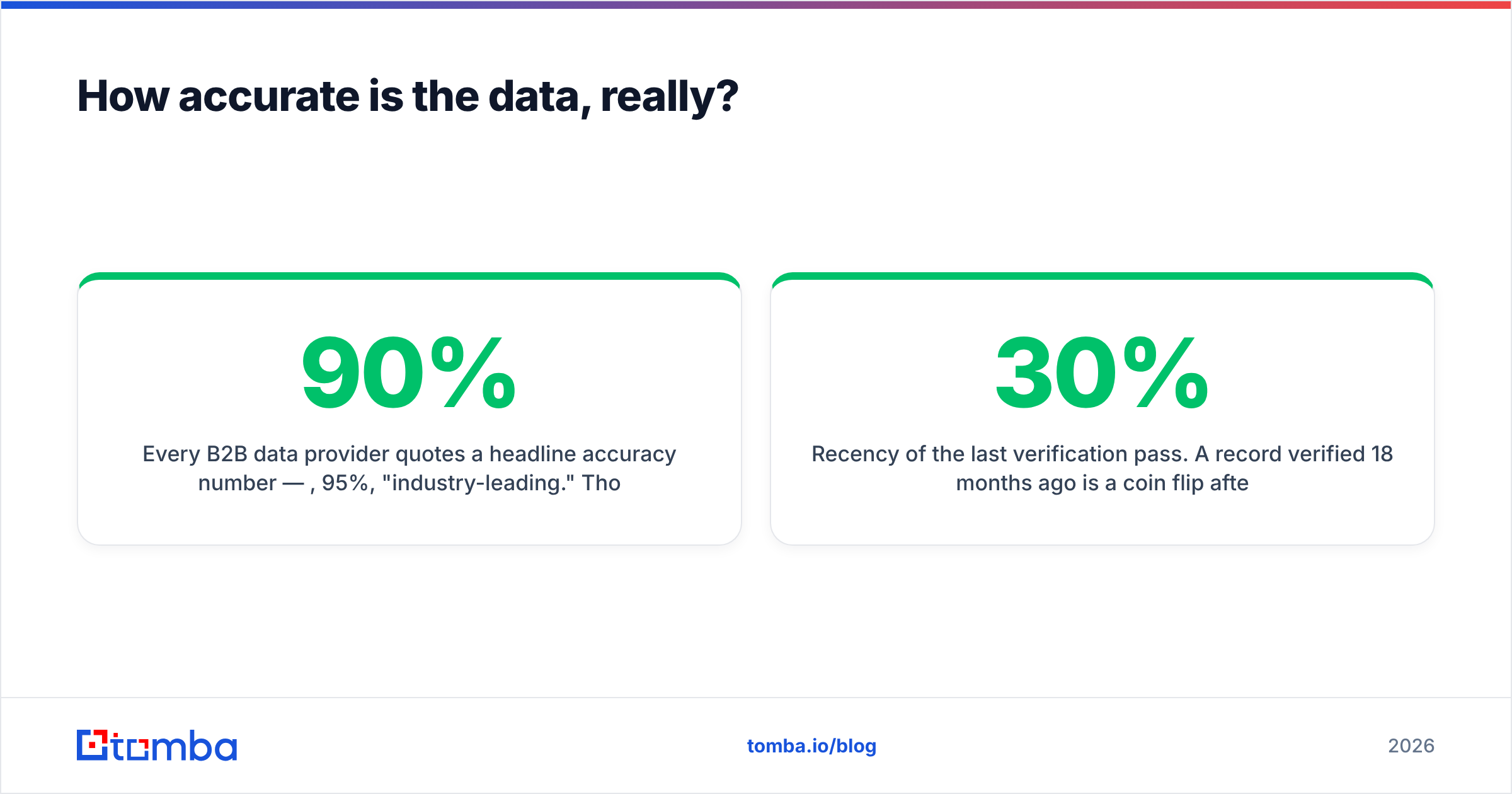
Every B2B data provider quotes a headline accuracy number — 90%, 95%, "industry-leading." Those numbers describe the database in aggregate, not your slice of it. A provider can be 95% accurate on US software directors and 60% accurate on German manufacturing buyers, and still print "95%" on the homepage.

What actually drives usable accuracy:
- Recency of the last verification pass. A record verified 18 months ago is a coin flip after normal job-change churn (roughly 30% of B2B contacts change roles each year).
- Catch-all handling. Many corporate domains accept every address at the SMTP layer, so "valid" means "the server didn't reject it," not "the person reads it." A serious workflow needs a catch-all verifier to separate real mailboxes from accept-alls.
- Email vs. mobile split. Smarte pushes mobile-number coverage hard; Arounddeal pushes email and intent. Decide which channel you actually run before you weigh the claims.
The honest move: ignore both homepages and run a sample. Pull 50 contacts that match your exact ICP from each tool, then push them through an independent email verifier and call a few mobiles. The bounce rate and connect rate you measure are worth more than any vendor benchmark.

Arounddeal vs Smarte: feature and pricing comparison#
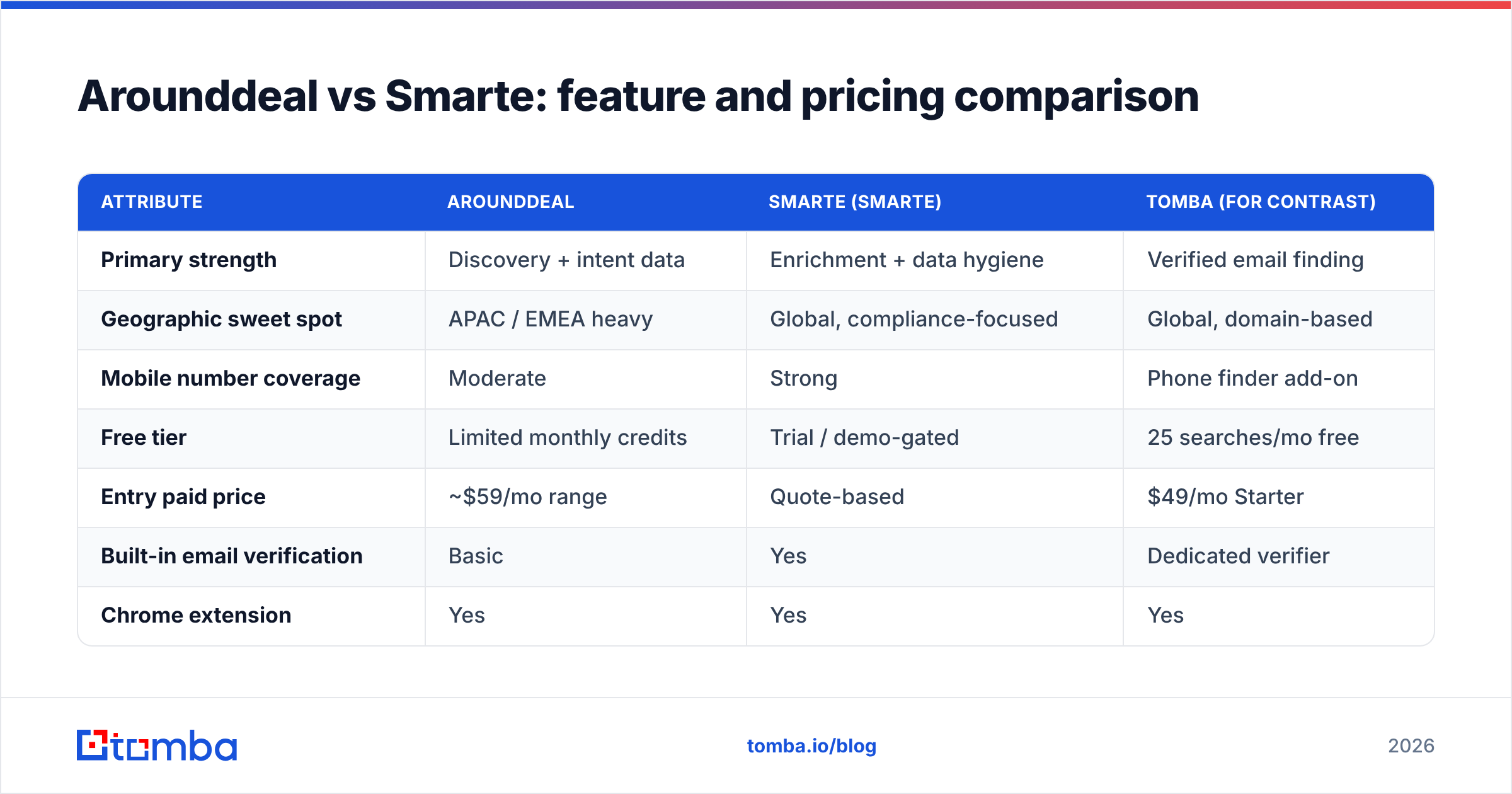
Here is the head-to-head on the attributes that change the buying decision. Pricing for both is quote-heavy and shifts with seat count and export volume, so treat the figures as direction, not gospel — confirm current numbers on each vendor's pricing page.
| Attribute | Arounddeal | Smarte (SMARTe) | Tomba (for contrast) |
|---|---|---|---|
| Primary strength | Discovery + intent data | Enrichment + data hygiene | Verified email finding |
| Geographic sweet spot | APAC / EMEA heavy | Global, compliance-focused | Global, domain-based |
| Mobile number coverage | Moderate | Strong | Phone finder add-on |
| Free tier | Limited monthly credits | Trial / demo-gated | 25 searches/mo free |
| Entry paid price | ~$59/mo range | Quote-based | $49/mo Starter |
| Built-in email verification | Basic | Yes | Dedicated verifier |
| Chrome extension | Yes | Yes | Yes |
| Best for | SDR teams prospecting at volume | RevOps cleaning CRM data | Outbound teams needing deliverable emails |
A few notes the table can't hold:
- Export caps bite harder than sticker price. Both platforms meter how many records you can export per month. A cheap plan with a low export ceiling can cost more per usable lead than a pricier plan with generous limits. Model your monthly contact volume first.
- Intent data is a tiebreaker, not a foundation. Arounddeal's intent signals are useful for prioritization, but intent without accurate contact data just tells you to email a bounce faster.
- Smarte's compliance posture is a genuine differentiator if you sell into GDPR-strict markets and need documented sourcing. Weigh it seriously if legal sign-off gates your data vendors.
Which one fits your team?#
Conclusion first: choose by workflow, not by brand.
- You are an SDR team chasing net-new pipeline across Asia or Europe? Arounddeal's discovery breadth and intent layer fit the motion. You want volume and prioritization.
- You are RevOps and your CRM is full of half-empty records? Smarte's enrichment-first design and mobile coverage fit better. You want completeness and compliance you can defend in an audit.
- You run outbound and the bottleneck is deliverable email addresses? Neither database tool is purpose-built for that. A dedicated finder with native verification will usually beat both on cost-per-inbox.
That third case is more common than vendors admit. Many teams buy a broad "sales intelligence platform," use 15% of it, and still struggle with bounce rates because the database wasn't re-verified at the moment of send. If that is you, a leaner stack — a focused finder plus a verifier — often outperforms an all-in-one suite you barely touch.
Where does a dedicated email finder beat both?#
A platform like Arounddeal or Smarte is a database you query. A tool like Tomba is a finder you point at a target. The distinction changes results in three ways.
First, verification at the moment of retrieval. When you look up a contact by name and company, the result is checked against live SMTP signals rather than served from a record last touched months ago. That single difference is usually the largest source of bounce-rate improvement.
Second, pattern-based discovery. If a person isn't in any database, a finder can still infer the address from the company's known email format and confirm it — using domain search to map a company's pattern and then validating the specific mailbox. Database tools simply return "no result."
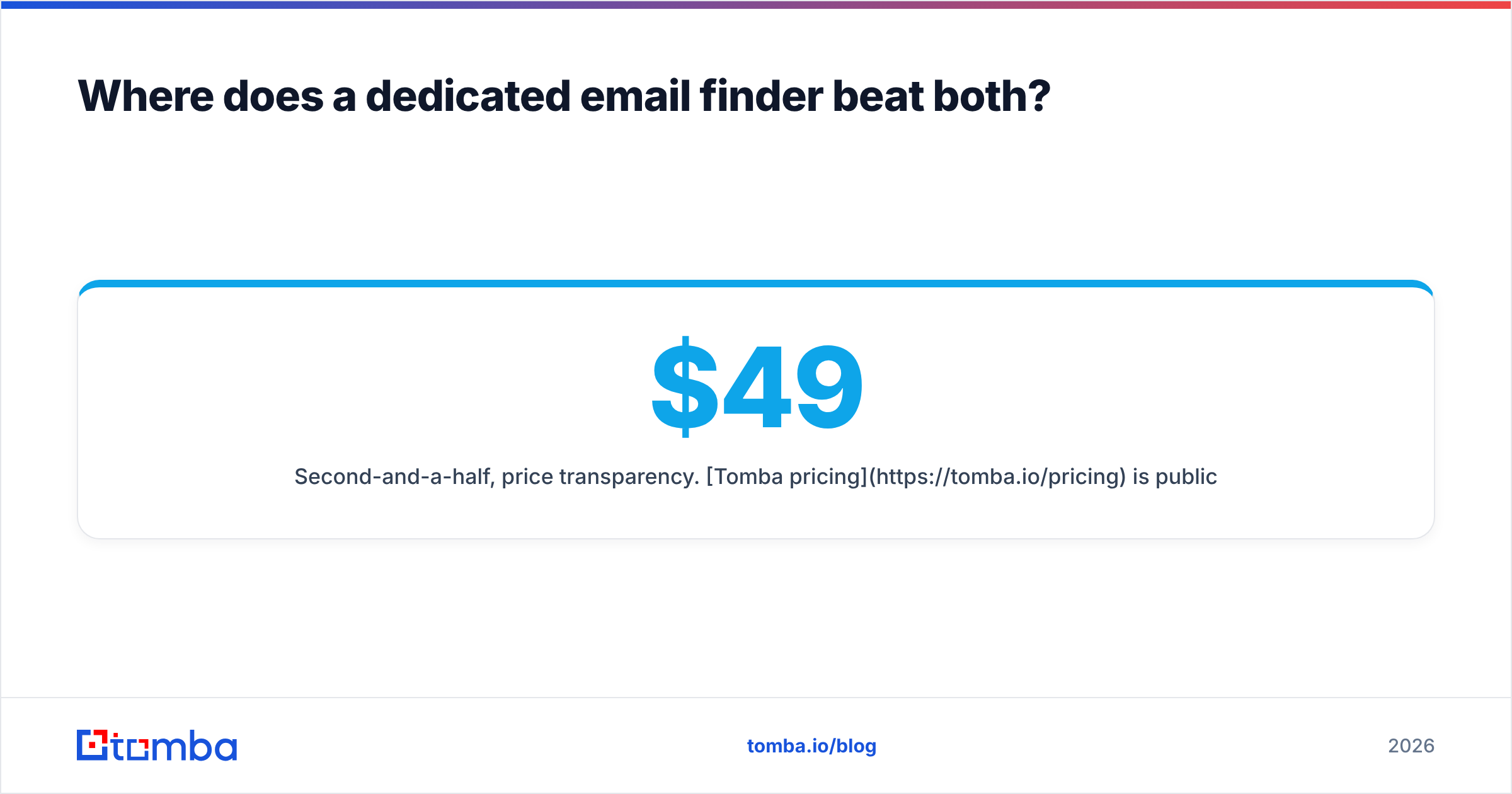
Second-and-a-half, price transparency. Tomba pricing is public and flat: a free tier with 25 searches a month, Starter at $49/mo, Growth at $99/mo, and Pro at $249/mo. You can model cost-per-lead before you talk to anyone. Quote-gated platforms make that math harder on purpose.
Third, API and workflow fit. If you are enriching at scale inside your own systems, an email finder API lets you fold lookups into the exact step where you need them — list-building, form enrichment, CRM sync — instead of exporting CSVs out of a dashboard and back in. Pair it with data enrichment to fill in firmographics on the same call.
None of this makes the big platforms useless. It means that if your single biggest pain is "too many of my emails bounce," a finder-plus-verifier stack attacks that pain directly, while a sales-intelligence suite spreads its value (and your budget) across features you may not use.
What about compliance and data sourcing?#
Don't skip this. In 2026, where your data comes from is a buying criterion, not a footnote.
Both Arounddeal and Smarte publish compliance language around GDPR and CCPA, and Smarte in particular leans on compliance-aware sourcing as a selling point. Two practical checks before you sign:
- Ask for the lawful basis and sourcing documentation in writing. "We're GDPR compliant" is a claim. A documented sourcing process and a working data-subject-request path is evidence. Reputable vendors hand this over without friction.
- Check independent reviews, not just case studies. Sites like G2 and Capterra surface the complaints case studies bury — stale records, export caps, support gaps, billing surprises. Read the 2- and 3-star reviews specifically; they are where the real product lives.
For your own outbound, compliance also means list hygiene before send. Suppress unsubscribes, drop role accounts where appropriate, and re-verify aged records. Clean lists protect email deliverability and your sender reputation regardless of which database you bought from.
How should you run the bake-off?#
A repeatable 30-minute test beats weeks of demos.
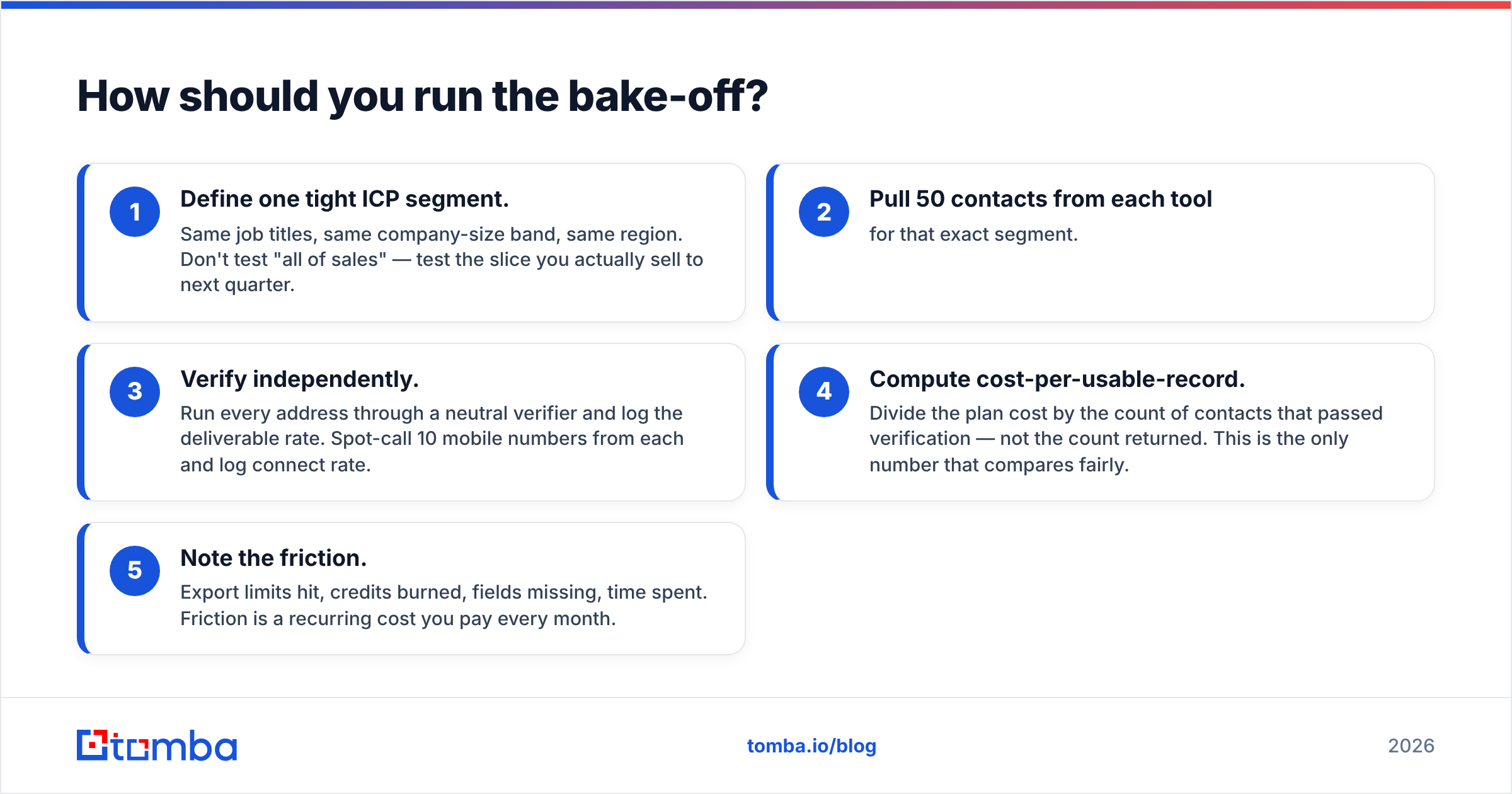
- Define one tight ICP segment. Same job titles, same company-size band, same region. Don't test "all of sales" — test the slice you actually sell to next quarter.
- Pull 50 contacts from each tool for that exact segment.
- Verify independently. Run every address through a neutral verifier and log the deliverable rate. Spot-call 10 mobile numbers from each and log connect rate.
- Compute cost-per-usable-record. Divide the plan cost by the count of contacts that passed verification — not the count returned. This is the only number that compares fairly.
- Note the friction. Export limits hit, credits burned, fields missing, time spent. Friction is a recurring cost you pay every month.
Whatever wins your bake-off wins your budget. If both database tools post mediocre deliverable rates on your ICP, that is your signal to add a dedicated finder rather than upgrading a plan that won't fix the underlying staleness.
The bottom line#
Arounddeal and Smarte are both credible B2B data platforms, and the "winner" depends entirely on your motion: Arounddeal for discovery and intent at volume, Smarte for enrichment, mobile coverage, and compliance-sensitive markets. Decide by your workflow and prove it with a 50-contact sample — never by the homepage accuracy number.
And if, after the bake-off, your real problem turns out to be deliverable emails rather than database size, point a purpose-built tool at it. The Tomba Email Finder verifies addresses at lookup, infers them from company patterns when no record exists, and prices transparently from a free 25-search tier up to $49/mo — so you can stop paying suite prices for outbound that still bounces. Start free, test it against your own ICP, and let the deliverable rate decide.
// get started
Find, verify and enrich your first contacts today
Start on the free plan with 25 searches a month, then scale when your team is ready.
Free plan · No credit card required · GDPR & CCPA
// about the author