Arounddeal vs The Data City: 2026 B2B Data Showdown
Arounddeal and The Data City solve different B2B data problems. Here's a neutral 2026 breakdown of coverage, pricing, accuracy, and which one fits your go-to-market motion.
TL;DR
- Arounddeal is a contact-and-company database built for prospecting: emails, direct dials, and titles you push into outreach. Strongest in APAC, decent globally.
- The Data City is a real-time market-intelligence platform that classifies companies by what they actually do (emerging sectors, R&D, growth signals) — built for analysts, economic development, and TAM mapping, not cold outreach.
- These tools barely compete. Pick Arounddeal if you need contactable leads; pick The Data City if you need to size and segment markets.
- Pricing differs sharply: Arounddeal is credit-based seat pricing; The Data City is enterprise/subscription quoted per organization.
- If your real job is finding and verifying emails to contact people, a dedicated finder like Tomba Email Finder usually beats a database subscription on cost-per-valid-contact.
What are Arounddeal and The Data City?#
The short answer: they're not really rivals, even though they get compared.
Arounddeal is a B2B contact and company database. You search by company, title, location, or industry and pull back work emails, phone numbers, and LinkedIn profiles you can drop into a sequence. It leans heavily on a Chrome extension workflow and is one of the better-known providers for Asia-Pacific coverage, where many Western databases thin out. Think of it as a prospecting fuel tank.
The Data City is a UK-founded real-time company intelligence platform. Instead of cataloguing job titles, it reads what companies publish — websites, filings, job ads — and classifies them into "Real-Time Industrial Classifications" (RTICs) like quantum computing or net zero. Analysts, government bodies, investors, and corporate strategy teams use it to map sectors, find fast-growing firms, and size markets. It's a microscope for markets, not a Rolodex of people.
So when you put "arounddeal vs the data city" into a search bar, you're usually comparing two answers to two different questions: "Who do I email?" versus "Which companies even exist in this space?"
How do they actually differ?#
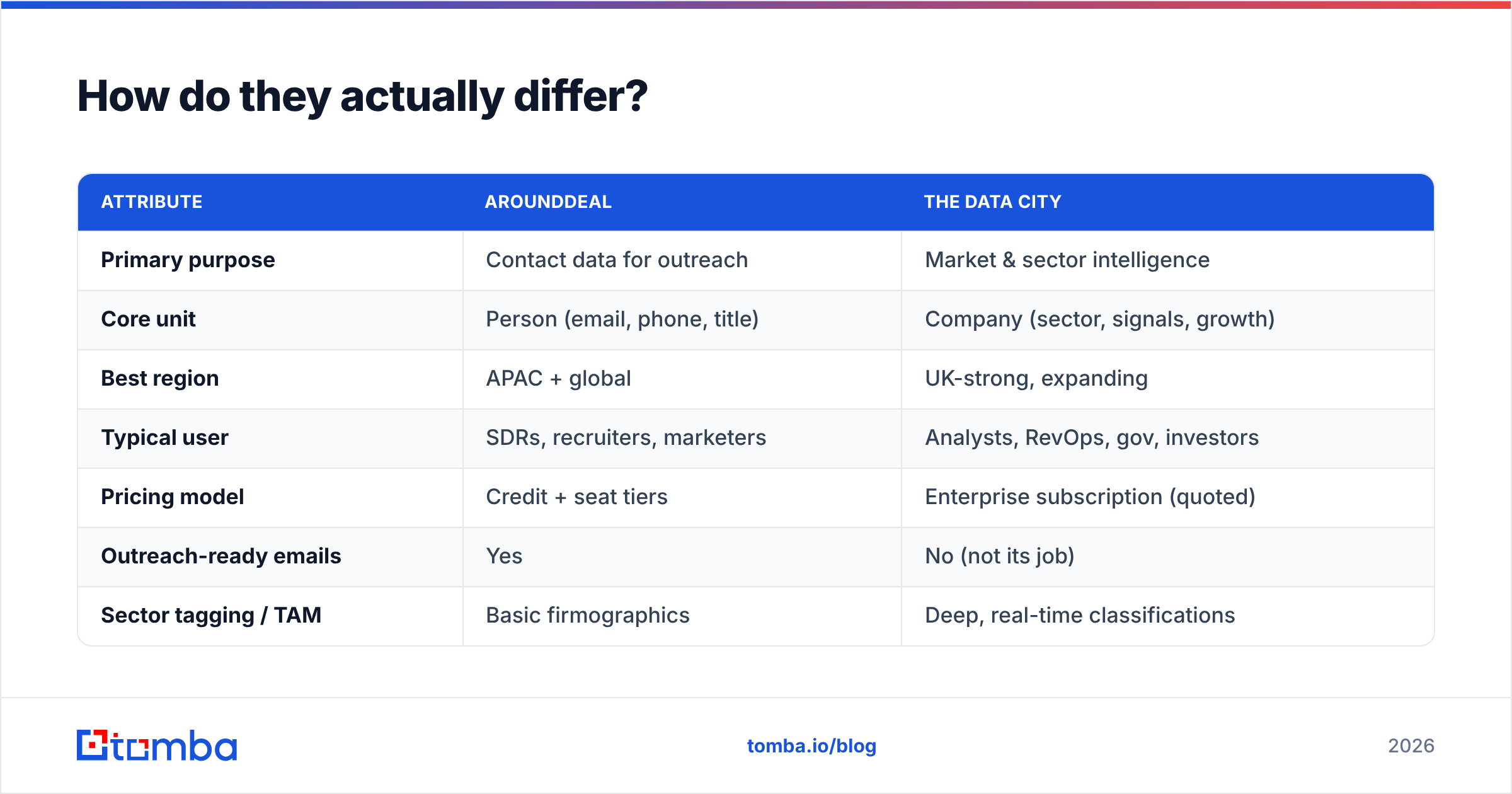
The cleanest way to see it is by the job each tool is hired to do.
| Attribute | Arounddeal | The Data City |
|---|---|---|
| Primary purpose | Contact data for outreach | Market & sector intelligence |
| Core unit | Person (email, phone, title) | Company (sector, signals, growth) |
| Best region | APAC + global | UK-strong, expanding |
| Typical user | SDRs, recruiters, marketers | Analysts, RevOps, gov, investors |
| Pricing model | Credit + seat tiers | Enterprise subscription (quoted) |
| Outreach-ready emails | Yes | No (not its job) |
| Sector tagging / TAM | Basic firmographics | Deep, real-time classifications |
| Export / API | CSV + API | API + platform dashboards |
If you scan that table and your eye lands on "outreach-ready emails," you want Arounddeal (or a purpose-built finder). If it lands on "sector tagging / TAM," you want The Data City. Trying to force one into the other's job is where teams waste budget.

Which one has better data quality?#
It depends on what "quality" means for your workflow — and the two platforms optimize for opposite definitions.
For Arounddeal, quality = contactability. Does the email bounce? Is the direct dial current? Is the person still in that role? Contact databases decay fast — roughly 30% of B2B data goes stale each year as people switch jobs — so any provider's accuracy claim is a snapshot, not a guarantee. Arounddeal does well in APAC where competitors are weak, but like every database, its US/EU records age the moment they're collected.
For The Data City, quality = classification accuracy and freshness. Did it correctly tag a firm as "synthetic biology"? Is the growth signal based on this quarter's hiring, not last year's? Because it re-reads public sources continuously, its company-level freshness is genuinely strong — but it won't hand you a verified inbox for the CTO.
This is the trap: people buy a database for outreach, then discover a chunk of emails bounce, which torches sender reputation and hurts email deliverability. The fix isn't a bigger database — it's verification before you send. Run any list, from any source, through an email verifier and you sidestep most of the bounce problem regardless of which platform sourced the record.
How does pricing compare?#
Arounddeal uses a familiar SaaS shape: a limited free tier, then paid plans that scale by credits and seats. You pay roughly per contact you reveal, and costs climb with team size and export volume.
The Data City is enterprise-first. Pricing is quoted per organization based on seats, modules, and data scope — closer to a research-platform contract than a self-serve tool. That makes sense for its buyer (a strategy team or government agency), but it's overkill if all you need is 500 verified emails this month.
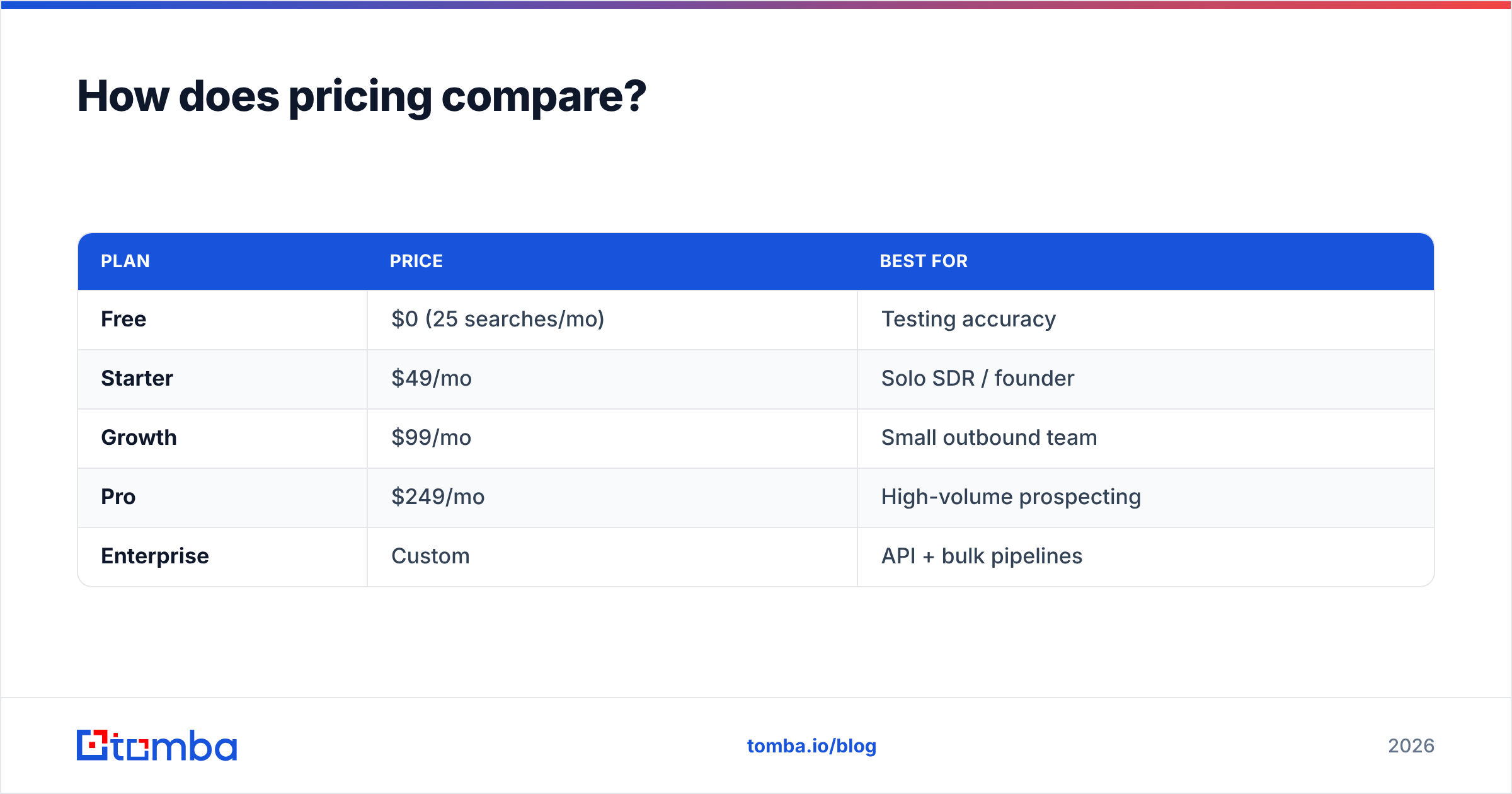
Here's the part teams miss: if your goal is contactable leads, a dedicated finder is almost always cheaper per valid contact than a broad database seat. For reference, here's how a focused finder is priced:
| Plan | Price | Best for |
|---|---|---|
| Free | $0 (25 searches/mo) | Testing accuracy |
| Starter | $49/mo | Solo SDR / founder |
| Growth | $99/mo | Small outbound team |
| Pro | $249/mo | High-volume prospecting |
| Enterprise | Custom | API + bulk pipelines |
You can see full Tomba pricing for credit details, but the point stands: you don't need a market-intelligence contract or a per-seat database to email 2,000 prospects a month. You need accurate emails and a verifier.
Is Arounddeal better than The Data City?#
For prospecting and outreach, yes — but only because The Data City was never built for that.
Arounddeal wins when:
- You need work emails and direct dials to load into a sequence.
- Your ICP is in APAC or you sell globally and need broad coverage.
- Your team is SDRs, recruiters, or growth marketers who live in a Chrome extension.
The Data City wins when:
- You're sizing a market, mapping a sector, or finding emerging-tech companies.
- Standard SIC/NAICS codes are too coarse for your segmentation.
- Your buyers are analysts, investors, RevOps, or public-sector strategists.
Declaring an overall "winner" is a category error. It's like asking whether a delivery van beats a telescope. Match the tool to the job and the answer writes itself.
When should you use a dedicated email finder instead?#
Whenever the actual task is "contact specific people," a focused finder beats a general database on three axes: accuracy, cost, and workflow.
Accuracy. A finder's entire job is returning a deliverable address and proving it's deliverable. You get the email and a confidence score in one step, so you're not re-verifying a database export by hand.
Cost. You pay for finds, not for seats and modules you won't touch. For a two-person outbound team, that's often the difference between $99/month and a four-figure annual contract.
Workflow. Good finders meet you where you work. You can search by name and company, run a whole domain search to pull every public address at a target account, enrich a CRM list, or hit the Tomba API from your own pipeline. The data goes straight into your motion instead of sitting in a dashboard.
Here's a simple decision rule:
- Need to understand a market? → The Data City.
- Need broad APAC contact lists inside one platform? → Arounddeal.
- Need verified emails for the exact people you want to reach, cheaply, at any scale? → a dedicated finder.
Many teams end up running two of these together: a market tool to decide which accounts matter, then a finder to get the people at those accounts. That combo is usually cheaper and more accurate than stretching a single contact database to do market research, or stretching a market platform to do outreach.
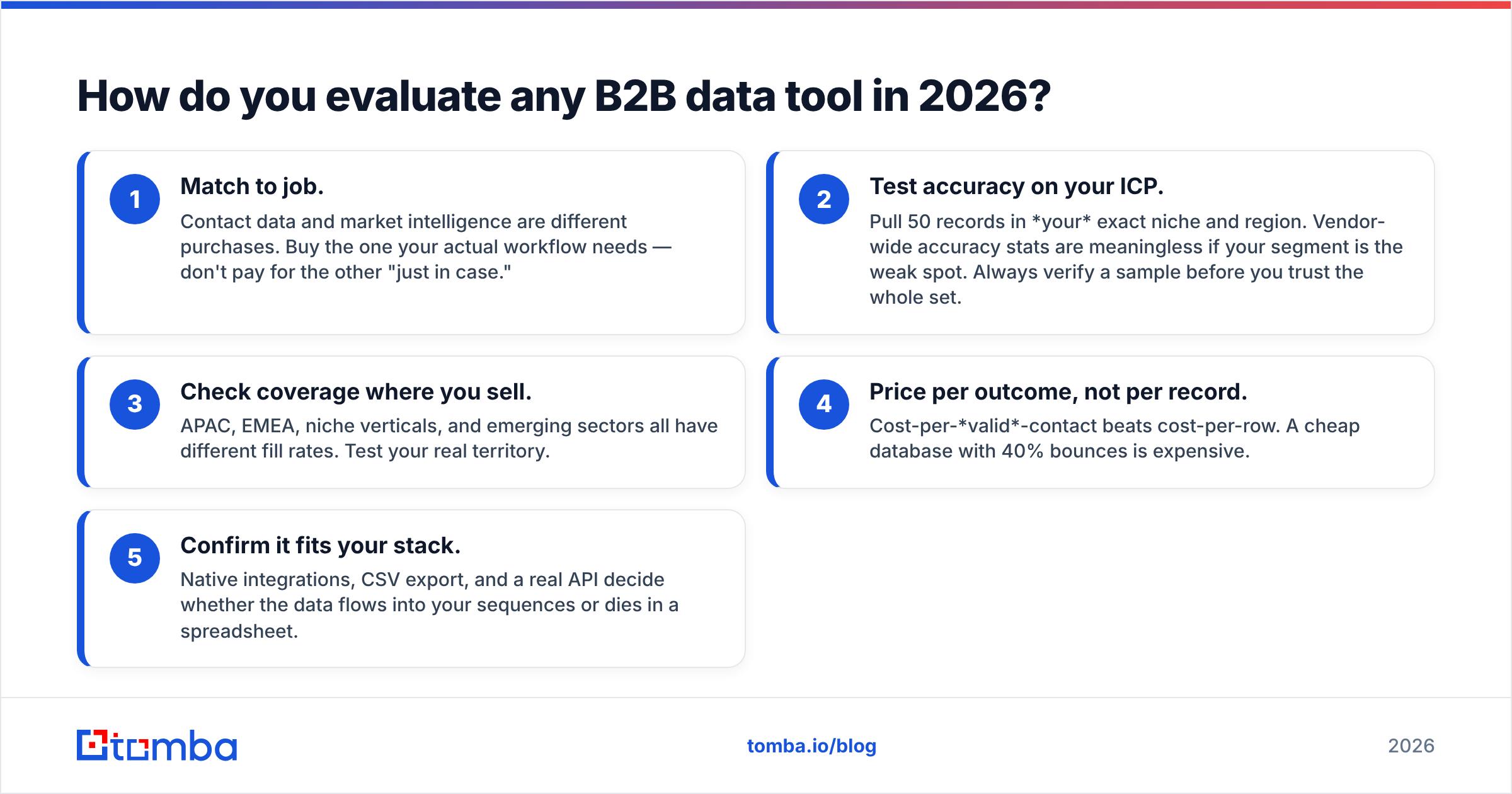
How do you evaluate any B2B data tool in 2026?#
Run the same five-point test on Arounddeal, The Data City, or anything else before you sign:
- Match to job. Contact data and market intelligence are different purchases. Buy the one your actual workflow needs — don't pay for the other "just in case."
- Test accuracy on your ICP. Pull 50 records in your exact niche and region. Vendor-wide accuracy stats are meaningless if your segment is the weak spot. Always verify a sample before you trust the whole set.
- Check coverage where you sell. APAC, EMEA, niche verticals, and emerging sectors all have different fill rates. Test your real territory.
- Price per outcome, not per record. Cost-per-valid-contact beats cost-per-row. A cheap database with 40% bounces is expensive.
- Confirm it fits your stack. Native integrations, CSV export, and a real API decide whether the data flows into your sequences or dies in a spreadsheet.
Score each tool out of 5 on those, weighted to what you care about most. The "winner" stops being a brand argument and becomes a fit calculation — which is exactly what it should be.
The bottom line#
Arounddeal and The Data City rarely belong on the same shortlist. One hands you people to contact; the other tells you which markets and companies are worth contacting. Pick by the job in front of you, not by which name sounds bigger.
But if you trace most of these searches back to their root, the real need is the same: get accurate, verified emails for the right people, without overpaying or burning your domain. That's a finder's job, not a database subscription's. Start free with Tomba's email finder — find professional emails by name, company, or domain, get a deliverability score on every result, and only scale up when the accuracy proves itself on your own list. Test 25 searches at no cost, then decide.
// get started
Find, verify and enrich your first contacts today
Start on the free plan with 25 searches a month, then scale when your team is ready.
Free plan · No credit card required · GDPR & CCPA
// about the author