Top Artisan Alternatives in 2026: AI SDR Tools Compared
Artisan's AI BDR Ava is slick, but it isn't the only way to automate outbound. Here are the best Artisan alternatives in 2026 — by use case, price, and data quality.
Artisan put a face on the "AI employee" pitch — Ava, the AI BDR who researches accounts, writes sequences, and sends mail while you sleep. It demos well. But a lot of teams sign up, run a few thousand sends, and realize the bottleneck was never the copy. It was the data underneath it, the price per seat, or the lack of control over what hits the inbox.
This guide ranks the best Artisan alternatives for 2026 — full-stack AI SDR platforms, modular tools you assemble yourself, and the data layer that makes any of them work.
TL;DR#
- Artisan is a strong all-in-one AI BDR, but it's priced for funded teams and locks your data and sending into one platform.
- The best Artisan alternatives fall into three camps: full-stack AI SDRs (11x, AiSDR), data-plus-sequencing platforms (Apollo, Clay), and modular stacks you build yourself.
- If your outbound is missing the mark, the fix is usually accurate contact data, not better AI copy — garbage in, garbage out.
- A build-your-own stack (Tomba for data + an outreach tool + your CRM) is often cheaper and more controllable than a bundled AI BDR.
- Pick by your real constraint: budget, data accuracy, deliverability control, or how much you want automated end to end.
What is Artisan and why look for alternatives?#
Artisan is an AI sales platform built around "Ava," an AI Business Development Representative that automates the top of the outbound funnel: finding prospects, enriching them, writing personalized sequences, and sending across email. You can read their pitch on the official Artisan site. It bundles a B2B data set, a sequencer, and AI personalization into one subscription.
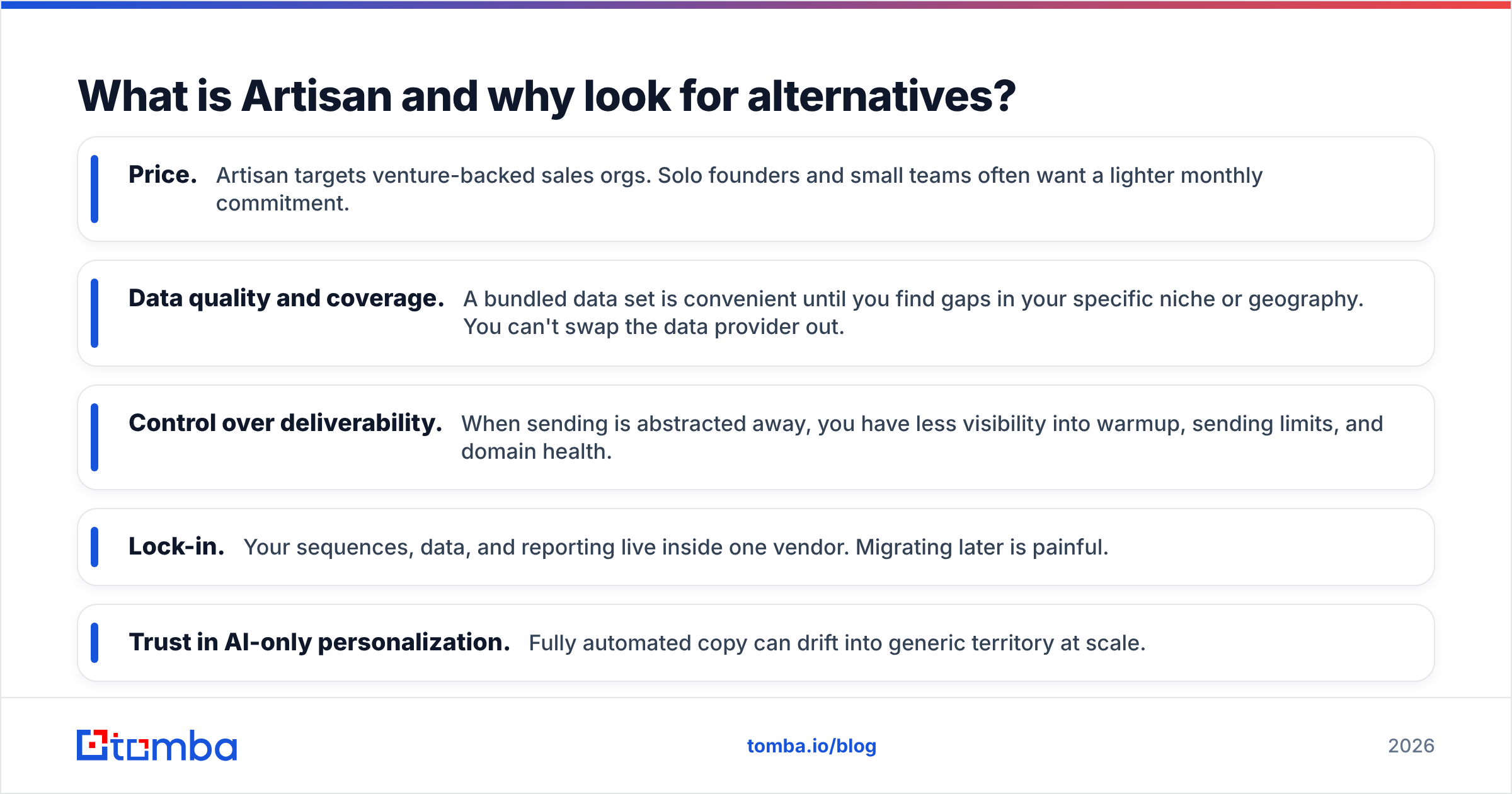
That bundling is the appeal and the problem. Teams shop for Artisan alternatives for a handful of recurring reasons:
- Price. Artisan targets venture-backed sales orgs. Solo founders and small teams often want a lighter monthly commitment.
- Data quality and coverage. A bundled data set is convenient until you find gaps in your specific niche or geography. You can't swap the data provider out.
- Control over deliverability. When sending is abstracted away, you have less visibility into warmup, sending limits, and domain health.
- Lock-in. Your sequences, data, and reporting live inside one vendor. Migrating later is painful.
- Trust in AI-only personalization. Fully automated copy can drift into generic territory at scale.
None of these mean Artisan is bad. They mean it isn't the right shape for every team. Below is how the alternatives stack up.
What are the best Artisan alternatives in 2026?#
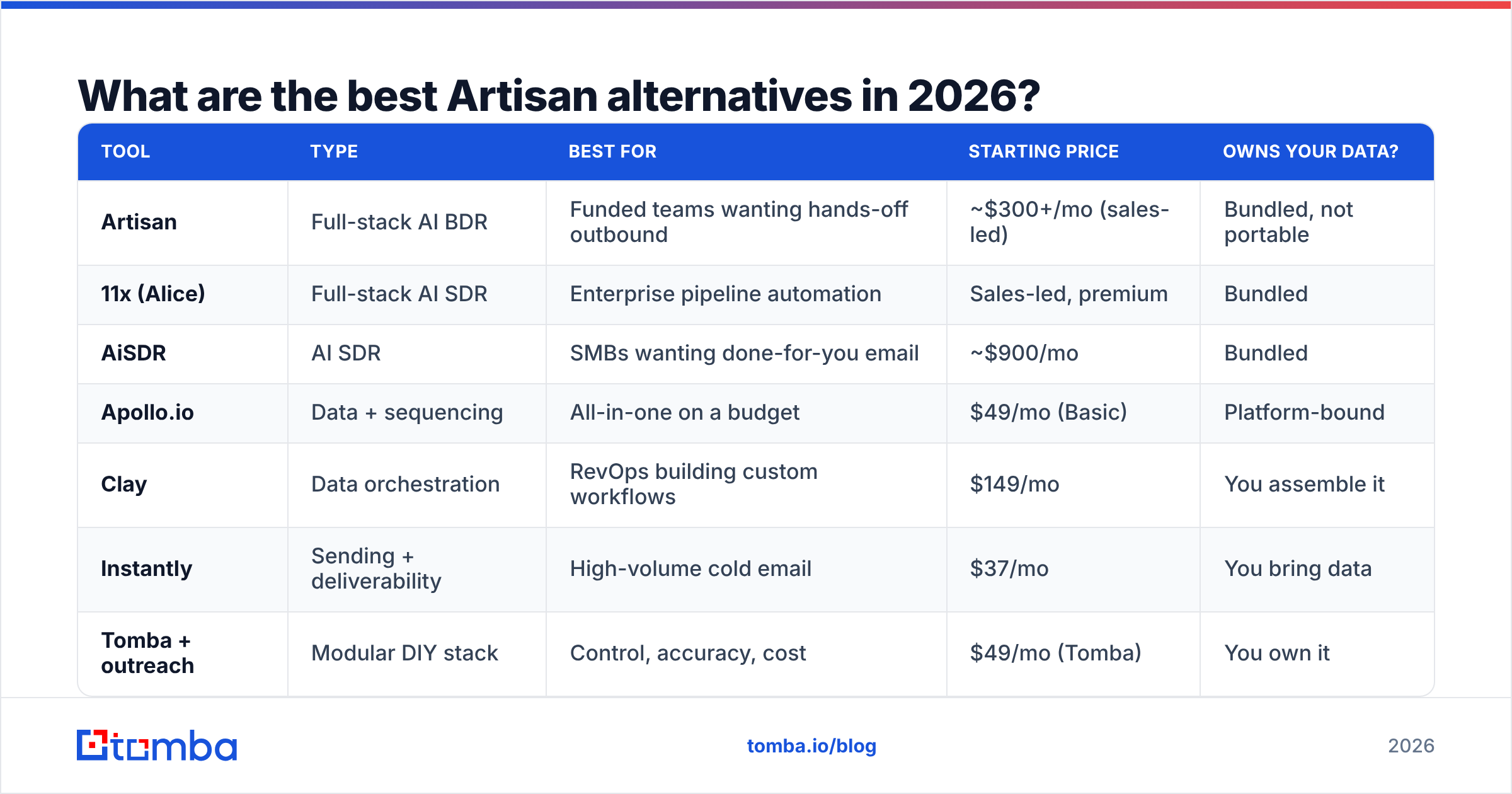
There's no single replacement, because "Artisan" is really three products in a trench coat: data, AI copy, and sending. The right alternative depends on which part you care about most.
Here's the shortlist by category.
| Tool | Type | Best for | Starting price | Owns your data? |
|---|---|---|---|---|
| Artisan | Full-stack AI BDR | Funded teams wanting hands-off outbound | ~$300+/mo (sales-led) | Bundled, not portable |
| 11x (Alice) | Full-stack AI SDR | Enterprise pipeline automation | Sales-led, premium | Bundled |
| AiSDR | AI SDR | SMBs wanting done-for-you email | ~$900/mo | Bundled |
| Apollo.io | Data + sequencing | All-in-one on a budget | $49/mo (Basic) | Platform-bound |
| Clay | Data orchestration | RevOps building custom workflows | $149/mo | You assemble it |
| Instantly | Sending + deliverability | High-volume cold email | $37/mo | You bring data |
| Tomba + outreach | Modular DIY stack | Control, accuracy, cost | $49/mo (Tomba) | You own it |
Let's break down who each one is actually for.
Full-stack AI SDRs: 11x and AiSDR#
If you liked Artisan's "set it and forget it" promise but want options, 11x and AiSDR are the closest direct competitors.
11x positions its agent (Alice) for enterprise-grade pipeline generation with multi-channel outreach. It's premium and sales-led, so expect a similar budget tier to Artisan. AiSDR leans toward SMBs and mid-market, offering done-for-you email outreach with a more transparent (if still steep) monthly price. Both bundle data and sending the same way Artisan does — so you trade lock-in for convenience, just with a different vendor.
Choose these if your real complaint about Artisan is the specific product, not the all-in-one model.
Data + sequencing platforms: Apollo and Clay#
Apollo.io is the budget all-rounder. It pairs a large B2B contact database with built-in sequencing and basic AI, starting at $49/mo — a fraction of any AI BDR. It's less "autonomous agent," more "powerful cockpit you still drive." For most teams leaving Artisan over price, Apollo is the first stop. (See real user comparisons on G2 before committing.)
Clay is the power-user's choice. It's a data orchestration layer that pulls from dozens of enrichment providers, waterfalls between them for coverage, and lets you build genuinely custom workflows with AI baked in. It's not plug-and-play — there's a learning curve — but RevOps teams love the control. Clay assumes you'll bring your own judgment about which data sources to trust.
)
The modular DIY stack#
Here's the option the bundled vendors don't advertise: build it yourself. The pattern is simple — a data layer, a sending layer, and your CRM.
- Data: a dedicated email finder and enrichment provider you can verify and swap.
- Sending: a deliverability-focused tool like Instantly or your existing sequencer.
- Glue: your CRM plus a workflow tool (
Zapier, Make).
This is more setup than clicking "activate Ava," but it's cheaper, more transparent, and you own every piece. When one part underperforms, you replace just that part instead of churning off an entire platform. The data layer is where this stack lives or dies — which brings us to the part most "AI SDR" buyers underweight.
Why does data quality matter more than the AI?#
Conclusion first: the best AI copy in the world fails if it's sent to a stale, guessed, or unverified email address. Every autonomous SDR — Artisan included — sits on top of a contact database, and that database is the real determinant of whether your campaign lands or bounces.
Think of it like a delivery service. The AI is the driver who writes a friendly note and rings the doorbell. But if the address is wrong, it doesn't matter how charming the note is — nobody's home. Outbound is the same: personalization is the note, deliverability and reply rates depend on the address being real.
This is why a high bounce rate quietly destroys campaigns. Mailbox providers read bounces as a signal that you're a careless sender, and your sender reputation drops. Once that happens, even your verified, correct emails start landing in spam. Bundled AI BDRs hide this from you; a modular stack lets you control it.
)
So before you pay for an autonomous agent, ask the unglamorous question: where does the data come from, and can I verify it? With a dedicated email finder and email verifier in your stack, you control accuracy directly instead of trusting a black box. You can also enrich existing records with firmographic and contact details using data enrichment — so the AI has something real to personalize against.
How do you choose the right Artisan alternative?#
Match the tool to your actual constraint. Run through these in order:
- What's your budget? Under a few hundred a month rules out the full-stack AI SDRs. Apollo, Instantly, or a Tomba-based DIY stack fit small budgets.
- How much do you want automated? If you genuinely want hands-off, stay in the AI BDR camp (11x, AiSDR). If you want control, go modular.
- Is your problem data or copy? If campaigns bounce or get no replies, it's almost always data. Fix that first — it's cheaper than any AI agent.
- Do you need deliverability control? High-volume senders should own their sending and warmup. Bundled platforms abstract this away.
- How important is avoiding lock-in? If you want portable data and the freedom to swap tools, a modular stack wins.
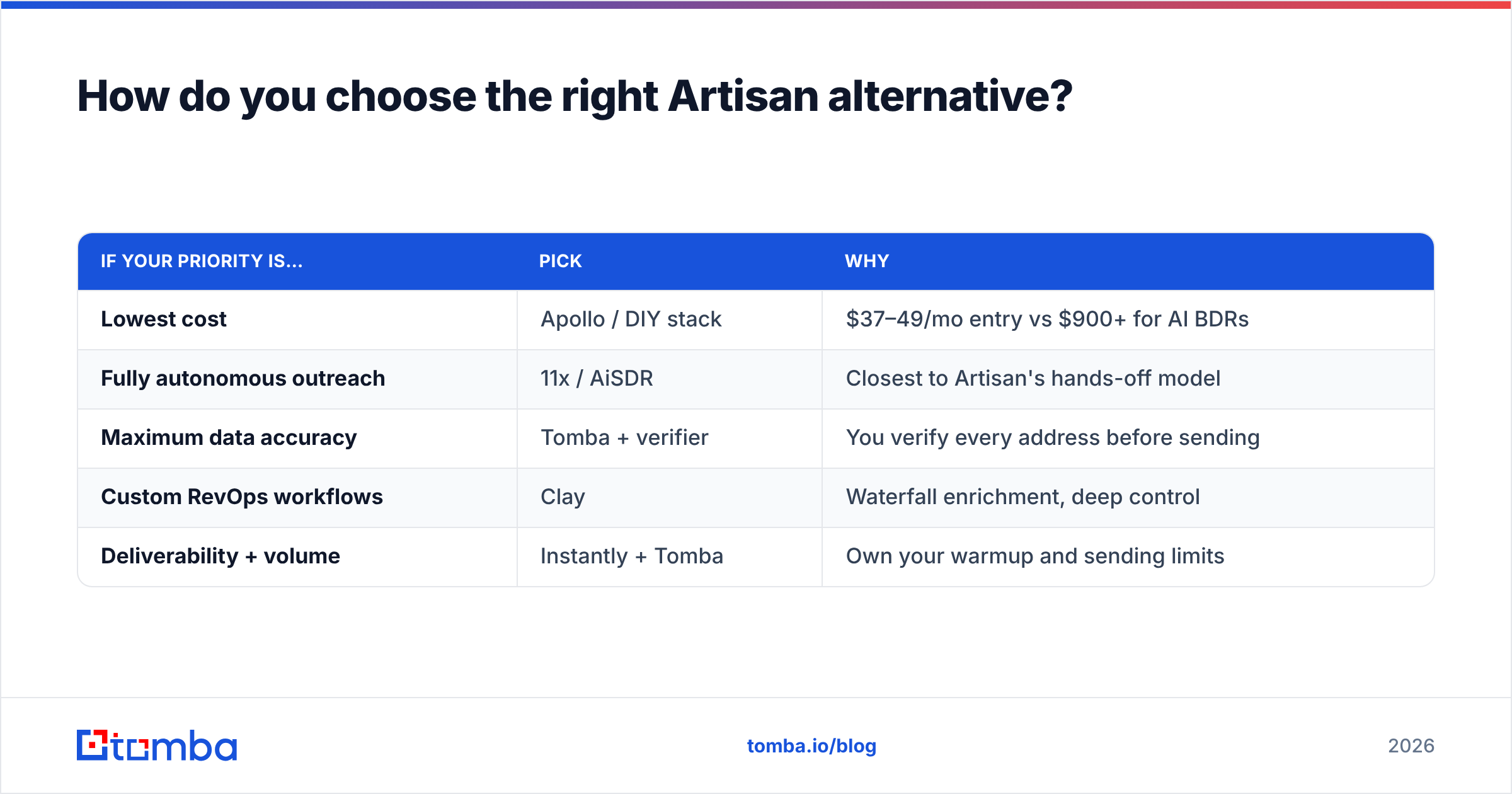
| If your priority is… | Pick | Why |
|---|---|---|
| Lowest cost | Apollo / DIY stack | $37–49/mo entry vs $900+ for AI BDRs |
| Fully autonomous outreach | 11x / AiSDR | Closest to Artisan's hands-off model |
| Maximum data accuracy | Tomba + verifier | You verify every address before sending |
| Custom RevOps workflows | Clay | Waterfall enrichment, deep control |
| Deliverability + volume | Instantly + Tomba | Own your warmup and sending limits |
A practical note on integrations: whichever path you choose, your data layer should plug into your CRM cleanly. Tools like HubSpot sit at the center of most outbound stacks, so verify that any alternative pushes clean, deduplicated records into it rather than dumping unverified contacts.
Is a build-your-own stack better than Artisan?#
For most teams under enterprise scale, yes — on cost and control. No — on convenience.
Artisan's value is that someone else assembled and tuned the pieces. You pay a premium for that integration and for not having to think about it. If your team is small, your time is scarce, and you're well funded, that trade can be worth it.
But if you're price-sensitive, if you operate in a niche where bundled data has gaps, or if you've been burned by deliverability you couldn't see into, a modular stack wins. You spend a weekend wiring it up, and in exchange you get: transparent per-contact data costs, the ability to verify before you send, no lock-in, and the freedom to upgrade one layer without churning the whole system.
The honest middle ground: start modular and cheap, prove the motion works with good data, and only then decide whether an autonomous agent is worth the premium. Most teams discover that once the data is clean, their existing sequencer plus a bit of AI copy does 90% of what the expensive AI BDR promised.
You can compare exact tiers on the Tomba pricing page if you want to model the DIY cost — the free tier alone (25 searches/mo) is enough to test data quality before you commit a dollar. For programmatic stacks, the email finder API lets you wire verification straight into whatever sequencer or agent you end up using.
The bottom line on Artisan alternatives#
Artisan is a capable AI BDR, but "autonomous outreach" is only as good as the data and deliverability beneath it. The best alternative for you depends on one question: are you paying for convenience, or for results? If it's results, start with the data layer — it's the cheapest, highest-leverage fix in your entire stack.
Whatever platform you land on, give it accurate contacts to work with. Tomba's Email Finder finds and verifies professional email addresses by name, domain, or company — with a free tier to test coverage in your niche before you scale. Build your outbound on data you can trust, and let the AI handle the part it's actually good at: the message, not the guesswork. Start free, verify your list, and watch your bounce rate — and your reputation — take care of themselves.
Ready to find emails that actually work?
Join 150,000+ professionals who stopped guessing and started sending. Free credits on signup — no credit card required.
Get the Tomba newsletter
Practical outbound tactics and product updates — once every two weeks.
About the author