Artisan Pricing in 2026: Plans, Real Costs & Alternatives
Artisan hides its price behind a demo call. Here's what Ava the AI BDR actually costs in 2026, how seats and credits stack up, and when a leaner stack wins.
Artisan markets Ava, an "AI BDR" that prospects, writes, and sends outbound on autopilot. The product is genuinely interesting. The pricing is genuinely opaque. If you have tried to find a real number on their site, you have already discovered the catch: there is no public price list, and almost every plan routes through a sales demo before you see a quote.
This post pulls together what Artisan actually costs in 2026, how its seat-plus-credit model works, where the hidden line items hide, and how to decide whether an all-in-one AI BDR is the right spend versus a leaner, transparent stack.
TL;DR#
- Artisan does not publish flat pricing. Reported deals in 2026 start around $1,500–$3,000/month for a single Ava seat plus a data allotment, scaling up with seats and credit volume.
- You pay for two things at once: the AI BDR software seat and the B2B data/credits that feed it. The data is often the bigger long-term cost.
- Annual contracts are the norm. Month-to-month is rare; most quotes assume a 12-month commitment.
- It is a bet on consolidation. Artisan replaces several tools — but if Ava's deliverability or data quality underperforms, you have bundled your risk.
- A transparent finder + verifier + your own sequencer often costs a fraction of an Ava seat and keeps you in control of data quality.
What is Artisan and how does its pricing work?#
Artisan (artisan.co) is an outbound sales platform built around "Ava," an AI sales development rep. Ava finds leads, enriches them, drafts personalized emails, and runs sequences with minimal human input. The pitch is consolidation: replace your data tool, your sequencer, and part of your SDR headcount with one AI agent.
Pricing follows a model common to AI BDR tools — you are not buying one thing, you are buying a bundle of a software seat and a data/credit pool. That is the key to reading any quote you receive.
The three cost layers you will see on an Artisan quote:
- Platform / seat fee — the recurring cost for Ava and the workspace. This is the headline number in the demo.
- Data credits — the volume of contacts you can find, enrich, and verify each month. Run out and you either upgrade the tier or stop prospecting.
- Add-ons — extra mailboxes, additional Ava seats, premium support, deliverability tooling, and integrations can all sit outside the base.
Because credits and seats are quoted together, two companies can both be "on Artisan" and pay wildly different amounts. That is by design, and it is why a published price sheet does not exist.
How much does Artisan cost in 2026?#
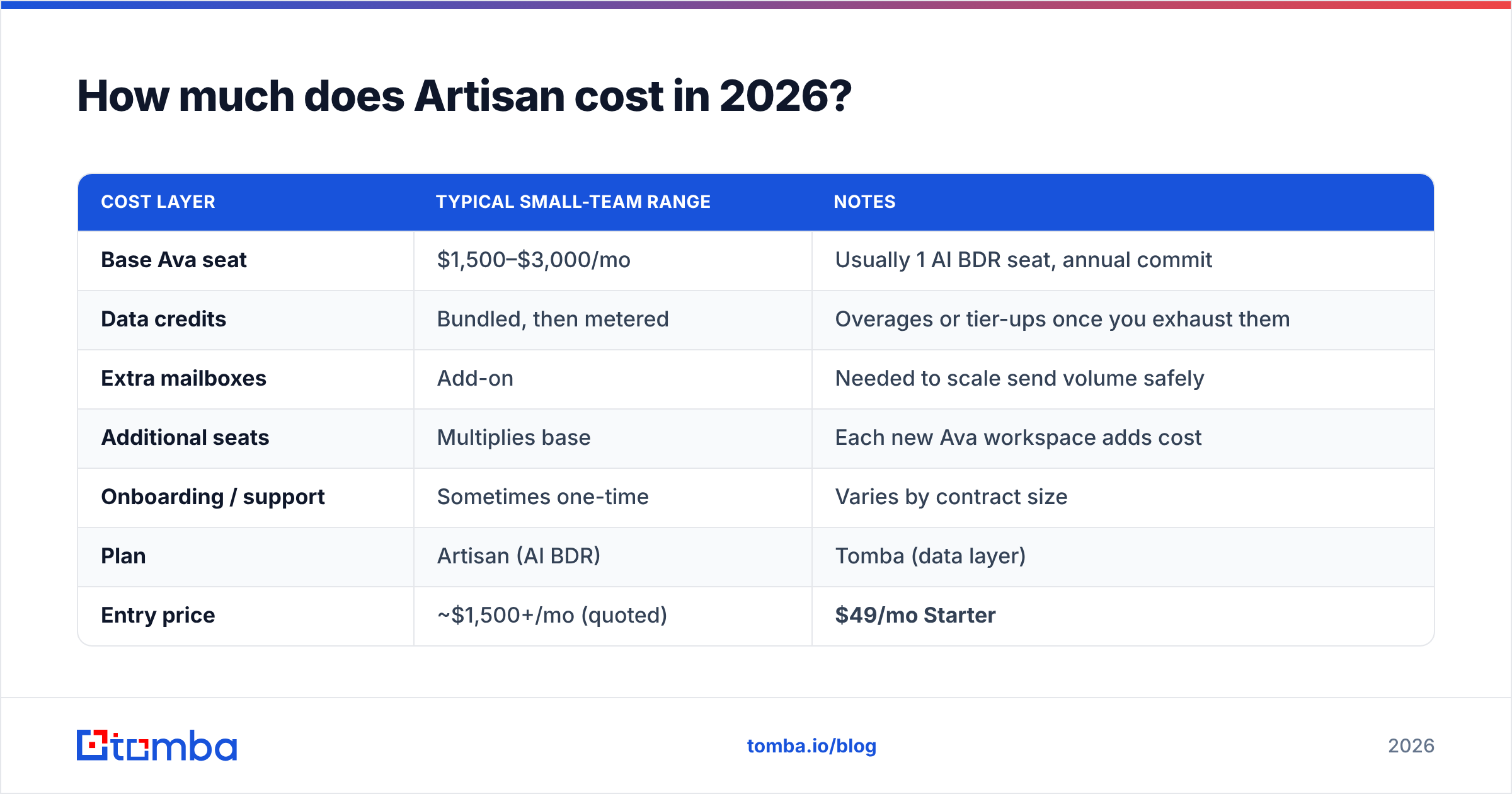
The short answer: expect to start in the low thousands per month, billed annually. Artisan has historically declined to publish flat rates, and 2026 is no different. Based on publicly shared deal sizes and buyer reports aggregated on review sites like G2 and Capterra, a single Ava seat with a working data allotment typically lands in the $1,500–$3,000/month range, with larger contracts climbing well past that as you add seats and credits.
Here is how the layers tend to stack for a small outbound team. Treat these as directional ranges for budgeting, not a quote — only a demo produces the real figure.
| Cost layer | Typical small-team range | Notes |
|---|---|---|
| Base Ava seat | $1,500–$3,000/mo | Usually 1 AI BDR seat, annual commit |
| Data credits | Bundled, then metered | Overages or tier-ups once you exhaust them |
| Extra mailboxes | Add-on | Needed to scale send volume safely |
| Additional seats | Multiplies base | Each new Ava workspace adds cost |
| Onboarding / support | Sometimes one-time | Varies by contract size |
Compare that shape to a transparent, self-serve stack where every number is on the website before you talk to anyone:
| Plan | Artisan (AI BDR) | Tomba (data layer) |
|---|---|---|
| Entry price | ~$1,500+/mo (quoted) | $49/mo Starter |
| Free tier | No public free tier | 25 searches/mo, free |
| Pricing transparency | Demo required | Published on site |
| Billing | Annual commit typical | Monthly or annual |
| What you get | AI BDR + data + sending | Email finder, verifier, enrichment, API |
| Best for | Teams replacing SDR work | Teams who own their workflow |
You can see Tomba's full Tomba pricing without a sales call — Free, Starter at $49/mo, Growth at $99/mo, Pro at $249/mo, and Enterprise. The contrast is the point: one model asks you to commit before you know the price; the other lets you test with 25 free searches first.
/blog/generated/memes/2026-06-15/artisan-pricing-meme-1.png
What is actually included in an Artisan plan?#
Artisan's value is consolidation, so a quote bundles functions you might otherwise buy separately:
- Lead sourcing — Ava pulls from a B2B contact database to build target lists.
- Enrichment — firmographic and contact data layered onto each lead.
- AI copywriting — personalized first lines and full sequences generated per prospect.
- Sending and sequencing — multi-step campaigns with follow-ups.
- Deliverability features — warmup and inbox rotation, depending on tier.
That bundle is attractive when it works. The risk is correlation: if the underlying data accuracy is weak, every downstream step inherits the problem. Bad data means Ava writes a confident, personalized email to the wrong person at a defunct address — and your domain reputation pays for it. When you own the email verifier step yourself, you can catch that before send instead of trusting a black box.
Is Artisan worth the price?#
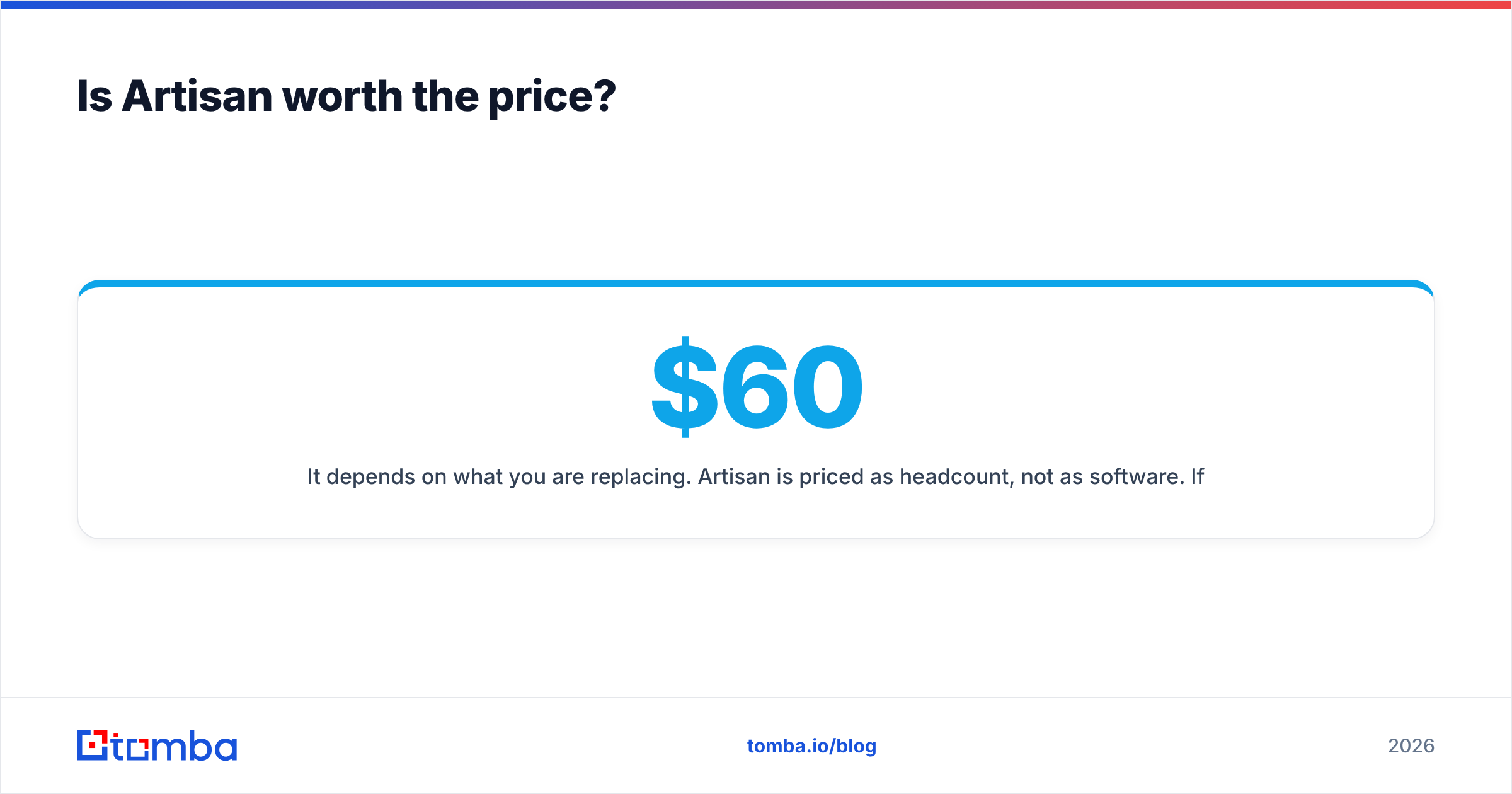
It depends on what you are replacing. Artisan is priced as headcount, not as software. If a single Ava seat genuinely offsets part of an SDR salary — say $60,000–$90,000 fully loaded — then $2,000/month can pencil out. That is the honest case for it.
It is not worth the price if:
- You already have a sequencer (Instantly, Smartlead, Salesloft) you like and only need better data.
- Your volume is low enough that a metered, transparent tool covers you for a tenth of the cost.
- You want to keep human judgment in the loop on messaging and targeting.
- You cannot stomach an annual commitment to a tool you have not stress-tested.
The strongest argument against any all-in-one AI BDR is lock-in plus opacity. You commit annually, you cannot see the price publicly, and you hand data quality, copy, and sending to one vendor. If any single layer underperforms, you are still paying for the bundle.
/blog/generated/memes/2026-06-15/artisan-pricing-meme-2.png
How does Artisan pricing compare to building your own stack?#
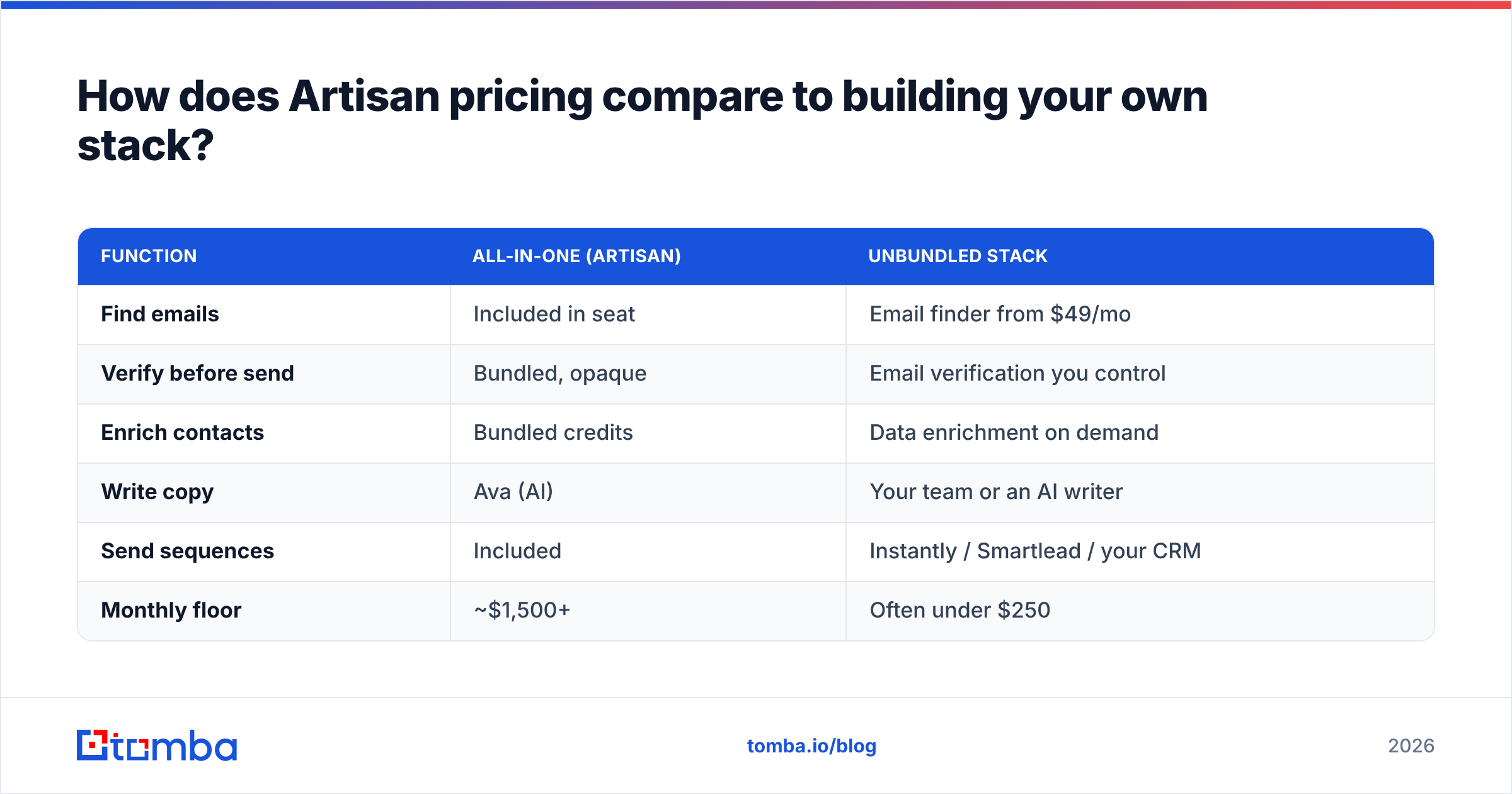
Here is the unbundled view. Instead of one opaque seat, you assemble three transparent pieces and keep control of each:
| Function | All-in-one (Artisan) | Unbundled stack |
|---|---|---|
| Find emails | Included in seat | Email finder from $49/mo |
| Verify before send | Bundled, opaque | Email verification you control |
| Enrich contacts | Bundled credits | Data enrichment on demand |
| Write copy | Ava (AI) | Your team or an AI writer |
| Send sequences | Included | Instantly / Smartlead / your CRM |
| Monthly floor | ~$1,500+ | Often under $250 |
The unbundled approach wins on three axes: cost transparency, control, and risk isolation. If your sequencer underperforms, you swap it without touching your data tool. If your data tool slips, you swap it without re-platforming sending. You never sign a 12-month bet on a single vendor's worst component.
It loses on convenience. One login and one invoice is genuinely easier to manage than four. If your team is small and time-poor and you trust the vendor, the bundle has real appeal — just go in knowing the price is negotiated, not posted.
For teams that source contacts at scale, a bulk email finder plus the Tomba API replaces the "data" half of an AI BDR for a predictable, published rate — and you can start free to benchmark accuracy before committing a dollar.
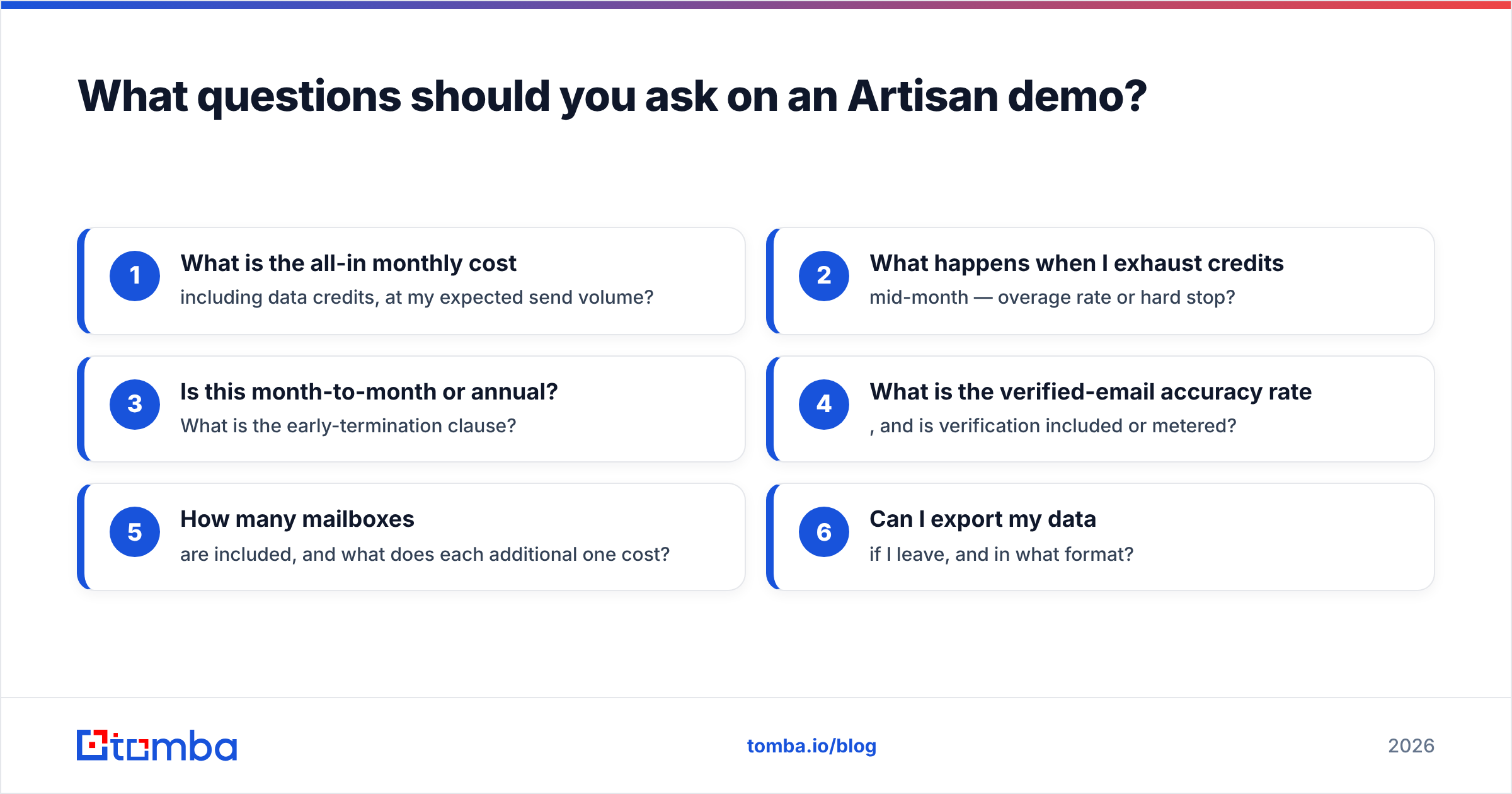
What questions should you ask on an Artisan demo?#
Because the price is quote-based, the demo is the pricing page. Walk in with these:
- What is the all-in monthly cost including data credits, at my expected send volume?
- What happens when I exhaust credits mid-month — overage rate or hard stop?
- Is this month-to-month or annual? What is the early-termination clause?
- What is the verified-email accuracy rate, and is verification included or metered?
- How many mailboxes are included, and what does each additional one cost?
- Can I export my data if I leave, and in what format?
If you cannot get a straight all-in number, that is information too. Transparent vendors put it on the site.
The bottom line on Artisan pricing#
Artisan is a credible AI BDR with deliberately invisible pricing that starts in the low thousands per month and scales with seats and credits. It is worth it when it truly replaces human prospecting headcount and you trust every layer of the bundle. It is overkill — and overpriced — when you mostly need clean, accurate contact data and already own the rest of your stack.
Before you sign an annual AI BDR contract, pressure-test the cheapest, most controllable layer first: the data. Spin up the Tomba Email Finder, run 25 free searches, and verify the results against contacts you already know are good. If a transparent $49/month tool gives you accurate, deliverable emails, you have just learned exactly how much of an AI BDR's bundled price was paying for data you could buy openly — and how much was paying for the demo. Start free, see the numbers, then decide what to consolidate.
// get started
Find, verify and enrich your first contacts today
Start on the free plan with 25 searches a month, then scale when your team is ready.
Free plan · No credit card required · GDPR & CCPA
// about the author