Artisan Reviews 2026: Is the AI BDR Ava Actually Worth It?
An honest, hands-on look at Artisan's AI BDR Ava in 2026 — what it automates well, where the data falls short, real pricing, and the best alternatives for outbound teams.
TL;DR
- Artisan is an all-in-one outbound platform built around "Ava," an AI BDR that researches prospects, writes sequences, and sends email at scale from one workspace.
- The product genuinely consolidates a stack — data, sequencing, and warmup live in one tab — but Artisan reviews consistently flag uneven data accuracy and sales-led, quote-only pricing.
- Ava is strong for lean teams that want fewer tools and less manual sequence-building; it is weaker if you need surgical, verified contact data or transparent per-credit costs.
- Expect a sales call before you see a number. There is no public self-serve tier, which makes side-by-side budgeting hard.
- The smart play for most teams: use Artisan (or any AI BDR) for orchestration, and pair it with a dedicated, verified data source like Tomba's email finder so your automation isn't firing at bad addresses.
What is Artisan?#
Artisan is a sales-automation platform that markets itself around a single character: Ava, "the AI BDR." Instead of buying a data tool, a sequencer, and a deliverability tool separately, Artisan's pitch is that Ava handles the full top-of-funnel motion — find the prospect, research them, draft personalized copy, and run the outreach — inside one product.
Think of Ava as a junior BDR who never sleeps and never forgets to follow up. You hand over an ideal-customer-profile (ICP), and the system pulls matching contacts from its built-in B2B database (Artisan claims 300M+ contacts), enriches them, and assembles multi-step email sequences. A human still approves the strategy and reviews messaging, but the grunt work of list-building and first-draft writing is automated.
You can see the full feature set and positioning on the official Artisan site. For this review, the question that matters is simpler: does the consolidation actually save you time without quietly costing you pipeline?
How does Artisan's AI BDR "Ava" work?#
Ava runs a loop that mirrors how a human SDR would work a list — just compressed into an automated pipeline. Understanding the loop is the fastest way to judge whether Artisan fits your motion.
The core stages look like this:
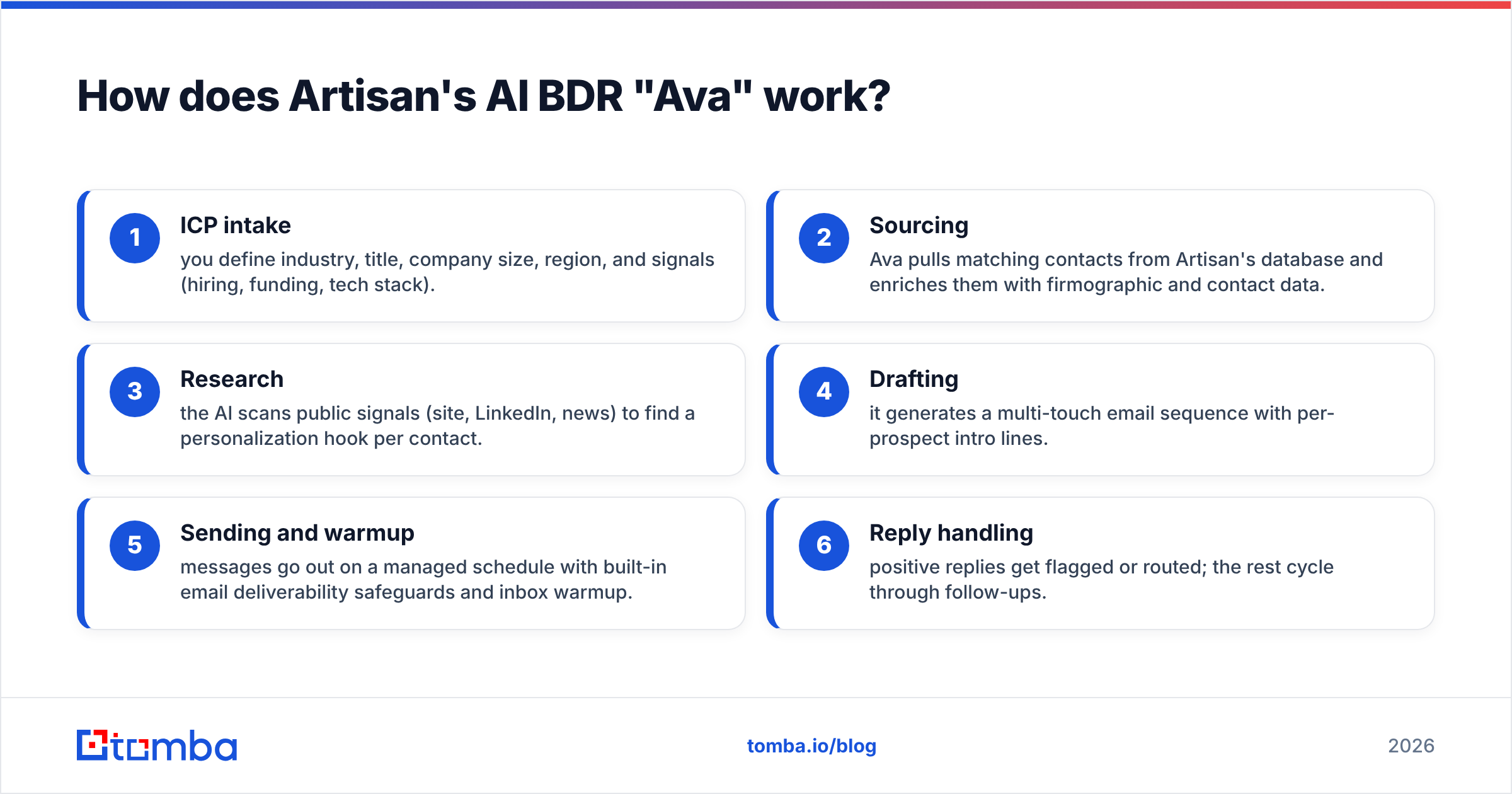
- ICP intake — you define industry, title, company size, region, and signals (hiring, funding, tech stack).
- Sourcing — Ava pulls matching contacts from Artisan's database and enriches them with firmographic and contact data.
- Research — the AI scans public signals (site, LinkedIn, news) to find a personalization hook per contact.
- Drafting — it generates a multi-touch email sequence with per-prospect intro lines.
- Sending and warmup — messages go out on a managed schedule with built-in email deliverability safeguards and inbox warmup.
- Reply handling — positive replies get flagged or routed; the rest cycle through follow-ups.
The appeal is obvious: one operator can run what used to take a small team. The risk is equally clear — every stage downstream of sourcing depends on the quality of the data in stage two. If the contact data is stale or unverified, Ava will happily personalize and send a polished email to an address that bounces.
What do Artisan reviews say about data accuracy?#
Accuracy is where most Artisan reviews split. The orchestration earns praise; the underlying data draws the sharpest criticism.
Common themes from public Artisan reviews on G2 and similar directories:
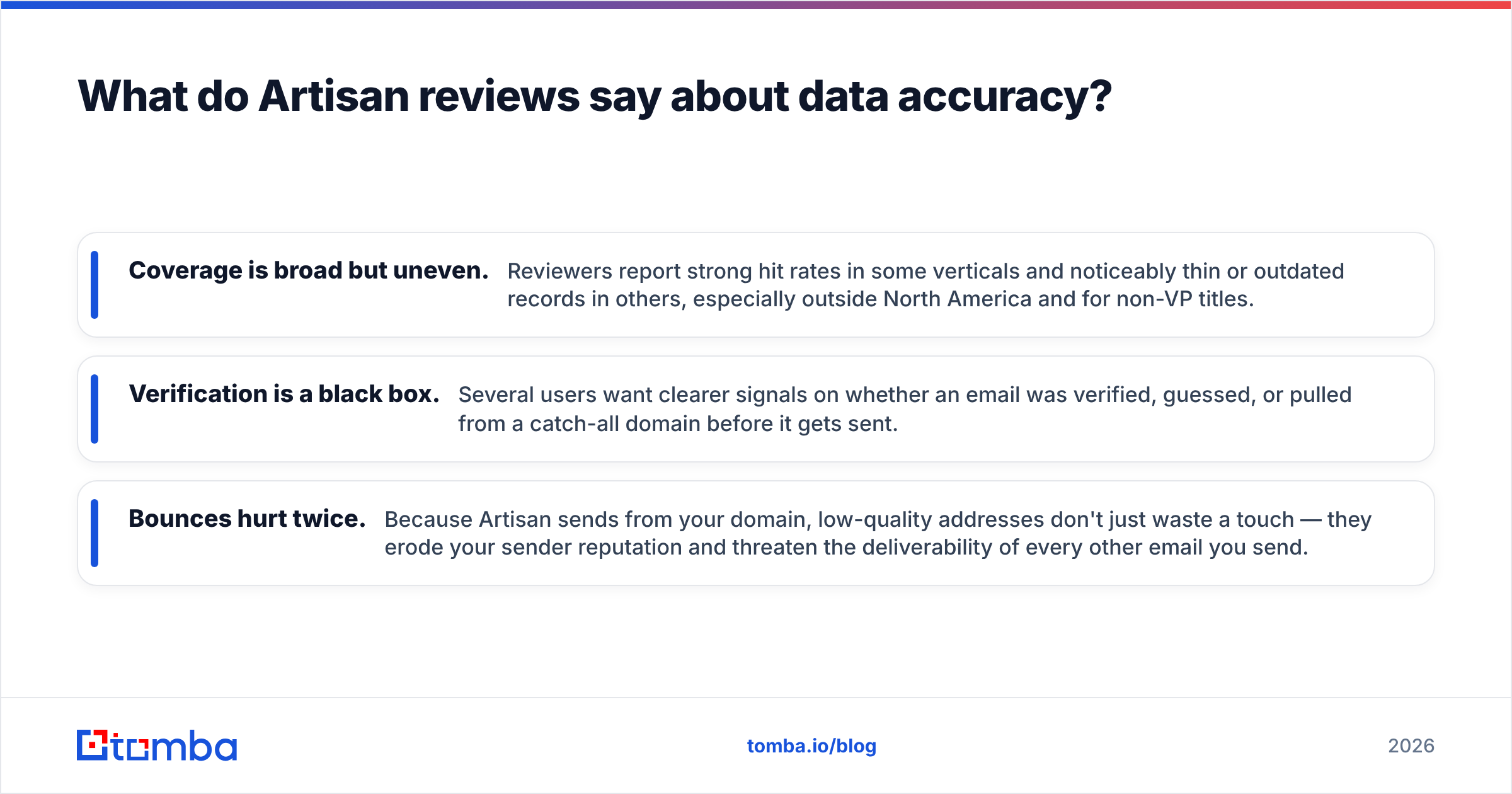
- Coverage is broad but uneven. Reviewers report strong hit rates in some verticals and noticeably thin or outdated records in others, especially outside North America and for non-VP titles.
- Verification is a black box. Several users want clearer signals on whether an email was verified, guessed, or pulled from a catch-all domain before it gets sent.
- Bounces hurt twice. Because Artisan sends from your domain, low-quality addresses don't just waste a touch — they erode your sender reputation and threaten the deliverability of every other email you send.
This isn't unique to Artisan; bundled "data + sending" platforms generally optimize for convenience over surgical data precision. But it's the single most important thing to test during a trial. Pull a sample list, then independently check the emails with a dedicated email verifier before you let Ava send anything at volume. If a meaningful share of "verified" contacts fail an independent check, you've found your ceiling.
A practical guardrail: treat any AI BDR's database as a first pass, and run risky segments — catch-all domains especially — through a catch-all verifier so you know what's actually deliverable.
How much does Artisan cost?#
Honest answer: Artisan does not publish self-serve pricing, so any specific monthly number you see quoted online should be treated as unverified. Pricing is sales-led — you book a demo, share seat count and contact volume, and receive a custom quote that typically scales with the number of users and the data/sending volume you need.
That model has trade-offs:
- Pro: quotes can be tailored, and onboarding tends to include hands-on setup.
- Con: you can't budget or compare without a sales call, and there's no low-commitment way to kick the tires before committing.
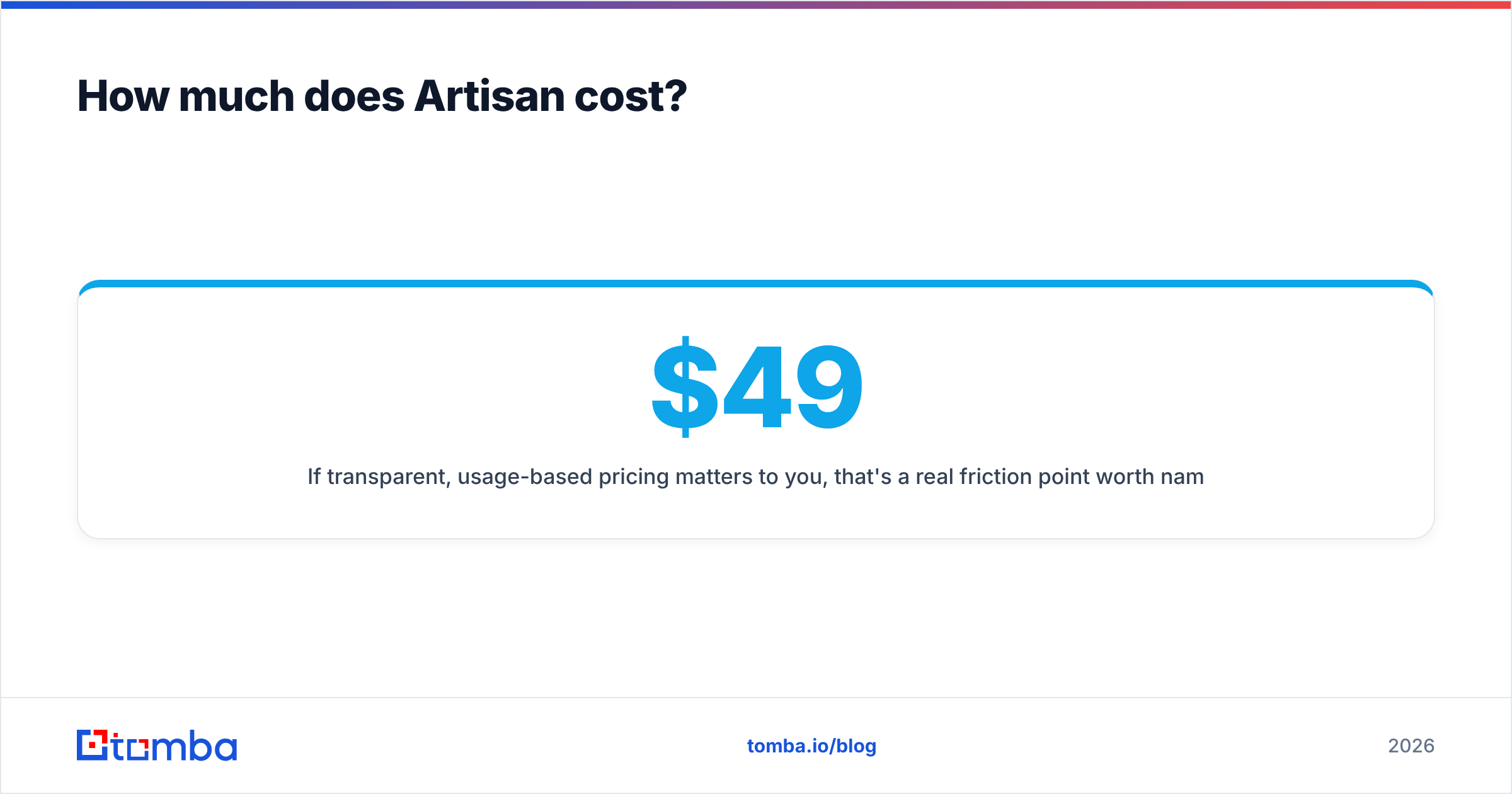
If transparent, usage-based pricing matters to you, that's a real friction point worth naming in your evaluation. For comparison, plenty of point tools publish their rates openly — for example, you can read Tomba's pricing (free tier at 25 searches/mo, Starter $49/mo, Growth $99/mo, Pro $249/mo) without talking to anyone.
Artisan vs the alternatives: how does it compare?#
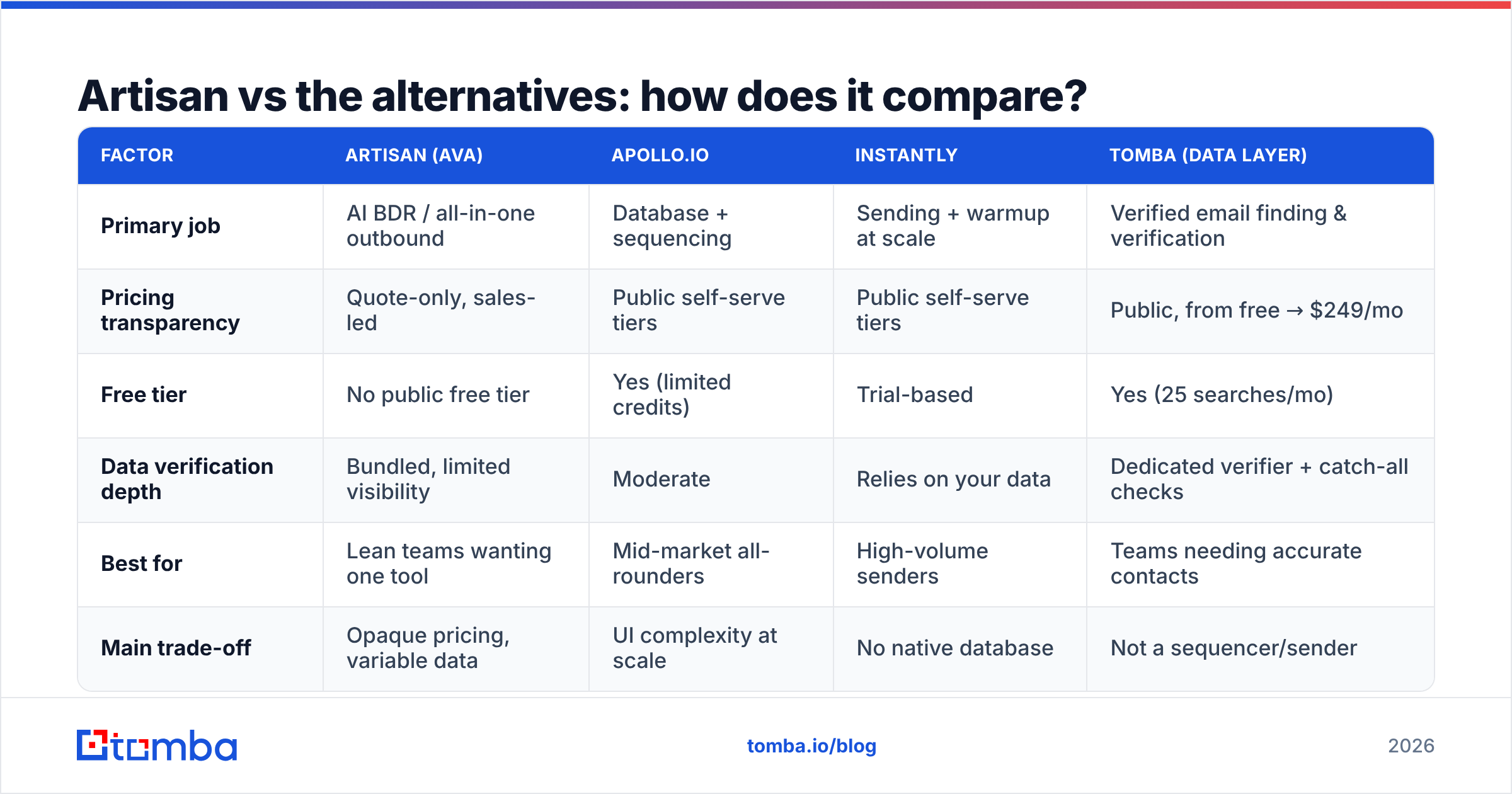
No single tool wins every category. Here's how Artisan's all-in-one approach stacks up against common alternatives teams evaluate alongside it.
| Factor | Artisan (Ava) | Apollo.io | Instantly | Tomba (data layer) |
|---|---|---|---|---|
| Primary job | AI BDR / all-in-one outbound | Database + sequencing | Sending + warmup at scale | Verified email finding & verification |
| Pricing transparency | Quote-only, sales-led | Public self-serve tiers | Public self-serve tiers | Public, from free → $249/mo |
| Free tier | No public free tier | Yes (limited credits) | Trial-based | Yes (25 searches/mo) |
| Data verification depth | Bundled, limited visibility | Moderate | Relies on your data | Dedicated verifier + catch-all checks |
| Best for | Lean teams wanting one tool | Mid-market all-rounders | High-volume senders | Teams needing accurate contacts |
| Main trade-off | Opaque pricing, variable data | UI complexity at scale | No native database | Not a sequencer/sender |
The pattern is clear: Artisan competes on consolidation, not on any single best-in-class component. If you're weighing the broader category, our roundups of Apollo alternatives and Instantly alternatives cover the trade-offs in more depth.
What are the pros and cons of Artisan?#
Pros
- Real consolidation. Sourcing, research, copy, and sending live in one place, which removes the integration tax of stitching three tools together.
- Time-to-first-campaign is fast. For a solo founder or a two-person sales team, Ava can stand up a working sequence in hours, not weeks.
- Hands-on onboarding. The sales-led model usually means a human helps you configure ICPs and sequences correctly.
- Built-in warmup. Deliverability tooling is included rather than bolted on, which lowers the chance of an obvious cold-start mistake.
Cons
- Opaque pricing. No public tier means no easy budgeting or comparison.
- Variable data accuracy. The most common complaint in Artisan reviews, and the one most likely to quietly cost you pipeline.
- Lock-in risk. All-in-one tools are harder to leave; if the data disappoints, you can't swap just the data layer without unwinding the whole workflow.
- Less control for power users. Teams with sophisticated, custom sequencing logic may find the AI's defaults limiting.
Who should use Artisan — and who shouldn't?#
Artisan is a strong fit if you:
- Run a lean team (1–5 reps) and want fewer tools to manage.
- Value speed-to-launch over granular control.
- Don't yet have an established data + sending stack you're attached to.
Look elsewhere if you:
- Need transparent, predictable pricing you can model in a spreadsheet.
- Already own a sequencer or CRM and only need a reliable data source.
- Sell into segments where contact accuracy is make-or-break (regulated industries, niche verticals, non-US markets).
For that second group, a better architecture is to keep your existing sender and bolt on a precise data layer. You can pull contacts by company with domain search, enrich your existing records with data enrichment, and run everything through verification before a single email goes out.
How do you fill the data gaps an AI BDR leaves?#
Whether you choose Artisan or not, the durable lesson from these reviews is that orchestration and data quality are two different problems. Don't let one tool's convenience hide a weakness in the other.
A reliable setup looks like this:
- Let the AI BDR orchestrate the sequence, timing, and follow-ups.
- Source and verify contacts independently so you control accuracy. Use a dedicated email finder for net-new prospects and a bulk email finder when you're building larger lists.
- Gate every send on verification to protect deliverability. A bounce isn't just a missed touch; it's reputation damage that compounds.
- Audit monthly. Re-verify any list older than 90 days — B2B data decays fast as people change jobs.
This separation also future-proofs you. If you ever switch sending platforms, your data process travels with you instead of being trapped inside a single vendor's black box.
The bottom line on Artisan in 2026#
Artisan is a legitimately useful AI BDR for teams that want to collapse their outbound stack into one tool and move fast. Ava handles the tedious parts of prospecting well, and the built-in warmup is a sensible default. But the two recurring knocks in Artisan reviews — opaque pricing and uneven data accuracy — are exactly the two things that decide whether automated outbound actually books meetings or just burns your domain.
If you adopt it, treat its database as a starting point, not gospel. Verify before you send, and own your data process independently of any single platform.
That's where a focused tool earns its keep. Tomba's Email Finder gives you verified, professional email addresses by name, company, or domain — with a free tier to test accuracy on your own ICP before you commit a dollar. Pair it with any AI BDR, including Artisan, and you get the speed of automation without gambling your deliverability on data you can't see inside. Find the right contacts, verify them, then let your sequencing tool do the rest.
Ready to find emails that actually work?
Join 150,000+ professionals who stopped guessing and started sending. Free credits on signup — no credit card required.
Get the Tomba newsletter
Practical outbound tactics and product updates — once every two weeks.
About the author