Artisan vs Clodura.ai (2026): AI SDR vs B2B Sales Database
Artisan automates the SDR role with an AI agent; Clodura.ai gives you a sales-intelligence database and sequencing. Here's how they actually compare in 2026 — and where a dedicated data layer beats both.
You are choosing between two very different bets. Artisan sells you an autonomous AI sales rep that drafts and sends outbound for you. Clodura.ai sells you a B2B contact database with sequencing bolted on. They get pitched as competitors because both promise "more pipeline, less manual work" — but under the hood they solve different problems, and picking wrong wastes a quarter.
This breakdown cuts through the marketing. We compare what each tool actually does, where the data comes from, what you pay, and the deliverability risk you inherit. We also flag the part neither vendor likes to discuss: an AI SDR or a bundled database is only as good as the email data feeding it, and that's usually the cheapest part of the stack to fix.
TL;DR#
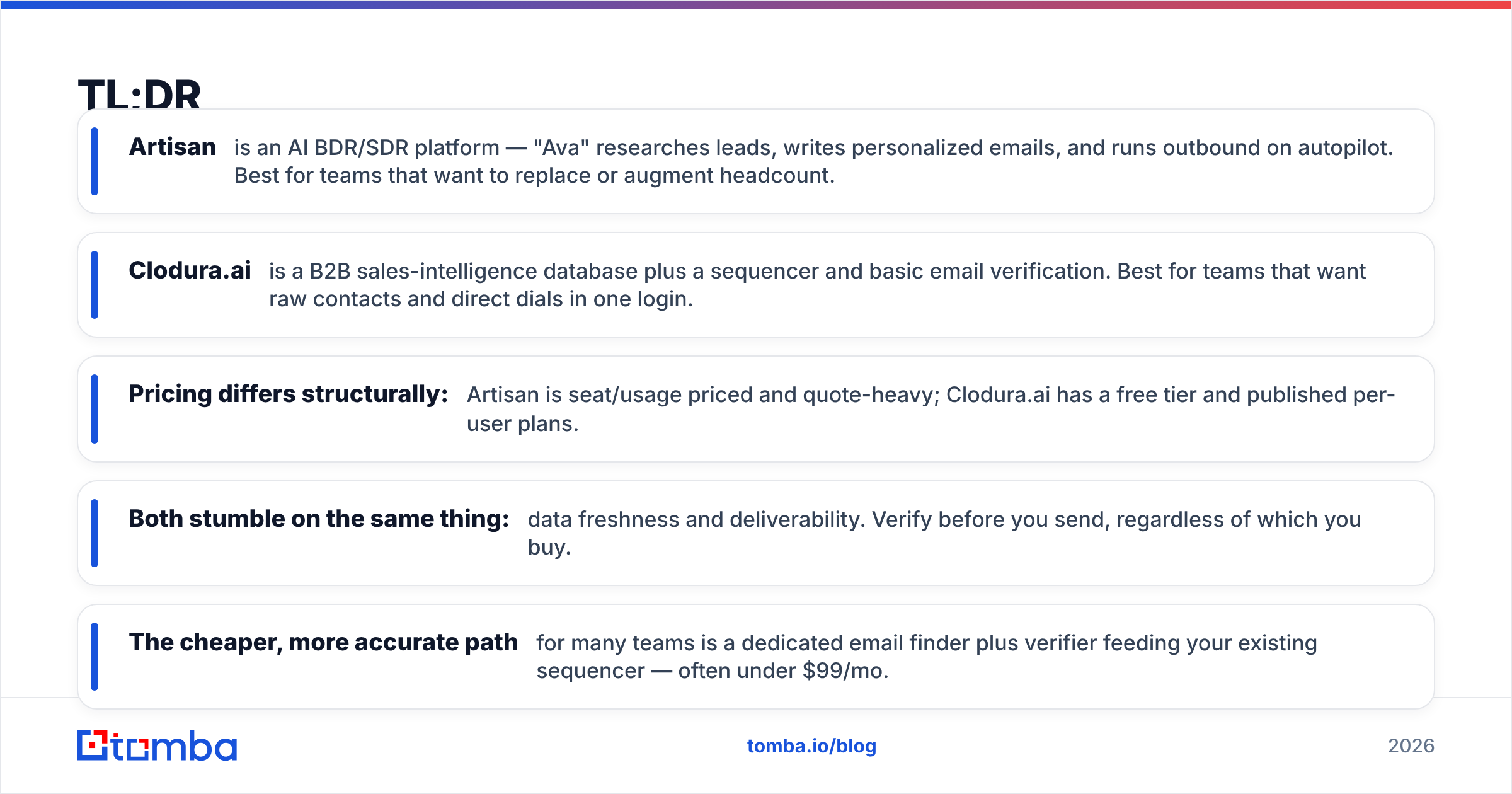
- Artisan is an AI BDR/SDR platform — "Ava" researches leads, writes personalized emails, and runs outbound on autopilot. Best for teams that want to replace or augment headcount.
- Clodura.ai is a B2B sales-intelligence database plus a sequencer and basic email verification. Best for teams that want raw contacts and direct dials in one login.
- Pricing differs structurally: Artisan is seat/usage priced and quote-heavy; Clodura.ai has a free tier and published per-user plans.
- Both stumble on the same thing: data freshness and deliverability. Verify before you send, regardless of which you buy.
- The cheaper, more accurate path for many teams is a dedicated email finder plus verifier feeding your existing sequencer — often under $99/mo.
What is Artisan?#
Artisan is an AI sales platform built around an agent it calls "Ava." Instead of giving you a list and a tool, it tries to do the SDR job: pull a prospect from its lead database, research the company, draft a personalized email, and send it through managed inboxes with warmup and deliverability handling. You supervise; the agent executes.
The pitch is headcount replacement. A founder or small team points Ava at an ICP, approves messaging, and lets it run sequences at volume. Artisan layers in its own data sourcing (it advertises a large B2B contact pool) so you don't bring your own list. You can read the full product framing on the official Artisan site.
Where Artisan shines: speed to first campaign and the "set it and watch it" workflow. Where it gets risky: you're trusting a black-box agent with your domain reputation, and the personalization quality varies with the underlying data. If Ava enriches a contact with a stale or guessed email, the agent confidently sends to a dead address — and your sending domain absorbs the bounce.
What is Clodura.ai?#
Clodura.ai is a sales-intelligence platform: a B2B database of companies and contacts, with direct-dial phone numbers, org charts, buyer-intent signals, and a built-in email sequencer. It also includes email verification and a Chrome extension. Think of it as a lighter-weight alternative to the big data vendors, aimed at SMBs who want contacts and outreach under one roof. The vendor's positioning is on the Clodura.ai homepage.
The model is "data + activation." You search for accounts matching your ICP, pull contacts, build a sequence, and send — all without leaving the app. The free tier and transparent per-user pricing make it approachable for small teams testing outbound.
Where Clodura.ai shines: breadth of contact and intent data for the price, plus direct dials that many cheaper tools lack. Where it gets weak: the database is smaller and refreshes less aggressively than tier-one providers, and the sequencer/deliverability tooling is functional rather than best-in-class. You'll often want to verify exported contacts before a real campaign — Clodura's built-in checks are a first pass, not a guarantee.
Artisan vs Clodura.ai: how do they compare?#
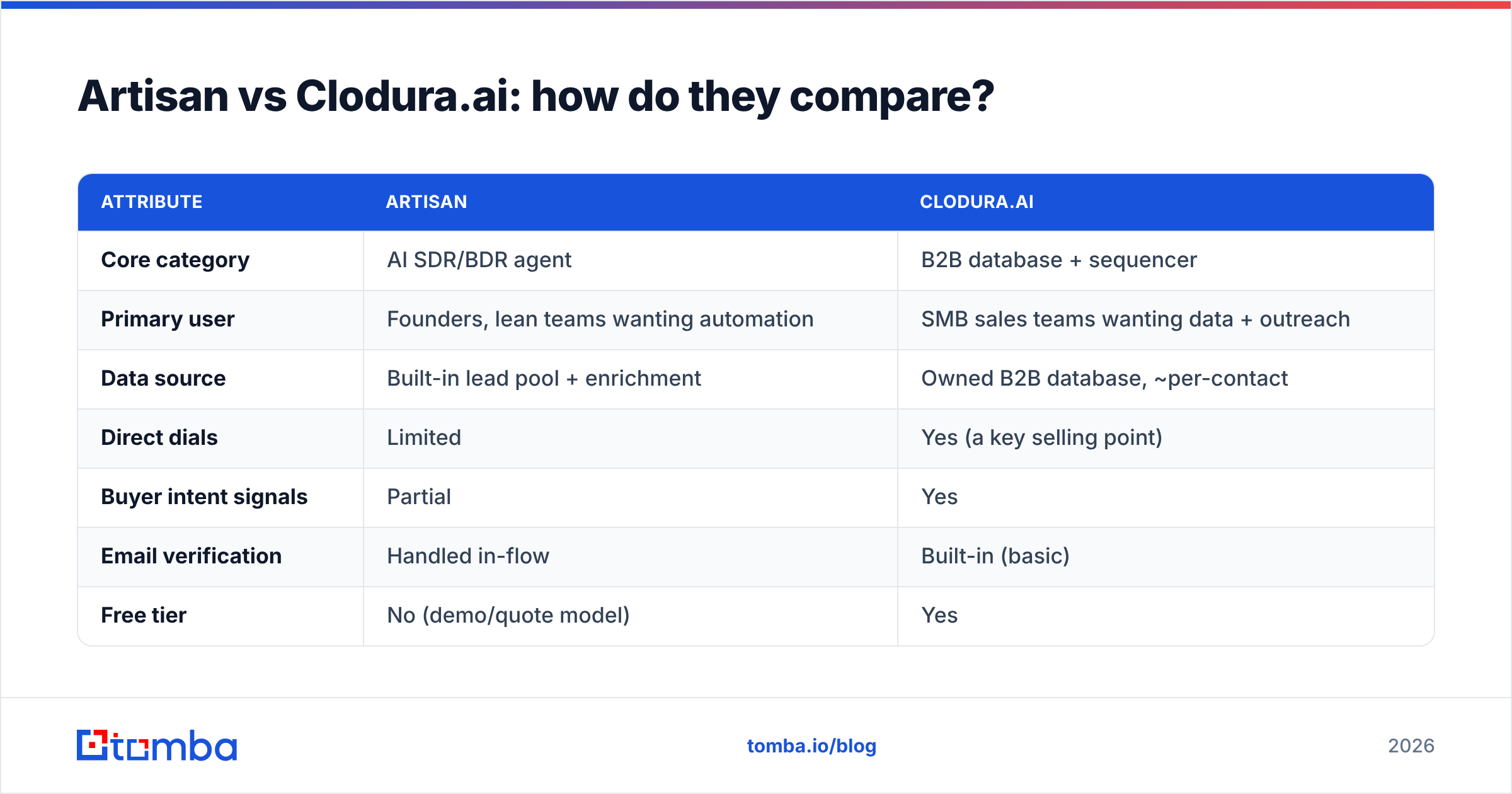
The core difference: Artisan does the work for you; Clodura.ai gives you the materials to do the work. One is an autonomous agent, the other is a database with a sequencer. That distinction drives everything else — pricing, control, and risk.
| Attribute | Artisan | Clodura.ai |
|---|---|---|
| Core category | AI SDR/BDR agent | B2B database + sequencer |
| Primary user | Founders, lean teams wanting automation | SMB sales teams wanting data + outreach |
| Data source | Built-in lead pool + enrichment | Owned B2B database, ~per-contact |
| Direct dials | Limited | Yes (a key selling point) |
| Buyer intent signals | Partial | Yes |
| Email verification | Handled in-flow | Built-in (basic) |
| Free tier | No (demo/quote model) | Yes |
| Pricing transparency | Quote-heavy, seat + usage | Published per-user plans |
| Deliverability control | Managed (less visibility) | Manual (more control) |
| Best when | You want to replace SDR busywork | You want contacts + dials cheaply |
Which one fits your team?#
Choose Artisan if your bottleneck is human hours — you have product-market fit, a defined ICP, and nobody to run outbound. The agent earns its keep by compressing research-and-send into one supervised loop.
Choose Clodura.ai if your bottleneck is data and phone numbers — you already have an SDR (or do it yourself) and just need affordable contacts, direct dials, and a place to sequence them.
Choose neither as your data layer if accuracy is the real problem. Both tools bundle data you can't fully audit. If your bounce rate is creeping up or replies are flat, the fix usually isn't a fancier agent — it's cleaner contacts. That's a separate, cheaper purchase.
How accurate is the data behind each tool?#
This is the question that decides campaign ROI, and it's the one both vendors answer vaguely. An AI SDR that sends to a 40%-accurate list will torch your domain reputation faster than any human rep. A database with stale records hands you the same problem one export at a time.
Here's the mechanism. Every email you send to a dead or mistyped address bounces. Mailbox providers like Google and Microsoft read high bounce rates as a spam signal and start routing your mail to spam — even for the valid addresses. So data quality isn't a "nice to have"; it's the input that protects sender reputation and keeps you in the inbox.
Bundled data tools optimize for coverage (how many contacts they can show you) over precision (how many are still correct). That trade-off is fine for prospecting research and bad for sending. The professional move is to treat any bundled list as raw input and run it through a dedicated email verifier before a single send.
A focused workflow looks like this:
- Source contacts (Artisan's pool, Clodura's database, or your own scraping).
- Find and confirm the real address pattern with an email finder.
- Verify the full list — flag invalids, catch-alls, and risky domains.
- Enrich the survivors with firmographics so personalization is accurate.
- Only then load them into a sequencer or hand them to the AI agent.
That middle layer — find, verify, enrich leads — is where a specialized tool beats a bundled one. It's also where Tomba sits: instead of asking you to commit to a whole AI-SDR philosophy or a closed database, it does one job (accurate contact data) and feeds whatever stack you already run.
What about pricing?#
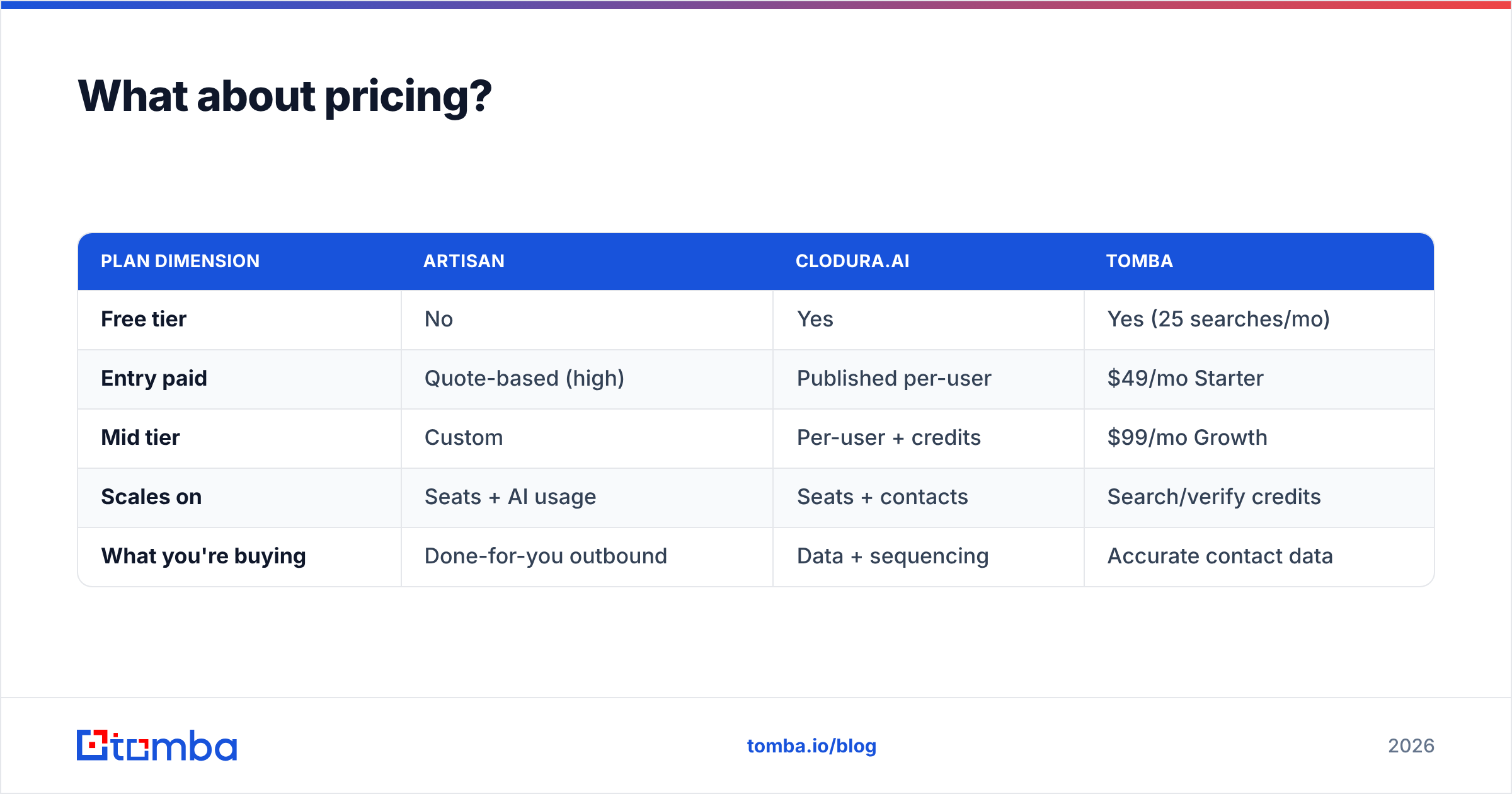
Pricing is where the two tools split hardest, and where a third option quietly wins on cost-per-valid-contact.
Artisan leans on a sales-led, quote-driven model: you book a demo, and pricing scales with seats and usage (the AI agent, managed inboxes, data credits). It's positioned as a replacement for an SDR salary, so the number is framed against headcount, not against a software line item. Expect a meaningful monthly commitment.
Clodura.ai publishes per-user plans and offers a free tier, which makes it easy to trial. You pay for credits/contacts and seats; direct dials and intent data sit in higher plans. It's the friendlier entry point for a budget-conscious SMB.
| Plan dimension | Artisan | Clodura.ai | Tomba |
|---|---|---|---|
| Free tier | No | Yes | Yes (25 searches/mo) |
| Entry paid | Quote-based (high) | Published per-user | $49/mo Starter |
| Mid tier | Custom | Per-user + credits | $99/mo Growth |
| Scales on | Seats + AI usage | Seats + contacts | Search/verify credits |
| What you're buying | Done-for-you outbound | Data + sequencing | Accurate contact data |
For teams that already own a sequencer (Instantly, Smartlead, HubSpot, Salesloft), the math often favors keeping that and adding a precise data layer rather than paying for a bundled agent or database. You can compare the full Tomba pricing against what you'd spend on credits inside Artisan or Clodura — the per-valid-contact cost is usually the honest metric, not the sticker price.
Where do AI SDR tools and databases fall short?#
Three recurring gaps show up in real deployments, regardless of vendor.
1. Deliverability is your problem, not theirs. Artisan manages inboxes for you, which sounds great until you realize you've outsourced reputation control. If the agent over-sends or hits bad data, you find out when replies stop. Clodura gives you more manual control but expects you to know SPF, DKIM, and warmup yourself. Either way, audit your own sending — start with email deliverability fundamentals before scaling volume.
2. Personalization is only as smart as the data. An AI agent writing "I saw you're the VP of Sales at [Company]" is impressive — and embarrassing when the title is two jobs out of date. Enrichment freshness drives whether automated personalization helps or hurts. Stale data makes the AI look like a bot.
3. Catch-all and role-based addresses inflate "valid" counts. Bundled verifiers tend to mark catch-all domains as "valid" because the server accepts everything. Those still bounce or land nowhere. A dedicated catch-all verifier separates genuinely deliverable addresses from accept-all noise — a distinction that quietly protects your domain.
None of these are reasons to avoid Artisan or Clodura.ai. They're reasons to not trust any single bundled tool as your source of truth for contact data. Independent verification is cheap insurance.
When should you use Artisan, Clodura.ai, or a dedicated data tool?#
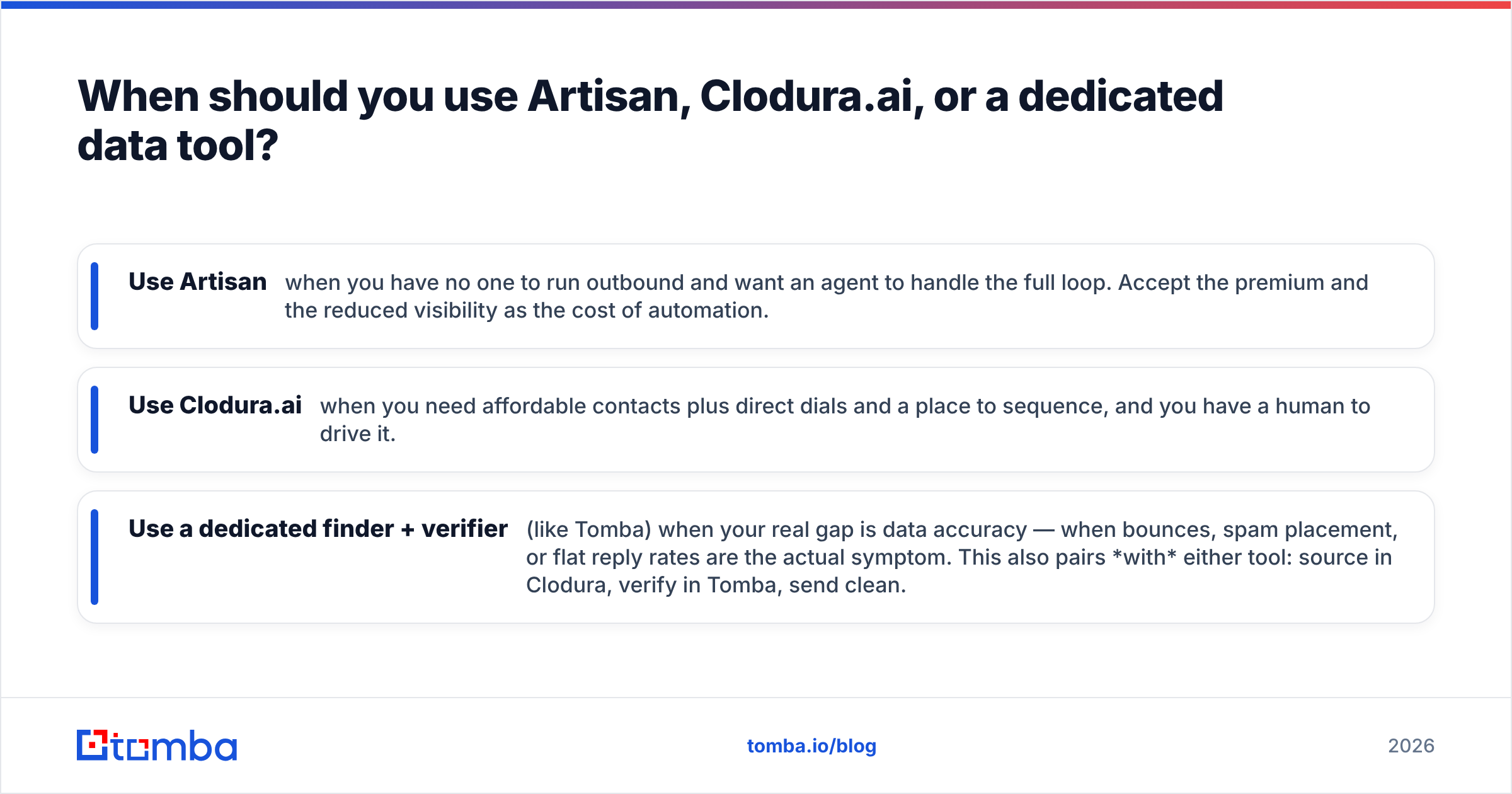
A simple decision rule:
- Use Artisan when you have no one to run outbound and want an agent to handle the full loop. Accept the premium and the reduced visibility as the cost of automation.
- Use Clodura.ai when you need affordable contacts plus direct dials and a place to sequence, and you have a human to drive it.
- Use a dedicated finder + verifier (like Tomba) when your real gap is data accuracy — when bounces, spam placement, or flat reply rates are the actual symptom. This also pairs with either tool: source in Clodura, verify in Tomba, send clean.
Most growing teams end up with a hybrid: a sequencer they like, a data layer they trust, and selective automation on top. The mistake is buying one monolith and assuming it solves sourcing, accuracy, sending, and reporting equally well. It never does.
For independent reviews and feature-by-feature user feedback before you commit, cross-check both vendors on G2 — buyer reviews surface the data-freshness and deliverability complaints that demos skip.
The bottom line#
Artisan and Clodura.ai aren't really the same product. Artisan automates the labor of outbound; Clodura.ai supplies the materials. If you need an autonomous SDR and have budget, Artisan is the more ambitious bet. If you need affordable data and dials with a sequencer, Clodura.ai is the pragmatic one. But for either to perform, the contact data has to be correct — and that's the layer most teams underinvest in.
If you want the highest-accuracy contact data feeding whatever you already use, start with the Tomba Email Finder. Find professional emails by name, domain, or company, verify them before you send, and keep your sender reputation clean — for a fraction of an AI-SDR contract. There's a free tier (25 searches/mo) to test accuracy against your own list before you pay a cent. Fix the data first; the rest of your stack works better the moment you do.
Ready to find emails that actually work?
Join 150,000+ professionals who stopped guessing and started sending. Free credits on signup — no credit card required.
Get the Tomba newsletter
Practical outbound tactics and product updates — once every two weeks.
About the author