Artisan vs DiscoverOrg: AI BDR vs Legacy Data in 2026
Artisan's AI BDR automates outbound end-to-end; DiscoverOrg (now ZoomInfo) sells the data underneath it. Here's which one your team actually needs in 2026.
You are comparing two tools that barely belong in the same sentence — and that is exactly why this matchup confuses so many sales teams. Artisan is an AI BDR platform that runs outbound campaigns end-to-end. DiscoverOrg is a legacy B2B data provider that was folded into ZoomInfo years ago. One automates the doing; the other sells the data. This guide breaks down what each actually delivers in 2026, what they cost, and where a leaner stack beats both.
TL;DR#
- Artisan is an AI Business Development Rep (BDR) platform built around "Ava," an autonomous agent that sources leads, writes emails, and books meetings. Best for teams wanting to replace or augment human SDR headcount.
- DiscoverOrg no longer exists as a standalone product — it was acquired by ZoomInfo in 2019 and its data/brand were absorbed into ZoomInfo. Buying "DiscoverOrg" today means buying ZoomInfo.
- They solve different problems: Artisan is execution + automation; DiscoverOrg/ZoomInfo is data + intelligence. Many teams using Artisan still pay a separate data vendor underneath it.
- Both carry enterprise pricing — annual contracts, four- to five-figure minimums, and limited transparency. Neither has a usable free tier.
- If your core need is accurate contact data without a long contract, a pay-as-you-go email finder like Tomba covers the data layer for a fraction of either price.
What is Artisan?#
Artisan is an AI sales platform whose headline product is Ava, an "AI BDR" agent. Instead of giving you a database and a sequencer and asking your reps to wire them together, Artisan tries to own the whole outbound motion: it pulls leads from a 300M+ contact database, enriches them, drafts personalized emails, manages sending and warmup, and surfaces replies for a human to close.
The pitch is headcount replacement. A traditional SDR costs a salary plus tooling; Artisan positions Ava as a always-on alternative that handles the repetitive top-of-funnel work. You can read the full positioning on the Artisan homepage.
Where Artisan is strong:
- End-to-end automation — research, copy, sending, and follow-up live in one system.
- Built-in data — you do not need to bolt on a separate prospecting database to get started.
- Deliverability tooling — warmup, inbox rotation, and sending guardrails are included rather than sold separately.
Where it gets tricky: you are trusting an AI agent with your domain reputation and your brand voice. Teams that want tight control over messaging and list quality often find the autonomy is a double-edged sword.
What is DiscoverOrg (and why can't you really buy it anymore)?#
Here is the part most comparison articles get wrong: DiscoverOrg is not an active standalone product in 2026. DiscoverOrg merged with ZoomInfo in 2019, and the combined company operates under the ZoomInfo brand. If you search for "DiscoverOrg pricing" today, you land on ZoomInfo.
Historically, DiscoverOrg was known for deeply researched, human-verified B2B data — org charts, direct dials, and technographics aimed at enterprise sales and account-based marketing. That DNA lives on inside ZoomInfo's data engine, which you can see at the ZoomInfo site.
So when you evaluate "DiscoverOrg," you are really evaluating:
- A massive B2B contact and company database with firmographics, intent signals, and direct dials.
- Intelligence layers — buying-intent data, org charts, and scoops (trigger events).
- Enterprise contracts — typically annual, seat-based, and negotiated, with reported minimums well into five figures per year.
It is a data and intelligence platform, full stop. It does not write your emails or run your sequences the way Artisan does.
Artisan vs DiscoverOrg: how do they actually compare?#
Because these tools sit at different layers of the stack, the honest comparison is "automation platform vs data platform." Here is the side-by-side.
| Attribute | Artisan | DiscoverOrg (ZoomInfo) |
|---|---|---|
| Primary job | AI BDR — runs outbound end-to-end | B2B data + sales intelligence |
| Core asset | Ava AI agent + 300M+ contacts | Human-verified database + intent data |
| Email outreach | Built in (writing, sending, warmup) | Not included (data only) |
| Direct dials / phone | Limited | Strong (legacy DiscoverOrg strength) |
| Intent / trigger data | Basic | Advanced (scoops, intent, org charts) |
| Pricing model | Annual, per-seat / per-agent | Annual contract, seat-based |
| Entry cost | Four-figure+/mo, sales-led | Five-figure/yr typical, sales-led |
| Free tier | No | No |
| Best for | Teams replacing SDR execution | Enterprise ABM + data-hungry teams |
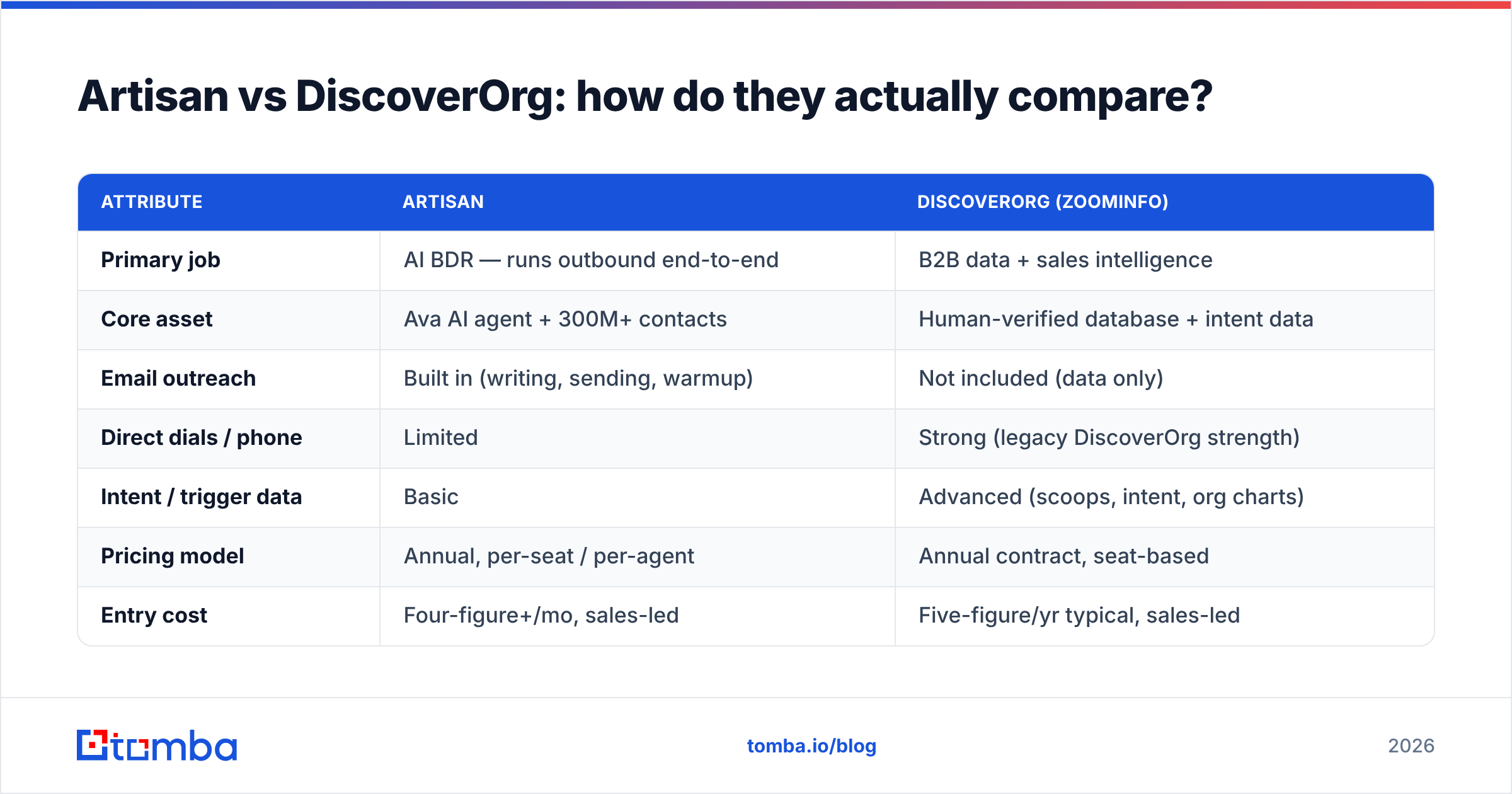
The takeaway: these are not direct substitutes. A team could plausibly run ZoomInfo for data and Artisan for execution at the same time — and pay heavily for both. The real question is whether you need that full stack, or whether a focused data tool plus your existing sequencer does the job.
Which one is right for your team?#
Conclusion first: pick Artisan if your bottleneck is execution; pick ZoomInfo (DiscoverOrg's successor) if your bottleneck is data depth; pick neither if your real need is accurate emails at a fair price.
Choose Artisan when:
- You are short on SDR capacity and want automation to fill the gap.
- You value a single system over a stitched-together stack.
- You are comfortable letting an AI agent manage messaging and sending.
Choose ZoomInfo/DiscoverOrg when:
- You run account-based motions that need org charts, direct dials, and intent data.
- You have an enterprise budget and a procurement process that can absorb annual contracts.
- Your reps already have a sequencer and just need richer data feeding it.
Choose a lean stack when:
- You primarily need verified email addresses and company contacts.
- You want pay-as-you-go pricing without a sales call or annual lock-in.
- You would rather plug data into the sequencer and CRM you already trust.
That third path is where most small and mid-market teams actually land. You do not need a $30k/year intelligence suite to find the right person's email — you need an accurate email verifier and a reliable finder.
How much do Artisan and DiscoverOrg cost?#
Both are sales-led, opaque, and annual. Neither publishes a clean self-serve price list, which itself tells you who they are built for.
- Artisan is priced per seat / per agent on annual contracts, generally starting in the low four figures per month for a meaningful deployment. You book a demo to get a quote.
- **DiscoverOrg/
ZoomInfo** is famously contract-heavy. Public reports and review sites like G2 put typical annual commitments in the five-figure range, scaling fast with seats and data modules.
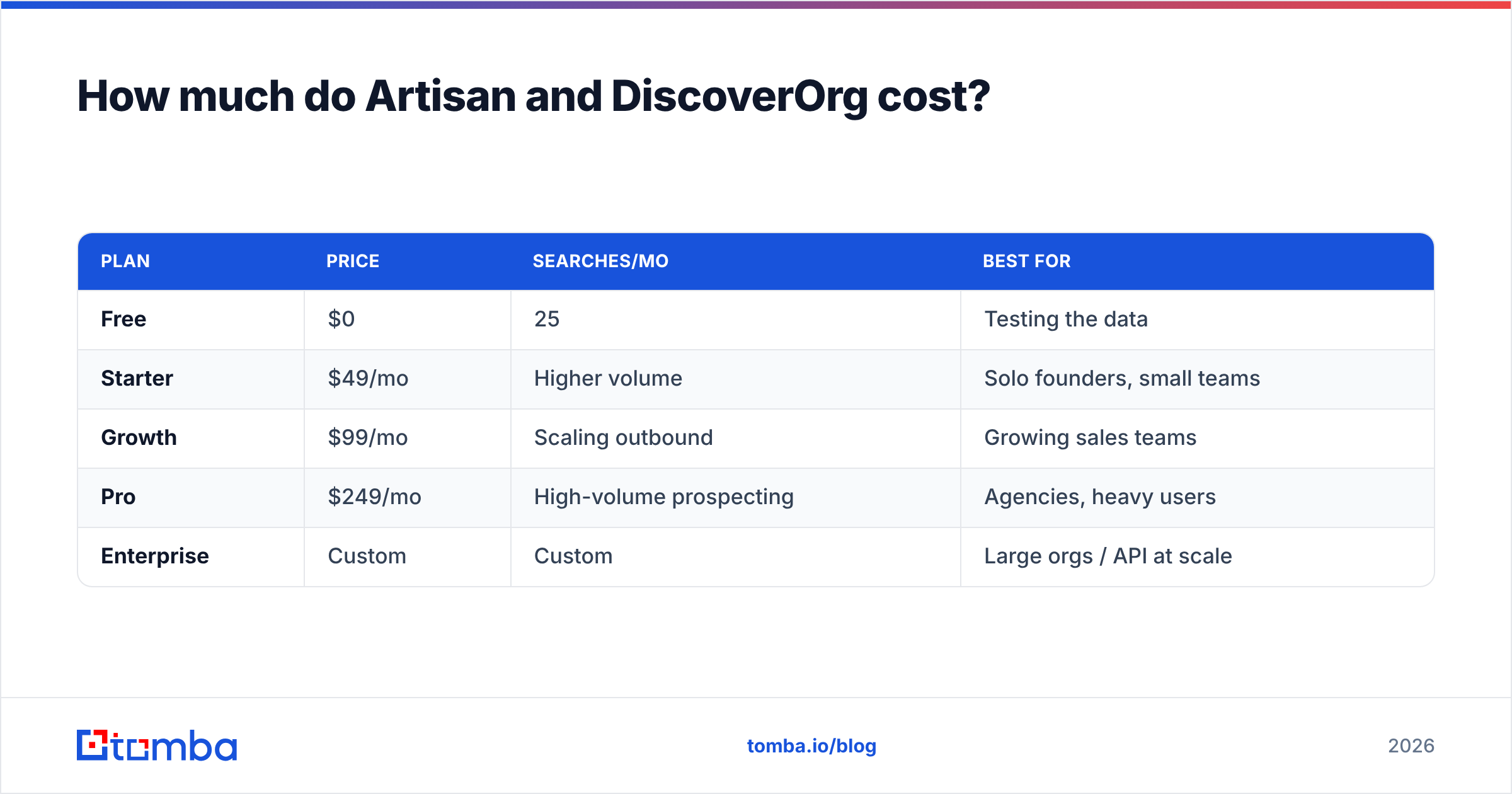
Compare that to transparent, usage-based tooling. Tomba publishes its pricing openly:
| Plan | Price | Searches/mo | Best for |
|---|---|---|---|
| Free | $0 | 25 | Testing the data |
| Starter | $49/mo | Higher volume | Solo founders, small teams |
| Growth | $99/mo | Scaling outbound | Growing sales teams |
| Pro | $249/mo | High-volume prospecting | Agencies, heavy users |
| Enterprise | Custom | Custom | Large orgs / API at scale |
The gap is not subtle. A team can run Tomba's bulk email finder and a sequencer for less than the setup fee on an enterprise data contract.
Do you even need an all-in-one platform?#
Often, no. The all-in-one pitch — whether it is Artisan's "AI does everything" or ZoomInfo's "all your data in one suite" — is attractive until you see the bill and the lock-in. A modular stack gives you three advantages: you control each layer, you swap any piece without re-tooling the rest, and you only pay for what you use.
A practical lean stack looks like this:
- Data layer — a precise email finder and domain search to build verified lists by company or role.
- Verification — an email verifier and catch-all verifier to protect deliverability before you send.
- Execution — your existing sequencer or CRM, fed by the Tomba API or a no-code integration.
This is the same outcome Artisan promises — qualified contacts in a working sequence — without handing your reputation to an autonomous agent or signing a multi-year data contract. And because data accuracy is the foundation of everything downstream, it pays to start with a provider whose sourcing is transparent. Tomba documents exactly where its data comes from, which matters when a single bad list can tank a sending domain.
What about data accuracy and deliverability?#
This is where the "execution vs data" framing matters most. Artisan automates sending, but automation amplifies whatever data you feed it — bad emails get sent faster, and bounces hit your domain harder. DiscoverOrg/ZoomInfo invests heavily in verification, which is why it commands enterprise prices, but you are paying for a whole intelligence suite to get there.
If your goal is clean, low-bounce lists, you can isolate that need. Run your contacts through a dedicated email verification step and check tricky domains with a catch-all finder before a single message goes out. The result: protected sender reputation without buying a platform you will only half-use.
The brutal truth is that most outbound failures are not a tooling problem — they are a data problem dressed up as one. A 300M-contact database is worthless if 30% of the rows bounce. Accuracy, verified at the point of send, beats raw database size almost every time.
The verdict: Artisan vs DiscoverOrg in 2026#
- Artisan is the better pick if you genuinely want to automate SDR execution and you trust an AI agent to run it. It is a real product solving a real headcount problem.
- DiscoverOrg is a legacy brand; in 2026 you are buying ZoomInfo, the deepest enterprise data and intelligence suite on the market — at enterprise prices and on enterprise terms.
- They are complements, not competitors, in many stacks: data underneath, automation on top.
- For most teams, the smarter move is to own the data layer cheaply and pair it with tools you already run.
If accurate, affordable contact data is what you actually came for, skip the demo gauntlet and the annual contract. Start with Tomba's Email Finder — find verified professional emails by name, company, or domain on a free tier, then scale to a $49/mo plan only when you are ready. It is the data layer both Artisan and DiscoverOrg are built on, without the enterprise overhead.
Ready to find emails that actually work?
Join 150,000+ professionals who stopped guessing and started sending. Free credits on signup — no credit card required.
Get the Tomba newsletter
Practical outbound tactics and product updates — once every two weeks.
About the author