Artisan vs Overloop AI (2026): AI Sales Agent Showdown
Artisan's Ava and Overloop AI both promise autonomous outbound. Here's an honest 2026 breakdown of features, pricing, data quality, and which AI SDR actually fits your team.
Artisan vs Overloop AI: Which AI Sales Agent Wins in 2026?
TL;DR
- Artisan centers everything on "Ava," an AI BDR that researches prospects, writes sequences, and books meetings inside a single all-in-one platform — strong for teams that want to replace an SDR seat outright.
- Overloop AI is a leaner AI sales agent built on top of a long-standing cold-outreach CRM — better if you want multichannel campaigns (email + LinkedIn) without paying enterprise prices.
- Neither tool is only as good as its contact data. Both lean on bundled databases that go stale fast, so pairing them with a dedicated email verifier matters more than the AI copy.
- Pick Artisan for hands-off, fully-managed outbound; pick Overloop for cheaper, more configurable campaigns you still control.
- Whatever you choose, garbage in means garbage out — verified, enriched leads are the real lever on reply rates.
What are Artisan and Overloop AI?#
Both are "AI SDR" platforms — software that automates the grunt work of outbound sales: building lead lists, writing personalized messages, sending sequences, and handling replies. Think of them as a junior sales rep who never sleeps, except you configure the rep instead of hiring one.
Artisan launched with a single, aggressive pitch: meet Ava, an "AI employee" that owns the top of the funnel end to end. You give Ava an ideal customer profile, and it sources contacts from a 300M+ B2B database, drafts hyper-personalized emails, manages warmup and deliverability, and surfaces booked meetings. It's marketed as a replacement for an entire BDR function, not a tool a BDR uses.
Overloop AI comes from a different lineage. Overloop (formerly Prospect.io) spent years as a cold-email CRM with multichannel sequencing. Its AI agent layer was bolted onto that mature foundation, so you get autonomous campaign generation plus the manual levers of a traditional outreach tool. It's less "fire and forget," more "AI does the first draft, you keep the wheel."
The core difference in one line: Artisan wants to be your SDR; Overloop wants to supercharge the one you already have.
How do Artisan and Overloop AI compare on features?#
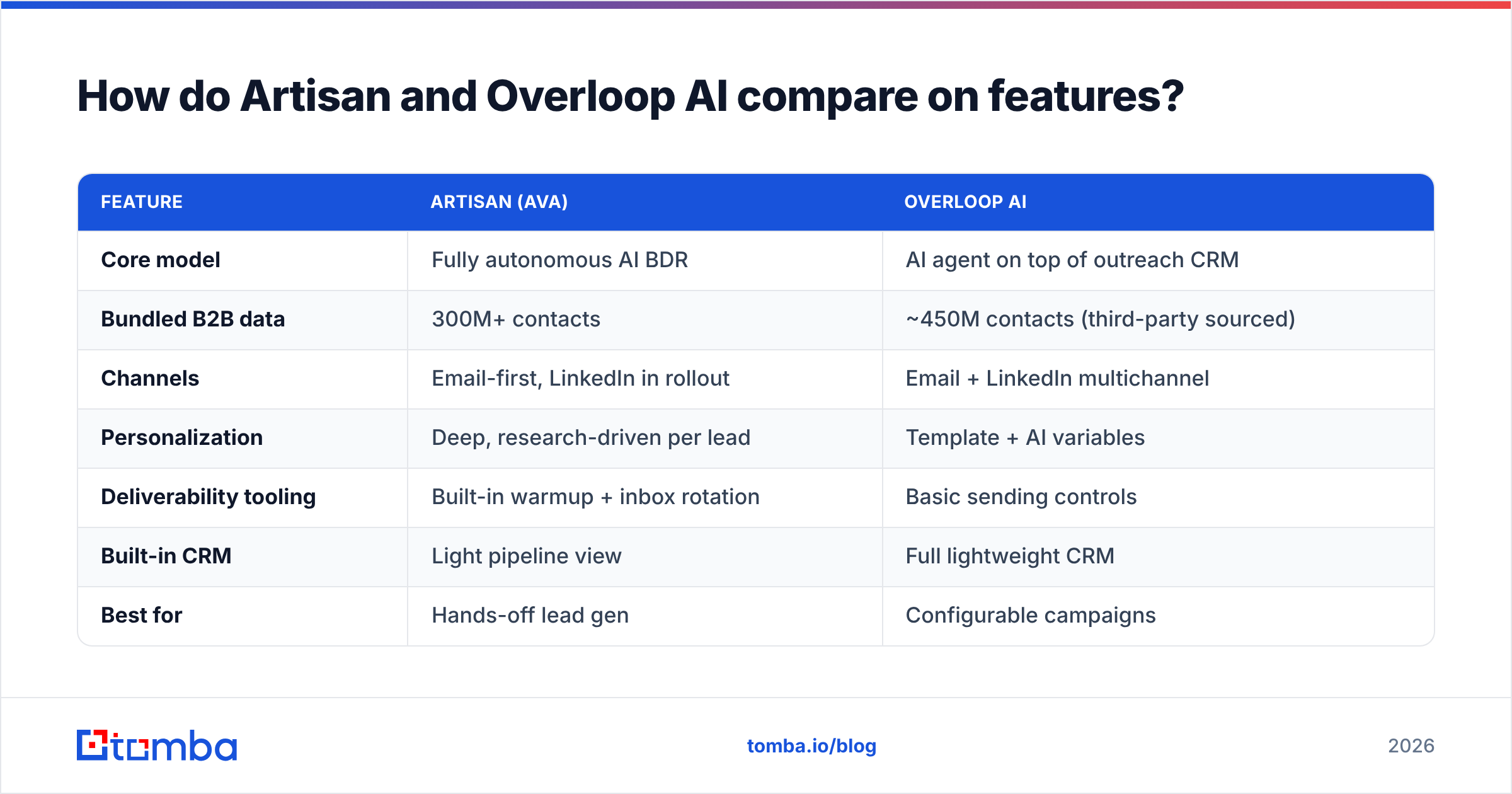
Here's the side-by-side on the attributes that actually change your day-to-day.
| Feature | Artisan (Ava) | Overloop AI |
|---|---|---|
| Core model | Fully autonomous AI BDR | AI agent on top of outreach CRM |
| Bundled B2B data | 300M+ contacts | ~450M contacts (third-party sourced) |
| Channels | Email-first, LinkedIn in rollout | Email + LinkedIn multichannel |
| Personalization | Deep, research-driven per lead | Template + AI variables |
| Deliverability tooling | Built-in warmup + inbox rotation | Basic sending controls |
| Built-in CRM | Light pipeline view | Full lightweight CRM |
| Best for | Hands-off lead gen | Configurable campaigns |
| Entry pricing | Custom / sales-led, often $1,500+/mo | From ~$49/user/mo |
| Free tier | No | Limited trial |
The headline gaps: Artisan invests heavily in deliverability infrastructure (warmup, inbox rotation, send throttling) because a fully autonomous sender lives or dies on landing in the inbox. Overloop gives you a real CRM and cheaper multichannel sending, but expects you to mind deliverability yourself. If you want to understand why that gap matters, our primer on email deliverability is worth ten minutes.
Is Artisan better than Overloop AI?#
It depends entirely on how much control you want to give up.
Artisan is "better" if your constraint is headcount. You can't or won't hire an SDR, you have a clear ICP, and you'd rather review booked meetings than manage campaigns. Ava genuinely automates the full loop, and the deliverability stack is more serious than most AI SDR startups ship. The trade-off is price (sales-led, frequently four figures monthly) and the opacity that comes with any "trust the AI" product — when reply rates dip, you have fewer knobs to turn.
Overloop AI is "better" if your constraint is budget and flexibility. You get an established CRM, multichannel sequencing, and per-seat pricing that starts where Artisan's floor is unreachable. You'll do more configuration and you'll babysit deliverability, but you also see exactly what's being sent and why.
Neither is universally superior. What is universal: both platforms' AI is only as persuasive as the contact it's writing to is real. An immaculately personalized email to a bounced address is wasted compute. That's the quiet failure mode of every AI SDR — they optimize the message and assume the data.
What about data quality and deliverability?#
This is where most AI SDR comparisons go quiet, so let's be blunt. Bundled databases — whether it's Artisan's 300M or Overloop's 450M — are aggregated, refreshed on the vendor's schedule, and shared across every customer. Decay is real: roughly 25–30% of B2B contact data goes stale each year as people change jobs. When the AI sends to a dead inbox, you don't just lose a lead — you damage your sender reputation, which drags down deliverability for every good address too.
That's why serious outbound teams treat data hygiene as a separate, owned layer rather than trusting whatever ships in the box:
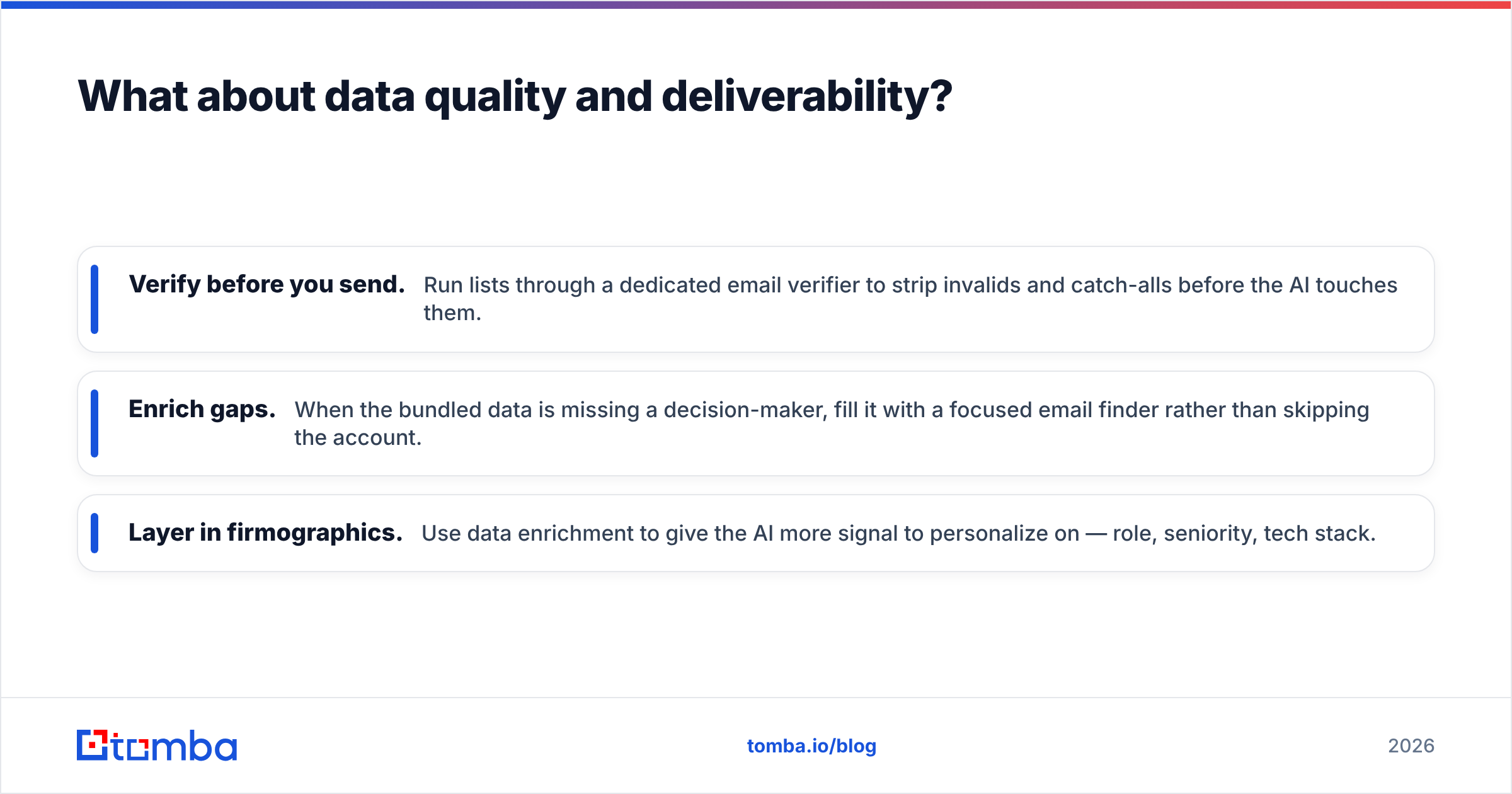
- Verify before you send. Run lists through a dedicated email verifier to strip invalids and catch-alls before the AI touches them.
- Enrich gaps. When the bundled data is missing a decision-maker, fill it with a focused email finder rather than skipping the account.
- Layer in firmographics. Use data enrichment to give the AI more signal to personalize on — role, seniority, tech stack.
Tomba's role here is complementary, not competitive: Artisan and Overloop write and send; a tool like Tomba makes sure the addresses are real and the records are complete. If your AI SDR is misfiring, data is the first thing to audit — long before you blame the copy.
How much do Artisan and Overloop AI cost?#
Pricing philosophies diverge as much as the products.
Artisan is sales-led. There's no transparent self-serve tier; you book a demo, and pricing scales with lead volume and seats. Public reports and customer reviews on G2 put realistic entry points in the $1,500–$3,000+/month range, positioning it against the loaded cost of a full-time SDR (salary, benefits, ramp, tooling). The pitch is "cheaper than a human BDR," and on a fully-loaded basis that's defensible.
Overloop AI publishes per-seat pricing starting around $49/user/month for outreach, with AI agent capabilities in higher tiers. It's an order of magnitude cheaper to start, which makes it accessible to founders and small teams testing outbound before committing.
A pragmatic stack for cost-conscious teams: pair an affordable sending tool with a precise data layer. For reference, Tomba pricing runs a Free tier (25 searches/month), Starter at $49/mo, Growth at $99/mo, and Pro at $249/mo — so even on a tight budget you can bolt verified data onto Overloop without approaching Artisan's floor.
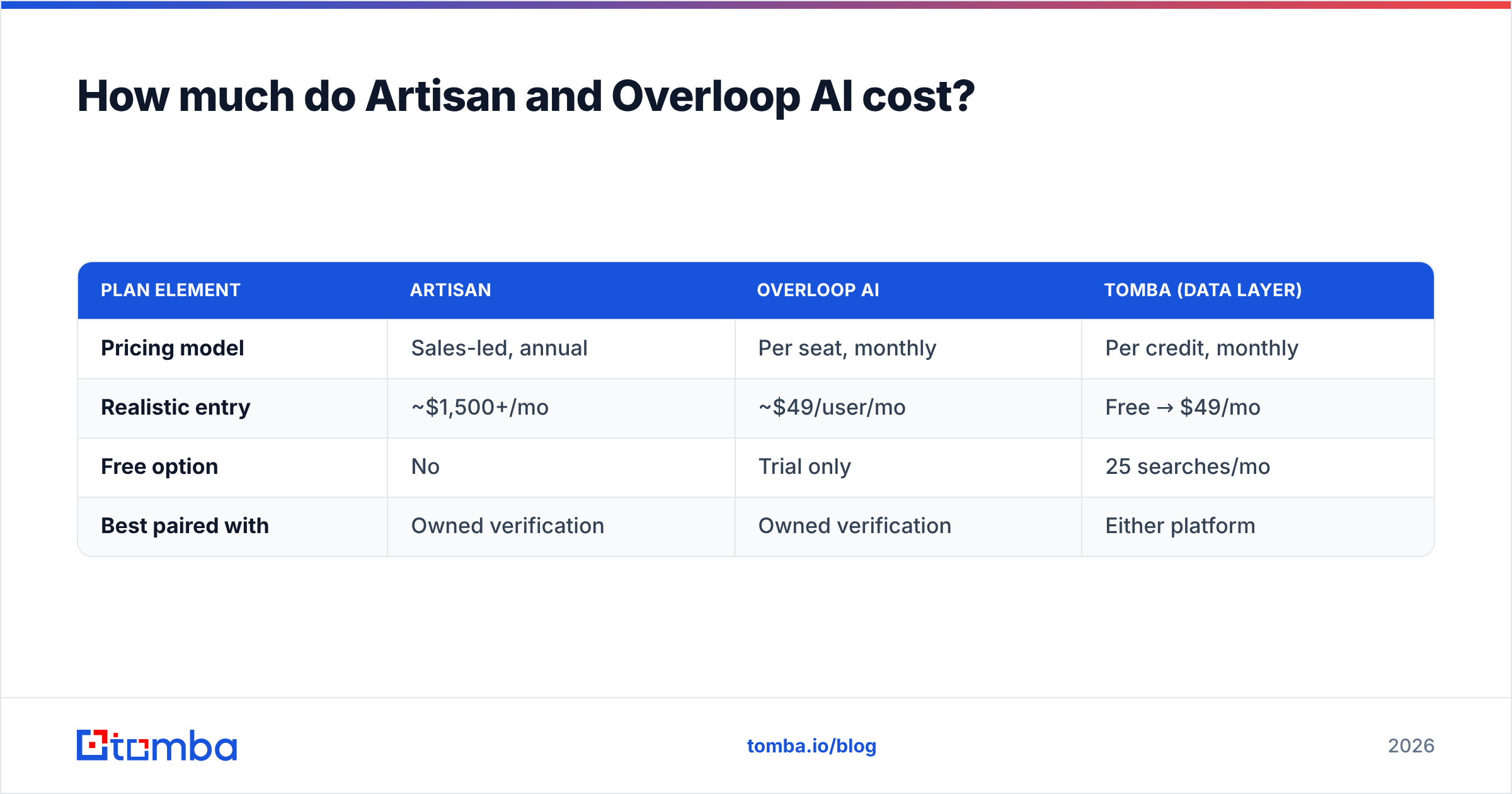
| Plan element | Artisan | Overloop AI | Tomba (data layer) |
|---|---|---|---|
| Pricing model | Sales-led, annual | Per seat, monthly | Per credit, monthly |
| Realistic entry | ~$1,500+/mo | ~$49/user/mo | Free → $49/mo |
| Free option | No | Trial only | 25 searches/mo |
| Best paired with | Owned verification | Owned verification | Either platform |
Which AI sales agent should you choose?#
Run it through three questions.
1. Do you have an SDR — or the budget for one? If yes, Overloop AI amplifies them affordably. If no and you can't hire, Artisan's Ava is the more complete replacement. If you're shopping specifically because an incumbent disappointed you, our breakdown of the best Overloop alternative options is a useful reality check before you re-sign.
2. How much control do you need? Regulated industries, complex sales, or brand-sensitive messaging favor Overloop's visibility. High-volume, top-of-funnel SMB prospecting favors Artisan's automation.
3. Where will your data come from? This is the tiebreaker most people skip. Both platforms' bundled data will decay. Decide upfront that verification and enrichment are your job, not the vendor's, and you'll outperform teams on either tool who trusted the box.
A sensible default for most small-to-mid teams in 2026: start on Overloop AI for cost and control, layer a dedicated data stack underneath, and only graduate to Artisan when outbound volume justifies a fully-managed, premium AI BDR. You can read each vendor's own framing on artisan.co and overloop.com — just read it as marketing, not as a deliverability guarantee.
The bottom line#
Artisan and Overloop AI solve the same problem from opposite ends of the price and control spectrum. Artisan replaces the SDR; Overloop equips one. Both are legitimate choices in 2026 — and both will underperform if you feed them stale, unverified contacts.
That last point is the one you control completely. Before your AI SDR sends a single email, route every lead through Tomba. Use the Tomba Email Finder to fill the gaps your platform's database misses, verify the rest, and enrich records so the AI has real signal to personalize on. The smartest outbound stack in 2026 isn't Artisan or Overloop — it's whichever sender you pick, sitting on top of data you actually trust. Start free, verify your first list, and watch your reply rate stop fighting your bounce rate.
Ready to find emails that actually work?
Join 150,000+ professionals who stopped guessing and started sending. Free credits on signup — no credit card required.
Get the Tomba newsletter
Practical outbound tactics and product updates — once every two weeks.
About the author