Artisan vs Success.ai (2026): AI Sales Platforms Compared
A neutral, hands-on breakdown of Artisan vs Successai in 2026 — AI BDR autonomy, data quality, deliverability, and pricing — so you pick the right outbound engine.
Picking between Artisan and Success.ai usually comes down to one question you can't answer from a pricing page: do you want a fully autonomous AI BDR that runs the whole motion, or a high-volume cold email engine you control yourself? They look similar in demos. They behave very differently once real prospects start hitting your sequences.
This is a neutral teardown. Both tools do real work, both have gaps, and the right pick depends on your team size, your data hygiene, and how much control you're willing to hand to an AI agent.
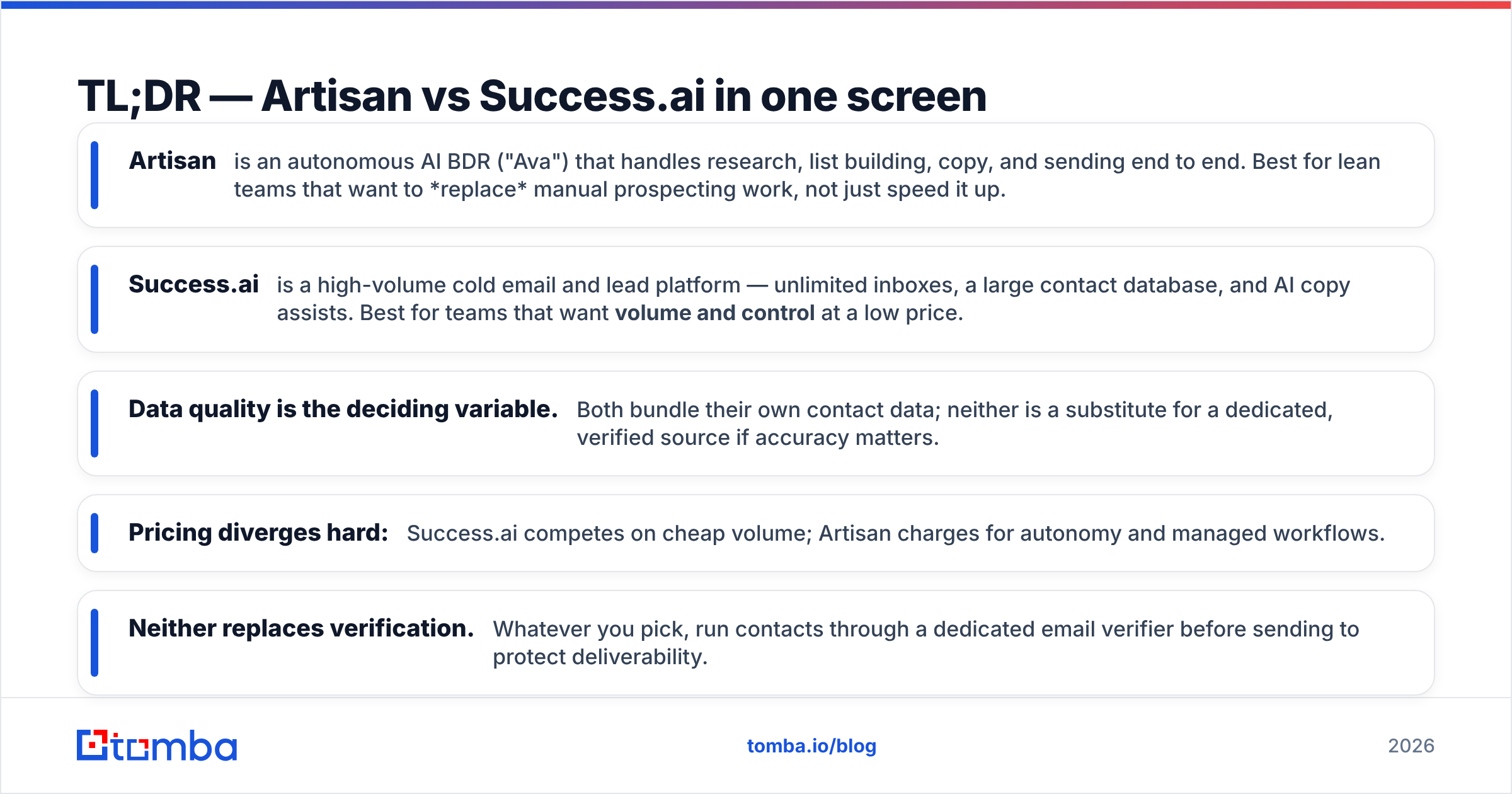
TL;DR — Artisan vs Success.ai in one screen#
- Artisan is an autonomous AI BDR ("Ava") that handles research, list building, copy, and sending end to end. Best for lean teams that want to replace manual prospecting work, not just speed it up.
- Success.ai is a high-volume cold email and lead platform — unlimited inboxes, a large contact database, and AI copy assists. Best for teams that want volume and control at a low price.
- Data quality is the deciding variable. Both bundle their own contact data; neither is a substitute for a dedicated, verified source if accuracy matters.
- Pricing diverges hard: Success.ai competes on cheap volume; Artisan charges for autonomy and managed workflows.
- Neither replaces verification. Whatever you pick, run contacts through a dedicated email verifier before sending to protect deliverability.
What is Artisan?#
Artisan positions itself as an "AI employee" — specifically Ava, an AI Business Development Representative. Instead of giving you a toolkit and asking you to assemble a workflow, Artisan tries to run the workflow for you: it builds the prospect list, researches each account, drafts personalized copy, schedules sends, and manages replies inside one platform.
The pitch is consolidation. Artisan wants to absorb the jobs you'd normally split across a data provider, a sequencer, and a copywriting tool. For a two-person founding sales team, that "set it and let Ava run" model is genuinely appealing — you trade granular control for not having to stitch five tools together.
The trade-off is exactly that loss of control. When an autonomous agent picks the wrong ICP signal or writes copy that's a little too "AI," you find out from your reply rate, not from a review step. You can read more about how autonomous agents fit the wider stack in our overview of AI sales technology.
What is Success.ai?#
Success.ai is built around volume and price. The core offer: a large B2B contact database (hundreds of millions of records, by their marketing), unlimited email accounts, automated warmup, and AI-assisted copy — sold at a price point that undercuts most enterprise sequencers.
Where Artisan says "let the agent do it," Success.ai says "do as much as you want, cheaply." You stay the operator. You build the lists, set the sequences, and decide the volume. The unlimited-inbox model is designed for teams running aggressive outbound across many sending domains.
That model rewards operators who already know what they're doing and punishes ones who don't. Unlimited sending capacity with mediocre data and weak warmup is a fast path to a burned domain. The platform gives you the volume; protecting your sender reputation is still on you.
Artisan vs Success.ai: the core comparison#
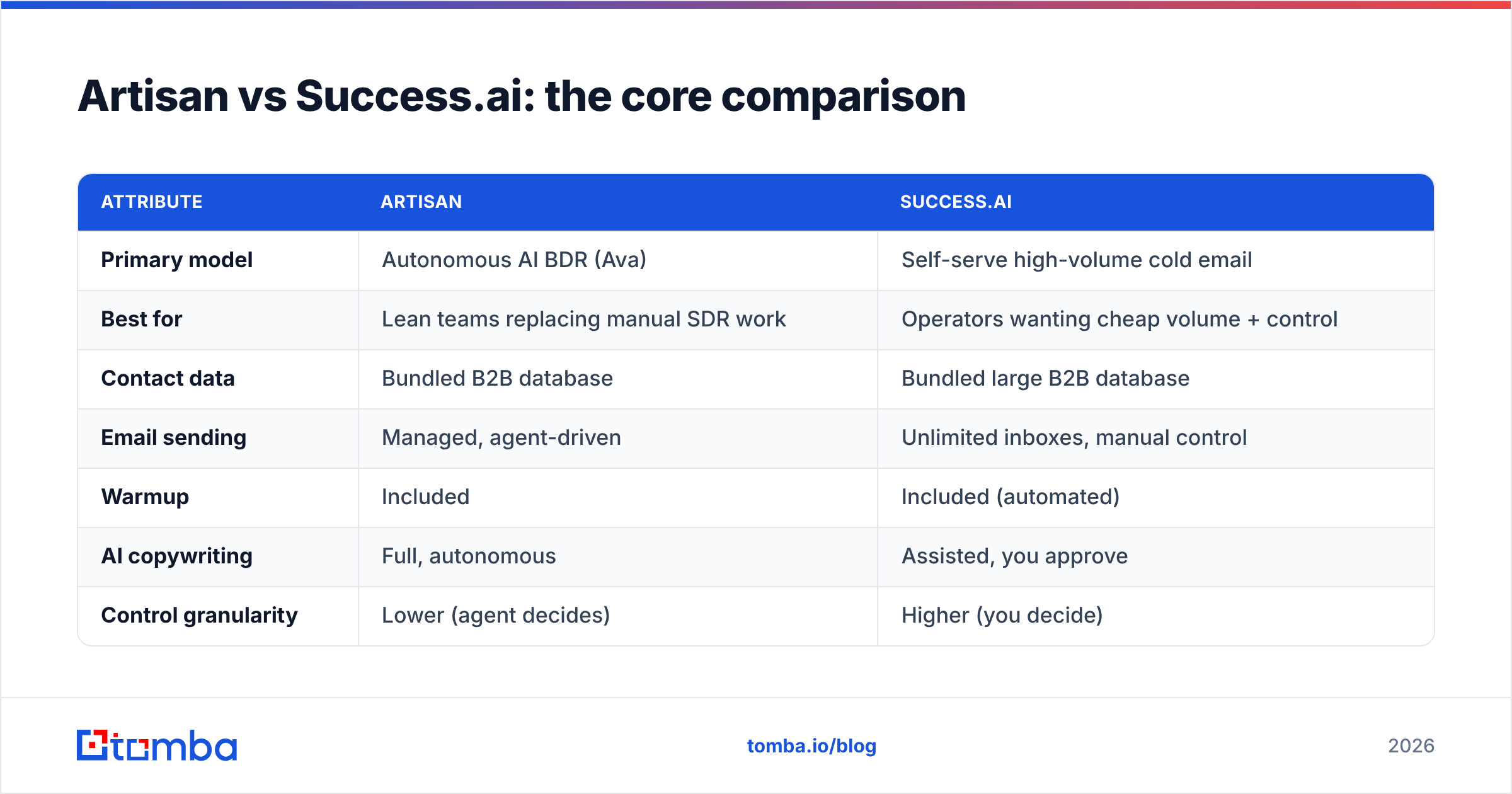
| Attribute | Artisan | Success.ai |
|---|---|---|
| Primary model | Autonomous AI BDR (Ava) | Self-serve high-volume cold email |
| Best for | Lean teams replacing manual SDR work | Operators wanting cheap volume + control |
| Contact data | Bundled B2B database | Bundled large B2B database |
| Email sending | Managed, agent-driven | Unlimited inboxes, manual control |
| Warmup | Included | Included (automated) |
| AI copywriting | Full, autonomous | Assisted, you approve |
| Control granularity | Lower (agent decides) | Higher (you decide) |
| Entry pricing | Higher (autonomy premium) | Low (volume-first) |
| Learning curve | Low to start, opaque to tune | Moderate, more knobs |
Two honest takeaways from this table. First, these tools aren't really competing for the same buyer — Artisan sells time saved, Success.ai sells volume per dollar. Second, the row that matters most isn't on most comparison pages: contact data quality, which neither vendor lets you fully audit before you buy.
Is Artisan better than Success.ai?#
Neither is "better" in the abstract — they optimize for opposite buyers.
Choose Artisan if you have more pipeline goals than headcount. A founder or a one-person sales team that needs prospecting to happen without hiring an SDR gets real leverage from an autonomous agent. You're paying for the work to disappear, not for a better dashboard.
Choose Success.ai if you already run outbound and want to scale send volume without scaling cost. Agencies, lead-gen shops, and operators comfortable managing domains and sequences get more raw output per dollar here.
The failure mode for each is predictable. Artisan disappoints teams that want to control every word and every targeting rule — the autonomy that's a feature for one buyer is a black box for another. Success.ai disappoints teams that mistake "unlimited inboxes" for "guaranteed inbox placement." Volume without email deliverability discipline just means more spam folders.
How accurate is the contact data in each tool?#
This is where most AI SDR comparisons go quiet, so let's be direct: bundled data is a convenience, not a guarantee.
Both Artisan and Success.ai include their own contact databases, and both market large record counts. But record count is a vanity metric. What matters for outbound is the percentage of those emails that are currently deliverable — and that number decays constantly as people change jobs. Industry studies routinely put B2B data decay at roughly 25–30% per year. A database that was 95% accurate at ingestion can be meaningfully stale within a quarter.
When you send to stale or guessed addresses, you don't just waste sends — you accumulate bounces, and bounce rate is one of the fastest ways to wreck a sending domain. An autonomous agent like Ava sending confidently to bad data is arguably more dangerous than a manual operator, because nobody's eyeballing the list first.
This is the practical argument for keeping a dedicated, verified data layer regardless of which platform you adopt. A focused tool like the Tomba Email Finder is built to find and confirm professional addresses, and pairing it with a real email verifier removes risky contacts before they ever enter a sequence. You can also enrich thin records with data enrichment so personalization has something to work with.

What about deliverability and warmup?#
Both platforms include automated warmup and both promote deliverability features. Treat those features as table stakes, not differentiators.
Deliverability is governed by fundamentals the tool can't fully own for you: clean lists, correct authentication (SPF, DKIM, DMARC), reasonable volume ramps, and genuine engagement. Success.ai's unlimited-inbox model makes it tempting to spin up dozens of sending accounts and blast — which is exactly the behavior mailbox providers penalize. Artisan's managed approach hides more of this from you, which is comfortable until something breaks and you have limited visibility into why.
A few non-negotiables that sit outside either platform:
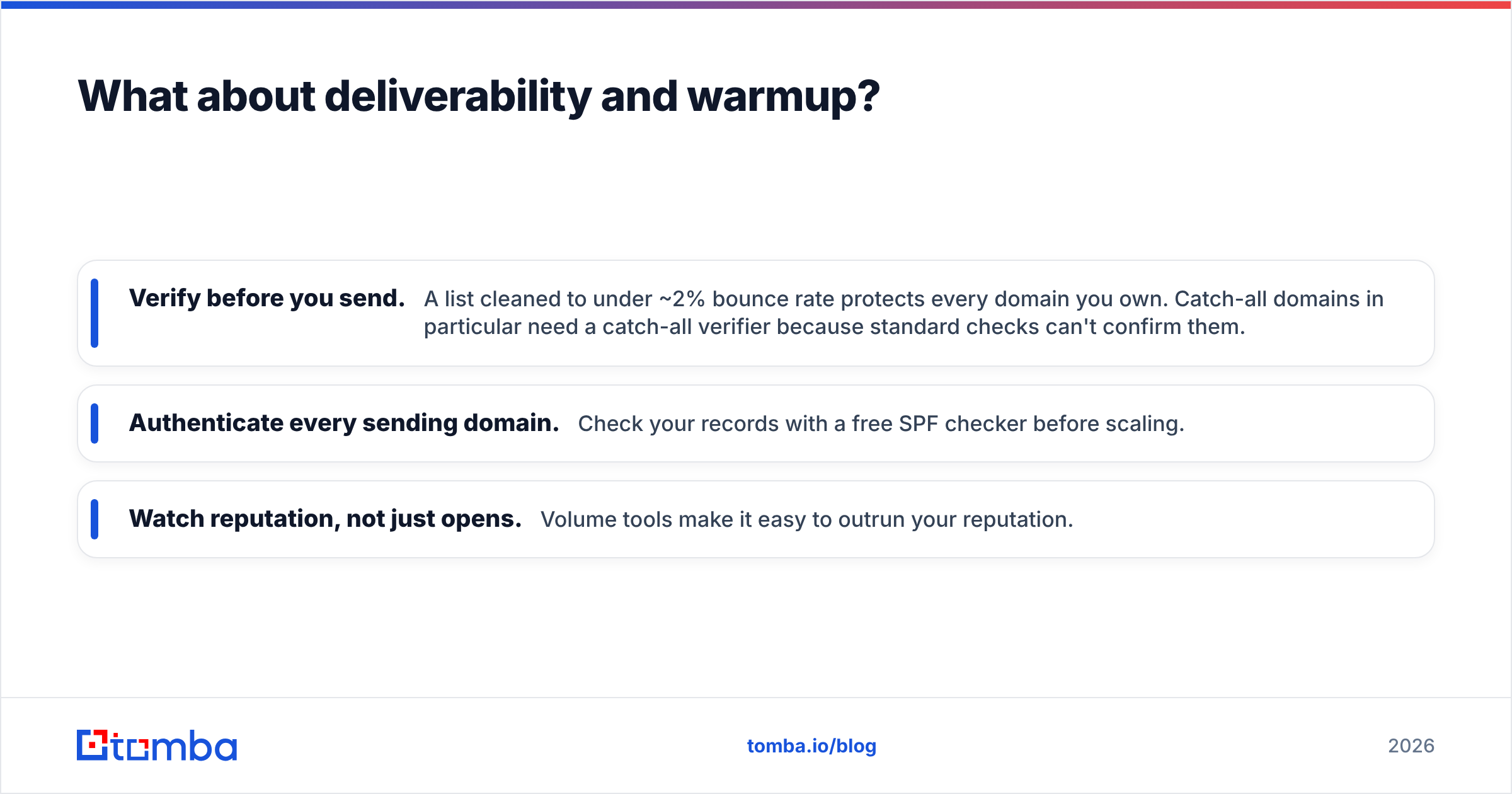
- Verify before you send. A list cleaned to under ~2% bounce rate protects every domain you own. Catch-all domains in particular need a catch-all verifier because standard checks can't confirm them.
- Authenticate every sending domain. Check your records with a free SPF checker before scaling.
- Watch reputation, not just opens. Volume tools make it easy to outrun your reputation.
If deliverability is your bottleneck, fixing data and authentication will move the needle more than switching between Artisan and Success.ai.
How does pricing compare?#
The pricing philosophies are as different as the products.
Success.ai leads with low entry pricing and an unlimited-inbox angle — it's engineered to look cheap on a per-send basis. Artisan prices for autonomy: you're buying an AI BDR's labor, so the entry point is higher and structured around managed workflows and seats. Both run custom enterprise tiers, and both adjust packaging frequently, so confirm current numbers on their own pages: artisan.co and success.ai. Cross-check independent reviews on G2 before committing — sales pages rarely surface churn-driving issues like data staleness or support latency.
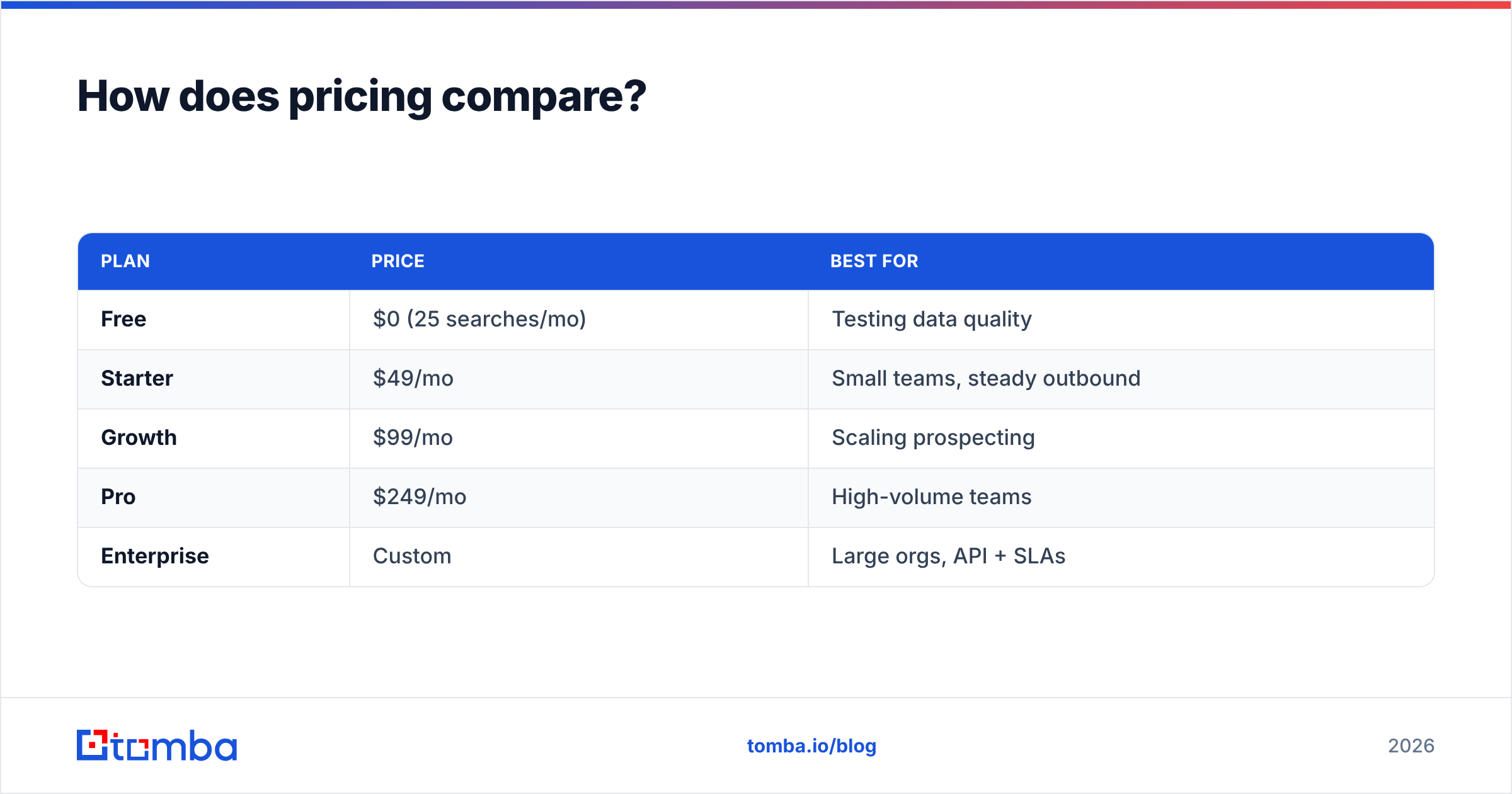
A budgeting reality check: the platform fee is rarely your true cost. If the bundled data is weak, you'll pay again for a verification or enrichment layer to keep deliverability intact. When you compare total cost of ownership, a transparent, pay-for-what-you-use tool can be cheaper than it looks — see Tomba pricing for a sense of how usage-based credits compare to all-in-one subscriptions:
| Plan | Price | Best for |
|---|---|---|
| Free | $0 (25 searches/mo) | Testing data quality |
| Starter | $49/mo | Small teams, steady outbound |
| Growth | $99/mo | Scaling prospecting |
| Pro | $249/mo | High-volume teams |
| Enterprise | Custom | Large orgs, API + SLAs |
The point isn't that one number beats another — it's that "all-in-one" pricing hides the data-quality line item, and that line item is where outbound campaigns quietly succeed or fail.
Which should you actually pick?#
Decide on three variables, in this order:
- Headcount vs. autonomy. No SDR and no time? Artisan's agent model earns its premium. Have operators who want control? Success.ai gives you more knobs for less money.
- Volume tolerance. Planning to run many domains at high volume? Success.ai's model fits — but only if you're disciplined about warmup and verification.
- Data accountability. If you can't audit the bundled data, plan to layer a dedicated finder, verifier, and enrichment source on top of whichever platform you choose. This is the step that protects everything downstream.
A pragmatic setup for most teams: use the platform for sending, sequencing, and AI assistance, and keep a separate, verifiable data layer feeding it clean contacts. That hybrid avoids the worst failure mode of both tools — confident sending into bad data.
The bottom line#
Artisan and Success.ai solve different problems. Artisan automates the who and how of prospecting through an autonomous AI BDR; Success.ai maximizes how much you can send for the lowest price. Match the tool to your constraint — labor or budget — and you'll be happy with either.
What you should not do is trust any all-in-one platform's bundled database to stay accurate on its own. Outbound lives or dies on whether the email actually lands, and that's a data problem before it's a tooling problem.
Start by fixing the data layer. Run your target accounts through the Tomba Email Finder to get verified, current professional emails, then feed only confirmed contacts into Artisan or Success.ai. Clean data in means fewer bounces, a protected domain, and AI personalization that has real signal to work with — no matter which platform you let do the sending.
// get started
Find, verify and enrich your first contacts today
Start on the free plan with 25 searches a month, then scale when your team is ready.
Free plan · No credit card required · GDPR & CCPA
// about the author