Aspr Pricing, Reviews, Pros and Cons (2026 Buyer Guide)
A neutral 2026 breakdown of Aspr pricing, real user reviews, and the honest pros and cons — plus where an AI SDR fits next to your data and email stack.
TL;DR
- Aspr is an AI SDR platform that automates prospect research, list building, and personalized outbound — it competes with the human-SDR-replacement category, not with single-purpose email tools.
- Pricing is quote-based and seat/usage-driven, not a public self-serve table. Expect to talk to sales, and expect annual commitments at the upper tiers. Always confirm current numbers before signing.
- Reviews praise the time savings on research and first-draft messaging; the most common complaints are price opacity, deliverability variance, and over-reliance on the tool's own data quality.
- An AI SDR is only as good as the contact data feeding it. Pairing Aspr-style automation with a dedicated finder and verifier fixes the weakest link.
- If your real bottleneck is finding and verifying accurate B2B emails — not orchestration — a focused tool like Tomba Email Finder is far cheaper and more transparent.
What is Aspr and who is it for?#
Aspr positions itself as an AI sales development rep (AI SDR) — software that does the grunt work a junior SDR would normally handle: building target lists, researching accounts, drafting personalized outreach, and sequencing follow-ups. Instead of paying $60K–$90K fully loaded for a human SDR, the pitch is that you rent an "always-on" agent for a fraction of that.
Think of it like cruise control for outbound. You still set the destination — your ICP, your offer, your guardrails — but the system handles the steady, repetitive steering of research and first-touch messaging. That analogy also explains the limits: cruise control is great on an open highway and dangerous in heavy traffic. AI SDRs shine on clean, well-defined segments and struggle when your data, targeting, or deliverability foundation is messy.
Aspr is aimed at:
- Seed-to-Series-B startups that can't yet justify a full SDR team.
- Lean RevOps teams wanting to scale top-of-funnel without headcount.
- Founders doing their own outbound who want leverage on research and writing.
It is not really built for teams that just need a better way to pull a verified email address. That distinction matters a lot once you look at the price.
How much does Aspr cost? (Aspr pricing breakdown)#
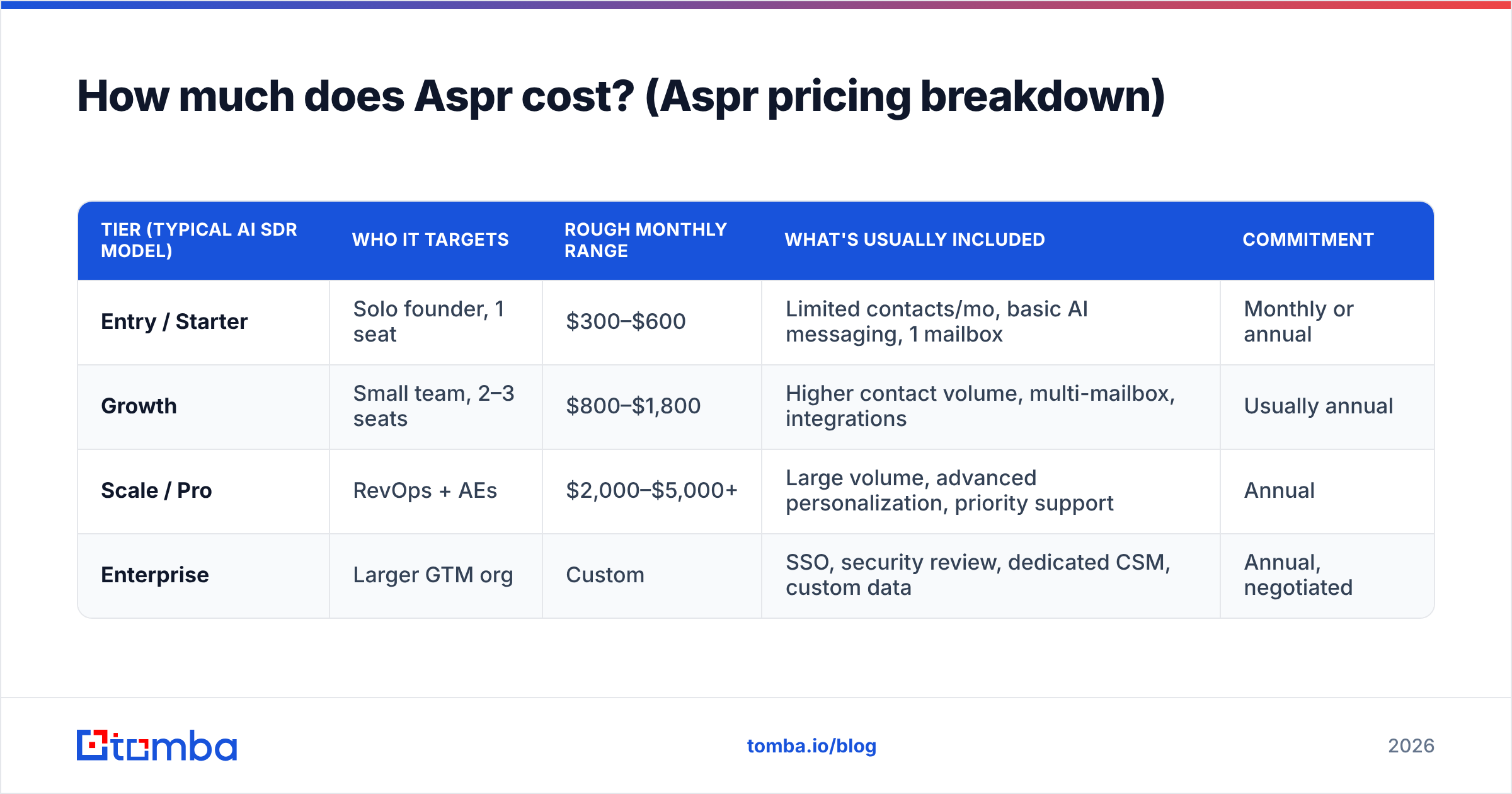
Here's the honest headline: Aspr does not publish a clean self-serve pricing page the way a tool like Tomba pricing does. Like most AI SDR vendors in 2026, it runs a demo-then-quote motion. Pricing scales with seats, the volume of contacts worked, sending volume, and whether data/enrichment is bundled.
Because numbers in this category change quarterly and are negotiated per deal, treat the table below as a directional model of how AI SDR pricing is typically structured, not as a guaranteed quote. Verify live figures with the vendor and on a review marketplace like G2 before you budget.
| Tier (typical AI SDR model) | Who it targets | Rough monthly range | What's usually included | Commitment |
|---|---|---|---|---|
| Entry / Starter | Solo founder, 1 seat | $300–$600 | Limited contacts/mo, basic AI messaging, 1 mailbox | Monthly or annual |
| Growth | Small team, 2–3 seats | $800–$1,800 | Higher contact volume, multi-mailbox, integrations | Usually annual |
| Scale / Pro | RevOps + AEs | $2,000–$5,000+ | Large volume, advanced personalization, priority support | Annual |
| Enterprise | Larger GTM org | Custom | SSO, security review, dedicated CSM, custom data | Annual, negotiated |
A few things to watch in any AI SDR quote, Aspr included:
- Data is often a separate line item. "Unlimited automation" means little if you pay extra per enriched or verified contact.
- Annual lock-in is common at Growth and above. Month-to-month is sometimes available only at the entry tier.
- Sending infrastructure (mailboxes, warmup) may be your responsibility, which adds cost and risk.
Compare that to a transparent, usage-based finder: Tomba's Free tier gives you 25 searches a month, Starter is $49/mo, Growth is $99/mo, and Pro is $249/mo — public, self-serve, no demo gate. Different job, very different price ceiling.
What do Aspr reviews actually say?#
Aggregating themes from public review sites like Capterra and G2, plus founder commentary, the sentiment splits cleanly into wins and gripes. (Always read recent reviews yourself — AI SDR products iterate fast, and a complaint from a year ago may already be fixed.)
What reviewers like:
- Real time savings on research. Users consistently say account research and "first draft" messaging that took hours now takes minutes.
- Decent personalization at volume. The AI pulls signals (role, company news, tech stack) into openers that beat generic mail-merge.
- Lower barrier than hiring. For pre-revenue and early teams, "an SDR you can switch off" is appealing.
What reviewers criticize:
- Price opacity and sticker shock. The demo-to-quote flow frustrates buyers who want to compare quickly.
- Deliverability variance. AI can write 500 emails; it can't fix a cold domain or a missing SPF record. Several reviewers report inboxing issues that trace back to setup, not copy.
- Data quality ceilings. When the underlying contact data is stale, the AI confidently emails the wrong person — a failure mode worse than sending nothing.
- "Looks personalized, reads robotic." At scale, recipients start recognizing the pattern.
The recurring lesson across reviews: the AI layer is rarely the problem — the data and deliverability layers underneath it are. That's a theme worth holding onto when you evaluate any tool in this space.
What are the pros and cons of Aspr?#
Here's the balanced view, stated plainly.
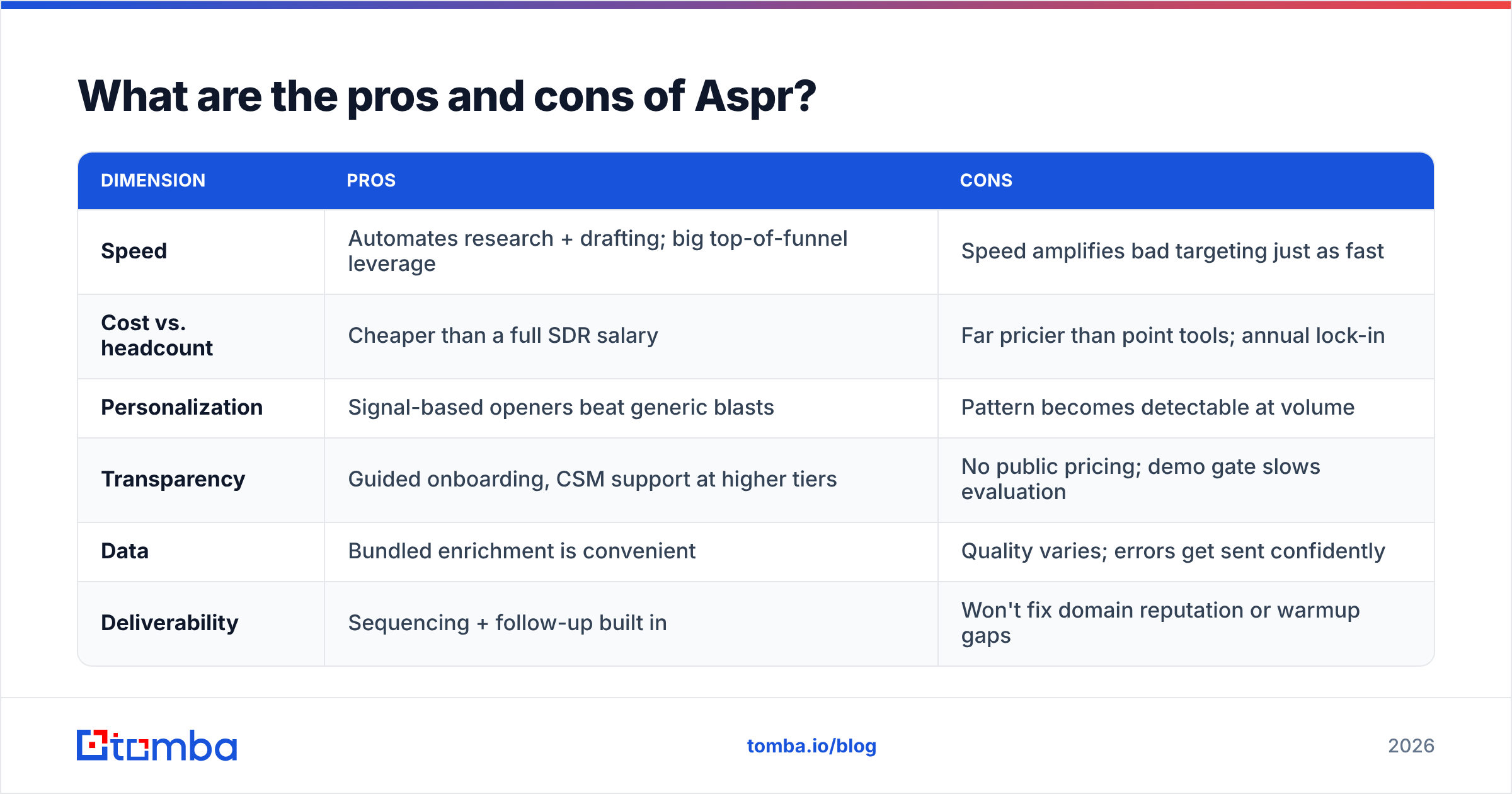
| Dimension | Pros | Cons |
|---|---|---|
| Speed | Automates research + drafting; big top-of-funnel leverage | Speed amplifies bad targeting just as fast |
| Cost vs. headcount | Cheaper than a full SDR salary | Far pricier than point tools; annual lock-in |
| Personalization | Signal-based openers beat generic blasts | Pattern becomes detectable at volume |
| Transparency | Guided onboarding, CSM support at higher tiers | No public pricing; demo gate slows evaluation |
| Data | Bundled enrichment is convenient | Quality varies; errors get sent confidently |
| Deliverability | Sequencing + follow-up built in | Won't fix domain reputation or warmup gaps |
Pros, summarized: if you have a clean ICP, a warmed-up sending setup, and reliable data, Aspr-style automation genuinely compresses the research-to-first-touch cycle and frees humans for live conversations.
Cons, summarized: it's an expensive, somewhat opaque layer that assumes the hard foundations — accurate contacts and healthy deliverability — are already solved. If they aren't, you're paying premium prices to scale a leaky funnel.
Is Aspr better than building your own outbound stack?#
It depends entirely on where your bottleneck actually is. Most teams misdiagnose this. Run the quick framework below before you buy.
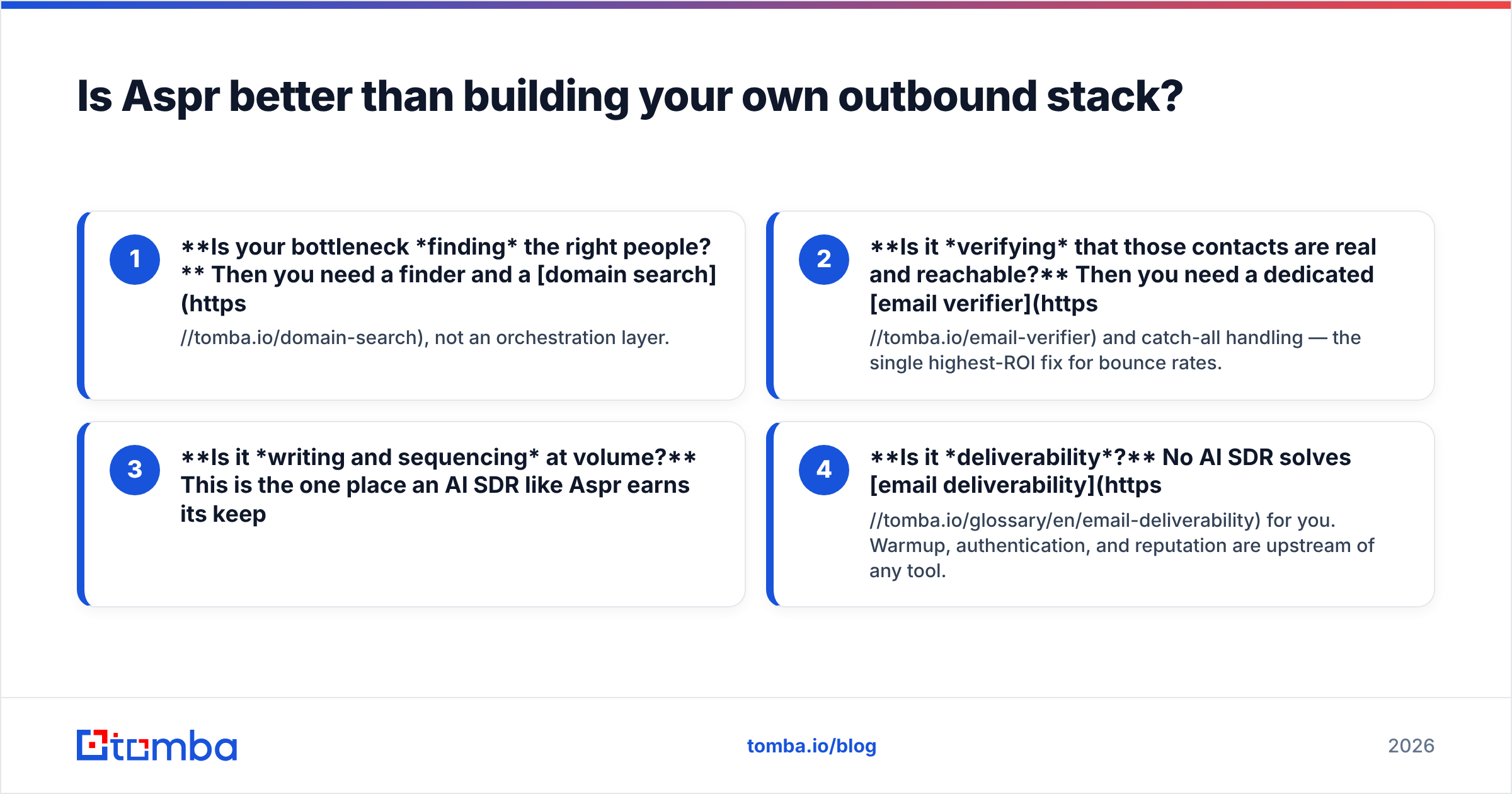
- Is your bottleneck finding the right people? Then you need a finder and a domain search, not an orchestration layer.
- Is it verifying that those contacts are real and reachable? Then you need a dedicated email verifier and catch-all handling — the single highest-ROI fix for bounce rates.
- Is it writing and sequencing at volume? This is the one place an AI SDR like Aspr earns its keep.
- Is it deliverability? No AI SDR solves email deliverability for you. Warmup, authentication, and reputation are upstream of any tool.
If only step 3 is your real problem, Aspr (or a competitor) can be worth it. If steps 1, 2, or 4 are the actual constraint — and for most teams they are — you'll get more results, faster and cheaper, by fixing the foundation first.
This is also why the "AI SDR vs. point tools" debate is a false binary. The smartest 2026 stacks augment: a transparent data and verification layer feeds a thin automation layer. You keep control of cost and quality where it matters most.
How does Aspr compare to alternatives and point tools?#
Aspr sits in a crowded field. Broadly, the market splits into three buckets, and many buyers comparing Aspr are really deciding which layer to invest in.
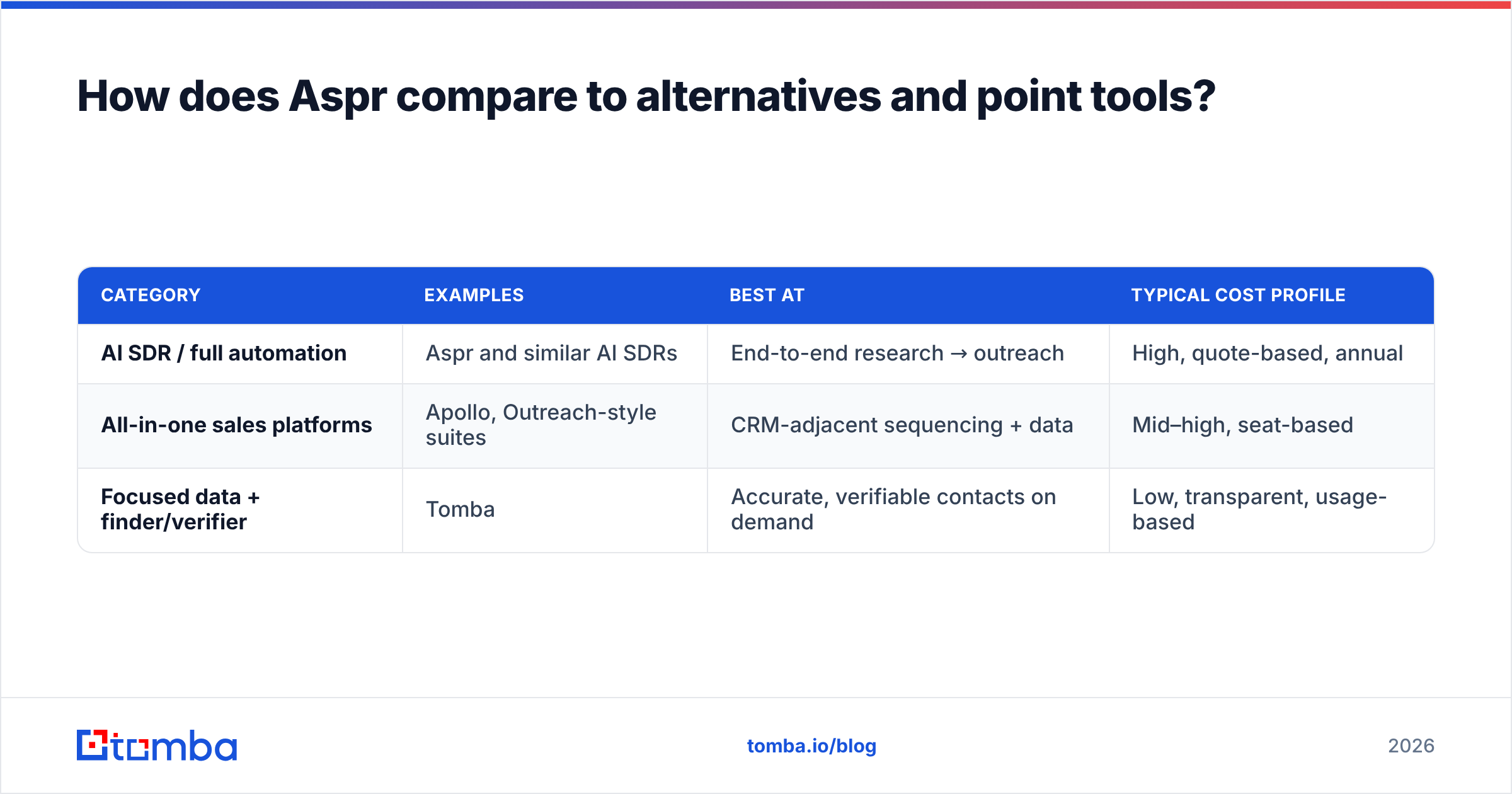
| Category | Examples | Best at | Typical cost profile |
|---|---|---|---|
| AI SDR / full automation | Aspr and similar AI SDRs | End-to-end research → outreach | High, quote-based, annual |
| All-in-one sales platforms | Apollo, Outreach-style suites | CRM-adjacent sequencing + data | Mid–high, seat-based |
| Focused data + finder/verifier | Tomba | Accurate, verifiable contacts on demand | Low, transparent, usage-based |
If you're cross-shopping the all-in-one suites, it's worth reading an honest Apollo alternative breakdown — the data-coverage and pricing trade-offs there mirror the questions you should ask Aspr.
And if your conclusion is "I mostly need reliable contacts and enrichment, not a robot SDR," then a focused stack of a finder, a verifier, and data enrichment will cost a fraction of an AI SDR contract while giving you full control over targeting and deliverability. You can also pull contacts at scale with a bulk email finder and push them straight into your sequencer.
For independent, third-party perspective on any of these vendors, cross-reference analyst coverage on Gartner and recent user reviews on G2 and Capterra rather than trusting any single vendor's marketing — including this article.
How should you decide if Aspr is worth it?#
Conclusion first: buy Aspr only if drafting and sequencing personalized outbound at volume is your proven bottleneck, your sending infrastructure is healthy, and your contact data is already accurate. Otherwise, fix the foundation before you rent the robot.
A practical evaluation checklist:
- Demand a real quote in writing, including data/enrichment line items and contract length. Don't accept "it depends."
- Run a paid pilot on one tight segment, not your whole TAM. Measure reply rate and positive reply rate, not just sends.
- Audit deliverability first. Check authentication and reputation before you scale volume. A great message to a spam folder is worth zero.
- Verify the data independently. Sample 100 Aspr-sourced contacts and run them through an external verifier. If bounce risk is high, the automation can't save you.
- Model the all-in cost against the alternative of a point-tool stack plus a part-time human for the live-conversation work AI still can't do.
The teams that get burned are the ones who buy an AI SDR hoping it will paper over weak data and a cold domain. The teams that win treat it as a force multiplier on a foundation that already works.
Where Tomba fits#
If this analysis surfaced that your real gap is accurate, verifiable contact data — not orchestration — start there, because it's the cheapest and highest-leverage fix. Tomba Email Finder lets you find professional email addresses by name, company, or domain, verify them before you send, and enrich records on demand — with public, usage-based Tomba pricing that starts free (25 searches/mo) and scales to $49/mo. Feed clean, verified contacts into whatever sequencer or AI SDR you choose, and you'll get more from every dollar you spend on automation. Build the foundation first; automate second.
Ready to find emails that actually work?
Join 150,000+ professionals who stopped guessing and started sending. Free credits on signup — no credit card required.
Get the Tomba newsletter
Practical outbound tactics and product updates — once every two weeks.
About the author