The Assumptive Close: Scripts, Examples & Tips for 2026
The assumptive close assumes the deal is done and moves straight to logistics. Here are the scripts, psychology, and guardrails that make it work in 2026.
The assumptive close is one of the oldest moves in sales, and it still closes deals in 2026 because it removes friction at the exact moment buyers want it gone. Instead of asking "Do you want to buy?", you act as if the decision is already made and move to logistics. Done well, it feels like service. Done badly, it feels like a used-car lot. This guide shows you the difference.
TL;DR#
- The assumptive close is a technique where you treat the sale as already agreed and shift the conversation to next steps (start date, seat count, payment), not whether to buy.
- It works because of commitment-and-consistency psychology and decision fatigue — buyers who have shown buying signals find it easier to confirm than to reverse course.
- Use it only after you've earned it with genuine buying signals; deploy it cold and you damage trust and your win rate.
- It pairs naturally with calendar invites, order forms, and CRM pipeline stages — the "yes" is implied by the next action you take.
- The biggest risk is using assumptive language on an unqualified or skeptical prospect; always have a soft fallback ready.
What is the assumptive close?#
The assumptive close is a closing technique where the salesperson proceeds as though the prospect has already decided to buy, then guides them toward logistical decisions rather than the purchase decision itself.
Think of it like a waiter who, instead of asking "Would you like dessert?", asks "Will you have the cheesecake or the crème brûlée?" The question quietly skips past whether you want dessert and lands you on which one. You feel like you're in control of the choice, but the frame has already moved past the bigger decision.
In B2B sales, the same logic sounds like:
- "I'll send the onboarding invite for Tuesday — does morning or afternoon work better for your team?"
- "We'll start you on the Growth plan since you mentioned five reps. I'll get the order form over now."
- "Let's get your data team looped in for kickoff. Who should I add to the invite?"
None of those sentences ask for permission to sell. They assume the sale and ask about implementation. That subtle reframe is the entire technique.
Why does the assumptive close work?#
The assumptive close works because of three well-documented behavioral patterns, not because of pressure.
Commitment and consistency. Once a prospect has nodded along to the value, agreed their problem is real, and confirmed budget, they have an internal drive to stay consistent with those statements. Robert Cialdini's research on influence shows people work hard to keep their actions aligned with prior commitments. Acting as if the deal is done lets them stay consistent instead of contradicting themselves.
Decision fatigue. By the end of a sales cycle, buyers are tired of evaluating. An assumptive close reduces the open loop from "Should I buy, and from whom, and when, and on what terms?" down to one small confirmation. Fewer open decisions means a faster yes.
Default bias. People tend to accept the default option presented to them. When you frame the start date, the plan, and the seat count as the default path, reversing it now requires effort. Most qualified buyers won't bother reversing something they already wanted.
This is also why the assumptive close cannot manufacture demand. It only converts existing intent into a signed deal. If the intent isn't there, no clever phrasing will create it — you'll just sound pushy.
When should you use the assumptive close?#
Use the assumptive close only after the prospect has shown real buying signals. The technique amplifies existing momentum; it cannot create it.
Green lights that earn the close:
- The prospect asks implementation questions ("How long does onboarding take?", "Can we import our existing list?").
- They use possessive or future language ("When we roll this out…", "our team would use it for…").
- They've confirmed budget authority and timeline.
- They've stopped raising new objections and are repeating the same one or two minor concerns.
Red lights where it backfires:
- The prospect is still comparing you against two other vendors and hasn't tipped your way.
- You haven't confirmed they can actually authorize spend.
- They've gone quiet or given short, guarded answers.
- It's an early discovery call, not a closing conversation.
A practical rule: if you'd be genuinely surprised to hear "no," the assumptive close is appropriate. If "no" wouldn't surprise you, you haven't earned it yet — keep qualifying. Strong qualification upstream is what protects your win rate downstream.
What are the best assumptive close examples and scripts?#
The strongest assumptive closes sound like coordination, not coercion. Here are field-tested scripts by scenario.
The logistics assumptive close
"Great — I'll get the contract over this afternoon. Should I address it to you, or does it need to route through procurement first?"
The calendar assumptive close
"Let's get kickoff on the books so your team isn't waiting. I have Thursday at 10 or Friday at 2 — which is cleaner for you?"
The configuration assumptive close
"Based on the five seats you mentioned, the Growth plan is the right fit. I'll set that up — want me to enable the API access now or after onboarding?"
The soft assumptive close (lower risk)
"It sounds like this solves the deliverability problem you described. Assuming that's right, the next step is a quick order form — should I send it over?"
Notice the last script includes an escape hatch ("Assuming that's right"). That phrase invites correction, which makes the close feel collaborative and gives a hesitant buyer a graceful way to surface a hidden objection instead of stonewalling.
A good closing motion also depends on reaching the right person in the first place. If you're closing with someone who can't sign, the cleanest script in the world won't help — which is why accurate contact data and a clean CRM record matter as much as the words you use.
How does the assumptive close compare to other closing techniques?#
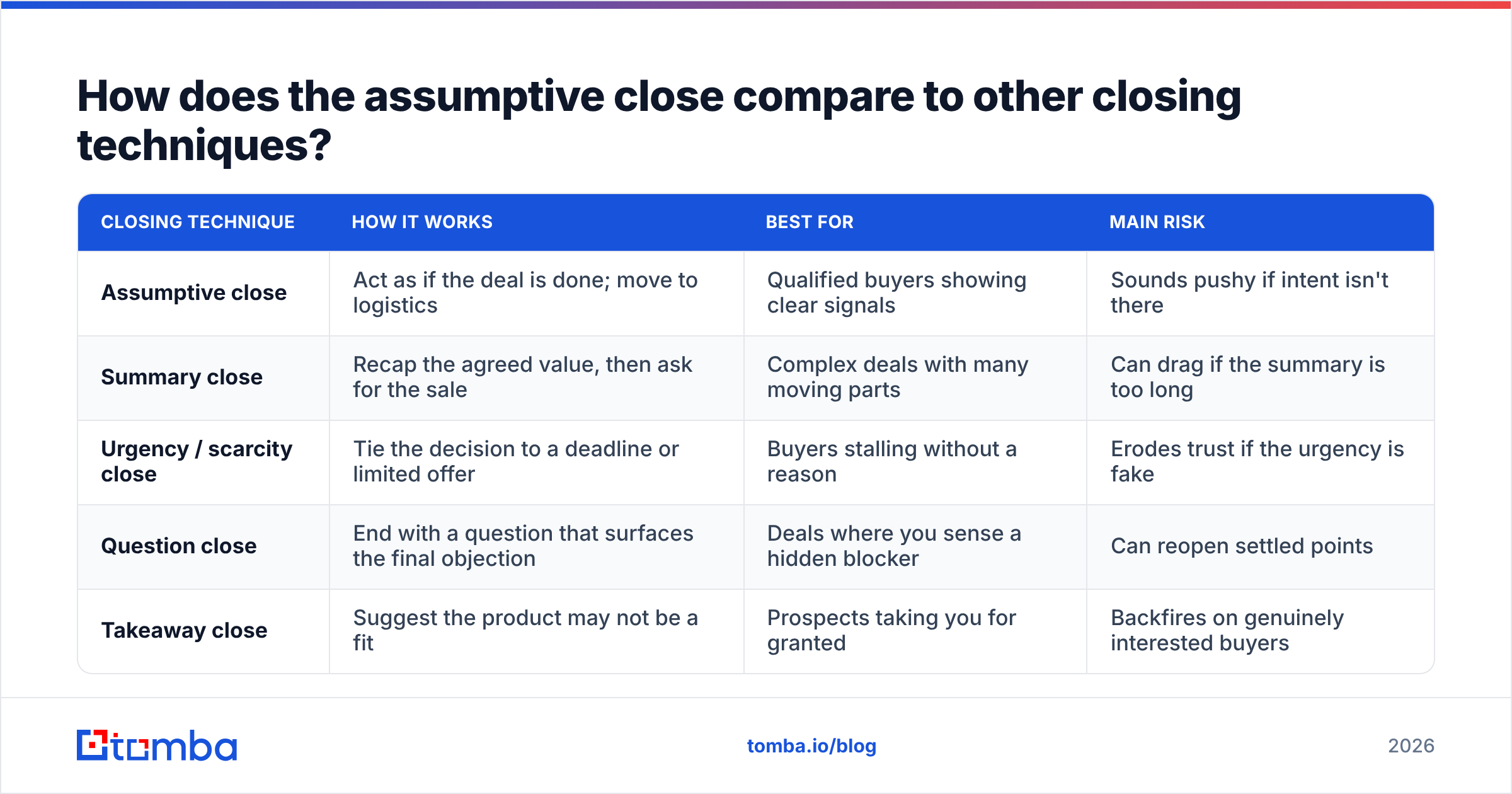
The assumptive close is one tool among several. Here's how it stacks up against the closes reps reach for most, so you can match the technique to the moment.
| Closing technique | How it works | Best for | Main risk |
|---|---|---|---|
| Assumptive close | Act as if the deal is done; move to logistics | Qualified buyers showing clear signals | Sounds pushy if intent isn't there |
| Summary close | Recap the agreed value, then ask for the sale | Complex deals with many moving parts | Can drag if the summary is too long |
| Urgency / scarcity close | Tie the decision to a deadline or limited offer | Buyers stalling without a reason | Erodes trust if the urgency is fake |
| Question close | End with a question that surfaces the final objection | Deals where you sense a hidden blocker | Can reopen settled points |
| Takeaway close | Suggest the product may not be a fit | Prospects taking you for granted | Backfires on genuinely interested buyers |
The assumptive close has the lowest friction of the group when conditions are right, and the highest backfire cost when they're wrong. That asymmetry is why timing matters more here than with almost any other technique.
According to closing-skills research summarized by HubSpot and Salesforce, reps who tailor the close to observed buying signals consistently outperform reps who default to a single technique. The assumptive close shouldn't be your only move — it should be the one you reach for when momentum is on your side.
How do you set up an assumptive close before the conversation?#
You earn the right to close assumptively long before the closing call, during prospecting and qualification. Three things have to be true.
1. You're talking to a decision-maker. Assumptive language ("I'll send the contract") only works if the person can actually act on it. Verify the title, the authority, and the buying role before you invest in the cycle. Reaching the right contact starts with a reliable email finder and accurate direct-dial data from a phone finder so your outreach lands with the person who signs.
2. The pipeline stage matches the language. Your CRM stage should reflect reality. If a deal is in "Discovery," assumptive closing is premature. Map your assumptive scripts to "Proposal" or "Negotiation" stages so the words match the buyer's actual readiness.
3. You've documented the buying signals. Before the call, review your notes: budget confirmed, timeline stated, implementation questions asked. If those boxes aren't checked, you're not ready to assume anything.
This pre-work is invisible to the buyer but decisive for you. A rep who closes assumptively on a fully qualified, correctly-contacted decision-maker looks confident. A rep who does it on a half-qualified lead looks desperate. The data and prep are what separate the two.
What are the risks of the assumptive close, and how do you avoid them?#
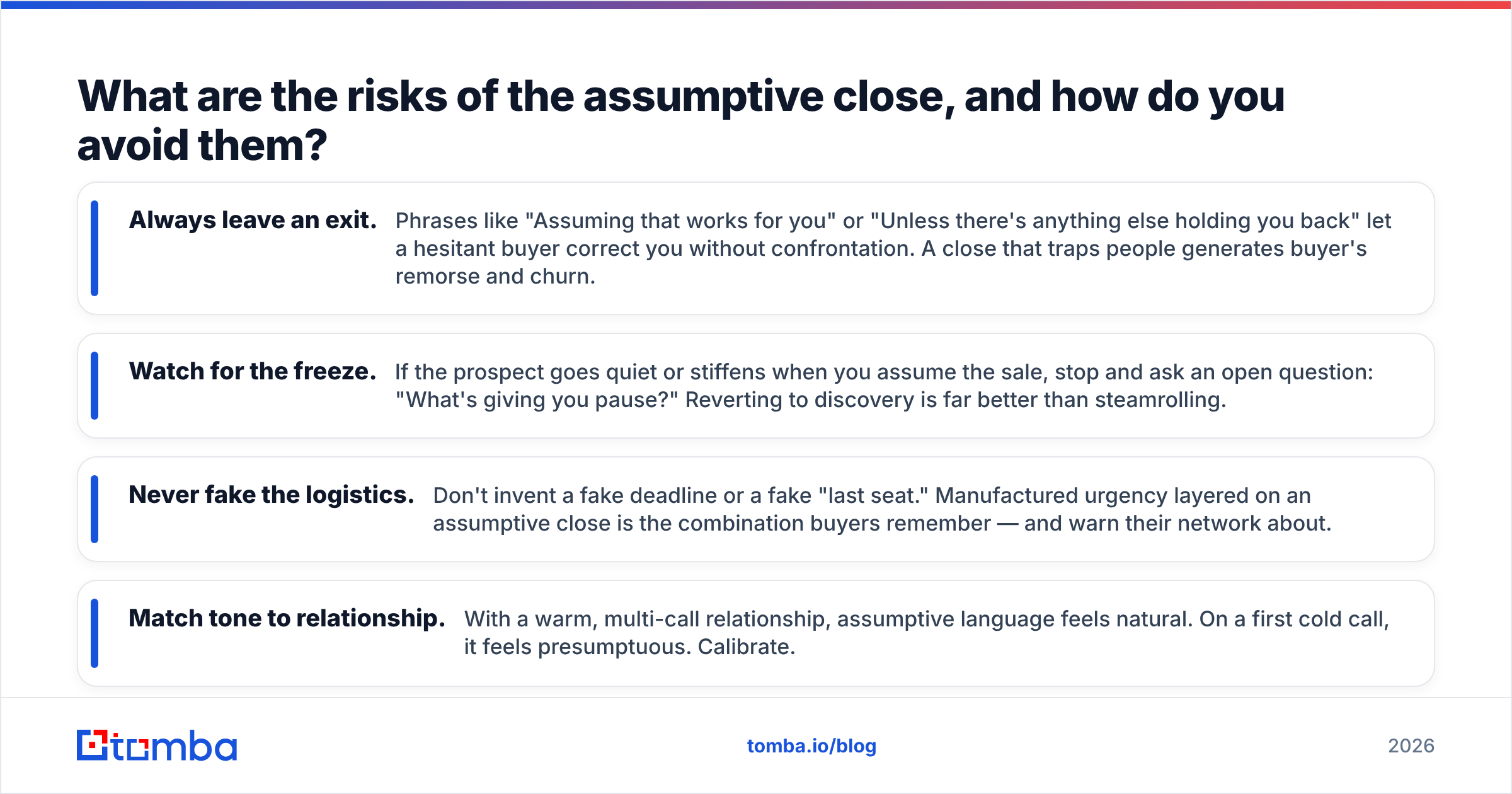
The assumptive close carries one major risk: applying it to a prospect who isn't ready, which reads as manipulation and can kill the deal and your reputation in one move.
Avoid the failure modes with these guardrails:
- Always leave an exit. Phrases like "Assuming that works for you" or "Unless there's anything else holding you back" let a hesitant buyer correct you without confrontation. A close that traps people generates buyer's remorse and churn.
- Watch for the freeze. If the prospect goes quiet or stiffens when you assume the sale, stop and ask an open question: "What's giving you pause?" Reverting to discovery is far better than steamrolling.
- Never fake the logistics. Don't invent a fake deadline or a fake "last seat." Manufactured urgency layered on an assumptive close is the combination buyers remember — and warn their network about.
- Match tone to relationship. With a warm, multi-call relationship, assumptive language feels natural. On a first cold call, it feels presumptuous. Calibrate.
The honest version of this technique is simply confident service: you believe the fit is right, the buyer has signaled the same, and you're saving everyone time by moving to next steps. Keep it on that side of the line and it strengthens trust instead of spending it.
How do you measure whether the assumptive close is working?#
Track close rate by technique and by pipeline stage, not just overall. If your assumptive closes convert well in late stages but tank in early ones, that's your signal to tighten qualification before you assume.
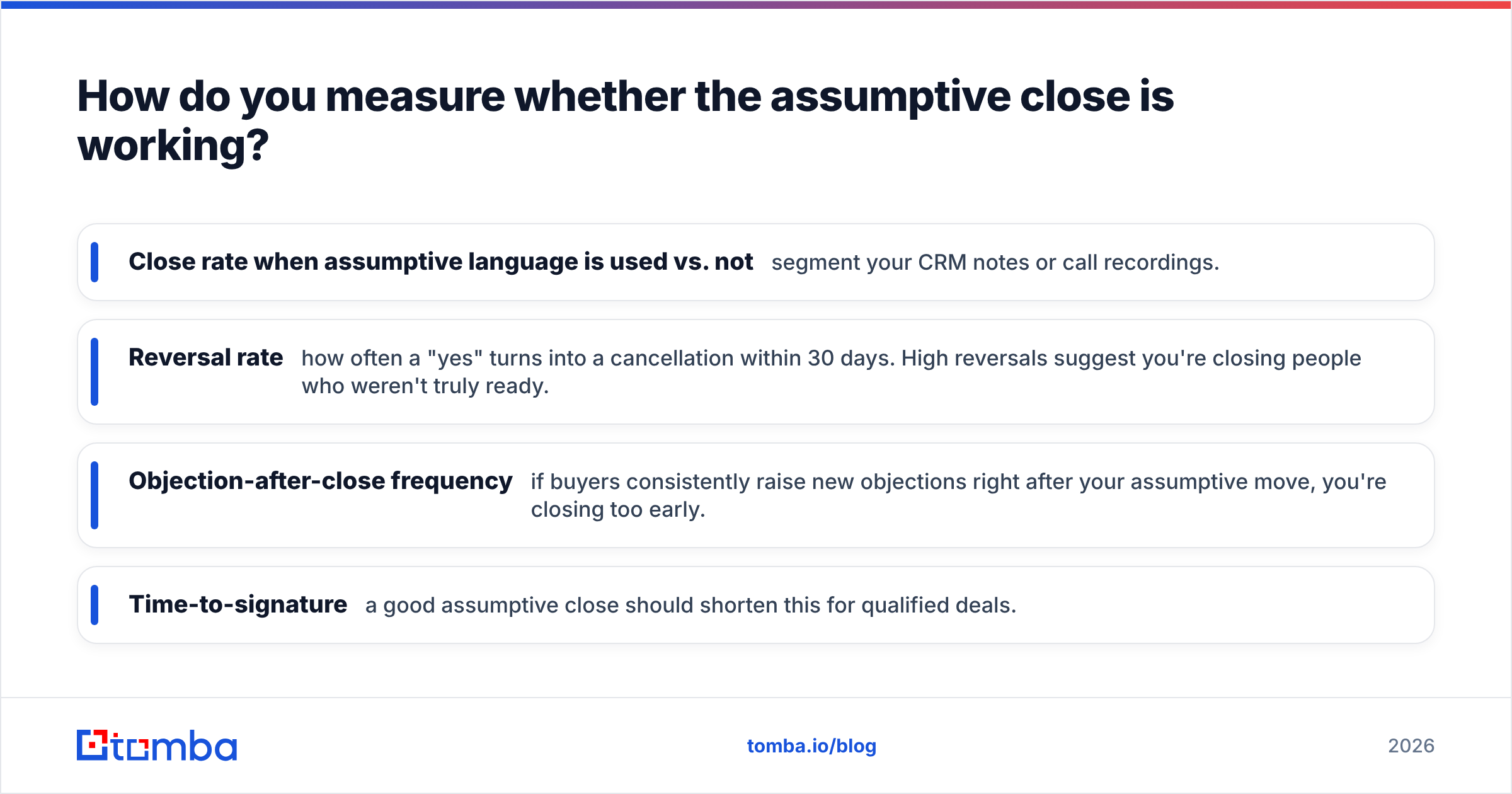
Useful metrics to watch:
- Close rate when assumptive language is used vs. not — segment your CRM notes or call recordings.
- Reversal rate — how often a "yes" turns into a cancellation within 30 days. High reversals suggest you're closing people who weren't truly ready.
- Objection-after-close frequency — if buyers consistently raise new objections right after your assumptive move, you're closing too early.
- Time-to-signature — a good assumptive close should shorten this for qualified deals.
Review a sample of recordings monthly. The reps who win with this technique aren't more aggressive — they're better at reading the moment the buyer is ready, then getting out of the way.
Final thoughts and your next step#
The assumptive close rewards preparation, not bravado. It converts demand you've already created into a signed deal by removing the last bit of friction — but only when you've genuinely earned the right to assume. Qualify hard, watch for real signals, keep a graceful exit ready, and the technique will lift your close rate without costing you trust.
All of that depends on one thing you control before any close: talking to the right person. If your pipeline is full of unverified contacts and gatekeepers, even a perfect assumptive close lands on the wrong desk. Start every deal on solid ground with the Tomba Email Finder — find verified, decision-maker email addresses by name, company, or domain so your closing energy goes where it counts. Check the Tomba pricing plans, including a free tier with 25 searches a month, and build a prospect list worth closing assumptively.
// get started
Find, verify and enrich your first contacts today
Start on the free plan with 25 searches a month, then scale when your team is ready.
Free plan · No credit card required · GDPR & CCPA
// about the author