AtData Pricing, Reviews, Pros and Cons (2026 Guide)
A neutral 2026 breakdown of AtData's pricing model, real user reviews, and the honest pros and cons before you commit to an email-intelligence contract.
AtData (formerly TowerData and Rapleaf) is one of the older names in email-based identity and verification. If you are weighing it for 2026, the hard part is that pricing is not on the website and reviews are thin. This guide fixes that with a concrete look at how AtData is priced, what real users praise and complain about, and where it fits versus lighter, transparent tools.
TL;DR#
- AtData is quote-only. There is no public price list and no self-serve free tier — expect a sales call, a custom contract, and usage- or volume-based pricing.
- Best fit: mid-market and enterprise marketing teams that need email validation plus identity/demographic enrichment at scale, not solo prospectors.
- Strengths: deep email hygiene, fraud signals, and append data built on 15+ years of email intelligence.
- Weaknesses: opaque pricing, slow procurement, and overkill for teams that only need to find and verify B2B emails.
- Cheaper, transparent option: for straightforward email finding and verification, a published-price tool like Tomba starts at $49/mo with a free tier.
What is AtData?#
AtData is an email intelligence platform. Think of it as a credit bureau for email addresses: you hand it an email, and it tells you whether the address is real, risky, or fraudulent, and what kind of person sits behind it.
The company sells three broad capabilities:
- Email validation and hygiene — catching invalid, mistyped, abandoned, and high-risk addresses before you send.
- Fraud prevention — scoring email addresses for signals tied to fake accounts and chargebacks.
- Email-based enrichment (append) — attaching demographic, interest, and contact data to an email you already hold.
That positioning matters for this review. AtData is not primarily a prospecting tool that finds new emails by name or domain. It is built to clean, score, and enrich emails you already have. If your goal is to discover decision-maker emails from a company website, that is a different job handled by an email finder.
You can confirm the current product scope on the official AtData site, since the lineup has shifted across its TowerData and Rapleaf rebrands.
How much does AtData cost?#
The honest answer: AtData does not publish pricing. Every plan is quote-based, negotiated through a sales rep, and shaped by your volume, the data products you license, and contract length. There is no public free trial or self-serve checkout.
Based on vendor patterns in the email-intelligence category and buyer reports, here is a realistic model of how the cost is structured. Treat the dollar figures as directional, not official.
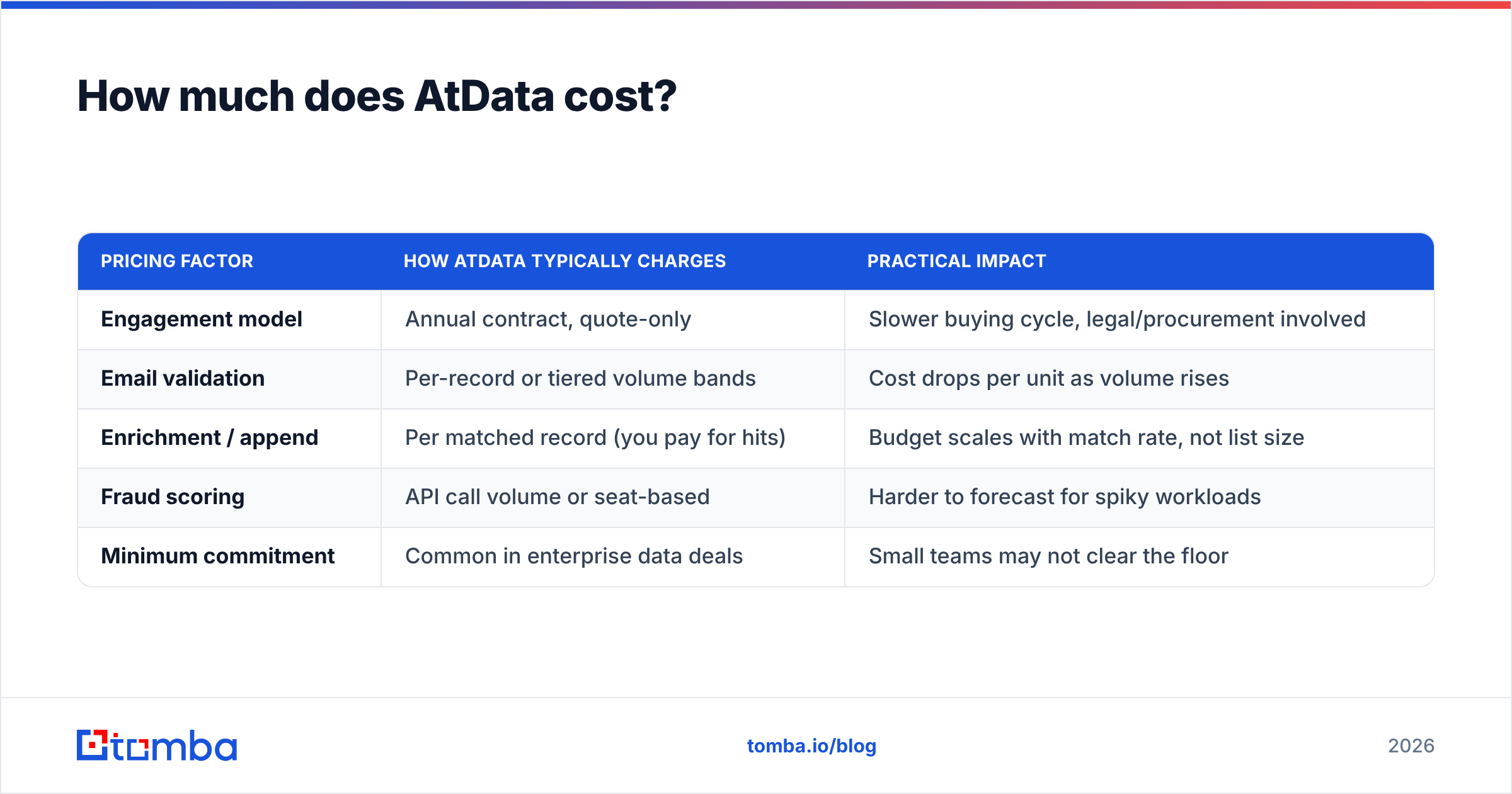
| Pricing factor | How AtData typically charges | Practical impact |
|---|---|---|
| Engagement model | Annual contract, quote-only | Slower buying cycle, legal/procurement involved |
| Email validation | Per-record or tiered volume bands | Cost drops per unit as volume rises |
| Enrichment / append | Per matched record (you pay for hits) | Budget scales with match rate, not list size |
| Fraud scoring | API call volume or seat-based | Harder to forecast for spiky workloads |
| Minimum commitment | Common in enterprise data deals | Small teams may not clear the floor |
The takeaway is not "AtData is expensive" — for a large sender cleaning millions of records, the per-unit economics can be reasonable. The takeaway is that you cannot self-serve or quickly estimate cost, which rules it out for many small teams that need a number today.
If transparent, published pricing is a hard requirement, compare AtData against tools that list tiers openly. You can see one example on the Tomba pricing page, where the Free, Starter ($49/mo), Growth ($99/mo), and Pro ($249/mo) tiers are visible before you ever talk to sales.
What do AtData reviews say?#
AtData has a smaller review footprint than mass-market sales tools, partly because its buyers are enterprise data teams who rarely leave public reviews. The signal that does exist clusters around a few themes. You can read current user feedback on G2 and Capterra to sanity-check the points below.
What reviewers like:
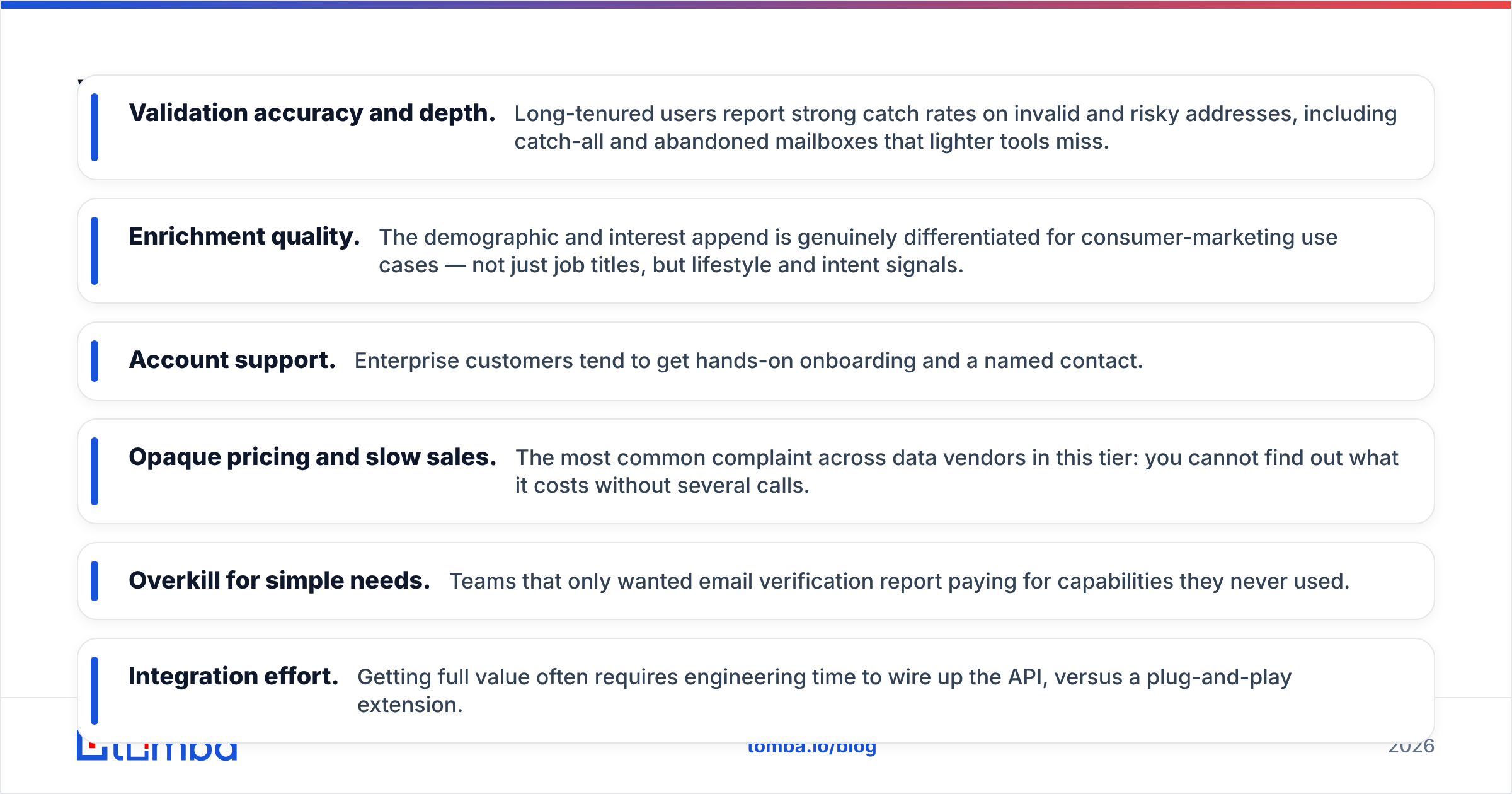
- Validation accuracy and depth. Long-tenured users report strong catch rates on invalid and risky addresses, including catch-all and abandoned mailboxes that lighter tools miss.
- Enrichment quality. The demographic and interest append is genuinely differentiated for consumer-marketing use cases — not just job titles, but lifestyle and intent signals.
- Account support. Enterprise customers tend to get hands-on onboarding and a named contact.
What reviewers criticize:
- Opaque pricing and slow sales. The most common complaint across data vendors in this tier: you cannot find out what it costs without several calls.
- Overkill for simple needs. Teams that only wanted email verification report paying for capabilities they never used.
- Integration effort. Getting full value often requires engineering time to wire up the API, versus a plug-and-play extension.
- Consumer-data tilt. The enrichment strength leans B2C; B2B prospecting teams sometimes find the contact discovery weaker than dedicated B2B tools.
A fair summary: AtData earns its reputation on data quality, and loses points on accessibility and fit for smaller or B2B-focused teams.
What are the pros and cons of AtData?#
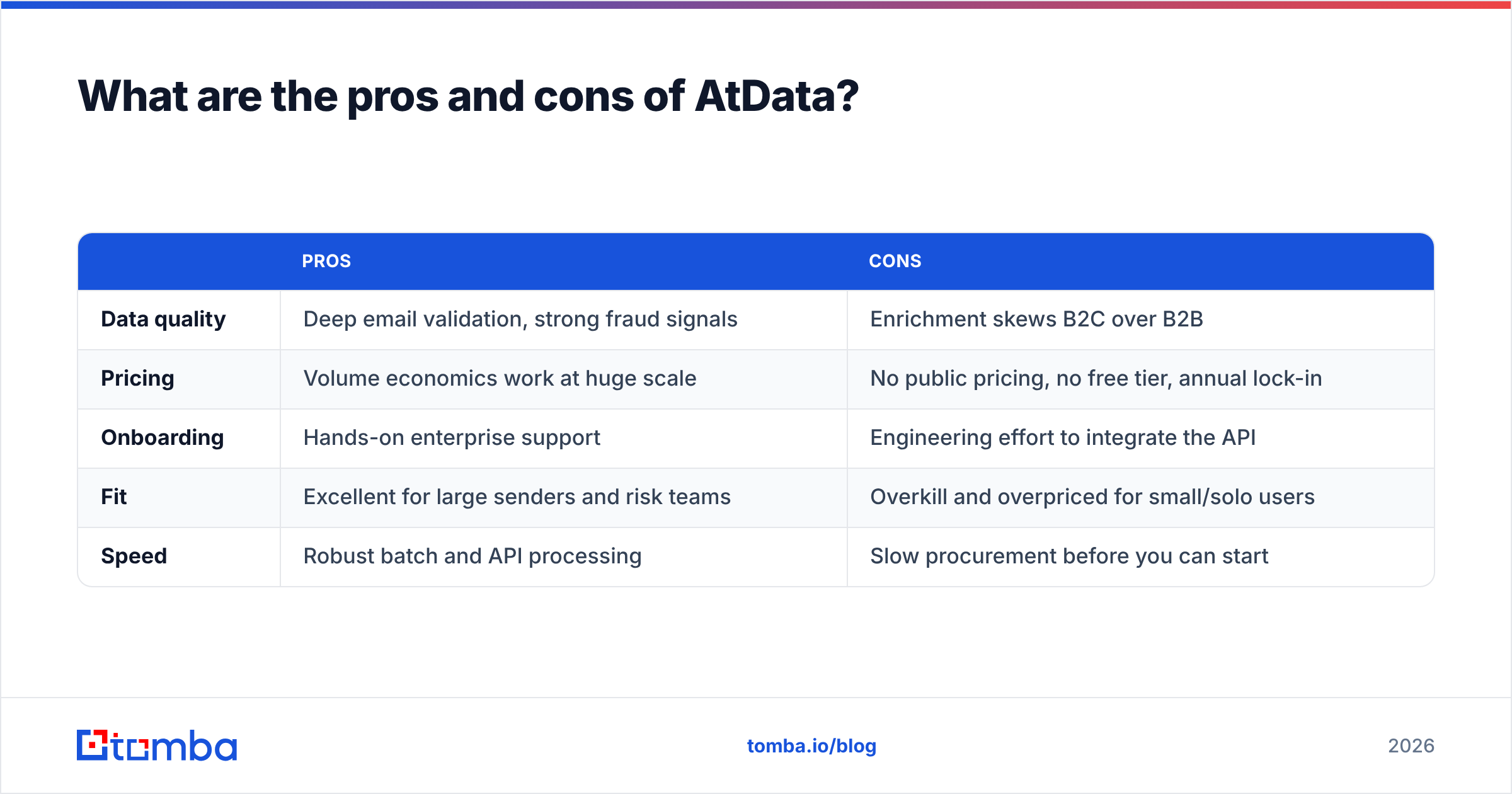
Here is the balanced scorecard, pulled together so you can scan it before a vendor call.
| Pros | Cons | |
|---|---|---|
| Data quality | Deep email validation, strong fraud signals | Enrichment skews B2C over B2B |
| Pricing | Volume economics work at huge scale | No public pricing, no free tier, annual lock-in |
| Onboarding | Hands-on enterprise support | Engineering effort to integrate the API |
| Fit | Excellent for large senders and risk teams | Overkill and overpriced for small/solo users |
| Speed | Robust batch and API processing | Slow procurement before you can start |
If you live in the top-right cell of that grid — a small team that just needs clean, found emails fast — AtData is probably the wrong shape, no matter how good its data is.
Who is AtData best for?#
AtData makes sense when all of these are true:
- You send high volumes (hundreds of thousands to millions of emails) and list hygiene directly affects deliverability and cost.
- You need consumer demographic or interest enrichment, not just a verified address.
- You have fraud or risk-scoring use cases tied to email-based account creation.
- You have budget and patience for an enterprise procurement cycle.
AtData is a poor fit when:
- You are a startup, agency, or sales team that needs to find B2B emails by name or domain.
- You want to start today with a transparent price and a free tier.
- You only need verification and would rather not pay for an enrichment suite you won't use.
For that second group, the workflow is usually simpler: find the email, verify it, enrich only when needed. That is where lighter, published-price tools win.
How does AtData compare to alternatives?#
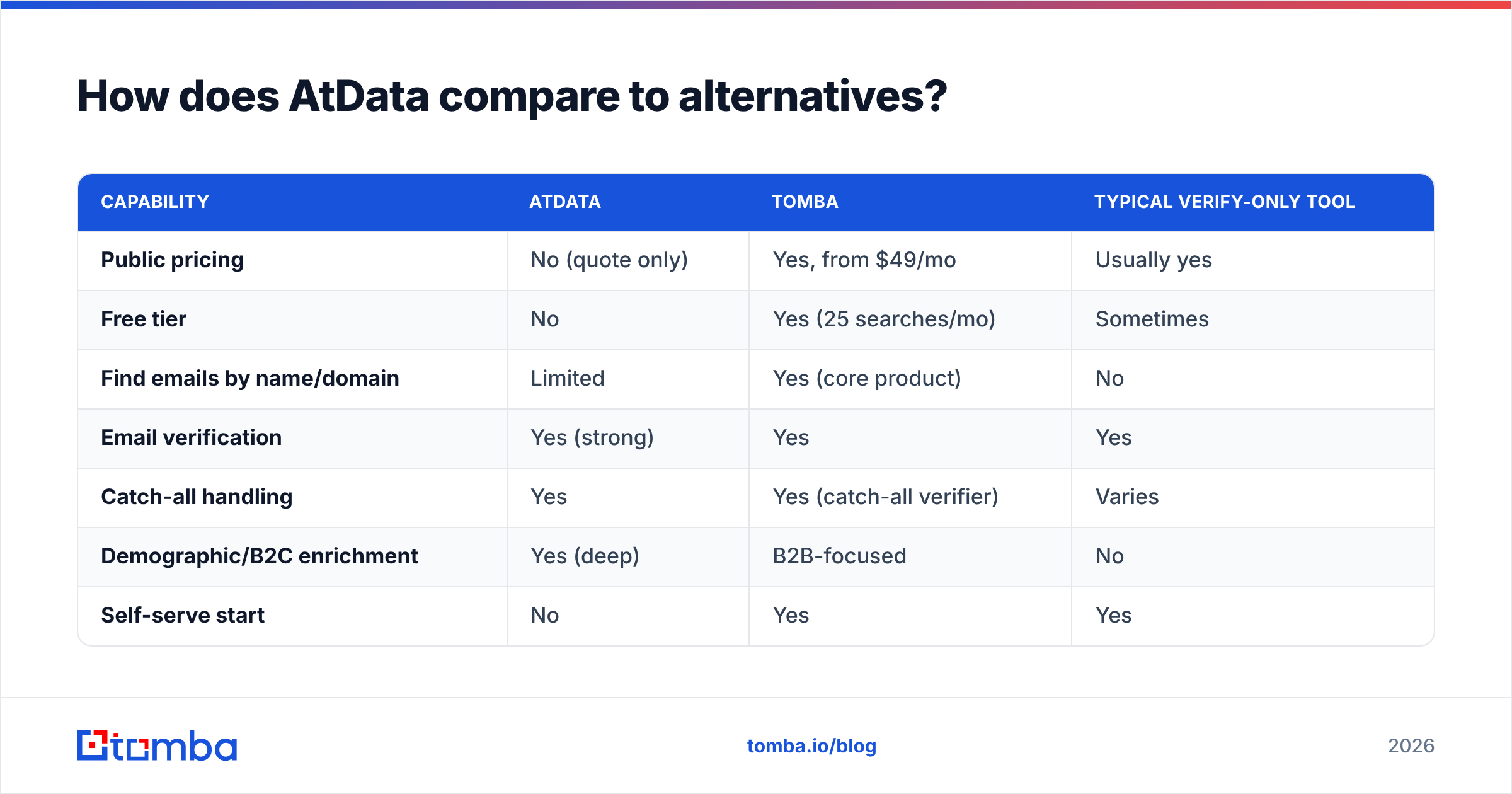
If AtData feels too heavy, the alternatives split into two camps: pure verification tools and find-plus-verify platforms. Here is how the categories stack up for a team that mainly needs accurate B2B contact data.
| Capability | AtData | Tomba | Typical verify-only tool |
|---|---|---|---|
| Public pricing | No (quote only) | Yes, from $49/mo | Usually yes |
| Free tier | No | Yes (25 searches/mo) | Sometimes |
| Find emails by name/domain | Limited | Yes (core product) | No |
| Email verification | Yes (strong) | Yes | Yes |
| Catch-all handling | Yes | Yes (catch-all verifier) | Varies |
| Demographic/B2C enrichment | Yes (deep) | B2B-focused | No |
| Self-serve start | No | Yes | Yes |
The practical difference is workflow ownership. With Tomba you can run domain search to pull a company's email pattern, find the specific decision-maker, and then verify emails in the same place — all on a published plan. AtData expects you to already have the addresses and bring them in for cleaning and append.
For teams that do want enrichment, it is worth noting Tomba also offers data enrichment and bulk processing, so "transparent pricing" does not have to mean "fewer features" for B2B use cases.
Is AtData worth it in 2026?#
It depends entirely on scale and use case — and that is the honest conclusion, not a hedge.
If you are an enterprise marketer running massive consumer email programs, AtData's validation depth and enrichment can pay for itself by protecting deliverability and reducing wasted sends. The opaque pricing is annoying but normal at that tier, and the volume economics tend to work in your favor.
If you are a B2B sales or growth team, the math usually tips the other way. You will spend weeks in procurement to license capabilities that overshoot your actual need, when a self-serve email verifier and email finder would have covered 90% of the job by Friday. The strongest reason to pick AtData — deep B2C enrichment — is the reason it is a mismatch for most B2B prospecting.
A simple test: write down the single sentence describing what you need. If it is "clean and enrich millions of consumer emails," shortlist AtData. If it is "find and verify the right person's work email at target accounts," start with a transparent find-and-verify tool and only add an enrichment vendor if a real gap appears.
Frequently asked questions#
Does AtData have a free trial? No public free trial or free tier is advertised. Access starts with a sales conversation and a custom quote.
How much does AtData cost per month? There is no published monthly price. Cost is quote-based and driven by volume, the data products you license, and contract terms — typically an annual commitment.
Is AtData a good email finder? Not really. Its core strengths are validation, fraud scoring, and enrichment of emails you already have. For discovering new B2B emails by name or domain, a dedicated email finder is a better fit.
What is the best AtData alternative for B2B teams? Teams that want transparent pricing and find-plus-verify in one place often choose tools like Tomba, which lists plans publicly and includes a free tier.
The bottom line and your next step#
AtData is a credible, data-rich platform that rewards large senders and punishes anyone in a hurry. Its accuracy and consumer enrichment are real; its opacity and procurement drag are equally real. Match it to scale, not to hype.
If your actual need is finding and verifying the right B2B contacts without a sales call, skip the quote queue. Start with the Tomba Email Finder: search by name, company, or domain, verify on the spot, and scale on a published plan that begins free and tops out far below an enterprise data contract. Find your first verified emails in minutes, then decide whether you ever truly needed the heavier suite.
// get started
Find, verify and enrich your first contacts today
Start on the free plan with 25 searches a month, then scale when your team is ready.
Free plan · No credit card required · GDPR & CCPA
// about the author