AtData vs Apollo.io (2026): B2B Email Data Compared
AtData and Apollo.io solve different halves of the B2B data problem. This 2026 breakdown compares accuracy, pricing, coverage, and the right use case for each — plus where a focused email finder beats both.
AtData and Apollo.io get lumped together because both promise "better B2B data," but they sit at opposite ends of the pipeline. AtData is an email intelligence and validation layer. Apollo.io is a prospecting database with outreach baked in. Picking between them as if they were interchangeable is how teams overpay for one and underuse the other.
This comparison breaks down what each tool actually does, where the data quality holds up, what you pay in 2026, and which one belongs in your stack. If your real need is simply finding and verifying accurate email addresses without the platform overhead, there's a third path we'll cover too.
TL;DR#
- AtData is an email-first data layer: validation, hygiene, demographic and behavioral enrichment. It shines when you already have emails and need them clean and enriched.
- Apollo.io is an all-in-one sales platform: a 275M+ contact database, sequences, dialer, and CRM-style workflows. It shines for prospecting from scratch.
- They overlap less than the marketing suggests. AtData rarely finds new contacts; Apollo's verification is decent but not its core strength.
- Pricing models differ sharply: AtData is volume/API-based and quote-driven; Apollo is seat-based with a usable free tier.
- If you mainly need accurate emails by name or domain — not a second CRM — a focused email finder is faster and cheaper than either.
What is AtData?#
AtData (formerly TowerData, then Atdata) is a B2B and B2C email intelligence provider that's been in the data business for over two decades. Its core products are email validation, email-based enrichment, and fraud/deliverability scoring. You hand AtData an email address, and it tells you whether the address is valid, how risky it is, and what it knows about the person or household behind it — demographics, interests, and engagement signals.
The key word is email-centric. AtData's graph is built around the email address as the primary key. That makes it strong for cleaning large existing lists, scoring inbound signups in real time, and appending attributes to records you already own. It's commonly used by ESPs, marketers running high-volume sends, and fraud teams.
What AtData is not is a prospecting tool. You don't typically open AtData to discover net-new decision-makers at target accounts. There's no sequence builder, no dialer, no Chrome extension for scraping LinkedIn. It's infrastructure, accessed mostly via API or batch file processing.
What is Apollo.io?#
Apollo.io is a sales intelligence and engagement platform. Its pitch is "find, contact, and close in one place." The foundation is a contact database that Apollo reports at 275M+ contacts and 70M+ companies, layered with filters for title, industry, headcount, technology used, and intent signals.
On top of the database, Apollo adds the outreach machinery: multi-step email sequences, a built-in dialer, email open/click tracking, a Chrome extension, and lightweight CRM features. For an SDR starting with an empty list and a target persona, Apollo is genuinely a one-stop shop — build a list, enrich it, sequence it, and dial, all without leaving the tab.
The tradeoff is that Apollo is a generalist. Its database coverage is broad but uneven by region and seniority, and its email verification — while present — is a feature, not the company's reason to exist. You're buying reach and workflow, not the cleanest possible data.
AtData vs Apollo.io: how do they compare?#
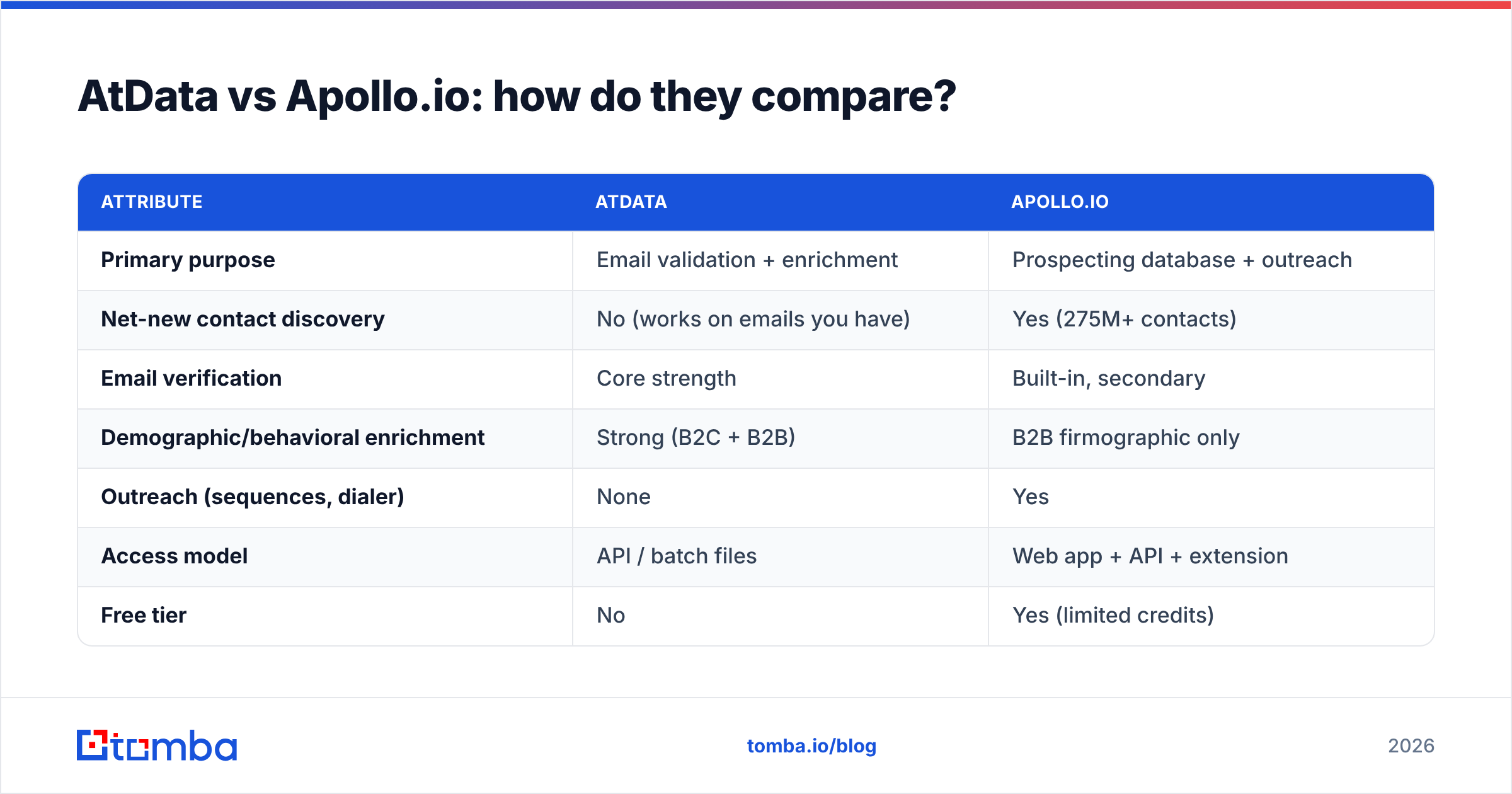
Here's the head-to-head on the attributes that actually drive a buying decision.
| Attribute | AtData | Apollo.io |
|---|---|---|
| Primary purpose | Email validation + enrichment | Prospecting database + outreach |
| Net-new contact discovery | No (works on emails you have) | Yes (275M+ contacts) |
| Email verification | Core strength | Built-in, secondary |
| Demographic/behavioral enrichment | Strong (B2C + B2B) | B2B firmographic only |
| Outreach (sequences, dialer) | None | Yes |
| Access model | API / batch files | Web app + API + extension |
| Free tier | No | Yes (limited credits) |
| Pricing | Volume / quote-based | Seat-based, from free to ~$99/seat/mo |
| Best for | Cleaning + enriching owned data | SDRs prospecting from scratch |
The pattern is clear: these tools win at different stages. AtData operates on data you already have. Apollo helps you acquire data in the first place. If you described your problem as "my list bounces too much," that's AtData. If it's "I don't have a list yet," that's Apollo.

Which has better data accuracy?#
It depends on what you mean by accuracy — and this is where most comparisons go wrong.
For validating that an email exists and is safe to send to, AtData has the edge. Verification is its specialty: SMTP checks, historical engagement data, and risk scoring built over 20+ years of email-graph data. If your KPI is bounce rate on a million-record send, AtData's hygiene is hard to beat.
For accurate contact discovery at scale, Apollo wins simply because AtData doesn't compete there — but Apollo's accuracy is the recurring complaint in reviews. Because its database is community-contributed and crowd-refreshed, you'll hit stale titles, job-changers, and the occasional catch-all domain that reports as valid but silently drops mail. Independent reviews on G2 consistently praise Apollo's reach while flagging data freshness as the weak point.
This is why many teams run a verification pass after exporting from Apollo. Whatever your source database, validating contacts with a dedicated email verifier before you send is the single highest-ROI hygiene step you can take. A 275M-contact database is worthless if a quarter of the addresses bounce and torch your sender reputation.
A useful mental model: discovery and verification are two jobs. Apollo is built for the first, AtData for a slice of the second, and neither does both at the quality a specialist delivers.
How does pricing compare?#
The pricing philosophies are completely different, which makes apples-to-apples hard.
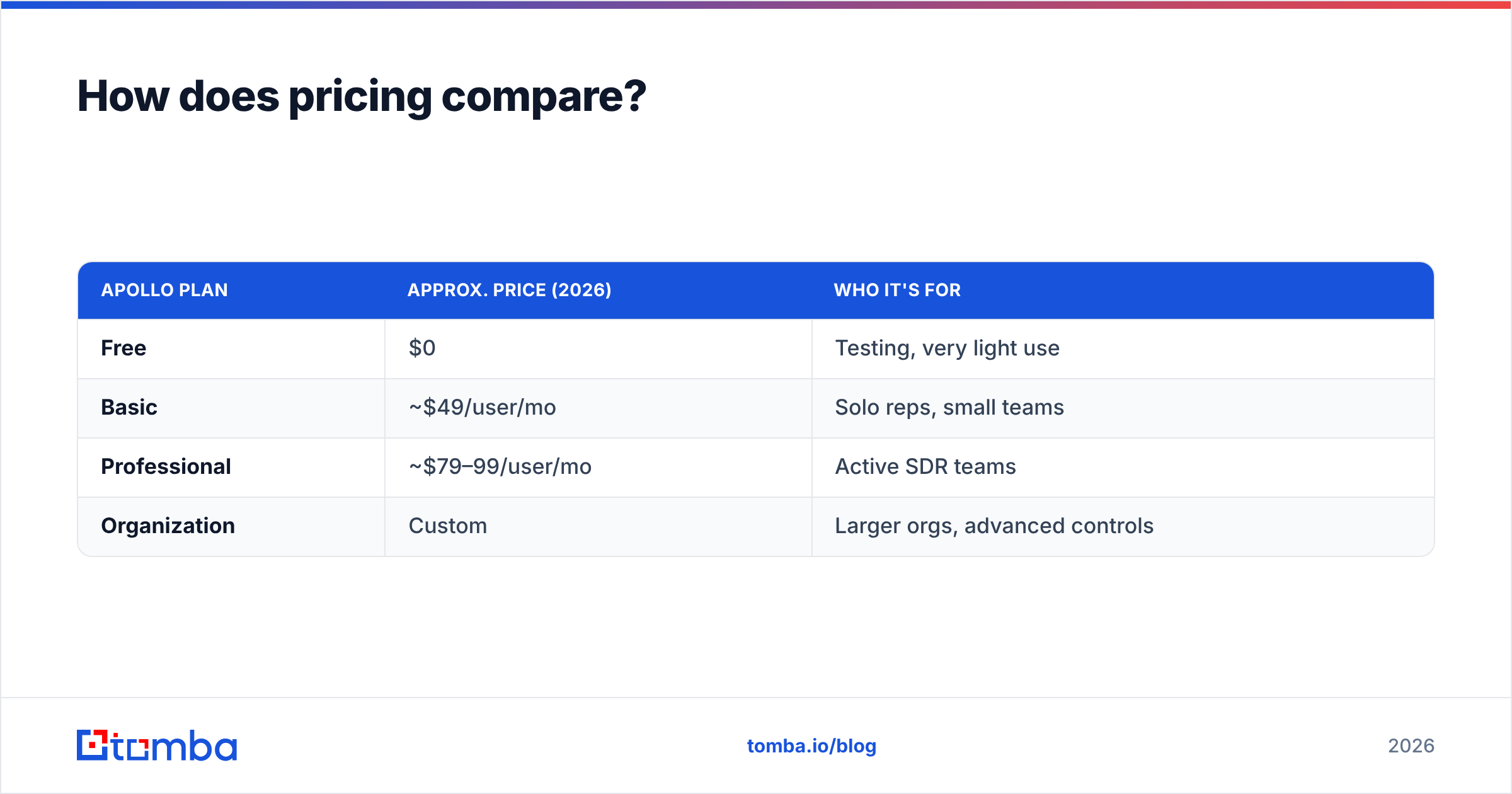
Apollo.io uses seat-based pricing with credit limits:
| Apollo plan | Approx. price (2026) | Who it's for |
|---|---|---|
| Free | $0 | Testing, very light use |
| Basic | ~$49/user/mo | Solo reps, small teams |
| Professional | ~$79–99/user/mo | Active SDR teams |
| Organization | Custom | Larger orgs, advanced controls |
Apollo's free tier is genuinely usable for evaluation, and credits reset monthly. The catch is that heavy data export and enrichment consume credits fast, and per-seat costs add up across a team.
AtData doesn't publish seat pricing because it's not a seat product. Pricing is volume-based and quote-driven — you're billed on records validated or enriched, typically through an annual contract or API usage tiers. That makes it cost-effective at high volume but overkill (and opaque) for a small team that just wants a few thousand verified emails a month.
If predictable, transparent pricing matters to you, neither model is ideal for small-to-mid teams. A flat monthly plan — like Tomba's pricing at $49/mo Starter, $99/mo Growth, and a free tier of 25 searches — is easier to budget against than Apollo's per-seat credits or AtData's enterprise quotes.
When should you choose AtData?#
Pick AtData when email is your primary key and quality is the bottleneck. Specifically:
- You run high-volume email programs (ESP, retailer, publisher) and bounce rates are hurting deliverability.
- You need real-time validation at the point of signup to block fraud and typos.
- You want behavioral and demographic enrichment on emails you already collected — interests, life-stage, household data.
- You have engineering resources to integrate an API or run batch jobs.
AtData is infrastructure for data-mature teams. If you don't already have a substantial email list to clean or enrich, you're buying a tool with no input to chew on.
When should you choose Apollo.io?#
Pick Apollo when you need to build pipeline from zero and want everything in one tab. Specifically:
- You're an SDR or small sales team starting outbound without an existing list.
- You want to filter by persona, export contacts, and immediately sequence them.
- You value workflow consolidation over best-in-class data quality.
- You're price-sensitive enough to start on the free tier and scale seats as needed.
Apollo's strength is momentum. It removes the friction of stitching together a database, an enrichment tool, and an outreach platform. Just budget for a verification step, because the all-in-one convenience comes with all-in-one data noise.
Is there a better alternative for finding emails?#
If you strip the question down to what most teams actually need — accurate email addresses for specific people or companies, verified before you hit send — neither AtData nor Apollo is the lean choice. AtData won't find net-new contacts, and Apollo bundles finding with a whole platform you may not want to pay per-seat for.
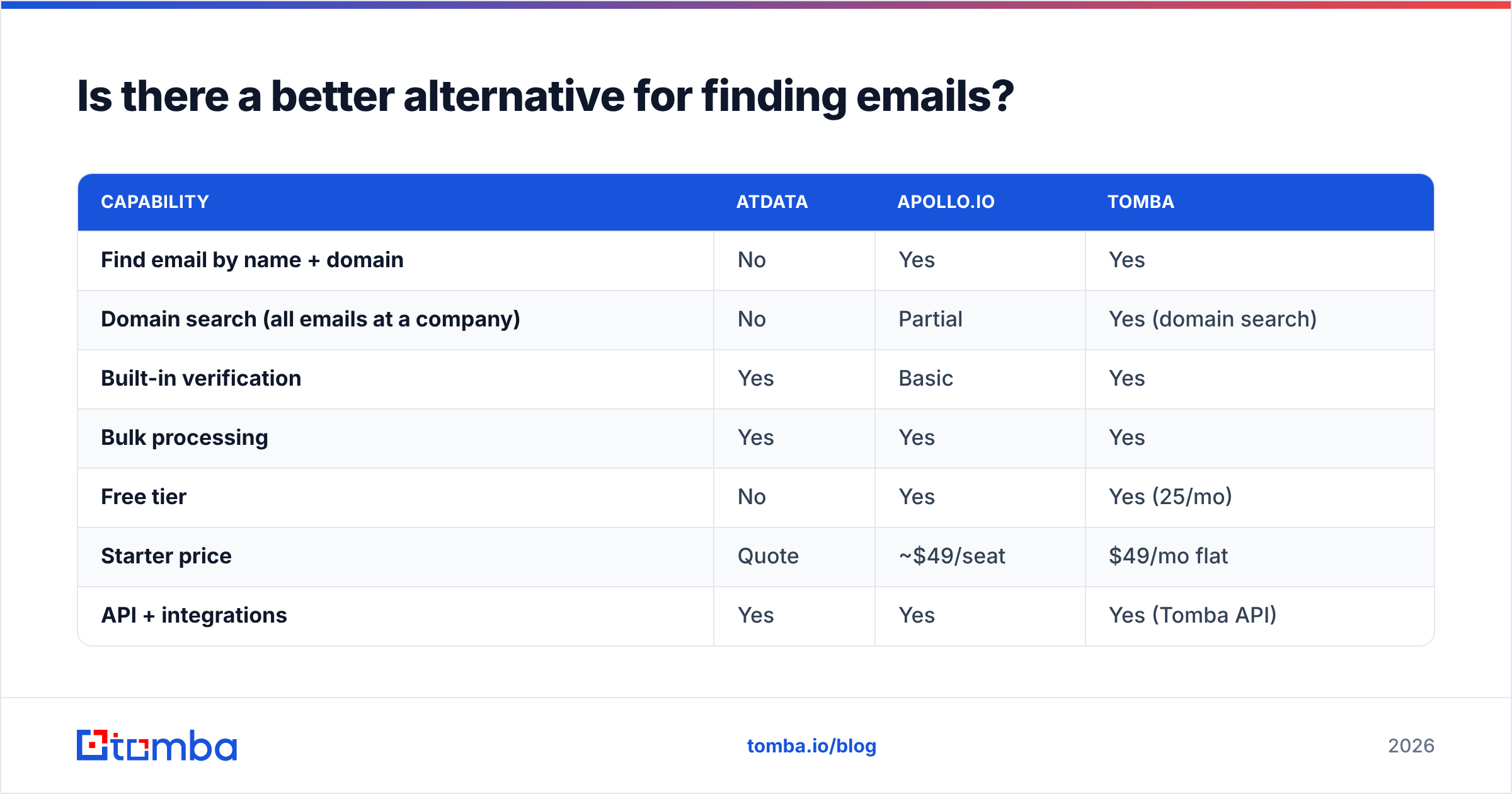
This is the gap a focused email finder fills. Tomba is built around one job: turning a name and domain (or just a domain) into a verified professional email, with verification built into the same workflow.
| Capability | AtData | Apollo.io | Tomba |
|---|---|---|---|
| Find email by name + domain | No | Yes | Yes |
| Domain search (all emails at a company) | No | Partial | Yes (domain search) |
| Built-in verification | Yes | Basic | Yes |
| Bulk processing | Yes | Yes | Yes |
| Free tier | No | Yes | Yes (25/mo) |
| Starter price | Quote | ~$49/seat | $49/mo flat |
| API + integrations | Yes | Yes | Yes (Tomba API) |
Where Tomba fits in the AtData-vs-Apollo debate: use it as the discovery-plus-verification engine. Find the contact, confirm the address, then push clean records into your CRM, your sequencer, or — if you genuinely need household-level enrichment — into AtData. You can also enrich the records you find with data enrichment to add firmographic context without a separate enterprise contract. And if you're specifically shopping for an Apollo alternative, Tomba covers the find-and-verify core without the per-seat math.
How do you choose the right tool for your stack?#
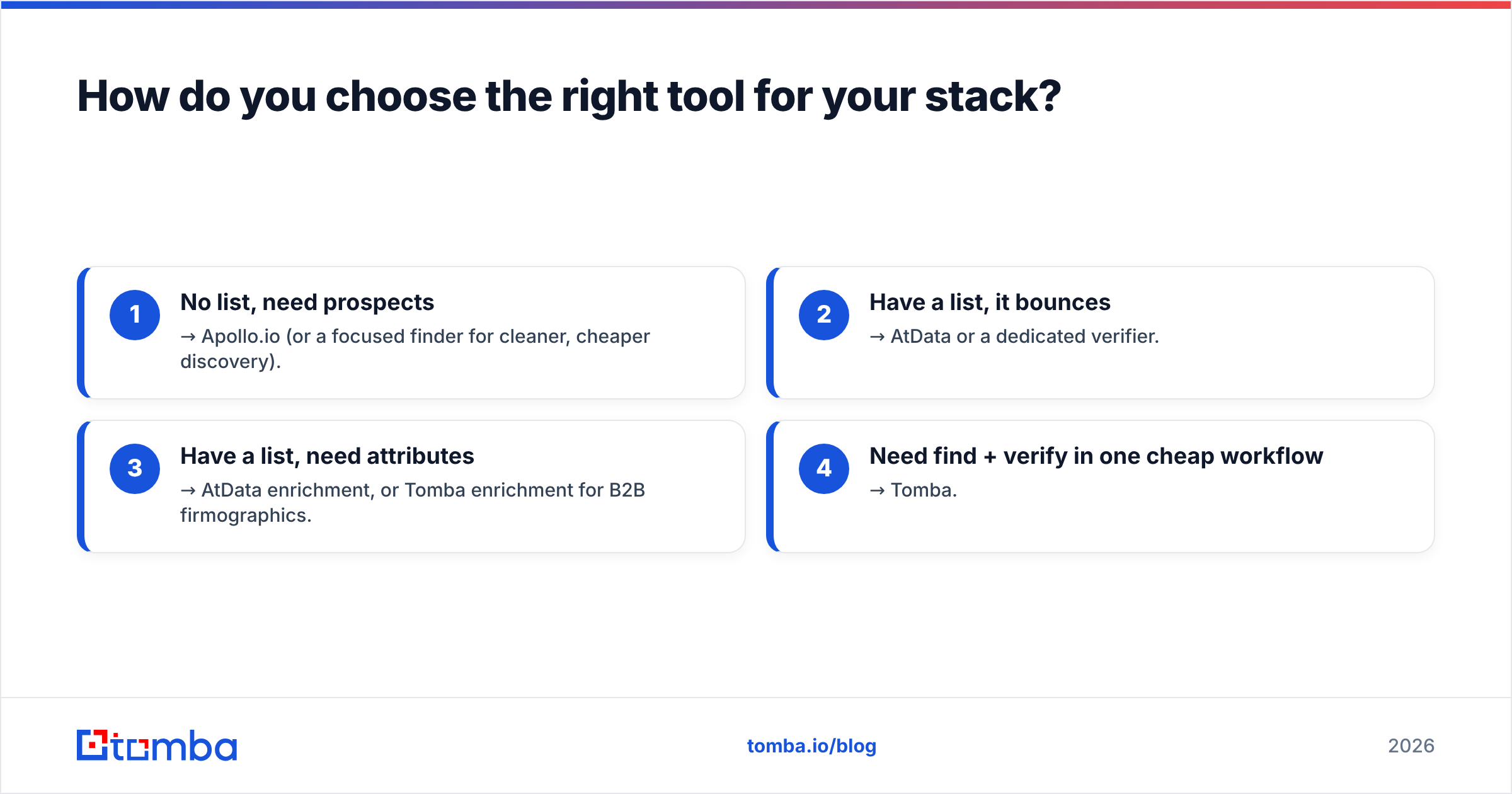
Map the tool to the stage of your funnel where you're actually bleeding:
- No list, need prospects → Apollo.io (or a focused finder for cleaner, cheaper discovery).
- Have a list, it bounces → AtData or a dedicated verifier.
- Have a list, need attributes → AtData enrichment, or Tomba enrichment for B2B firmographics.
- Need find + verify in one cheap workflow → Tomba.
The expensive mistake is buying a broad platform to solve a narrow problem. Teams sign annual AtData contracts to clean a list they could verify for a fraction of the cost, or pay for ten Apollo seats when three reps need find-and-verify and nothing else. Match the tool to the job, not to the logo.
A second mistake is skipping verification entirely. No matter which database you pull from — Apollo, an old export, a scraped list — running it through verification before sending protects your domain reputation. Bounces and spam traps are far more expensive than the cents per check that verification costs.
The bottom line#
AtData and Apollo.io aren't really rivals; they're tools for different jobs. AtData is the email-intelligence layer for data-mature teams cleaning and enriching what they already own. Apollo.io is the prospecting-and-outreach engine for SDRs building pipeline from scratch. Choose AtData for hygiene and enrichment at volume, Apollo for discovery plus workflow — and budget for verification either way.
But if your honest need is "find accurate B2B emails and verify them without paying for a second CRM or signing an enterprise quote," start with the tool built for exactly that. Tomba's Email Finder turns names and domains into verified emails, with domain search, bulk processing, and an API on a flat, predictable plan — including a free tier so you can test before you commit. Find the right people, confirm the addresses, and keep your sender reputation intact.
// get started
Find, verify and enrich your first contacts today
Start on the free plan with 25 searches a month, then scale when your team is ready.
Free plan · No credit card required · GDPR & CCPA
// about the author