AtData vs DiscoverOrg: B2B Data Platform Compared (2026)
AtData and DiscoverOrg solve different B2B data problems. Here's an honest 2026 breakdown of accuracy, pricing, and which fits your go-to-market stack.
TL;DR
If you searched AtData vs DiscoverOrg expecting two rival tools, here's the surprise: they don't really compete. They sit at opposite ends of the B2B data pipeline.
- AtData (formerly TowerData) is an email intelligence and verification provider. It scores, validates, and enriches email addresses you already have. It is not a prospecting database.
- DiscoverOrg is a sales intelligence database — org charts, direct dials, and firmographics. It was folded into ZoomInfo after the 2019 merger.
- They are not true competitors. You'd use AtData to clean and enrich a list. You'd use DiscoverOrg/ZoomInfo to build a list of net-new accounts.
- DiscoverOrg/ZoomInfo carries enterprise pricing (often $15k+/yr with per-seat fees). AtData is usage-based and quote-driven.
- If your real job is finding and verifying business emails without an enterprise contract, a usage-based email finder like Tomba is a cheaper, faster middle path.
What are AtData and DiscoverOrg?#
Short answer: they sit on opposite ends of the B2B data pipeline. One enriches contacts you already touch. The other helps you discover contacts you've never met. That is the heart of the AtData vs DiscoverOrg question.
AtData has sold email data for over two decades. It ran under the TowerData and Rapleaf names before the rebrand to AtData. Think of it as a credit bureau for email addresses. You hand it an email, and it returns a hygiene score, fraud signals, activity recency, and demographic enrichment. Marketers use it to scrub lists before a send. They also use it to enrich signup forms in real time.
DiscoverOrg was built differently. It was a research-heavy B2B database. It became famous for human-verified org charts and accurate direct-dial phone numbers in IT, marketing, and finance. In 2019 it acquired ZoomInfo and adopted that brand. So today "DiscoverOrg" is really ZoomInfo's intelligence layer. If you evaluate DiscoverOrg in 2026, you are really evaluating ZoomInfo.
The confusion is understandable. Both sell "B2B data." But the analogy is a water-testing kit versus a reservoir. AtData tells you whether the water you have is clean. DiscoverOrg sells you the reservoir.
AtData vs DiscoverOrg: how do they differ at the core?#
The cleanest way to see the difference is by what each product takes as input and returns as output.
| Dimension | AtData | DiscoverOrg (ZoomInfo) |
|---|---|---|
| Primary job | Email validation + enrichment | Prospecting database + org charts |
| You supply | Emails / records you already own | Search filters (industry, title, tech) |
| You receive | Hygiene score, demographics, activity | Net-new contacts, direct dials, firmographics |
| Strongest data | Email deliverability + identity | Org structure, direct-dial phones |
| Typical buyer | Marketing ops, ESP senders | SDR / sales teams, ABM marketers |
| Pricing model | Usage / volume, quote-based | Annual platform license + seats |
| Free self-serve tier | No | No |
| Best for | Cleaning + enriching known lists | Discovering net-new accounts |
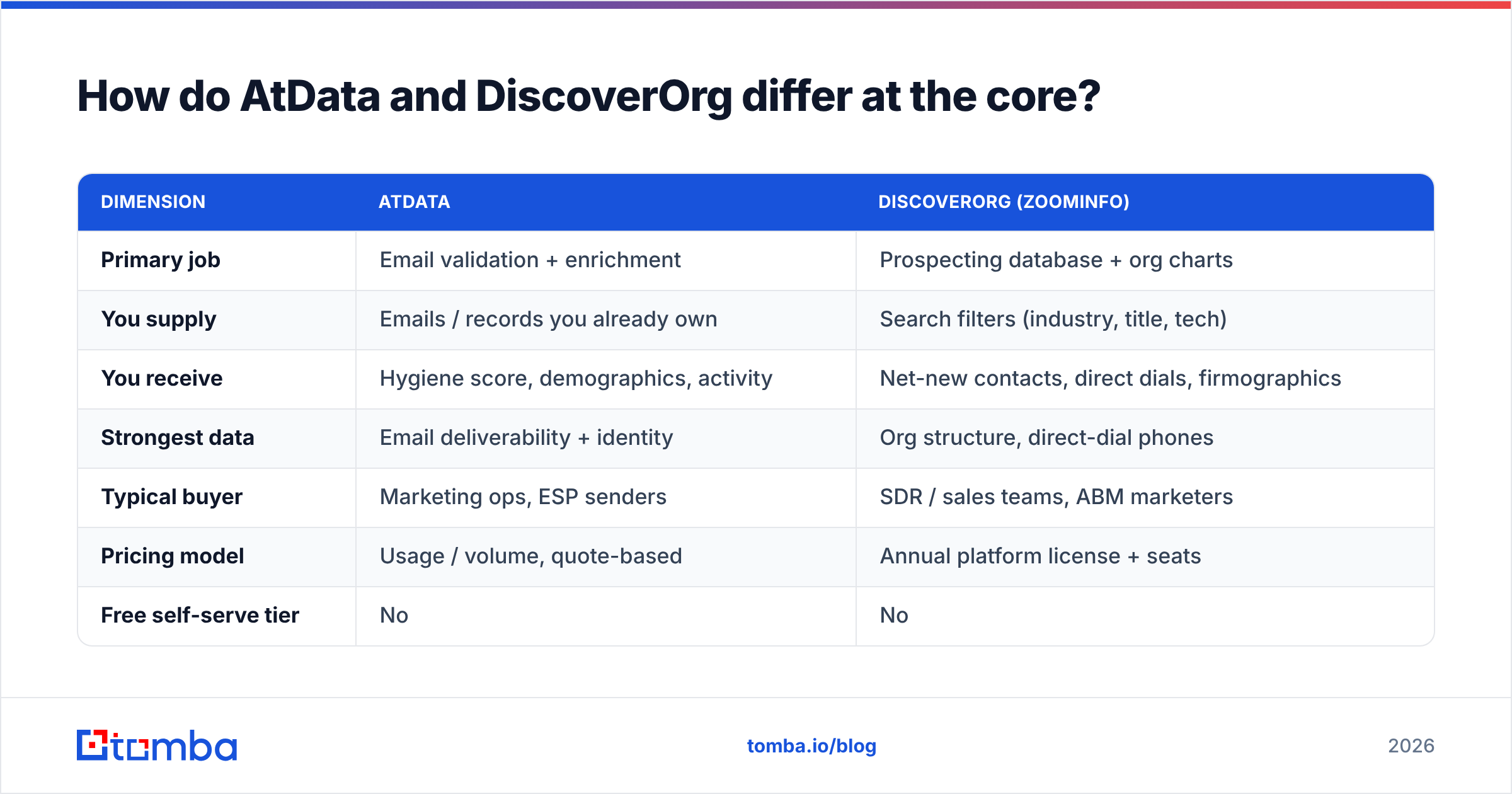
The takeaway is simple. If you already have a list and want it to land in the inbox, AtData is the specialist. If you have an empty CRM and need accounts to call, DiscoverOrg/ZoomInfo is the specialist. Buying one expecting the other's job is the most common mistake teams make.
Which has better data accuracy?#
It depends on the data type. Comparing a single "accuracy" number is misleading.
AtData's edge is email validity and identity. Email is its entire business, so its hygiene and fraud-scoring models run deep. It can flag a spam trap, a role account, or a long-dormant address before you damage your sender reputation. That directly protects email deliverability, which is the metric most marketing teams actually care about.
DiscoverOrg's historical edge is human-verified firmographics and direct dials. Its research team manually maintained org charts. Independent reviews on G2 still rate its direct-dial accuracy among the highest in the category. Where it gets weaker is freshness at the long tail. Titles change, people leave, and any static database decays roughly 25–30% per year. ZoomInfo itself has cited that figure in its data-decay research.
So the honest answer:
- For "will this email bounce or hurt my domain?" → AtData wins.
- For "who is the VP of Engineering at this 5,000-person company and what's their direct line?" → DiscoverOrg/ZoomInfo wins.
Neither tool is built to find a specific person's work email from just a name and a company domain, cheaply and on demand. That is exactly the gap a dedicated email finder fills. If a verified work email is your bottleneck, you also want a standalone email verifier in the loop, whichever platform you buy.
How do AtData and DiscoverOrg compare on pricing?#
Both are quote-only, and both skew expensive — but for different reasons.
DiscoverOrg/
ZoomInfo is a classic enterprise SaaS contract. You pay an annual platform fee plus per-seat licensing plus optional add-ons (intent data, Engage, Enrich). Public reviews on Capterra and Vendr commonly put real-world spend well above $15,000/year. For larger teams it often runs into six figures. There is no free tier and no month-to-month self-serve plan.
AtData is usage-based. You pay by the volume of records validated or enriched. That can be cheaper for a one-time list clean. But it still requires talking to sales and signing a contract for ongoing API use.
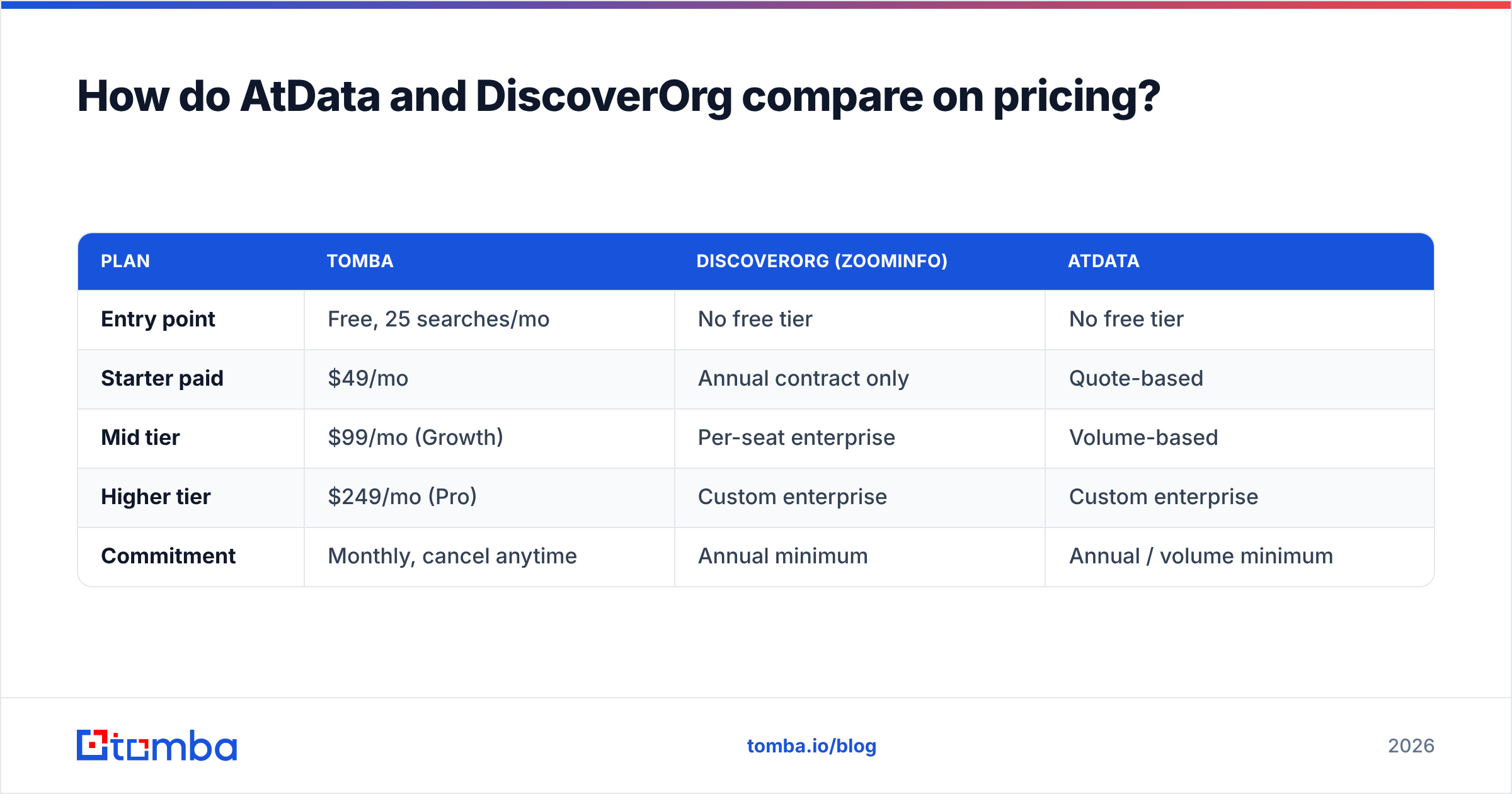
For comparison, here's where a usage-based finder/verifier sits:
| Plan | Tomba | DiscoverOrg (ZoomInfo) | AtData |
|---|---|---|---|
| Entry point | Free, 25 searches/mo | No free tier | No free tier |
| Starter paid | $49/mo | Annual contract only | Quote-based |
| Mid tier | $99/mo (Growth) | Per-seat enterprise | Volume-based |
| Higher tier | $249/mo (Pro) | Custom enterprise | Custom enterprise |
| Commitment | Monthly, cancel anytime | Annual minimum | Annual / volume minimum |
You can see full Tomba pricing without a sales call. The structural point is this: if you don't need org charts and intent signals across thousands of accounts, enterprise prices are overkill. Many teams land on a simpler stack — a self-serve finder plus targeted enrichment.
When should you choose each one?#
Match the tool to the job, not to the brand.
Choose AtData when:
- You run high-volume email programs and bounce rates or spam-trap hits are hurting deliverability.
- You want real-time form validation and demographic enrichment at signup.
- You already have the contacts and just need them clean and richer.
Choose DiscoverOrg/ZoomInfo when:
- You're an enterprise sales org that needs net-new accounts, org charts, and direct dials at scale.
- You run account-based marketing and want intent data layered on firmographics.
- You have the budget for an annual platform contract and per-seat licensing.
Choose a dedicated finder/verifier (like Tomba) when:
- You need to find and verify specific work emails by name or domain search without an enterprise contract.
- You want predictable monthly pricing and an email finder API you can wire into your own workflow.
- You'd rather run bulk lead generation on demand than license a giant static database.
Here's a practical stack. Use a finder to discover and verify the emails. Add an enrichment step for firmographics. Run a hygiene check before every send. You don't need a single six-figure platform to do all three.
What are the main pros and cons?#
| Pros | Cons | |
|---|---|---|
| AtData | Deep email validity + fraud scoring; strong identity data; decades of email expertise | Not a prospecting source; quote-only; overkill if you only need basic verification |
| DiscoverOrg | Best-in-class org charts + direct dials; intent data; enterprise integrations | Expensive annual contracts; per-seat fees; data decay at the long tail; no free tier |
| Tomba | Self-serve, monthly pricing, free tier, finder + verifier + API | Smaller firmographic depth than |
ZoomInfo; not an intent-data platform |
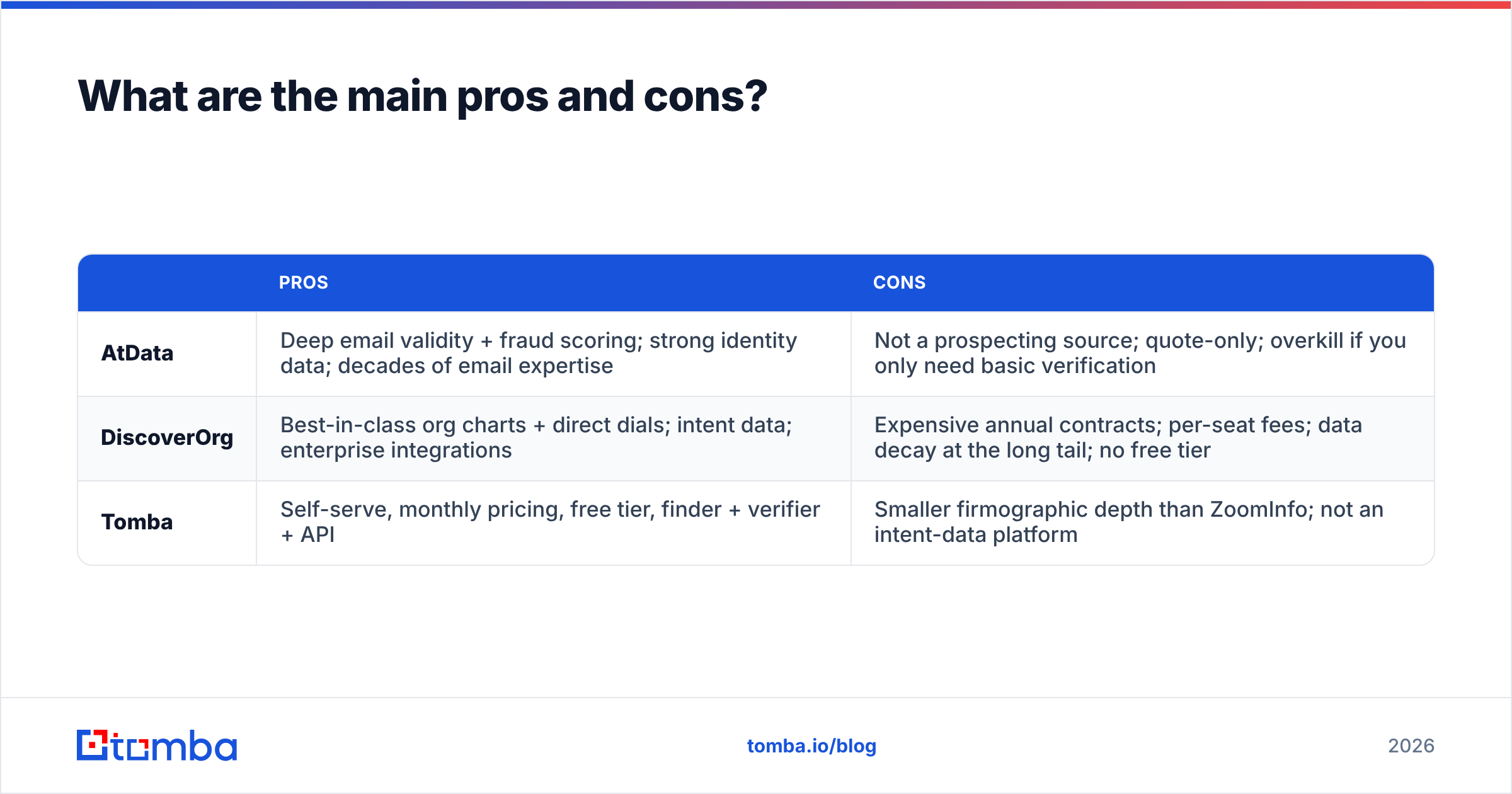
The honest framing: AtData and DiscoverOrg are both strong inside their lane. Both are priced for teams with budget and procurement cycles. Neither is the right first purchase if your core need is simply finding and verifying business emails affordably.
Frequently asked questions#
Is AtData the same as TowerData? Yes. AtData is the rebranded identity of TowerData, which earlier absorbed Rapleaf. The email-intelligence DNA is the same.
Is DiscoverOrg still a separate product? Not really. DiscoverOrg acquired ZoomInfo in 2019 and adopted the ZoomInfo brand. When you evaluate "DiscoverOrg" today, you are evaluating ZoomInfo's intelligence platform.
Can either one find a specific person's email for me? That's not their primary design. AtData verifies and enriches emails you supply. DiscoverOrg surfaces contacts via database search. For on-demand lookups by name and company, a purpose-built email finder is faster and cheaper.
Which is cheaper? AtData's usage model can be cheaper for one-off list cleaning. For ongoing prospecting, both run into thousands per year. A monthly finder/verifier plan is the lowest-commitment option.
The bottom line#
The real answer to AtData vs DiscoverOrg is that they aren't rivals. They are two specialists at opposite ends of your data pipeline. AtData keeps the emails you own clean and enriched. DiscoverOrg (ZoomInfo) helps enterprise teams discover net-new accounts and reach the right decision-makers. Pick based on the job in front of you. Don't pay enterprise prices for a problem a focused tool solves better.
If your actual bottleneck is finding and verifying real, deliverable business emails — without a procurement cycle — start with the Tomba Email Finder. The free tier gives you 25 searches a month. Paid plans start at $49/mo. The same data is available through the Tomba API when you're ready to automate. Clean discovery first, enrichment second — and skip the six-figure contract until you genuinely need one.
Ready to find emails that actually work?
Join 150,000+ professionals who stopped guessing and started sending. Free credits on signup — no credit card required.
Get the Tomba newsletter
Practical outbound tactics and product updates — once every two weeks.
About the author