AtData vs GetProspect: Which Email Data Tool Wins in 2026?
AtData and GetProspect both promise clean B2B email data, but they solve different problems. Here's an honest breakdown of accuracy, pricing, and fit in 2026.
Choosing between AtData and GetProspect feels like comparing a power plant to a flashlight. Both deal with electricity — but you would not wire your house with one or light a camping trip with the other. This guide cuts through the marketing so you pick the right tool for how you actually prospect.
TL;DR#
- AtData (formerly TowerData) is an enterprise email intelligence and verification platform built for data quality, fraud signals, and large-scale enrichment — not for finding net-new contacts one by one.
- GetProspect is a self-serve email finder and B2B lead database aimed at SDRs and small teams who want LinkedIn-driven prospecting and list building.
- They overlap less than the "vs" suggests: AtData cleans and enriches data you already have; GetProspect helps you discover data you don't.
- On price, GetProspect is transparent and starts low; AtData is quote-based and skews enterprise.
- If you want both discovery and verification without enterprise contracts, a focused finder like Tomba Email Finder often beats picking just one.
What is AtData?#
AtData is a long-standing email-centric data company (you may remember it as TowerData or Rapleaf). Its core job is email intelligence: take an email address and tell you whether it's valid, risky, active, and who sits behind it. It layers on demographic enrichment, fraud and activity scoring, and hygiene services that scrub large customer files.
The typical AtData buyer is a marketing or risk team at a mid-to-large company with a database of hundreds of thousands of records. They are not trying to find a single VP of Sales at a 40-person startup. They are trying to keep a 2-million-row list clean, suppress bad addresses before a send, and append attributes for segmentation.
That framing matters. AtData is excellent at validating and enriching what you have but it is not a prospecting tool you point at a LinkedIn profile to grab a fresh email.

What is GetProspect?#
GetProspect sits at the opposite end. It's a self-serve email finder and lead-generation platform with a Chrome extension, a searchable B2B contact database, and bulk list-building features. SDRs use it to turn a LinkedIn search into a list of names, titles, companies, and email addresses, then push that into a CRM or sequencer.
GetProspect's strengths are discovery and accessibility: a clean UI, a free tier to test, LinkedIn integration, and credit-based pricing anyone can sign up for without talking to sales. It also offers email verification, but verification is a feature on top of finding — not the main event the way it is at AtData.
In short: GetProspect finds contacts; AtData scores and cleans them. The G2 categories reflect this — AtData lives under data quality and email verification, GetProspect under lead intelligence and sales prospecting.
AtData vs GetProspect: how do they compare head-to-head?#
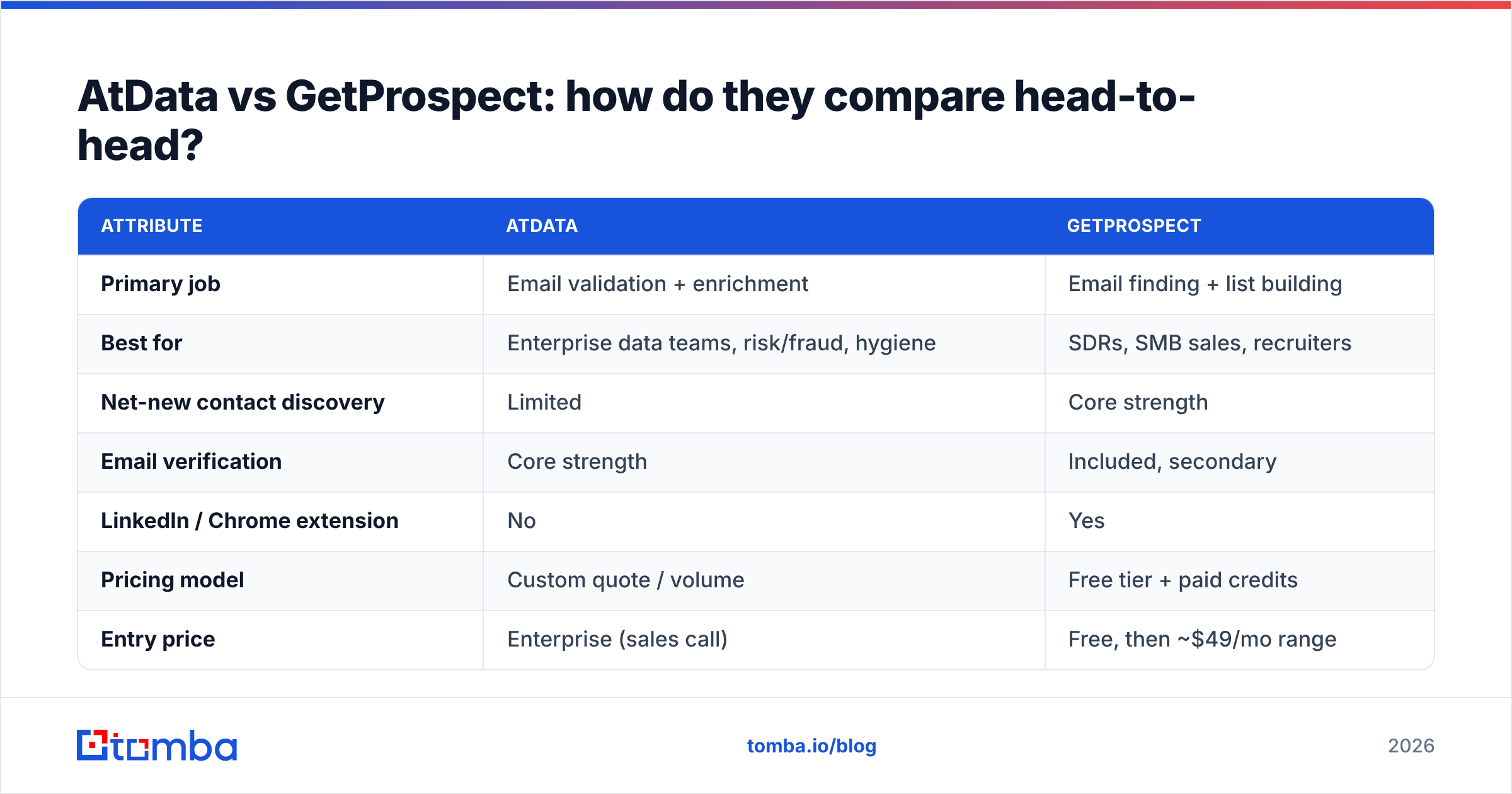
Here's the honest side-by-side. Treat pricing as directional — AtData is quote-based and GetProspect adjusts tiers periodically.
| Attribute | AtData | GetProspect |
|---|---|---|
| Primary job | Email validation + enrichment | Email finding + list building |
| Best for | Enterprise data teams, risk/fraud, hygiene | SDRs, SMB sales, recruiters |
| Net-new contact discovery | Limited | Core strength |
| Email verification | Core strength | Included, secondary |
| LinkedIn / Chrome extension | No | Yes |
| Pricing model | Custom quote / volume | Free tier + paid credits |
| Entry price | Enterprise (sales call) | Free, then ~$49/mo range |
| Free tier | No | Yes (limited credits) |
| API access | Yes, mature | Yes |
| Typical contract | Annual | Monthly or annual |
The takeaway: if your problem is "my database is dirty and I need fraud and activity signals at scale," AtData is built for you. If your problem is "I need 500 verified emails for next quarter's outbound," GetProspect is the closer fit — and so are several dedicated finders.

How accurate is each tool?#
Accuracy is where buyers get burned, so be specific about what you're measuring.
AtData's accuracy claim is about verification and activity — can it tell a deliverable, active mailbox from a dead or risky one? On established, US-heavy consumer and B2B files, its hygiene and validity scoring are strong because it has years of email-activity data to draw on. That's its moat.
GetProspect's accuracy claim is about discovery — when it returns an email for "Jane Smith at Acme," is that the real, current address? Discovery accuracy is harder and noisier across every finder on the market, because people change jobs and companies use catch-all domains that mask whether a mailbox truly exists.
This is exactly why discovery and verification should be paired, not chosen between. A finder that surfaces an address is only useful if a verifier confirms it lands. If you rely on a single tool, check whether it does both honestly — and whether it can handle catch-all domains, which is where most accuracy claims quietly fall apart. A dedicated catch-all verifier closes that gap.

When you compare accuracy numbers, insist on the methodology. "98% accurate" means nothing without knowing the test set, the bounce definition, and whether catch-all domains were excluded or counted. Vendors that publish their data sources and verification method earn more trust than ones quoting a round number.

Which one is cheaper — AtData or GetProspect?#
GetProspect wins on transparency and entry cost; AtData wins on per-record economics at massive scale.
GetProspect publishes credit-based plans, offers a free tier, and lets you start for tens of dollars a month. You can prove value in an afternoon without a procurement cycle. The trade-off is that credit costs add up fast once you're running bulk discovery across thousands of prospects monthly.
AtData is quote-based. You'll talk to a salesperson, sign an annual agreement, and pay for volume. For a team validating millions of records that can be cost-effective per record, but it's a poor fit if you want to test with a small budget or need predictable monthly costs. There is no meaningful free tier to kick the tires.
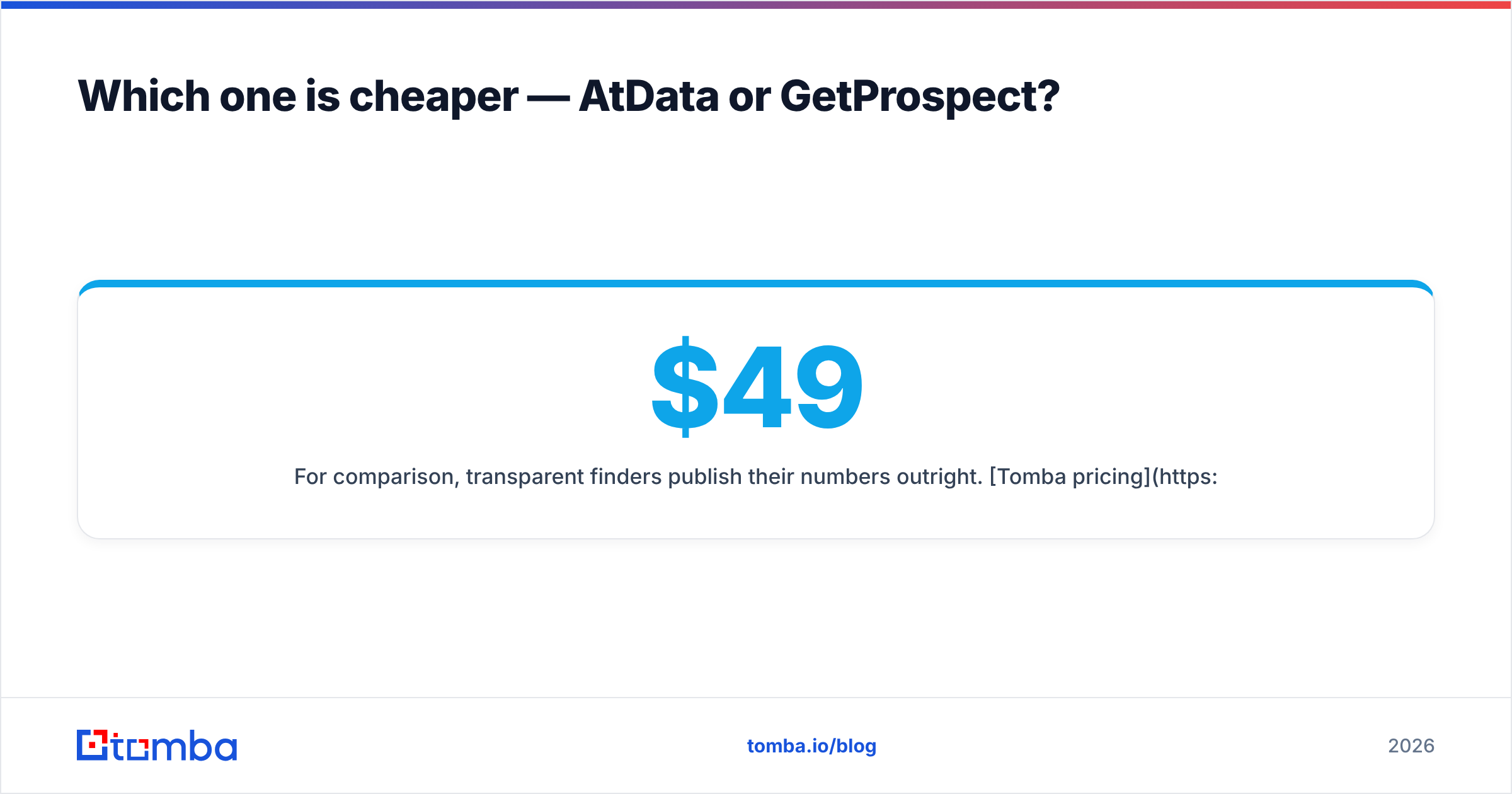
For comparison, transparent finders publish their numbers outright. Tomba pricing runs a free tier at 25 searches/month, Starter at $49/mo, Growth at $99/mo, and Pro at $249/mo — no sales call to see the price. That kind of clarity is what most SMB and mid-market teams actually want when weighing AtData vs GetProspect.
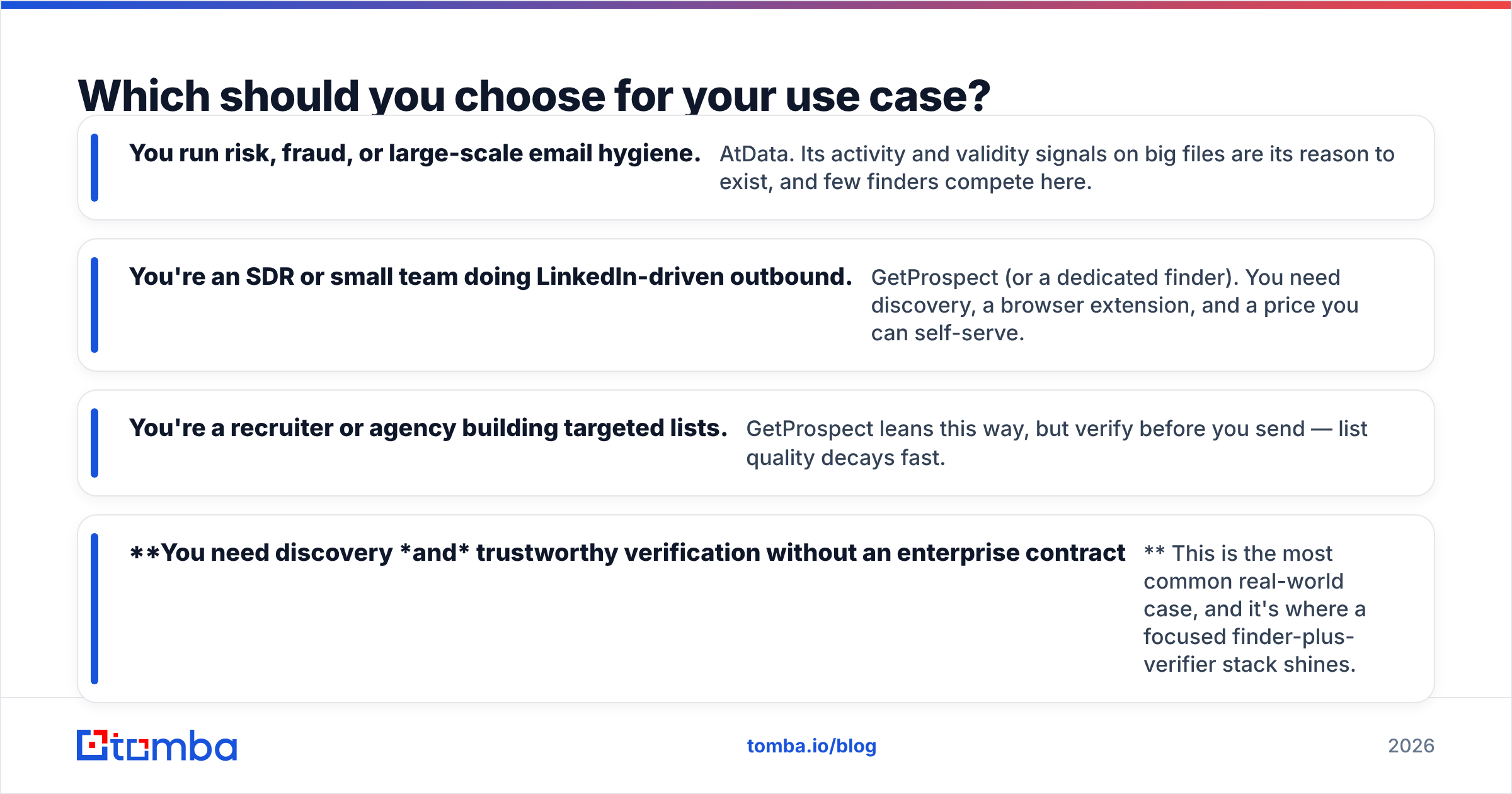
Which should you choose for your use case?#
Match the tool to the job, not the brand:
- You run risk, fraud, or large-scale email hygiene. AtData. Its activity and validity signals on big files are its reason to exist, and few finders compete here.
- You're an SDR or small team doing LinkedIn-driven outbound. GetProspect (or a dedicated finder). You need discovery, a browser extension, and a price you can self-serve.
- You're a recruiter or agency building targeted lists. GetProspect leans this way, but verify before you send — list quality decays fast.
- You need discovery and trustworthy verification without an enterprise contract. This is the most common real-world case, and it's where a focused finder-plus-verifier stack shines.
If you fall in that last bucket, you don't have to compromise. Pair a domain search to map a company's contacts with an email verifier to confirm deliverability before anything hits a sequence. That combination gives you GetProspect-style discovery with AtData-style confidence, at a transparent price.
Do AtData and GetProspect integrate with your stack?#
Both expose APIs, which matters more than it sounds. AtData's API is mature and built for high-volume batch validation and enrichment — it's the integration point for engineering teams piping data through hygiene checks before a send.
GetProspect connects to common CRMs and sequencers and offers an API for programmatic finding, but its center of gravity is the UI and Chrome extension, not headless automation at enterprise scale.
If API-first workflows are central to you, evaluate the developer experience directly. A clean, well-documented email finder API with predictable rate limits and clear credit accounting will save your engineers weeks compared with reverse-engineering a tool built primarily for clicking around a dashboard. Check rate limits, response schemas, and whether verification is a separate call or bundled — those details decide whether the integration is a day or a sprint.
What do reviewers say?#
On third-party review sites the pattern is consistent. AtData earns praise for data quality, account support, and validation accuracy, with criticism around opaque pricing and a heavier onboarding. GetProspect earns praise for ease of use, the free tier, and fast list building, with criticism around credit burn and the usual discovery-accuracy variance every finder faces.
You can read current sentiment on G2 and Capterra — just weight reviews by company size, because an enterprise data team and a two-person agency want very different things from these tools. A glowing review from a Fortune 500 risk analyst tells you little about whether the tool fits your five-person outbound team.
It's also worth checking how each vendor talks about email deliverability and sender reputation. Tools that treat verification as a checkbox tend to leave you with lists that look clean but still bounce. The ones that explain bounce types, role accounts, and catch-all handling are the ones that protect your domain.
AtData vs GetProspect: the honest verdict#
Neither tool is "better" in the abstract — they're built for different jobs, and most "vs" framings online ignore that.
Choose AtData if you're an enterprise that owns a large database and needs best-in-class validation, fraud signals, and enrichment, and you can absorb a quote-based annual contract.
Choose GetProspect if you're a sales or recruiting team that needs accessible, self-serve discovery with LinkedIn integration and a free tier to start.
But notice what's missing from both single choices: AtData won't find your net-new prospects, and GetProspect's verification is a side feature, not its specialty. Most teams comparing these two are really asking, "How do I get accurate B2B emails I can actually send to, without an enterprise contract?"
That's a finder-and-verifier problem. Tomba Email Finder gives you domain-level discovery, individual lookups, bulk processing, and built-in verification — including catch-all handling — with public pricing that starts free and scales to $249/mo, no sales call required. If you're weighing AtData vs GetProspect and want discovery and deliverability in one transparent tool, start with Tomba's free tier, test it against your own list, and let the bounce rate decide.
Sources and further reading: G2 software reviews, Capterra, and HubSpot's guide to email deliverability.
Ready to find emails that actually work?
Join 150,000+ professionals who stopped guessing and started sending. Free credits on signup — no credit card required.
Get the Tomba newsletter
Practical outbound tactics and product updates — once every two weeks.
About the author