AtData vs ZoomInfo: B2B Data Platform Showdown (2026)
AtData vs ZoomInfo, compared on data type, coverage, pricing, and verification. See which B2B data platform fits your team in 2026 — and the leaner alternative.
TL;DR
- AtData and ZoomInfo solve different problems. AtData is an email-intelligence and verification specialist; ZoomInfo is a full-stack B2B data and go-to-market platform. Picking between them starts with what you actually need.
- ZoomInfo wins on breadth — firmographics, intent, org charts, and workflow automation — but it locks you into annual contracts that routinely start near $15K/year.
- AtData wins on email-specific accuracy and hygiene, especially for high-volume marketers who care about deliverability more than prospecting depth.
- Neither is cheap or self-serve. If you mostly need verified work emails by domain or name, a usage-based tool like Tomba covers that slice at a fraction of the cost.
- Best move: match the platform to your dominant workflow (prospecting vs. list hygiene), then layer a lightweight email finder for the rest.
What is the real difference between AtData and ZoomInfo?#
The short answer: AtData is an email data company, and ZoomInfo is a sales-intelligence platform. They overlap on "B2B data," but their centers of gravity are far apart.
Think of it like the difference between a water-testing lab and a full plumbing contractor. AtData (atdata.com) tests, scores, and enriches the email addresses you already have — checking validity, fraud risk, demographic signals, and engagement likelihood. ZoomInfo (zoominfo.com) builds the whole house: it tells you which companies to target, who works there, what they're researching, and pipes that into your CRM and sequences.
That distinction drives every other decision. If your pain is "my email list bounces and hurts deliverability," AtData is built for you. If your pain is "I don't know who to call next quarter," ZoomInfo is the heavier, pricier answer.

How do AtData and ZoomInfo compare head-to-head?#
Here's the side-by-side on the attributes that actually change your buying decision.
| Attribute | AtData | ZoomInfo |
|---|---|---|
| Primary focus | Email validation, hygiene, enrichment | Full B2B sales intelligence + GTM workflow |
| Best for | Email marketers, deliverability teams | SDR/AE prospecting, RevOps, marketing ops |
| Core data | Email validity, fraud, demographic & engagement signals | Firmographics, contacts, intent, org charts, technographics |
| Phone numbers | Limited | Extensive (direct dials, mobile) |
| Intent data | No | Yes (Bombora-based + proprietary) |
| Pricing model | Custom, volume-based | Annual contract, seat + credit based |
| Entry cost | Custom quote | Commonly ~$15,000/year and up |
| Free tier | No | No (free trial only) |
| Self-serve signup | No | No |
| CRM/workflow automation | Minimal | Deep (Salesforce, HubSpot, sequences) |
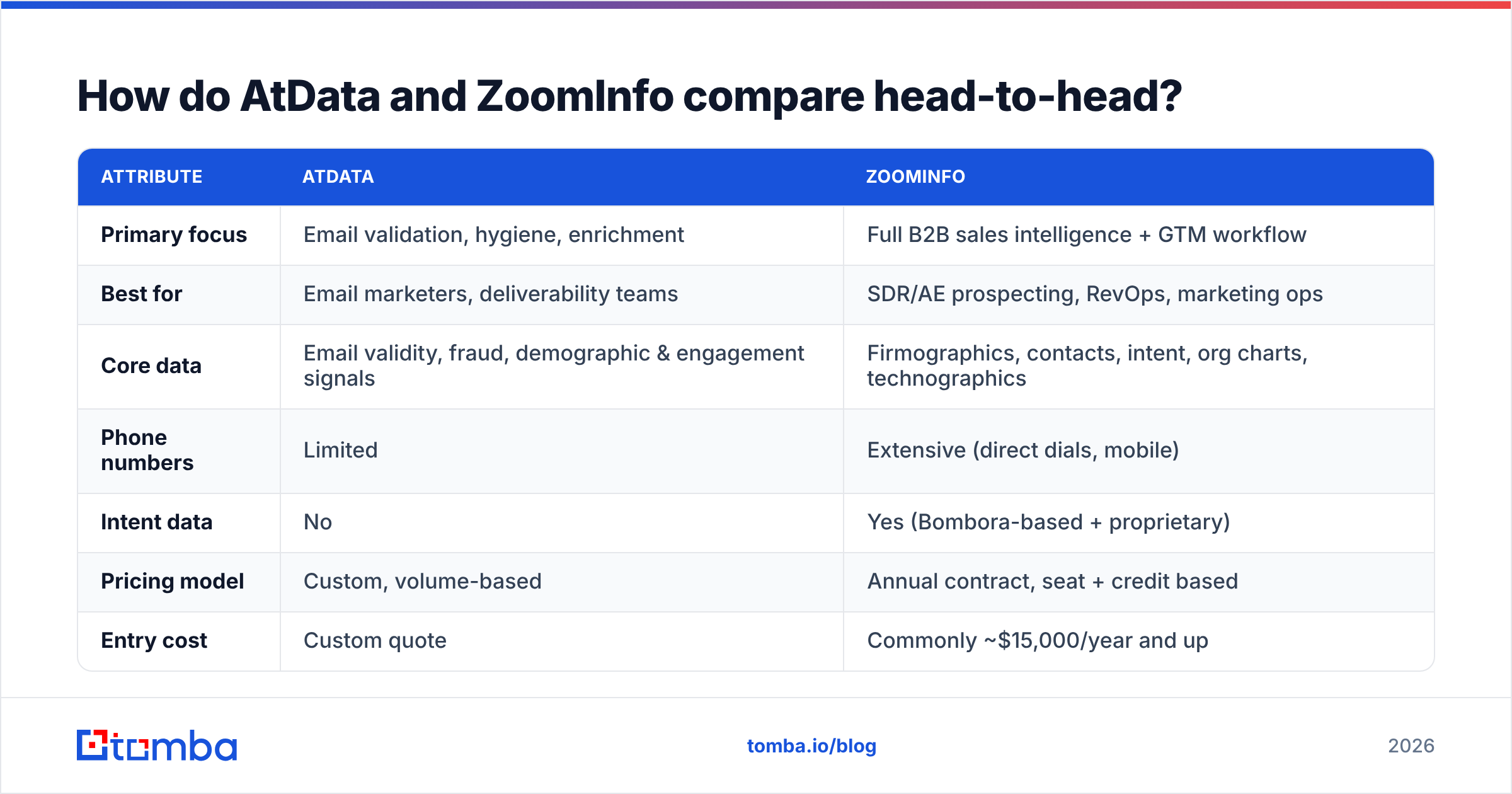
The pattern is clear. ZoomInfo is the broader platform and charges like one. AtData is narrower, deeper on email quality, and priced for data-volume buyers rather than per-seat sales teams.
Which one has better data accuracy?#
It depends on which data you're measuring. For email validity and deliverability scoring, AtData is purpose-built and tends to outperform general platforms — it processes email hygiene at massive scale and that's its entire reason to exist. For contact coverage and firmographic depth across millions of companies, ZoomInfo's database is one of the largest in the category and is hard to beat on raw breadth.
But accuracy in B2B data decays fast. Roughly 25–30% of contact data goes stale every year as people change jobs. That means two things matter more than the marketing claims:
- Recency of refresh — how often the vendor re-verifies records.
- Verification at the point of use — whether you re-check an email before you send.
This is where many teams over-buy. You don't always need a platform that re-verifies a billion records nightly; you need the specific 5,000 emails on your campaign list to be valid today. A dedicated email verifier handles that final check without a platform subscription, and you can pair it with data enrichment only on the records that pass.

What does each platform actually cost in 2026?#
**Neither AtData nor
ZoomInfo publishes transparent pricing**, and both lean on custom quotes and annual commitments. That's the single biggest friction point for smaller teams.
Here's how the cost structures break down:
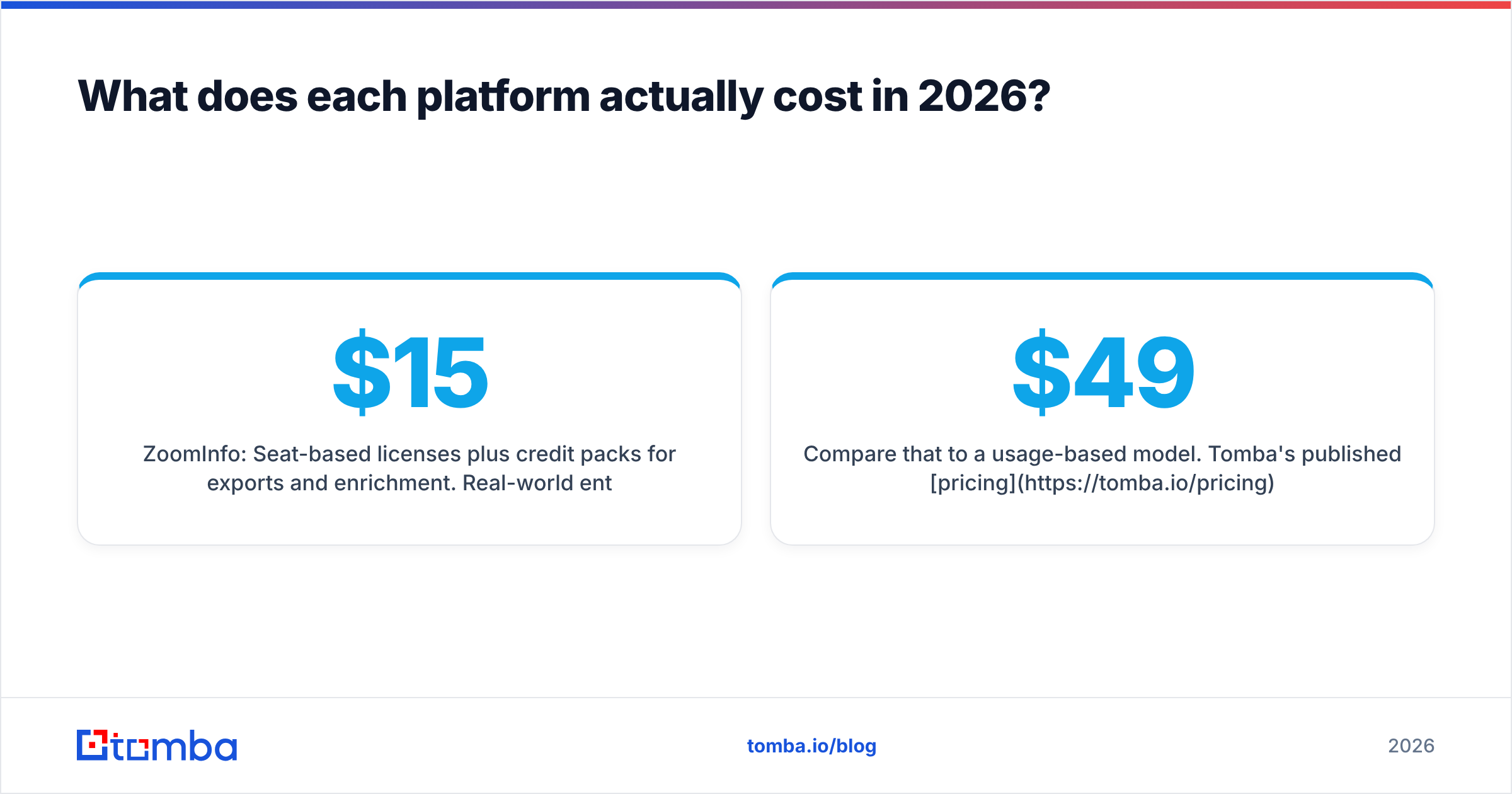
- ZoomInfo: Seat-based licenses plus credit packs for exports and enrichment. Real-world entry points commonly land in the $15,000/year range and climb quickly with intent data, the engagement suite, or additional seats. Contracts are annual, and overage on credits is a recurring complaint on review sites like G2.
- AtData: Volume-based and custom. You're quoted on records processed or API calls, which can be efficient at very high volume but still requires sales contact and a commitment.
Compare that to a usage-based model. Tomba's published pricing runs a Free tier (25 searches/month), Starter at $49/month, Growth at $99/month, and Pro at $249/month — no annual lock, no sales call to get started. For teams that need verified emails by domain or name rather than a full intelligence suite, the cost difference is an order of magnitude.
Who should choose ZoomInfo?#
Choose
ZoomInfo when prospecting and workflow are the job, and budget isn't the gating factor. It's the strongest fit when:
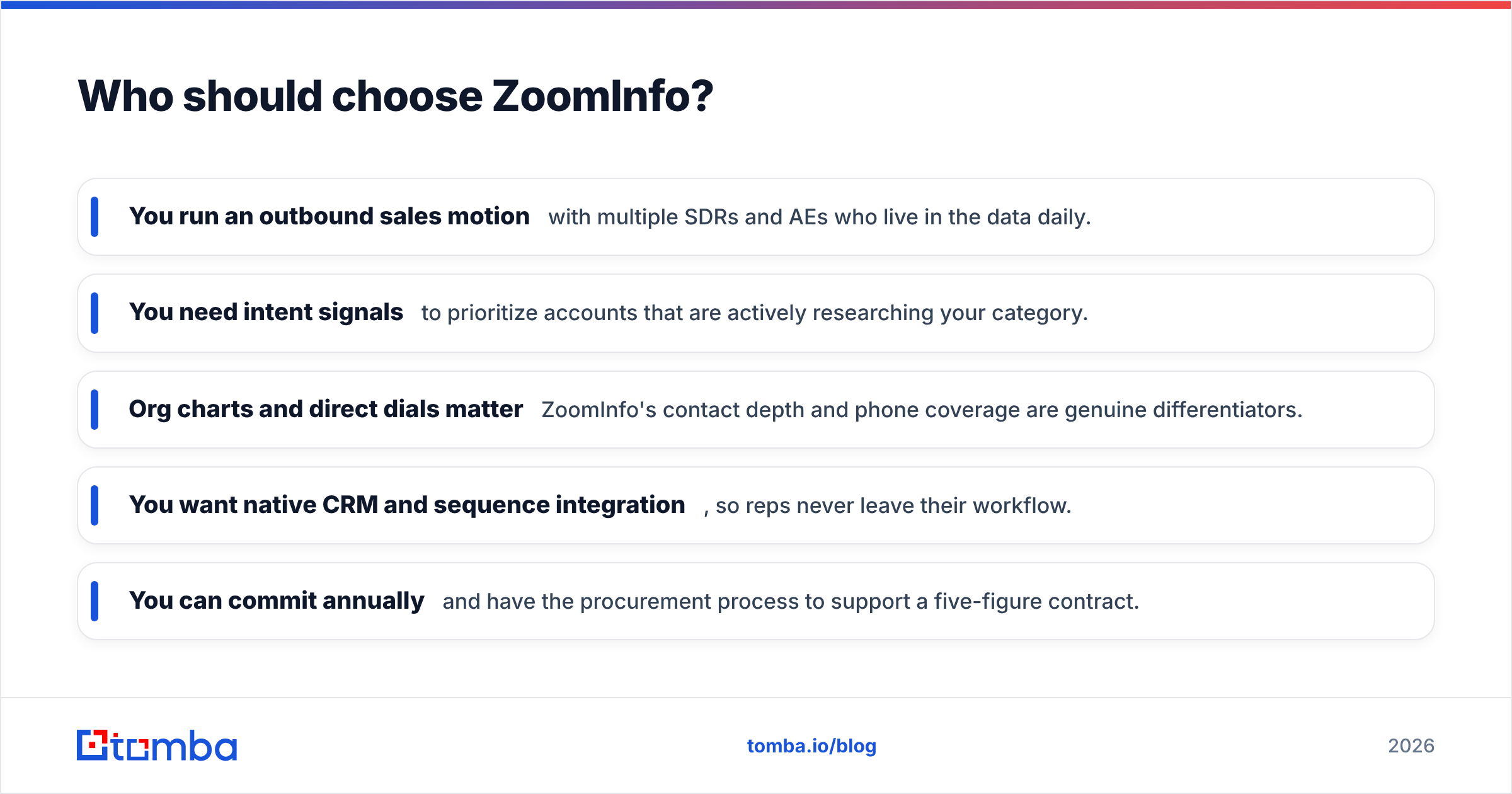
- You run an outbound sales motion with multiple SDRs and AEs who live in the data daily.
- You need intent signals to prioritize accounts that are actively researching your category.
- Org charts and direct dials matter — ZoomInfo's contact depth and phone coverage are genuine differentiators.
- You want native CRM and sequence integration, so reps never leave their workflow.
- You can commit annually and have the procurement process to support a five-figure contract.
If you're a 20-person sales org chasing enterprise accounts, ZoomInfo's breadth often justifies its price. The platform earns its keep when many seats use it every day. For teams evaluating that breadth against leaner options, our Apollo alternative breakdown covers similar trade-offs in the all-in-one category.
Who should choose AtData?#
Choose AtData when email is the asset you're protecting. It's the better pick when:
- You're an email marketer or ESP sending at high volume and need to keep bounce rates and spam complaints low.
- Deliverability and sender reputation are KPIs you actually report on. (If those terms are fuzzy, our glossary on email deliverability and sender reputation is a quick primer.)
- You need demographic and engagement enrichment layered onto existing email lists rather than net-new prospecting.
- Fraud and risk scoring on email signups matters to your business.
AtData is a specialist tool, and specialists win inside their lane. The mistake is buying it expecting ZoomInfo-style prospecting — that's not what it does.
Is there a leaner alternative to both?#
Yes — and for many teams it's the right starting point. Both AtData and
ZoomInfo are heavy commitments designed for buyers with platform-scale needs. A large share of teams evaluating them actually have a narrower job: find and verify professional email addresses, reliably, without a contract.
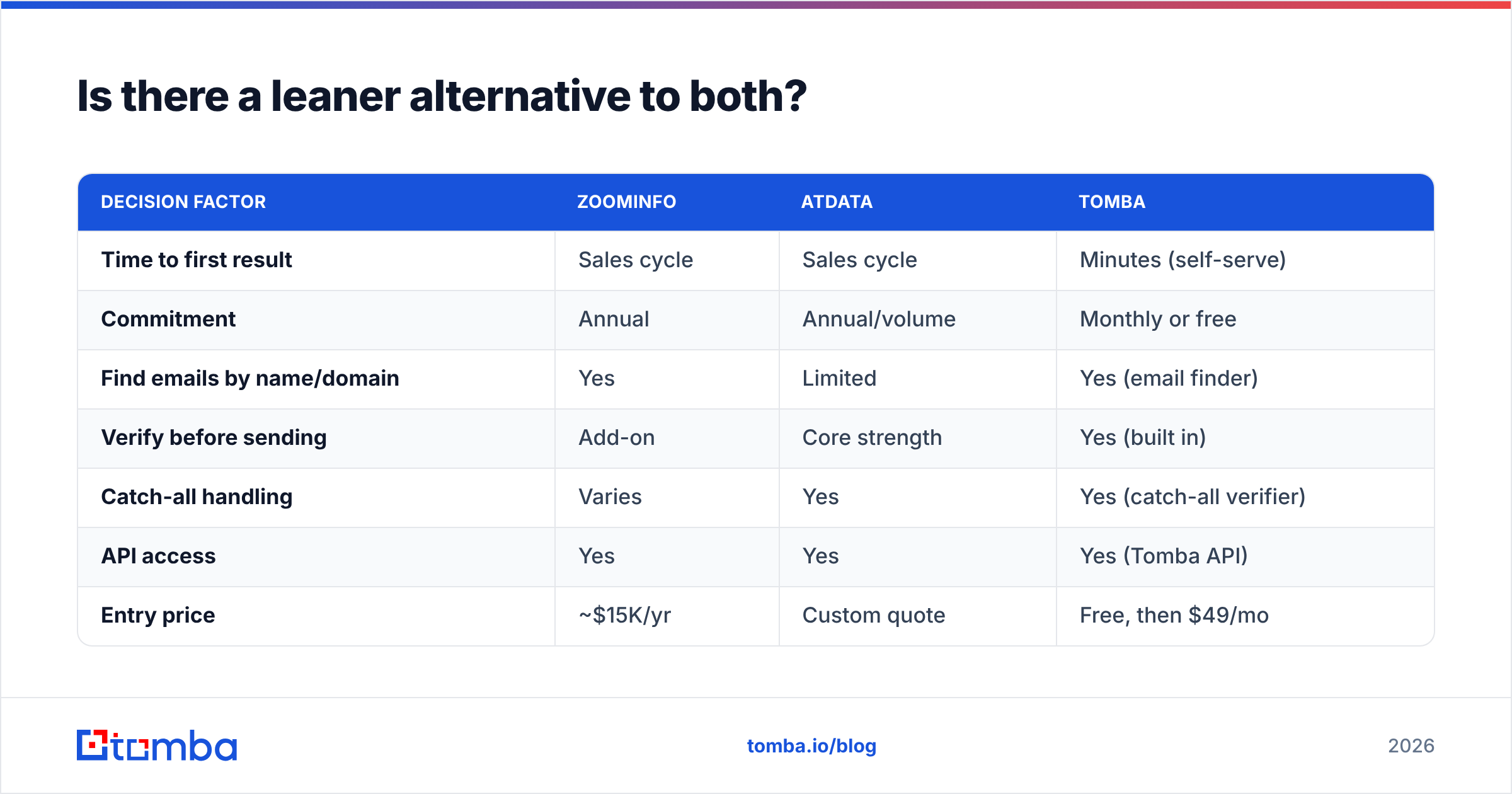
That's the gap usage-based email tooling fills. Here's how the three approaches stack up on the dimensions that matter to a smaller or mid-market team:
| Decision factor | ZoomInfo | AtData | Tomba |
|---|---|---|---|
| Time to first result | Sales cycle | Sales cycle | Minutes (self-serve) |
| Commitment | Annual | Annual/volume | Monthly or free |
| Find emails by name/domain | Yes | Limited | Yes (email finder) |
| Verify before sending | Add-on | Core strength | Yes (built in) |
| Catch-all handling | Varies | Yes | Yes (catch-all verifier) |
| API access | Yes | Yes | Yes (Tomba API) |
| Entry price | ~$15K/yr | Custom quote | Free, then $49/mo |
The honest framing: Tomba doesn't replace ZoomInfo's intent data or AtData's enterprise-grade hygiene pipeline. What it replaces is the reason most teams shop for those platforms in the first place — getting accurate work emails and confirming they're deliverable. You can run a domain search to pull every email pattern at a target company, verify the results, and push them into your CRM, all on a self-serve plan.
How do you actually decide?#
Run this three-question test before you talk to any sales rep:
- What's the dominant job? Prospecting and territory planning → lean ZoomInfo. Email hygiene at scale → lean AtData. Finding and verifying specific contacts → start with a usage-based finder.
- What's your commitment tolerance? If you can't justify an annual five-figure contract yet, don't force it. Begin with a monthly or free tool and graduate to a platform when daily seat usage proves the need.
- Where does data decay hurt you most? If it's bounced campaigns, prioritize verification. If it's wasted rep hours on bad accounts, prioritize coverage and intent.
Most teams discover their real need is narrower than the platforms they were quoting. Buy for the job you have this quarter, not the org chart you hope to have in two years.
The bottom line on AtData vs ZoomInfo#
ZoomInfo is the broader platform; AtData is the email specialist — and most teams comparing them actually need a third, leaner option first. ZoomInfo justifies its price when many reps use it daily for prospecting and intent. AtData justifies its when email deliverability is a reported KPI. Both demand annual or volume commitments and a sales conversation just to see a number.
If your core need is finding professional email addresses by domain, name, or company — and confirming they're valid before you send — start with the Tomba Email Finder. You get a free tier with 25 searches a month, transparent pricing from $49/month, built-in verification, and an API, with no annual lock and no procurement gauntlet. Prove the workflow, see your real volume, and only move up to a heavyweight platform when the data actually tells you to.
// get started
Find, verify and enrich your first contacts today
Start on the free plan with 25 searches a month, then scale when your team is ready.
Free plan · No credit card required · GDPR & CCPA
// about the author