Atompark Software vs Apollo.io: The 2026 B2B Tool Verdict
Atompark builds bulk email and extraction tools; Apollo.io sells a sales-intelligence database. We compare data accuracy, deliverability, pricing, and fit so you pick the right stack for 2026.
Atompark Software vs Apollo.io is a common comparison for B2B teams, yet the two tools rarely do the same job. This guide breaks down data accuracy, deliverability, features, and pricing so you can pick the right fit for 2026.
TL;DR
- Atompark Software is a veteran desktop-and-cloud suite for bulk email sending and extraction (Atomic Mail Sender, Atomic Email Hunter, EPOCHTA). Apollo.io is a cloud sales-intelligence and engagement platform with a 270M+ contact database. They overlap only at the edges.
- Choose Atompark if you want one-time license pricing and full control of your own SMTP for volume email. Choose Apollo.io if you need fresh B2B contact data, prospecting filters, and sequences inside one tool.
- On data accuracy, Apollo wins against Atompark's scraped lists — but neither matches a verification-first finder. Bounce rates make or break both.
- Pricing models differ completely: Atompark sells perpetual desktop licenses (roughly $30–$300 one-time per app); Apollo runs per-seat SaaS from a free tier up to $99/user/mo on Organization.
- If your real goal is accurate, verified emails to feed either tool, a dedicated finder like Tomba is the cleaner front end — and far cheaper than wasting Apollo credits on stale records.
What are Atompark Software and Apollo.io?#
Short answer: they solve different problems that happen to touch the same inbox.
Atompark Software is one of the older names in email marketing. Think of it as a workshop full of standalone tools. Atomic Mail Sender blasts newsletters through your own SMTP. Atomic Email Hunter scrapes addresses off websites. Atomic Email Studio bundles them, and the EPOCHTA cloud service handles managed sending. You buy a license, install it, and own the workflow. It suits marketers who want to control delivery and pay once, not forever.
Apollo.io sits at the opposite end of the modern stack. It is a SaaS platform built around a large, always-refreshed B2B database.
On top of that data, it adds prospecting filters, email and call sequences, a Chrome extension, and CRM sync. You don't scrape the open web yourself. Instead, you search Apollo's index of companies and people, apply filters like title, headcount, tech stack, or intent, and push contacts into outreach. You can read more on the Apollo.io homepage and its reviews on G2.
The confusion is understandable. Both tools can build a list of email addresses, and both can send mail. But Atompark's value is sending infrastructure and DIY extraction. Apollo's value is data plus an engagement layer. So the real Atompark Software vs Apollo.io question is about your goal. Pick without naming that goal, and you end up paying for the wrong thing.

Atompark Software vs Apollo.io: how do they compare feature by feature?#
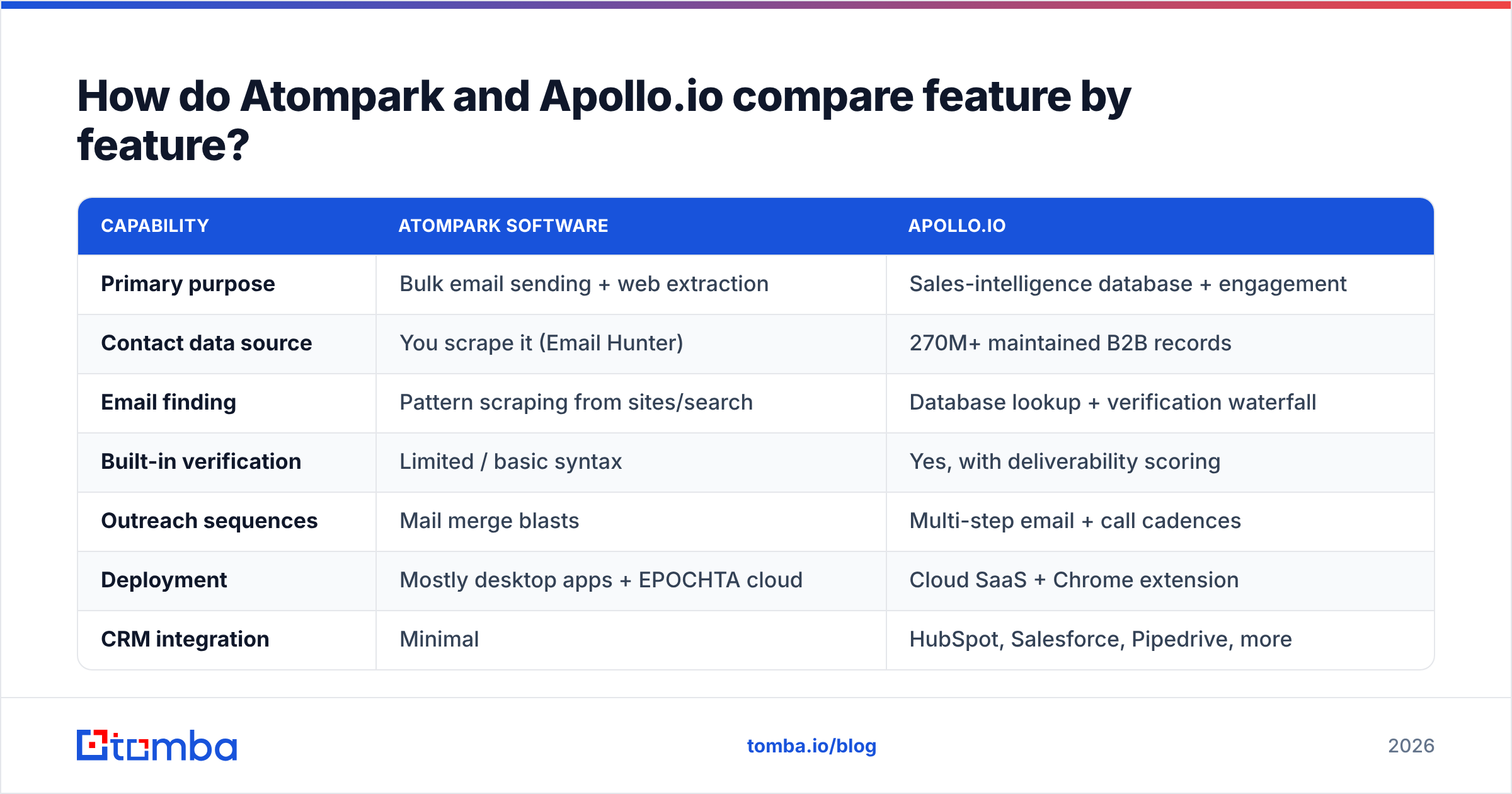
Here is the core breakdown. Notice that the two products barely overlap outside of "emails go out the door."
| Capability | Atompark Software | Apollo.io |
|---|---|---|
| Primary purpose | Bulk email sending + web extraction | Sales-intelligence database + engagement |
| Contact data source | You scrape it (Email Hunter) | 270M+ maintained B2B records |
| Email finding | Pattern scraping from sites/search | Database lookup + verification waterfall |
| Built-in verification | Limited / basic syntax | Yes, with deliverability scoring |
| Outreach sequences | Mail merge blasts | Multi-step email + call cadences |
| Deployment | Mostly desktop apps + EPOCHTA cloud | Cloud SaaS + Chrome extension |
| CRM integration | Minimal | HubSpot, Salesforce, Pipedrive, more |
| Pricing model | One-time license per app | Per-seat subscription |
| Best for | DIY marketers controlling SMTP | SDR/AE teams prospecting at scale |
The pattern is clear. Apollo is the choice when you don't have data and want a turnkey prospecting-to-sequence pipeline. Atompark is the choice when you already have a list (or a way to build one) and you want to own the sending engine without a recurring SaaS bill.
One caution on Atompark's extraction model. Scraping addresses off public pages pulls in many role accounts (info@, sales@), catch-all domains, and stale records. Feed those straight into a sender and your bounce rate spikes. Your domain reputation suffers too. That is why a verification step is no longer optional — use Apollo's built-in scoring or a standalone email verifier.
Which has better data accuracy?#
Apollo.io is more accurate than Atompark's scraped output, but "accurate enough to send" still depends on a verification pass.
Atompark's Email Hunter finds whatever is published on a page. That is fast and cheap. But published addresses skew toward generic inboxes and dead mailboxes. No large database sits behind it to correct for job changes or dead domains. Apollo works differently. It maintains its index and runs contacts through an internal waterfall before showing them. That is why its accuracy usually lands far higher in independent tests.
But Apollo is not flawless. Large databases age. People switch jobs, companies rebrand, and a record that verified six months ago may now bounce. Many teams re-verify Apollo exports before a cold campaign, especially for senior titles where turnover is high. The safe workflow is the same for either tool: never trust a list blind.

This is where a dedicated finder earns its place. Tomba's approach is verification-first. Every address is checked against SMTP, MX, and catch-all signals before it reaches you. You can also confirm shaky records with the catch-all verifier instead of gambling on them. Whether you export from Apollo or scrape with Atompark, a finder-grade verifier is the cheapest insurance against a reputation hit.
How does deliverability differ between the two?#
Atompark gives you more control over sending; Apollo gives you more guardrails — and neither protects you from a dirty list.
Atompark's Mail Sender connects to your own SMTP or local server. You decide IPs, throttling, and headers. Power users love this. The risk is that all the deliverability work lands on you. SPF, DKIM, DMARC, warmup, and list hygiene are your job. Get the SPF record wrong and your campaign hits spam, no matter how good the copy.
Apollo hides much of that complexity. It connects to your Google or Microsoft mailbox, paces sends, and flags deliverability warnings. But you are bound by mailbox sending limits and Apollo's sequencing rules. It is safer for beginners and tighter for volume senders.
Either way, deliverability still starts with the list. A 5% bounce rate will tank both tools. So validate your domains and patterns before any send. Our domain search confirms which addresses really exist at a company first. The glossary entry on email deliverability explains the reputation mechanics in plain terms.
What about pricing — one-time license vs subscription?#
This is the sharpest dividing line: Atompark sells software you own, Apollo rents you data.
Atompark uses perpetual licensing. You pay once per app — usually tens to low hundreds of dollars, depending on the tool and edition. Then you keep using it. The EPOCHTA cloud service is the exception, billed by volume. For a small business that hates recurring SaaS fees, the one-time model is appealing.
Apollo is classic per-seat SaaS. It has a usable free tier and paid plans that scale by credits and features. For a growing SDR team that needs fresh data each month, the subscription buys ongoing database upkeep you could never match by scraping.
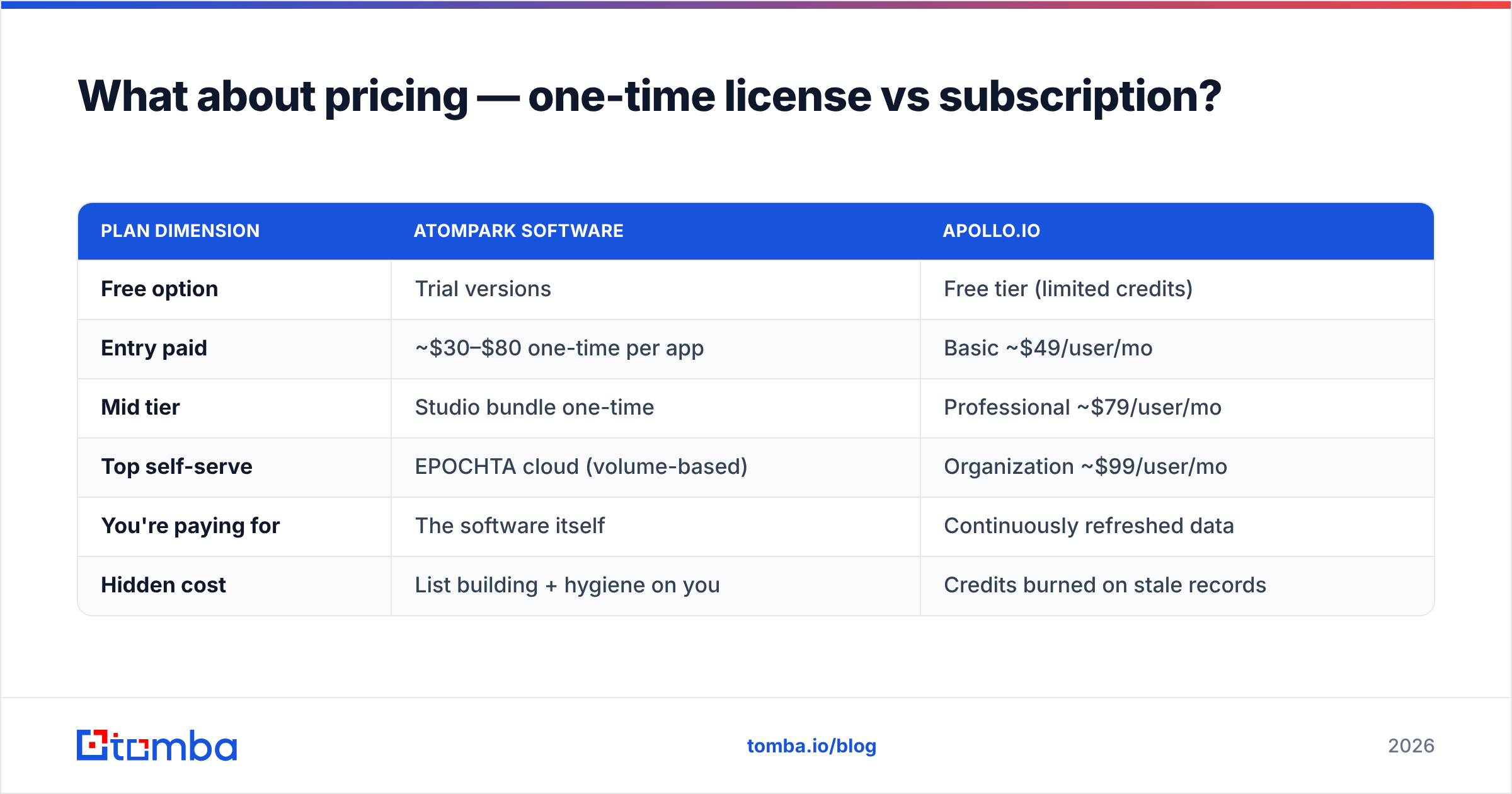
| Plan dimension | Atompark Software | Apollo.io |
|---|---|---|
| Free option | Trial versions | Free tier (limited credits) |
| Entry paid | ~$30–$80 one-time per app | Basic ~$49/user/mo |
| Mid tier | Studio bundle one-time | Professional ~$79/user/mo |
| Top self-serve | EPOCHTA cloud (volume-based) | Organization ~$99/user/mo |
| You're paying for | The software itself | Continuously refreshed data |
| Hidden cost | List building + hygiene on you | Credits burned on stale records |
The hidden cost line matters most. Atompark's cheap license looks like a bargain until you count the hours spent building and cleaning lists. Apollo's subscription looks complete until you watch credits burn on records that bounce. In both cases, a focused finder with transparent Tomba pricing — a free tier at 25 searches, Starter at $49/mo, Growth at $99/mo — often replaces the priciest part of either workflow: getting clean, verified contacts in the first place.

When should you pick Atompark, Apollo, or something else?#
Match the tool to the job, not the brand.
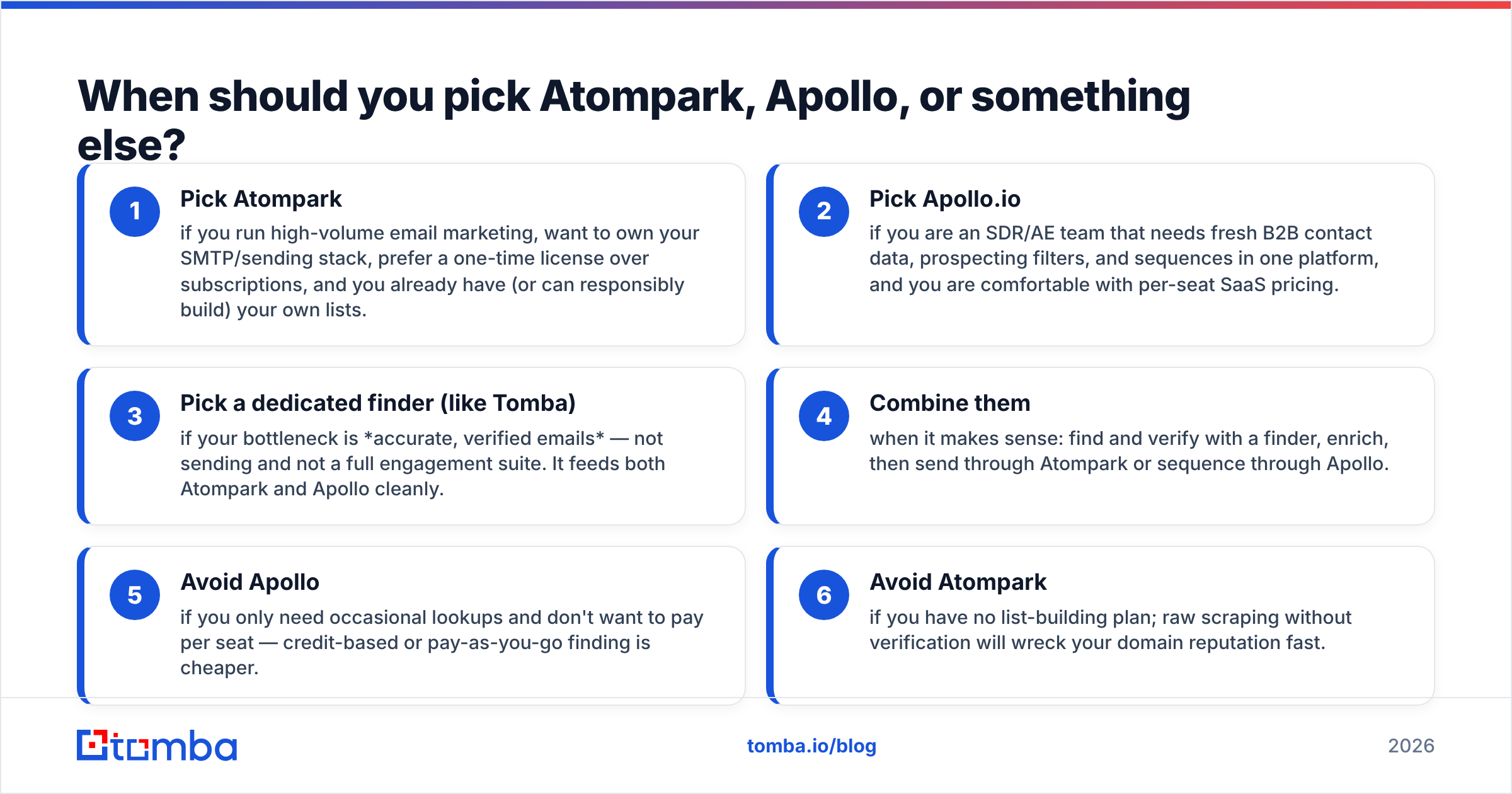
Use these quick rules:
- Pick Atompark if you run high-volume email marketing, want to own your SMTP/sending stack, prefer a one-time license over subscriptions, and you already have (or can responsibly build) your own lists.
- Pick Apollo.io if you are an SDR/AE team that needs fresh B2B contact data, prospecting filters, and sequences in one platform, and you are comfortable with per-seat SaaS pricing.
- Pick a dedicated finder (like Tomba) if your bottleneck is accurate, verified emails — not sending and not a full engagement suite. It feeds both Atompark and Apollo cleanly.
- Combine them when it makes sense: find and verify with a finder, enrich, then send through Atompark or sequence through Apollo.
- Avoid Apollo if you only need occasional lookups and don't want to pay per seat — credit-based or pay-as-you-go finding is cheaper.
- Avoid Atompark if you have no list-building plan; raw scraping without verification will wreck your domain reputation fast.
Leaning toward Apollo but worried about per-seat cost or data freshness? Scan the Apollo alternative options before you commit a whole team to seats. And if your campaigns live or die on data quality, pair any sender with proper data enrichment. That closes the gap between "a list" and "a list that converts."

Is there a smarter middle path?#
Yes — separate the three jobs these tools blur together: finding, verifying, and sending.
Atompark bundles finding and sending. Apollo bundles data, finding, verifying, and sequencing. Unbundle them, and you can buy the best version of each job. That beats paying for an all-in-one that is only average at the part you care about.
For most B2B teams in 2026, the front of the funnel matters most: getting real, deliverable emails for the right people at the right companies. That is exactly what a purpose-built finder does. It is also the input that decides whether Apollo sequences or Atompark blasts ever land. Get it wrong, and no amount of clever copy or sending control saves the campaign.
So before you renew an Apollo seat or buy another Atompark license, ask what you are actually short on. If it's data accuracy, fix that first.
The bottom line#
In the end, Atompark Software vs Apollo.io is not a real rivalry — the two answer different questions. Atompark is the DIY sender-and-scraper you own outright. Apollo is the subscription database-and-sequencer you rent. Atompark wins on price control and infrastructure ownership. Apollo wins on data freshness, verification, and an integrated outreach workflow. Both lose the moment your list goes dirty.
That shared weakness is the opportunity. Start with verified data, and the rest of the stack works. Tomba's email finder gives you accurate, SMTP-verified professional emails by domain, name, or company. That clean fuel makes Atompark's sending and Apollo's sequences actually perform. Try the free tier (25 searches, no card). Then scale to Starter at $49/mo when you are ready to feed your outbound machine the right contacts from day one.
// get started
Find, verify and enrich your first contacts today
Start on the free plan with 25 searches a month, then scale when your team is ready.
Free plan · No credit card required · GDPR & CCPA
// about the author