Atompark Software vs DiscoverOrg: B2B Data Compared (2026)
Atompark Software and DiscoverOrg solve different B2B problems at wildly different prices. Here's an honest 2026 breakdown of features, cost, and the smarter modern alternative.
Atompark Software and DiscoverOrg get lumped together in "B2B lead generation tool" lists, but they are not the same kind of product, and choosing between them by name alone is how teams waste budget. One is a suite of desktop email-marketing utilities. The other was an enterprise sales-intelligence database that no longer exists under its own name. Before you buy either, you need to know what they actually do in 2026.
TL;DR#
- Atompark Software is a Cyprus-based vendor of desktop and SaaS email-marketing tools (Atomic Mail Sender, email extractors, list verifiers). It's cheap, self-serve, and built for bulk email senders — not for sourcing accurate B2B contacts.
- DiscoverOrg no longer exists as a standalone product. It merged with ZoomInfo in 2019, and the brand was folded into the ZoomInfo platform. Enterprise pricing, deep org charts, intent data.
- These tools sit at opposite ends of the market: Atompark is a low-cost sending toolkit; DiscoverOrg/ZoomInfo is a high-cost data engine.
- If you actually need accurate, verified B2B contact data without an enterprise contract, a modern API-first finder like Tomba is the more practical middle ground.
- Pick by job-to-be-done: bulk send (Atompark), enterprise account intelligence (ZoomInfo), or affordable verified email sourcing (Tomba).
What is Atompark Software?#
Atompark Software is a long-running vendor (around since the early 2000s) that sells a collection of email-focused desktop applications and a hosted service called Atomic Mail Sender / MassMailer. Its catalog includes bulk email senders, email extractors, email list verifiers, and email-address harvesting utilities that scrape addresses from websites, search engines, and local files.
The appeal is simple: you pay once (or a low subscription), install the software, and blast email campaigns from your own machine. There is no per-contact data charge because Atompark does not sell you a contact database — you bring or scrape your own list.
That model has a catch. Scraped lists are unverified, often outdated, and frequently violate sending-platform terms and modern privacy law. Sending bulk mail to harvested addresses is the fastest way to destroy your sender reputation and land on a blacklist. Atompark gives you the gun; it does not check whether you're aiming at your own foot.
You can read more about the vendor on its own site at atompark.com and browse user reviews on G2.
What is DiscoverOrg (and does it still exist)?#
DiscoverOrg was a premium B2B sales-intelligence platform known for human-verified org charts, direct-dial phone numbers, and deep account data in IT, finance, and marketing verticals. It built a reputation for accuracy because it employed research teams that manually validated records.
Here's the key fact for 2026: DiscoverOrg acquired ZoomInfo in 2019 and rebranded the combined company as ZoomInfo. The DiscoverOrg product line was absorbed into the ZoomInfo platform. So when someone says they want "DiscoverOrg today," they really mean ZoomInfo — its data depth, its intent signals, and its enterprise pricing.
That matters because the buying experience changed completely. DiscoverOrg-via-ZoomInfo is now a sales-led, annual-contract enterprise platform. You talk to a rep, you negotiate seats and credits, and the entry cost typically runs into five figures per year. There is no cheap self-serve tier comparable to Atompark.
Atompark Software vs DiscoverOrg: how do they compare?#
The honest answer is that they barely compete — they solve different problems for different buyers. Atompark is a sending and list-building toolkit. DiscoverOrg/
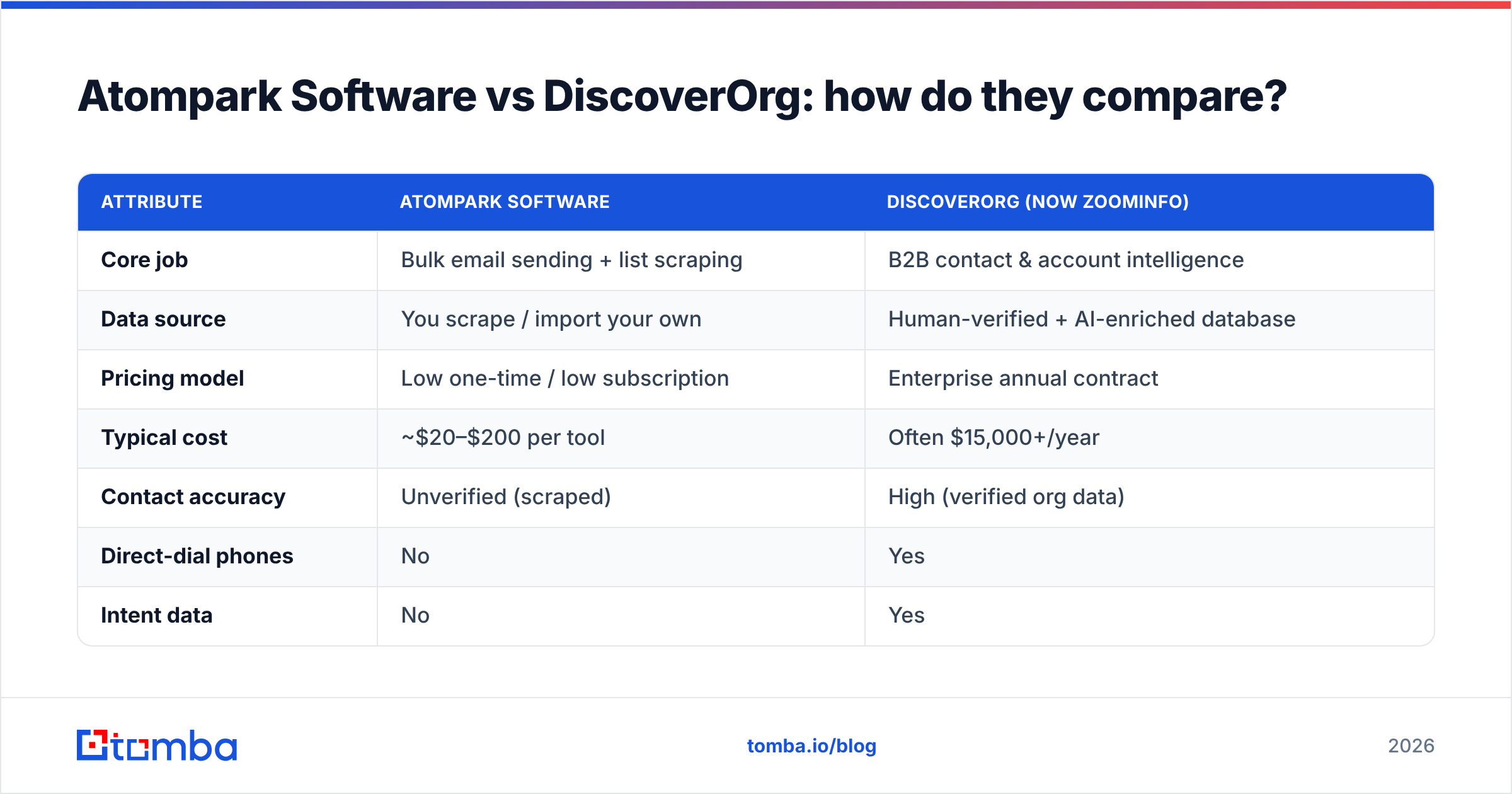
ZoomInfo is a data and intelligence platform. The table below makes the contrast concrete.
| Attribute | Atompark Software | DiscoverOrg (now ZoomInfo) |
|---|---|---|
| Core job | Bulk email sending + list scraping | B2B contact & account intelligence |
| Data source | You scrape / import your own | Human-verified + AI-enriched database |
| Pricing model | Low one-time / low subscription | Enterprise annual contract |
| Typical cost | ~$20–$200 per tool | Often $15,000+/year |
| Contact accuracy | Unverified (scraped) | High (verified org data) |
| Direct-dial phones | No | Yes |
| Intent data | No | Yes |
| Deployment | Desktop apps + hosted sender | Cloud SaaS + CRM integrations |
| Best for | Solo senders, tight budgets | Enterprise sales & RevOps teams |
| Compliance risk | High (harvested lists) | Low (managed data) |
The gap in price reflects the gap in value. Atompark sells software; ZoomInfo sells data. If your problem is "I need to send a newsletter from my desktop," Atompark is overkill-free and cheap. If your problem is "I need to map the buying committee at 2,000 target accounts," only the ZoomInfo side answers it — at a price most small teams can't justify.
Which one is more accurate for B2B contact data?#
DiscoverOrg/ZoomInfo wins on raw accuracy, full stop. Verified org charts and maintained records beat anything you scrape with a desktop extractor. But accuracy you can't afford isn't accuracy you can use, and that's the trap many small and mid-market teams fall into.
Atompark's extractors pull whatever text matches an email pattern. There's no validation that the inbox exists, that the person still works there, or that the address isn't a spam trap. You'd need a separate email verifier step before sending anything — and even then, you're verifying low-quality raw input.
This is exactly the middle ground a focused email finder fills. Instead of scraping or buying an entire enterprise database, you look up the specific people you need, get a confidence score on each address, and verify catch-all domains before they burn your reputation. You can read about where the data comes from rather than trusting a black-box scrape.

How does pricing really differ?#
This is where the two vendors are furthest apart, and where a third option usually wins.
Atompark is priced like utility software. Individual tools cost roughly $20 to a couple hundred dollars, sometimes as a one-time license. There's no per-lead data fee because there's no data product — which also means there's no quality guarantee.
**DiscoverOrg/
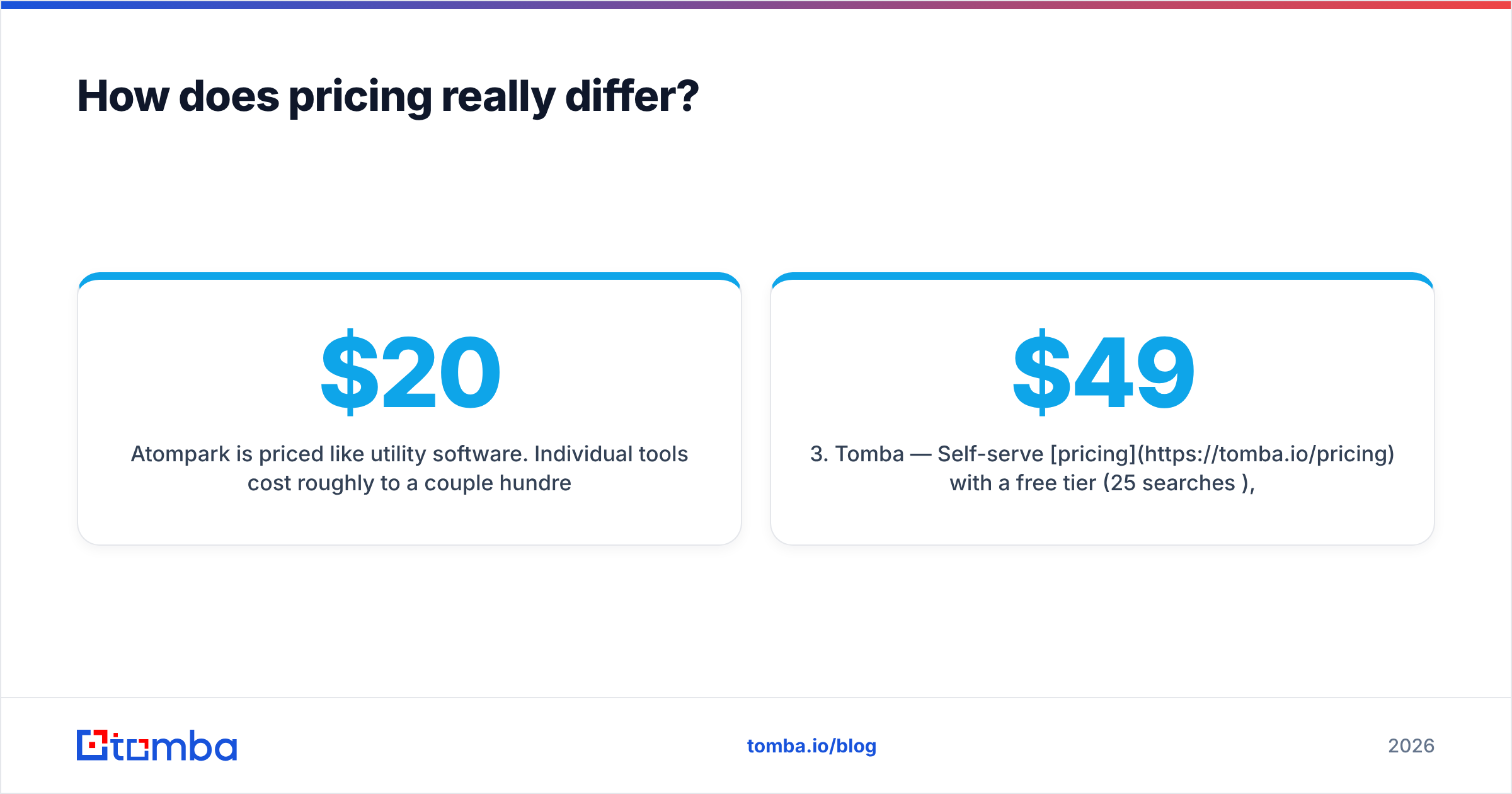
ZoomInfo** is priced like enterprise infrastructure. Contracts are annual, negotiated, and commonly start in the mid-five-figures once you add seats, credits, and premium data packages like intent. Great if you're a funded sales org; painful if you're a three-person team.
For teams that want verified data without an enterprise contract, transparent usage-based pricing is the sweet spot. Here's how the three approaches stack up:
- Atompark — Low upfront cost, but you pay later in deliverability damage and manual cleanup. No usable contact database included.
- DiscoverOrg / ZoomInfo — Best-in-class data, enterprise-only price, annual lock-in. Overkill unless you're scaling outbound at volume.
- Tomba — Self-serve pricing with a free tier (25 searches/mo), Starter at $49/mo, Growth at $99/mo, and Pro at $249/mo. Verified emails, data enrichment, and an API without a sales call.
- Hybrid stack — Some teams use ZoomInfo for account mapping and a finder like Tomba for fast, cheap email lookups on the long tail of contacts ZoomInfo charges premium credits for.
The point isn't that one price is "right." It's that you should match spend to the job. Paying enterprise rates to find a handful of emails is waste; relying on free scrapers for revenue-critical outreach is risk.
Which tool should you choose in 2026?#
Choose based on the job in front of you, not the brand recognition.
Pick Atompark Software if you're a solo operator or very small business that needs a cheap, self-hosted way to send bulk email and you already have a clean, opt-in list. Just know you're responsible for list quality, compliance, and deliverability — the tool won't protect you.
Pick DiscoverOrg (ZoomInfo) if you're an enterprise or well-funded mid-market sales org that needs verified org charts, direct dials, intent data, and tight CRM integration — and you can absorb a five-figure annual contract. The data is genuinely excellent at that tier.
Pick a modern email finder like Tomba if you sit in the large gap between those two: you need accurate, verified B2B emails and phone numbers, you want transparent pay-as-you-grow pricing, and you'd rather call an email finder API than negotiate a contract or babysit a scraper. You can find emails by name, run domain search across a company, verify catch-all domains, and enrich records — all self-serve.
Most teams under a few hundred reps land in that third bucket. They don't need a desktop scraper, and they can't justify enterprise data spend, but they absolutely need contacts that actually deliver.
The bottom line#
Atompark Software and DiscoverOrg aren't really rivals — they're answers to different questions. Atompark is a budget sending toolkit that leaves data quality entirely on you. DiscoverOrg is now ZoomInfo: premium, accurate, and priced for the enterprise. Neither is the obvious default for a growing team that just needs reliable contact data at a fair price.
If that's you, skip the false binary. Start with Tomba's email finder — find and verify professional emails by name, company, or domain, get a confidence score on every result, and only pay for what you use. Try the free tier (25 searches), and scale to a paid plan when your pipeline does. It's the accuracy you want from DiscoverOrg at a price closer to Atompark, without the deliverability risk of either.
Ready to find emails that actually work?
Join 150,000+ professionals who stopped guessing and started sending. Free credits on signup — no credit card required.
Get the Tomba newsletter
Practical outbound tactics and product updates — once every two weeks.
About the author