Atompark Software vs Exellius: 2026 B2B Outreach Compared
Atompark Software is DIY bulk-email software; Exellius is a done-for-you lead-gen service. Here's which model fits your 2026 outbound motion — and the data layer both need.
Choosing between Atompark Software vs Exellius is really a choice between two outbound philosophies: own the tooling and run campaigns yourself, or hand the whole motion to an outside team. They get lumped together in "B2B outreach" searches, but they sit on opposite ends of the build-vs-buy spectrum. This guide breaks down what each one actually does, what it costs, where it breaks, and how to decide — without the marketing gloss.
TL;DR#
- Atompark Software is a long-running vendor of desktop and SaaS bulk-email/SMS tools (Atomic Mail Sender, Atomic Email Studio, Atomic Email Hunter). You buy a license and run the sending yourself.
- Exellius is a done-for-you B2B lead-generation and appointment-setting service — a team runs multichannel outbound on your behalf and books meetings.
- They're not direct competitors. One sells software; the other sells outcomes. The right pick depends on whether you have in-house operators and time.
- Both live or die on contact data. Stale lists tank deliverability and waste spend no matter which model you choose.
- Tomba sits underneath either approach as the verified email and data layer — find and verify contacts, then feed them into your sender or your agency.
What is Atompark Software?#
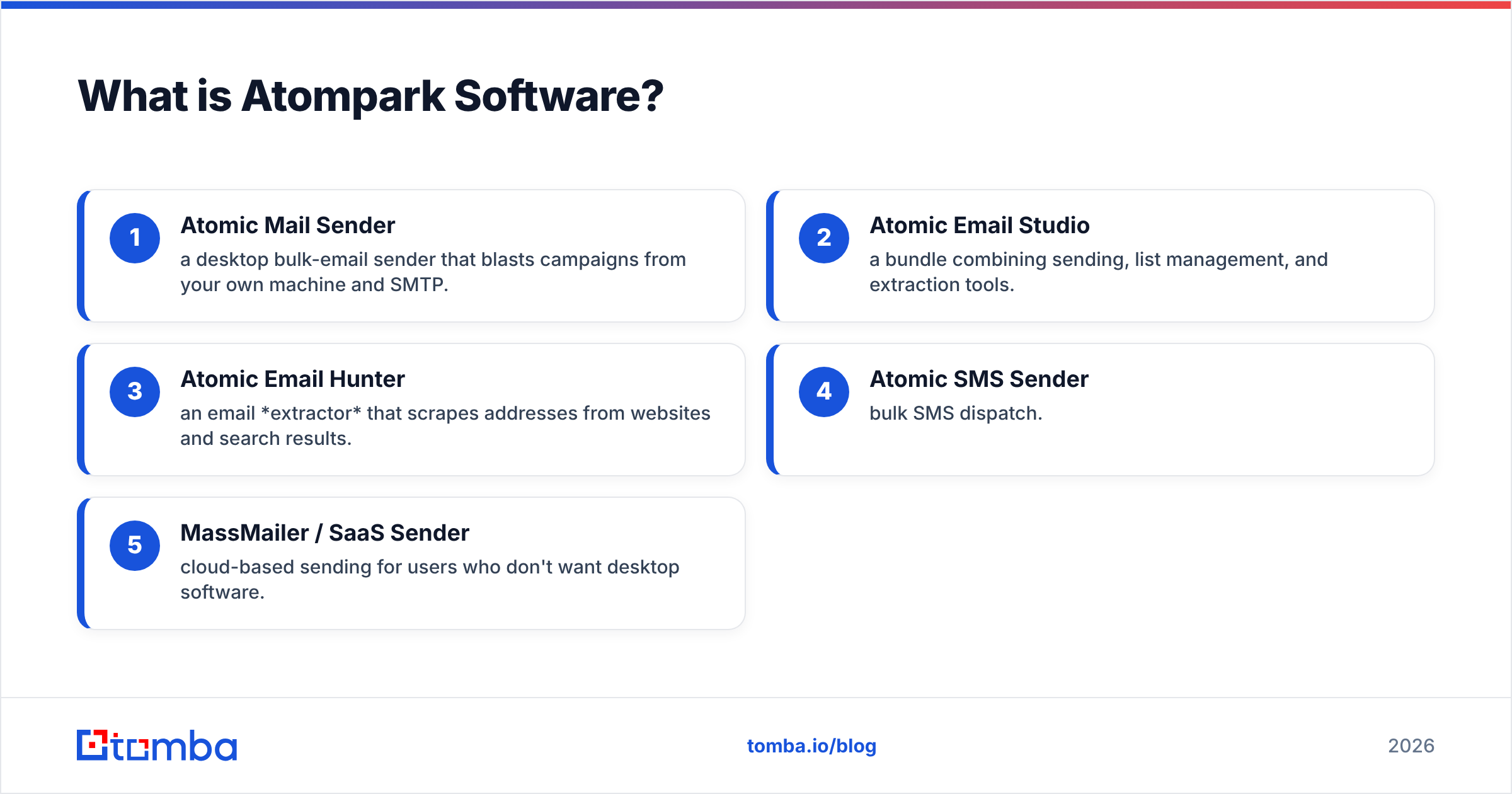
Atompark Software is a veteran desktop-software vendor that has been shipping email and SMS marketing tools since the early 2000s. Its catalog is a suite of standalone Windows applications and a few SaaS products rather than one unified platform. The best-known pieces are:
- Atomic Mail Sender — a desktop bulk-email sender that blasts campaigns from your own machine and SMTP.
- Atomic Email Studio — a bundle combining sending, list management, and extraction tools.
- Atomic Email Hunter — an email extractor that scrapes addresses from websites and search results.
- Atomic SMS Sender — bulk SMS dispatch.
- MassMailer / SaaS Sender — cloud-based sending for users who don't want desktop software.
The model is DIY and license-based: you pay (often a one-time license per app, plus upgrades) and you operate everything. That appeals to technical marketers who want control over the sending engine and don't want a per-contact SaaS bill. The trade-off is that you are responsible for list quality, deliverability, warm-up, and compliance — the software hands you a loaded sprayer and trusts you to aim it.
A word of caution that any honest review has to make: scraped-and-blast workflows (extract addresses, then mail them in volume) carry real deliverability and legal risk under GDPR and CAN-SPAM. The tool doesn't enforce consent; that's on you.
What is Exellius?#
Exellius is a service, not software. Exellius Systems positions itself as a B2B demand-generation and appointment-setting partner: you brief them on your ideal customer profile, and their team builds target lists, writes sequences, runs multichannel outreach (email + LinkedIn + sometimes phone), and books qualified meetings into your reps' calendars.
The value proposition is offloading the work. You don't hire SDRs, buy a sending stack, or manage deliverability — you pay a retainer (or per-meeting fee) and receive booked appointments. For founders and small sales teams without an outbound engine, that's attractive. The trade-offs are the usual agency ones: less control over messaging, variable lead quality depending on the team assigned, ramp time, and a monthly commitment that dwarfs a software license.
Because Exellius owns the execution, your results depend heavily on their data sources and their SDRs — which is exactly why you should ask any agency where their contact data comes from and how it's verified before signing.
Atompark Software vs Exellius: how do they compare?#
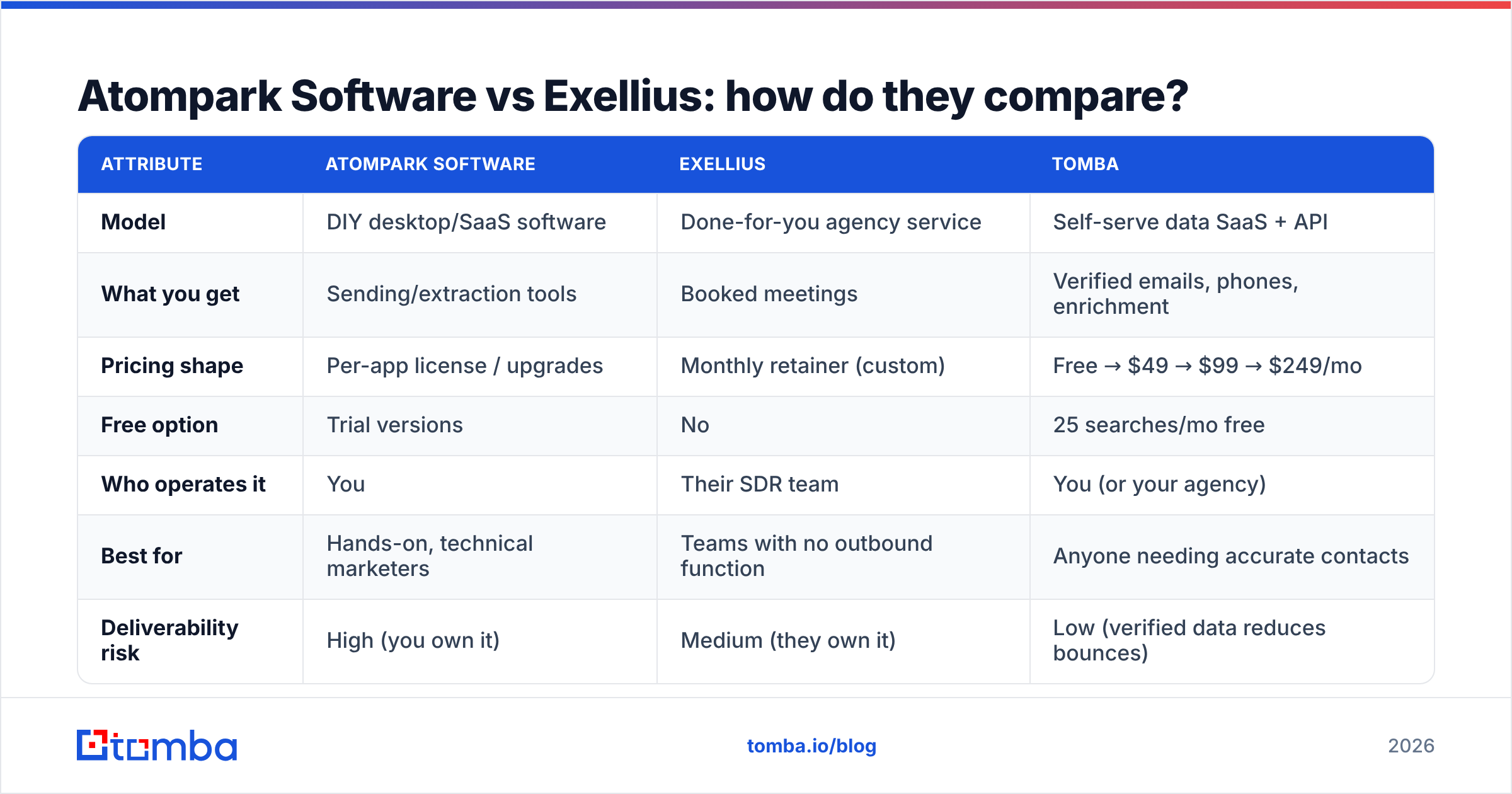
The clearest way to see the difference is side by side. Because these two solve the same business goal through different models, the table also includes Tomba — the data layer that complements either choice.
| Attribute | Atompark Software | Exellius | Tomba |
|---|---|---|---|
| Model | DIY desktop/SaaS software | Done-for-you agency service | Self-serve data SaaS + API |
| What you get | Sending/extraction tools | Booked meetings | Verified emails, phones, enrichment |
| Pricing shape | Per-app license / upgrades | Monthly retainer (custom) | Free → $49 → $99 → $249/mo |
| Free option | Trial versions | No | 25 searches/mo free |
| Who operates it | You | Their SDR team | You (or your agency) |
| Best for | Hands-on, technical marketers | Teams with no outbound function | Anyone needing accurate contacts |
| Deliverability risk | High (you own it) | Medium (they own it) | Low (verified data reduces bounces) |
| Time to first send | Hours | Weeks (onboarding) | Minutes |
| Data freshness | Scraped, unverified | Varies by vendor | Continuously verified |
The headline: Atompark sells you the machine, Exellius sells you the result, and Tomba sells you the fuel both need. None of them is "better" in the abstract — they answer different questions.
Which one fits your team in 2026?#
Use these quick filters to self-select:
- Pick Atompark Software if you're technical, want to own your sending stack, have legitimate opt-in lists, and prefer a one-time license over recurring SaaS fees. You're comfortable managing SMTP, warm-up, and compliance yourself.
- Pick Exellius if you have budget but no outbound team, want meetings on the calendar without building the machine, and are willing to trade control for convenience. You'd rather pay for outcomes than learn a tooling stack.
- Pick neither alone if your real problem is data. A sender with bad addresses bounces; an agency with stale lists books no-shows. In both cases, fixing the contact layer first is the highest-leverage move.
There's also a third, increasingly common pattern in 2026: run lean in-house outbound with modern tooling instead of either extreme. A verified email finder plus a deliverability-safe sequencer often beats both a 2000s-era desktop blaster and a five-figure retainer — at a fraction of the cost and with full control.

Why does contact data decide the winner?#
Here's the part most comparison posts skip. Whether you run Atompark yourself or hire Exellius, your outbound is only as good as the list underneath it. This is the single biggest predictor of email deliverability and reply rates, and it's where both models quietly fail.
Consider what actually happens with low-quality data:
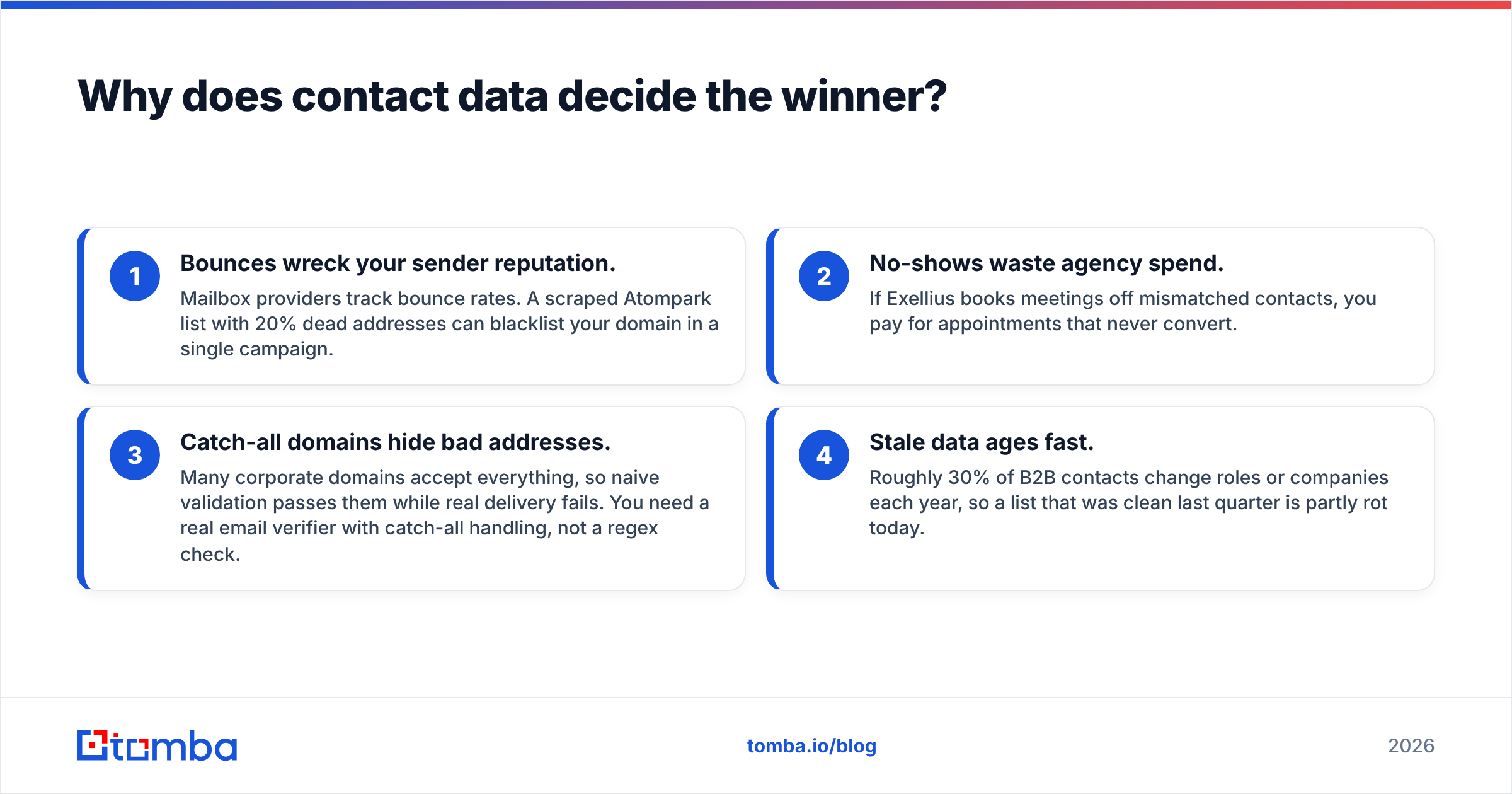
- Bounces wreck your sender reputation. Mailbox providers track bounce rates. A scraped Atompark list with 20% dead addresses can blacklist your domain in a single campaign.
- No-shows waste agency spend. If Exellius books meetings off mismatched contacts, you pay for appointments that never convert.
- Catch-all domains hide bad addresses. Many corporate domains accept everything, so naive validation passes them while real delivery fails. You need a real email verifier with catch-all handling, not a regex check.
- Stale data ages fast. Roughly 30% of B2B contacts change roles or companies each year, so a list that was clean last quarter is partly rot today.
This is why the smart play is to separate the data layer from the sending or service layer. Get verified, fresh contacts first — by name, role, or company domain search — then push them into whatever execution model you choose. According to independent review sites like G2 and Capterra, the highest-rated outbound stacks almost always pair a dedicated data tool with their sender, rather than relying on a single all-in-one blaster.
What does each model really cost?#
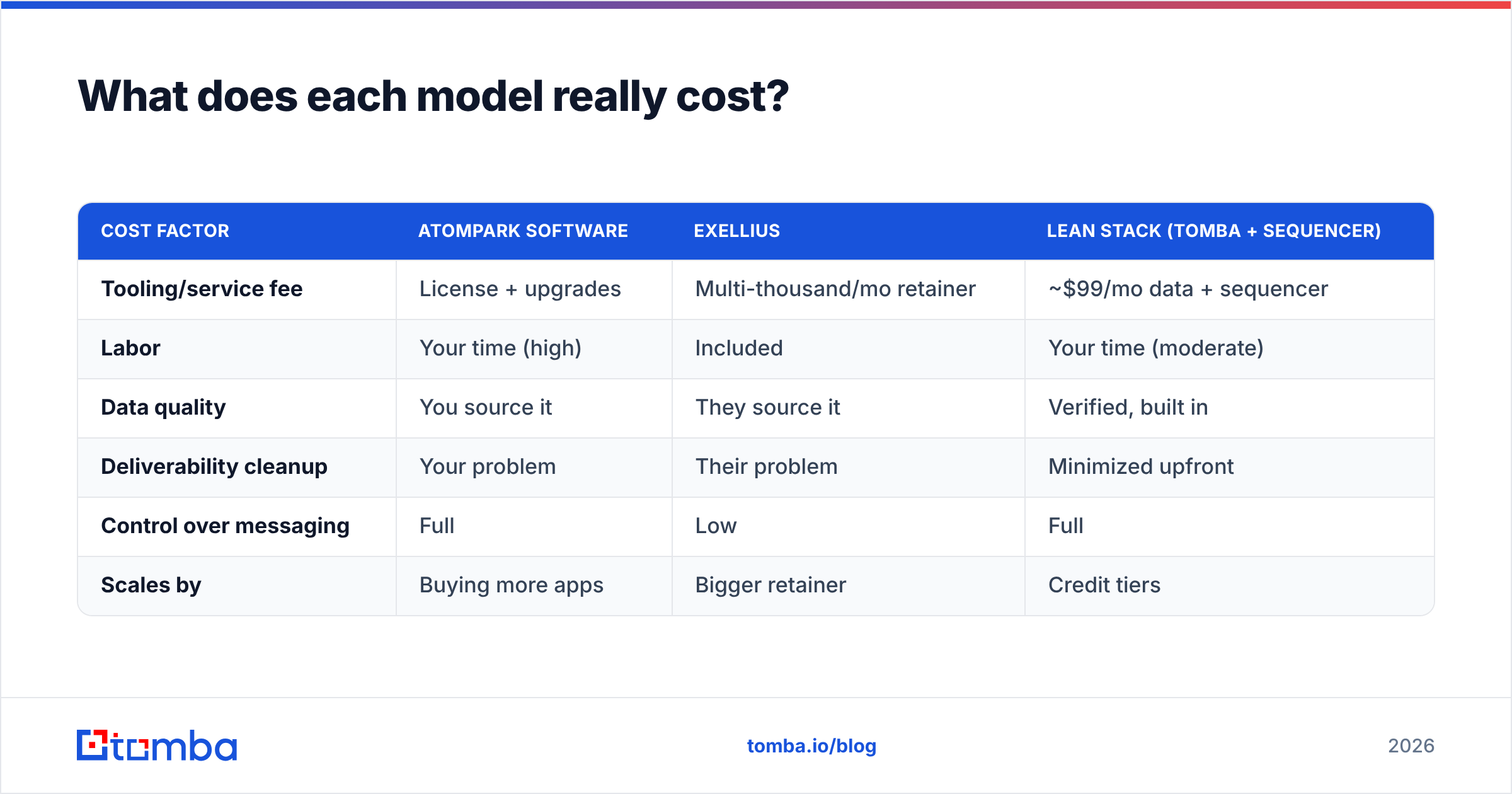
Sticker price hides the true cost. Let's look at total cost of ownership for a small B2B team running ~5,000 prospects a month.
| Cost factor | Atompark Software | Exellius | Lean stack (Tomba + sequencer) |
|---|---|---|---|
| Tooling/service fee | License + upgrades | Multi-thousand/mo retainer | ~$99/mo data + sequencer |
| Labor | Your time (high) | Included | Your time (moderate) |
| Data quality | You source it | They source it | Verified, built in |
| Deliverability cleanup | Your problem | Their problem | Minimized upfront |
| Control over messaging | Full | Low | Full |
| Scales by | Buying more apps | Bigger retainer | Credit tiers |
The desktop-license route looks cheap until you price in the hours spent sourcing lists, warming domains, and recovering from a blacklist. The agency route looks turnkey until you multiply the retainer across a year and account for ramp time. The lean middle path — a verified data source feeding a modern sequencer — tends to win on cost-per-booked-meeting for most teams under 50 reps. You can see transparent, self-serve Tomba pricing as a reference point: Free (25 searches), Starter $49/mo, Growth $99/mo, Pro $249/mo, Enterprise custom.
For deeper benchmarking on outbound stack ROI, vendor-neutral frameworks like HubSpot's sales research are a useful sanity check before you commit budget.
What are the pros and cons of each?#
Atompark Software — pros
- One-time license economics; no per-contact SaaS bill
- Full control over the sending engine and SMTP
- Long track record and a broad tool catalog
- Works offline from your own machine
Atompark Software — cons
- Desktop-centric, dated UX on several apps
- You own all deliverability and compliance risk
- Built-in extraction encourages unverified, scrape-and-blast workflows
- Steep learning curve for warm-up and reputation management
Exellius — pros
- Fully outsourced; no team or stack to build
- Meetings booked directly into your calendar
- Faster to "results" if you have zero outbound function
- Multichannel execution handled for you
Exellius — cons
- High recurring retainer vs a software license
- Limited control over messaging and brand voice
- Lead quality depends on their data sources and SDRs
- Onboarding and ramp take weeks, not hours
The recurring theme in both con lists is data ownership and quality — which is exactly the gap a dedicated finder-and-verifier fills.
How do you build a stack that beats both?#
If you want the control of Atompark without the deliverability landmines, and the results of Exellius without the retainer, build a thin, modern stack:
- Define your ICP — role, industry, company size, geography.
- Find verified contacts — use an email finder and bulk email finder to pull addresses by name or domain, already validated.
- Verify before you send — run every address through a verifier with catch-all detection to protect your sender reputation.
- Sequence responsibly — warm your domain, personalize, respect opt-out, and keep volume sane.
- Measure and refresh — re-verify lists quarterly so role changes don't quietly rot your deliverability.
This is the pattern that wins in 2026: not the heaviest tool or the most expensive service, but the cleanest data feeding a disciplined send. The execution layer becomes almost interchangeable once the data is right.
The bottom line#
Atompark Software vs Exellius isn't a fair fight — it's a fork in the road. Atompark is for hands-on operators who want to own the machine; Exellius is for teams who'd rather buy the outcome. Both are legitimate for the right buyer, and both quietly depend on something neither one specializes in: accurate, verified contact data.
Before you license another bulk sender or sign an agency retainer, fix the layer underneath. Start with Tomba's Email Finder to pull verified professional emails by domain, name, or company — then plug those clean contacts into whichever outbound model you choose. Better data makes a cheap stack outperform an expensive one, and it's the one upgrade that pays off no matter which side of this comparison you land on. Spin up the free tier, find your first 25 verified contacts, and see how much your reply rate improves before you commit a dollar to either Atompark or Exellius.
Ready to find emails that actually work?
Join 150,000+ professionals who stopped guessing and started sending. Free credits on signup — no credit card required.
Get the Tomba newsletter
Practical outbound tactics and product updates — once every two weeks.
About the author