Atompark Software vs Finalscout: 2026 Email Tool Comparison
Atompark Software and Finalscout solve different halves of cold outreach. Here's how they compare on pricing, accuracy, and data — and where a finder like Tomba fits.
Choosing between Atompark Software and Finalscout trips up a lot of buyers because the two tools barely overlap. One is a bulk email sending suite with deep roots in mass mailing. The other is an AI-assisted email finder built around LinkedIn. Pick the wrong one and you either have a megaphone with no list, or a list with nothing to send it through.
This guide breaks down what each tool actually does, how pricing compares, where accuracy matters, and which workflows each one fits. We'll also be honest about where a dedicated data tool like Tomba slots in.
TL;DR#
- Atompark Software is a mass-email and marketing-automation vendor (Atomic Email Studio, ePochta) focused on sending large volumes — not on sourcing fresh, verified B2B contacts.
- Finalscout is an AI email finder built on LinkedIn, designed to extract business emails and draft outreach with ChatGPT-style assistance.
- They are complementary, not direct rivals: Finalscout finds and writes; Atompark blasts and tracks.
- Neither is a best-in-class B2B data layer. If accuracy and bounce rates are your priority, a dedicated finder/verifier wins.
- For most teams in 2026, the winning stack is a high-accuracy email finder feeding a clean list into whatever sender you already trust.
What is Atompark Software?#
Atompark Software is a long-running email-marketing company best known for desktop and cloud sending products like Atomic Email Studio and the ePochta suite. Its core promise is volume: build or import a list, design a campaign, and push email (and in some products, SMS) to large audiences with tracking and scheduling.
Atompark leans toward the "owned audience" side of marketing — newsletters, promotions, re-engagement, and bulk announcements. It includes list-management features and basic email verification to reduce bounces, but its center of gravity is delivery and throughput, not net-new prospect discovery. You can read their positioning on the official atompark.com site.
That distinction matters. Atompark assumes you already have addresses. It is not designed to turn a name and a company domain into a verified work email.
What is Finalscout?#
Finalscout is a newer, AI-first email finder. Its workflow starts on LinkedIn: you browse profiles or search results, and Finalscout surfaces likely business email addresses, then helps you draft and personalize outreach with built-in AI writing. The pitch on finalscout.com is "find emails and reach anyone," with an emphasis on deliverability-safe extraction.
In other words, Finalscout sits at the top of the funnel — sourcing contacts — and stretches into copywriting. It does not aim to be a heavy-duty bulk sender or a full marketing-automation platform the way Atompark does. Its strength is turning LinkedIn activity into a contactable list with minimal manual digging.
)
Atompark Software vs Finalscout: how do they compare?#
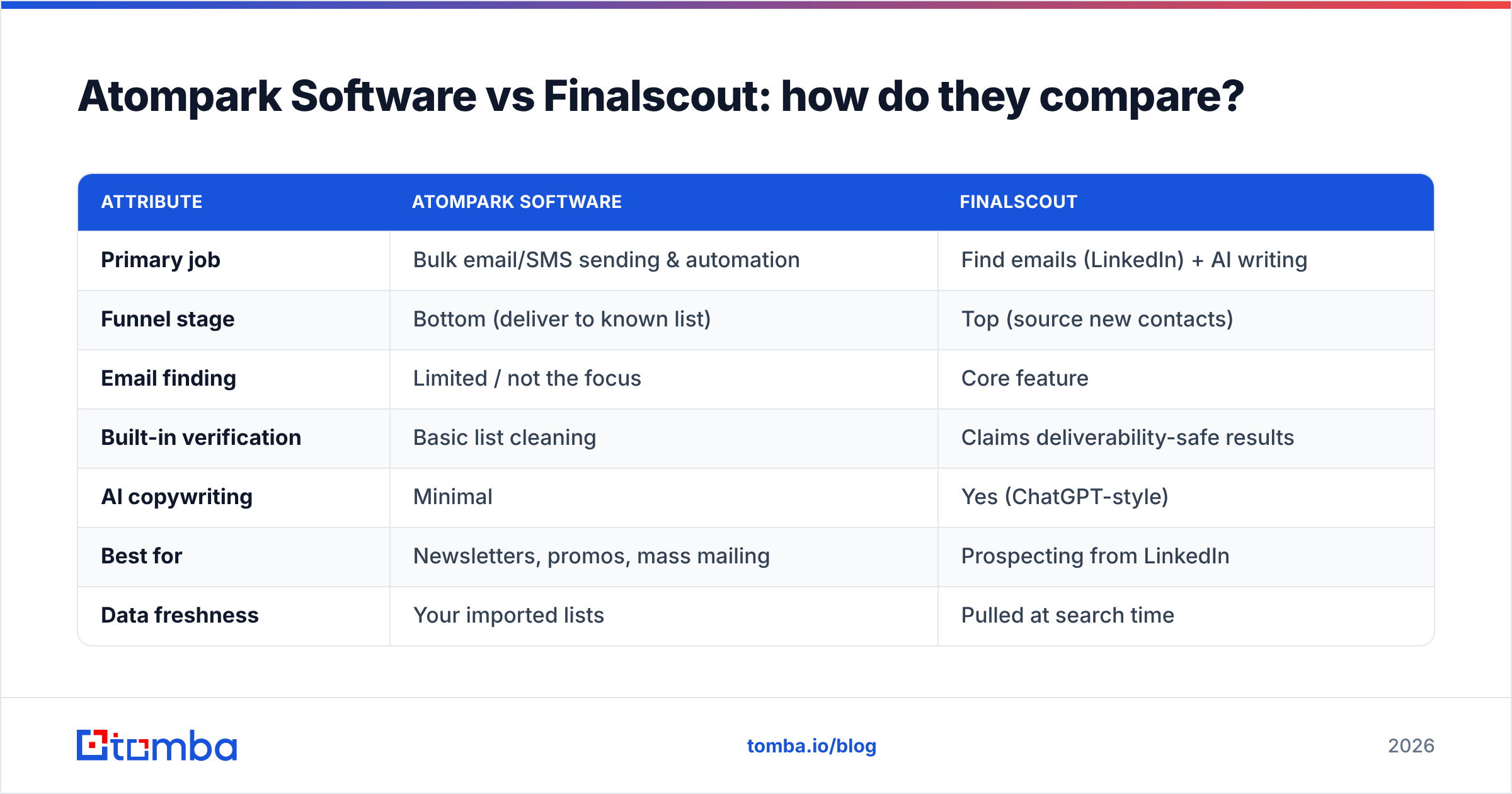
The cleanest way to see the difference is feature-by-feature. The two tools are strong in almost opposite places.
| Attribute | Atompark Software | Finalscout |
|---|---|---|
| Primary job | Bulk email/SMS sending & automation | Find emails (LinkedIn) + AI writing |
| Funnel stage | Bottom (deliver to known list) | Top (source new contacts) |
| Email finding | Limited / not the focus | Core feature |
| Built-in verification | Basic list cleaning | Claims deliverability-safe results |
| AI copywriting | Minimal | Yes (ChatGPT-style) |
| Best for | Newsletters, promos, mass mailing | Prospecting from LinkedIn |
| Data freshness | Your imported lists | Pulled at search time |
| Bulk API workflows | Sending-oriented | Finder-oriented |
The takeaway: they are not substitutes. If you compared them on a single spreadsheet and picked the "winner," you'd be optimizing for the wrong job. Atompark wins if your problem is getting email out the door at scale. Finalscout wins if your problem is not having anyone to email yet.
When Atompark Software is the better pick#
- You own a large opted-in list. Newsletters, e-commerce promos, and event blasts are squarely Atompark's wheelhouse.
- You need sending throughput. High-volume campaigns with scheduling and tracking are the point of the product.
- You want desktop-grade control. The Atomic/ePochta lineage appeals to users who like standalone mailing software.
- SMS matters too. Multi-channel blasts are part of the suite.
When Finalscout is the better pick#
- LinkedIn is your prospecting source. Finalscout is built to convert profiles into emails.
- You want find-and-write in one place. AI drafting beside the contact reduces tool switching.
- You run lean, targeted outreach. It favors precision over raw send volume.
- You don't already own a sender. It bridges sourcing and first-touch copy.
Which one is more accurate?#
Accuracy is the real battleground for cold outreach, and it's where neither tool is a category leader. Atompark's verification is a list-hygiene feature bolted onto a sender — fine for trimming obvious junk, not built to validate thousands of net-new B2B addresses. Finalscout finds emails at search time, which is good for freshness, but LinkedIn-sourced guesses still need independent verification before you send at scale.
Why does this matter so much? Think of your sending domain like a credit score. Every hard bounce is a missed payment. A few are survivable; a pattern of them quietly tanks your sender reputation until even your good emails land in spam. Industry guidance from inbox providers and tools cataloged on G2 consistently points to keeping bounce rates under ~2-3%.
That's why serious senders run a dedicated email verifier as a separate step, regardless of which finder or sender they use. The verification built into an all-in-one tool is a convenience, not a guarantee.
)
How does pricing compare?#
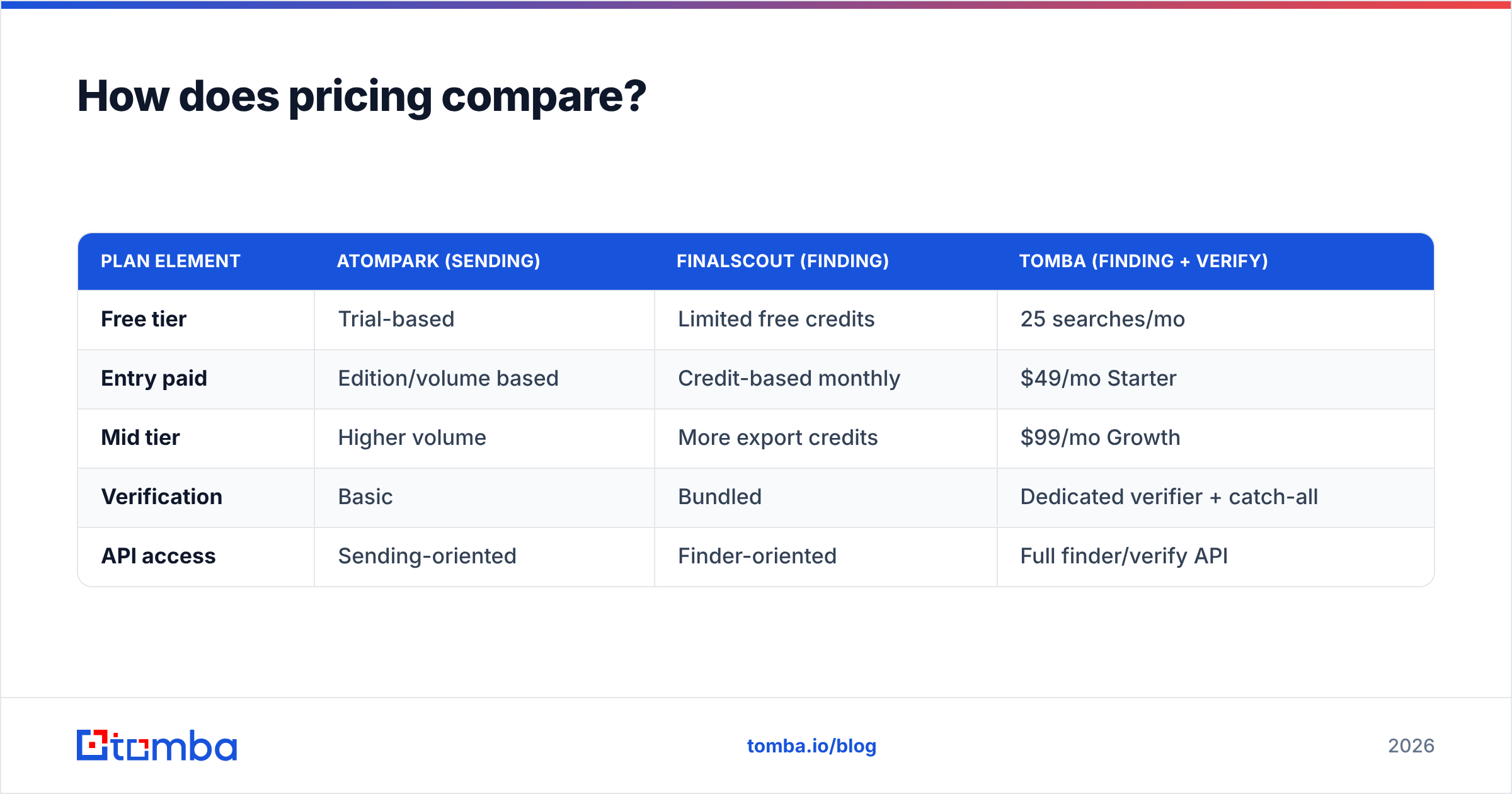
Pricing models reflect the different jobs. Atompark tends to price around sending volume and product editions (one-time desktop licenses in some products, subscription tiers in others). Finalscout prices around the number of emails you find and export per month, typically with a small free allowance and credit-based paid tiers.
Because the units differ — messages sent versus contacts found — a like-for-like dollar comparison is misleading. The better question is cost per usable, verified contact and cost per delivered message. A cheap finder that produces 15% bounces is more expensive than a pricier one at 2%, once you factor in domain damage and wasted send slots.
Here's how the value framing looks when you add a dedicated data layer to the picture:
| Plan element | Atompark (sending) | Finalscout (finding) | Tomba (finding + verify) |
|---|---|---|---|
| Free tier | Trial-based | Limited free credits | 25 searches/mo |
| Entry paid | Edition/volume based | Credit-based monthly | $49/mo Starter |
| Mid tier | Higher volume | More export credits | $99/mo Growth |
| Verification | Basic | Bundled | Dedicated verifier + catch-all |
| API access | Sending-oriented | Finder-oriented | Full finder/verify API |
You can see Tomba's exact tiers on the Tomba pricing page. The point isn't that Tomba is "cheaper than" either tool line-for-line — it's that the finding-plus-verification job is what protects every dollar you spend on sending.
Do you actually need both — or something else?#
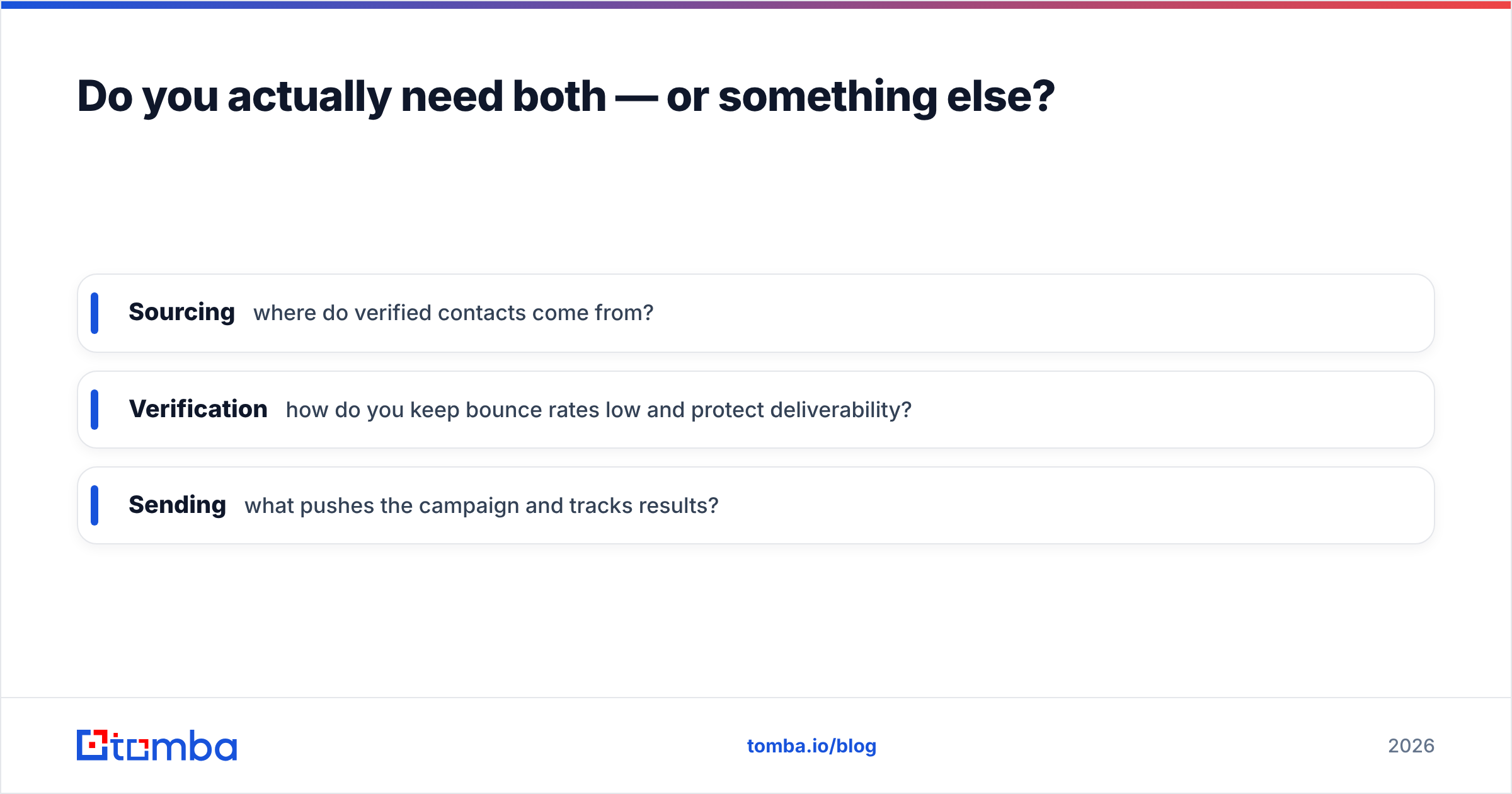
Here's the honest answer most comparison posts skip: the Atompark-vs-Finalscout question is usually the wrong frame. You're really deciding how to fill three buckets:
- Sourcing — where do verified contacts come from?
- Verification — how do you keep bounce rates low and protect deliverability?
- Sending — what pushes the campaign and tracks results?
Atompark covers the third bucket well. Finalscout covers the first and dabbles in copy. Neither nails verification as a standalone strength. That gap is exactly why many teams keep their trusted sender (Atompark, or a mainstream ESP) and slot in a specialized data tool for buckets one and two.
A focused finder also unlocks workflows neither tool prioritizes: searching every address on a domain via domain search, validating risky catch-all domains, and running bulk lead generation against a CSV of companies you already target. For outbound teams, that breadth is the difference between a one-off list and a repeatable pipeline.
What about deliverability and compliance?#
Whichever tools you choose, deliverability discipline outranks features. Authenticate your domain (SPF, DKIM, DMARC), warm up new sending domains gradually, and keep lists clean. HubSpot's deliverability resources and most ESP documentation echo the same fundamentals — the HubSpot blog is a solid neutral reference.
Atompark's bulk orientation makes warm-up and list hygiene especially important; high volume amplifies the cost of a dirty list. Finalscout's LinkedIn sourcing keeps data fresh but still benefits from a verification pass before a single message goes out. In both cases, treating verification as a non-negotiable step — not an afterthought — is what keeps campaigns landing in the inbox.
Verdict: which should you choose in 2026?#
Decide by the job, not the brand:
- Pick Atompark Software if your bottleneck is sending — you have an owned audience and need volume, scheduling, and tracking, possibly across email and SMS.
- Pick Finalscout if your bottleneck is sourcing from LinkedIn and you want AI drafting beside your finds.
- Add a dedicated finder + verifier if accuracy, bounce rates, and repeatable B2B prospecting are what actually move your numbers — because that's the layer both tools treat as secondary.
For most B2B outbound teams, the smartest 2026 stack is a high-accuracy data source feeding clean contacts into whatever sender you already trust. That's where Tomba fits: it's not trying to be your bulk blaster, it's trying to make sure every address you load is real.
If your real problem is finding verified work emails — not just sending to a list — start with the Tomba Email Finder. Search by name, company, or domain, verify in the same flow, and export clean contacts into Atompark, Finalscout, or any sender you like. Begin free with 25 searches a month, then scale to the $49/mo Starter plan when your pipeline grows. Find the right people first; the sending part is easy once the data is right.
Ready to find emails that actually work?
Join 150,000+ professionals who stopped guessing and started sending. Free credits on signup — no credit card required.
Get the Tomba newsletter
Practical outbound tactics and product updates — once every two weeks.
About the author