Atompark Software vs ListKit: Which Lead Tool Wins in 2026
Atompark sends mass email and SMS; ListKit sells ready-made B2B lists. We compare data accuracy, pricing, and use cases to show which one actually fills your pipeline in 2026 — and where a dedicated email finder beats both.
You typed "Atompark Software vs ListKit" into a search bar because you want one tool to fix your outbound. The honest answer up front: these two products barely overlap. One is a mass-mailing engine, the other is a B2B contact database. Picking between them without knowing that difference is how teams waste a quarter and a budget.
This guide breaks down what each actually does, where they compete, and where neither is the right pick.
TL;DR#
- Atompark Software is an email and SMS sending suite (Atomic Mail Sender, Atomic Email Studio, plus an email extractor). It moves volume; it does not vet your data.
- ListKit is a B2B data platform — pre-verified contact lists with filters, built for cold-email teams who want a list and a sequence, fast.
- They only overlap on one job: getting contacts into a campaign. Atompark scrapes and blasts; ListKit hands you a cleaned list.
- For most modern outbound teams, neither replaces a precise email finder + verifier — scraped or bulk-bought lists bounce, and that wrecks deliverability.
- If your priority is accurate, on-demand contact data you actually control, a dedicated tool like Tomba Email Finder sits cleaner in the stack than either.
What is Atompark Software?#
Atompark is a long-running desktop-and-cloud vendor focused on bulk communication. Its best-known products are Atomic Mail Sender (a mass email tool), Atomic Email Studio, an SMS sender, and Atomic Email Hunter — an email extractor that scrapes addresses from websites and search results.
The pitch is volume and self-hosting. You install software, point it at your list (or scrape one), build a template, and send at scale from your own SMTP or theirs. It appeals to operators who want to own the sending layer and pay a one-time license rather than a per-seat SaaS subscription.
The catch is the same as its strength. Atompark gives you a firehose, not a filter. The email extractor pulls whatever pattern looks like an address off a page — role accounts, outdated contacts, spam traps — with no verification step worth the name. Sending that straight into a mass blast is the fastest way to torch your sender reputation.
What is ListKit?#
ListKit is a newer, cold-email-native data platform. Instead of software you install, you log into a web app, apply filters (title, industry, headcount, geography, technology), and export a list of contacts that the platform claims are pre-verified. It markets triple-verified emails and tight integration with cold-email sending tools like Instantly and Smartlead.
The audience is agencies and SDR teams running high-volume cold email who don't want to assemble lists by hand. You buy credits, pull contacts, push them into a sequencer, and go. The value is speed-to-list and the promise that the data is clean enough to protect your inboxes.
The trade-offs: you're renting access to a shared database that thousands of other senders also pull from, so the same prospects see near-identical outreach. And "verified" is a moving target — B2B data decays at roughly 2–3% per month as people change jobs, so a list that was clean at export can be stale by the time you finish a sequence.
Atompark Software vs ListKit: how do they actually compare?#
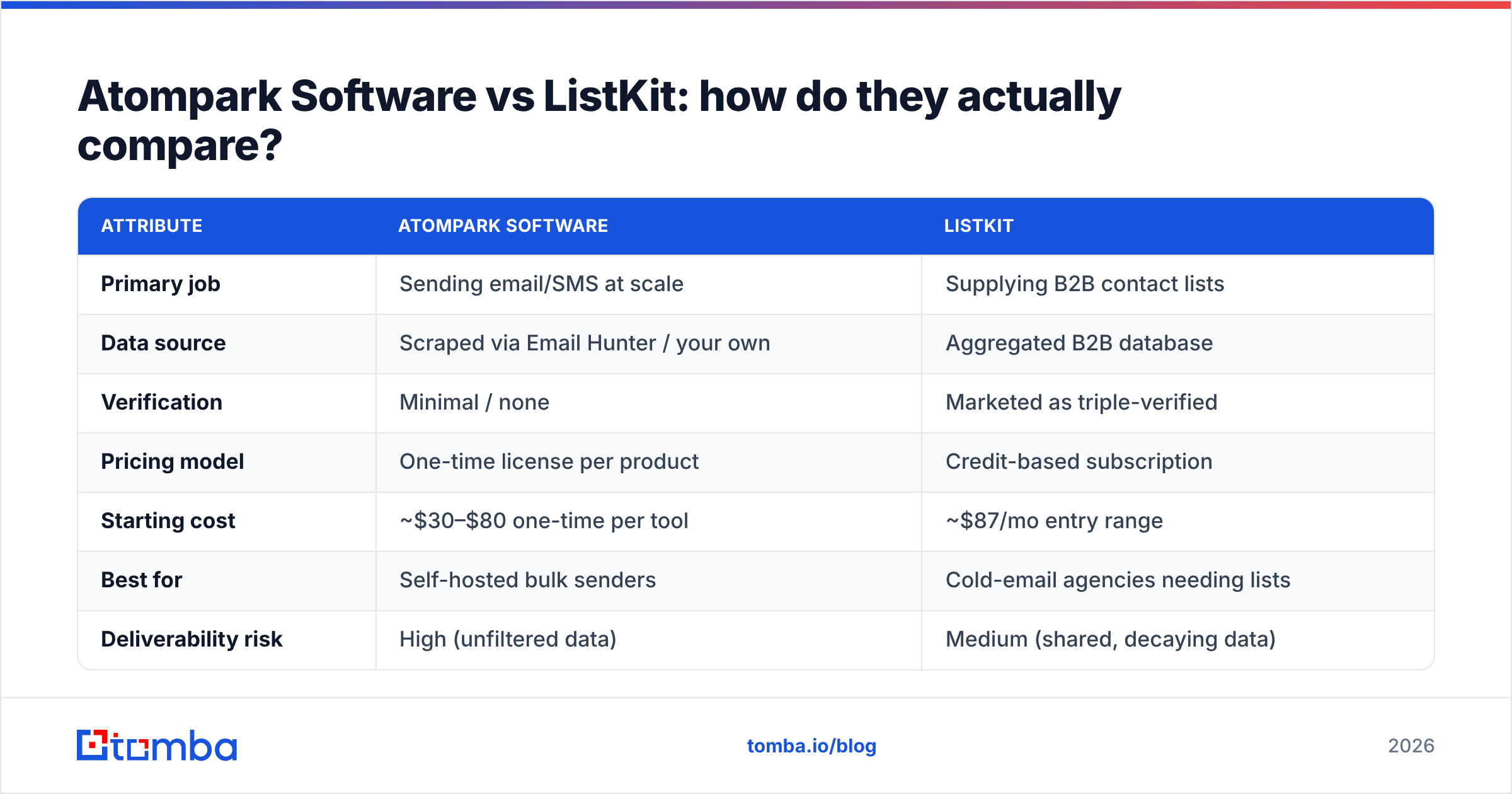
Here is the core difference in one table. Read it as "what job is this hired for," not "which brand is better."
| Attribute | Atompark Software | ListKit |
|---|---|---|
| Primary job | Sending email/SMS at scale | Supplying B2B contact lists |
| Data source | Scraped via Email Hunter / your own | Aggregated B2B database |
| Verification | Minimal / none | Marketed as triple-verified |
| Pricing model | One-time license per product | Credit-based subscription |
| Starting cost | ~$30–$80 one-time per tool | ~$87/mo entry range |
| Best for | Self-hosted bulk senders | Cold-email agencies needing lists |
| Deliverability risk | High (unfiltered data) | Medium (shared, decaying data) |
| Owns the sending? | Yes | No — exports to other tools |
| Learning curve | Dated desktop UI | Modern web app |
The pattern is clear. Atompark owns sending but not data quality. ListKit owns data but not sending. Neither owns the part that actually determines campaign success in 2026: fresh, accurate, verified contact data tied to the specific people you want to reach.
Which one fits your use case?#
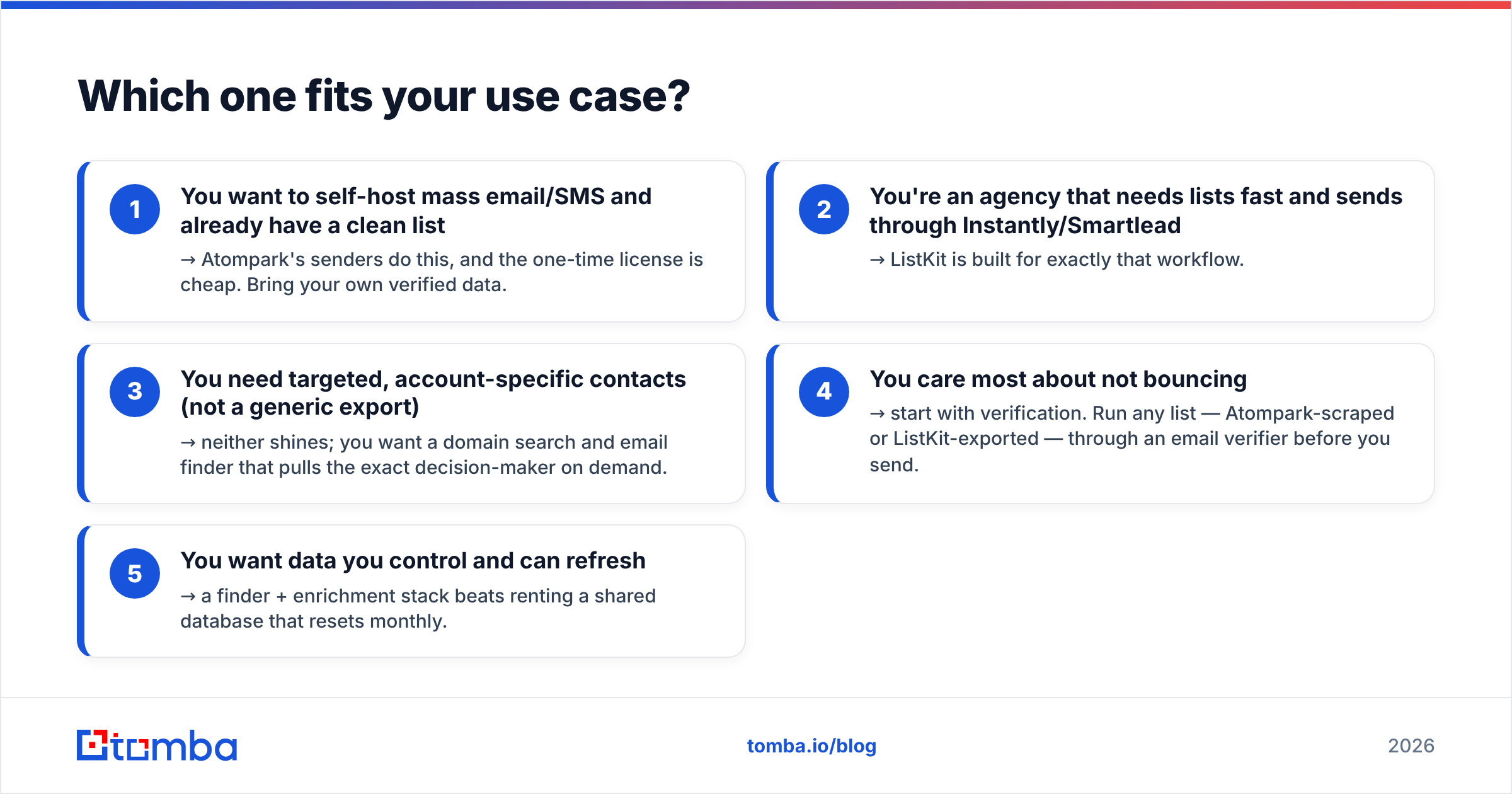
Rather than crown a winner, match the tool to the job:
- You want to self-host mass email/SMS and already have a clean list → Atompark's senders do this, and the one-time license is cheap. Bring your own verified data.
- You're an agency that needs lists fast and sends through Instantly/Smartlead → ListKit is built for exactly that workflow.
- You need targeted, account-specific contacts (not a generic export) → neither shines; you want a domain search and email finder that pulls the exact decision-maker on demand.
- You care most about not bouncing → start with verification. Run any list — Atompark-scraped or ListKit-exported — through an email verifier before you send.
- You want data you control and can refresh → a finder + enrichment stack beats renting a shared database that resets monthly.
Is data accuracy the real deciding factor?#
Yes — and it's where both tools expose their weak side.
Atompark's Email Hunter scrapes. Scraped data is unverified by definition: you get whatever string matched an email pattern, including abandoned addresses and spam traps that mailbox providers plant specifically to catch bulk senders. One trap hit can land your domain on a blacklist. If you go the Atompark route, treat every extracted address as unverified until a real verifier says otherwise.
ListKit verifies, but you're drinking from a shared well. The same contacts get sold to many buyers, so your "fresh" list may have already absorbed ten cold sequences this month. Worse, no provider beats data decay — titles and emails go stale fast, and a verification stamp from export day doesn't survive a job change two weeks later.
This is why serious outbound teams decouple data from sending and put a verification layer between them. A focused email finder returns a single, current, confidence-scored address for a named person at a named company — then a verifier confirms it's deliverable right now, not last quarter. You can read how that sourcing works on Tomba's data page.
How does pricing compare?#
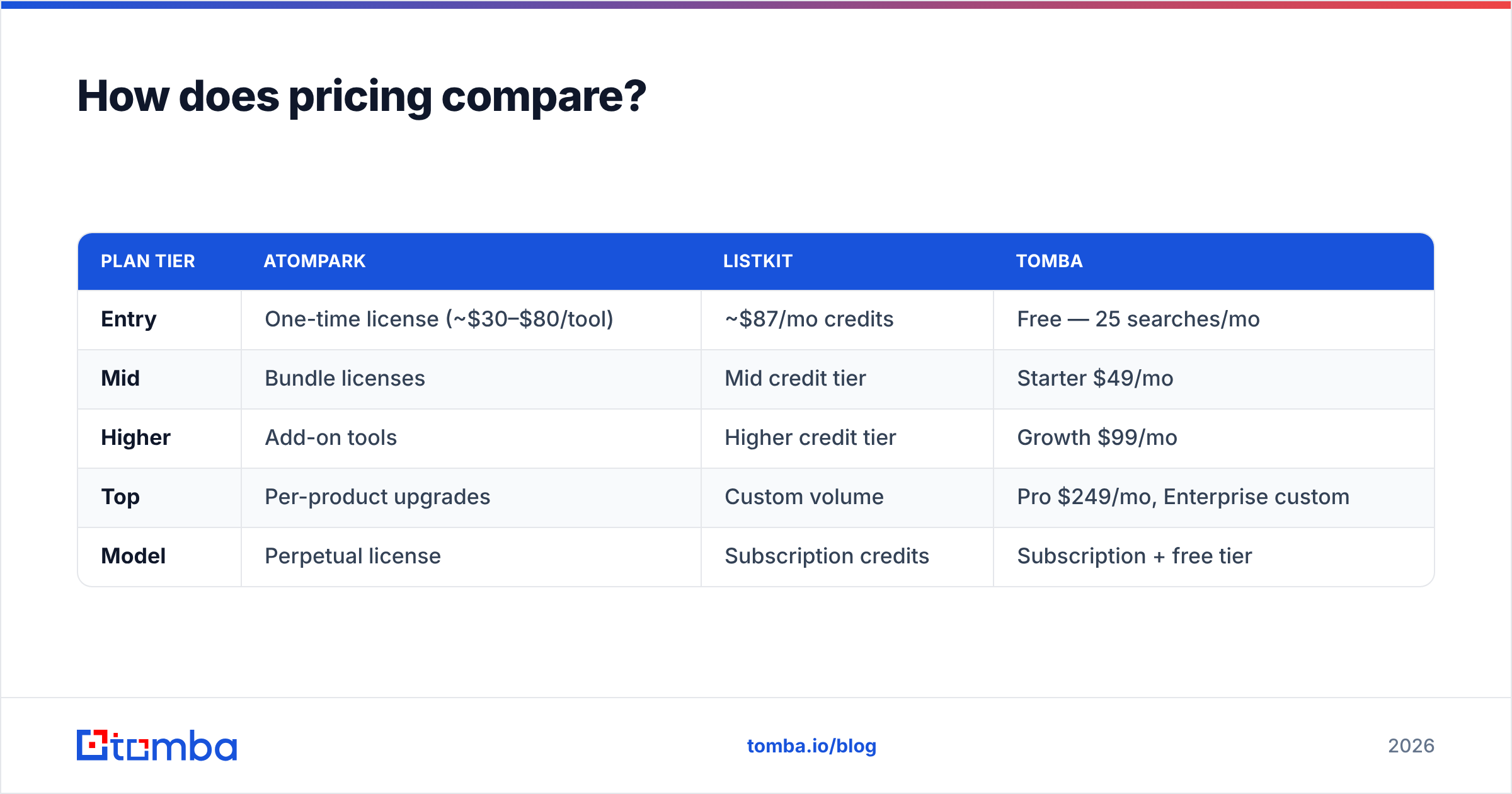
The pricing philosophies are as different as the products.
| Plan tier | Atompark | ListKit | Tomba |
|---|---|---|---|
| Entry | One-time license (~$30–$80/tool) | ~$87/mo credits | Free — 25 searches/mo |
| Mid | Bundle licenses | Mid credit tier | Starter $49/mo |
| Higher | Add-on tools | Higher credit tier | Growth $99/mo |
| Top | Per-product upgrades | Custom volume | Pro $249/mo, Enterprise custom |
| Model | Perpetual license | Subscription credits | Subscription + free tier |
Atompark's one-time license looks cheapest on paper, but you pay separately per tool and you're still on the hook for clean data and your own sending infrastructure. ListKit's credit model scales with how many contacts you pull, which gets expensive fast for high-volume teams.
A finder-and-verifier subscription like Tomba's pricing sits in the middle: a free tier to test, then predictable monthly plans where the value is accuracy per credit, not raw export volume. For teams that would otherwise pay for a bulk list and then pay again to verify it, consolidating is usually cheaper.
What about deliverability and compliance?#
This is the part the "vs" framing hides. The tool you pick changes your risk profile.
Mass-blasting a scraped Atompark list is the highest-risk play in cold outreach. Unfiltered data plus high volume is the exact signal mailbox providers penalize, and you'll feel it as plummeting inbox placement. If you use Atompark, you must layer in email deliverability hygiene: warm the domain, authenticate with SPF/DKIM/DMARC, and verify before every send.
ListKit lowers but doesn't remove the risk. Pre-verified data helps, but shared lists mean shared fatigue, and recipients who've seen the same template from five agencies are quick to hit "spam" — which hurts your reputation regardless of how clean the address was.
The durable fix is the same in both cases: send less, send to verified addresses, and personalize. Smaller lists of accurate contacts beat huge lists of maybe contacts every time. Pull the right person with a finder, confirm the address with a verifier, and enrich with firmographics from a B2B database so the message is relevant. Volume without accuracy is just faster blacklisting.
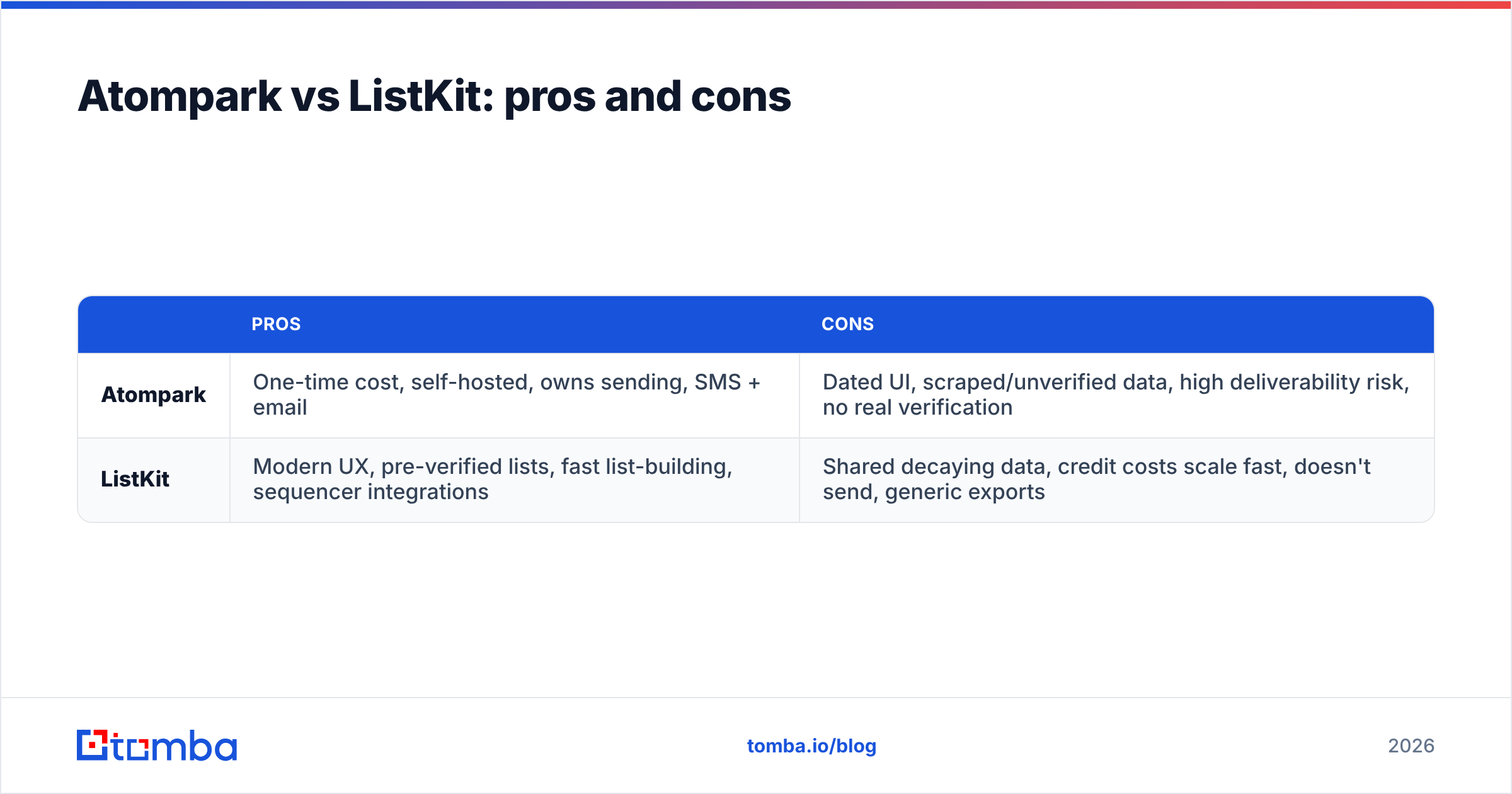
Atompark vs ListKit: pros and cons#
| Pros | Cons | |
|---|---|---|
| Atompark | One-time cost, self-hosted, owns sending, SMS + email | Dated UI, scraped/unverified data, high deliverability risk, no real verification |
| ListKit | Modern UX, pre-verified lists, fast list-building, sequencer integrations | Shared decaying data, credit costs scale fast, doesn't send, generic exports |
Use this to set expectations, not to declare a winner. If you must choose between only these two, pick based on which half of the workflow you're missing: buy Atompark if you have data but no sender, buy ListKit if you have a sender but no data.
But most teams reading a comparison like this are really missing the middle layer — accurate, controllable, verifiable contact data — and that's a different category of tool.
What's the smarter alternative for 2026?#
Stop trying to make one tool do the whole job poorly. Build a thin, accurate stack instead:
- Source precisely — find the specific decision-maker's email by name and domain rather than scraping or buying a bulk export.
- Verify before sending — confirm deliverability the day you send, not the day the list was built.
- Enrich for relevance — add title, company size, and tech so your message earns a reply.
- Send small and personal — through whatever sequencer you already trust.
That's where a focused platform fits. Tomba Email Finder returns current, confidence-scored professional emails by domain, name, or company — then its built-in email verification and data enrichment close the accuracy gap that Atompark's scraping and ListKit's shared lists both leave open. Start free with 25 searches a month, scale to Starter at $49/mo when it earns its keep, and feed your existing sender clean data instead of guesses.
Before you commit to either Atompark or ListKit, check independent reviews on G2 and the vendors' own sites (atompark.com, listkit.io) — then ask the only question that matters: will this actually put accurate contacts in front of the right people? If the answer is "only half," you've found your gap.
Ready to fix the data half? Try the Tomba Email Finder free and see how verified, on-demand contacts change your reply rate — no scraping, no shared lists, no surprises in your bounce report.
// get started
Find, verify and enrich your first contacts today
Start on the free plan with 25 searches a month, then scale when your team is ready.
Free plan · No credit card required · GDPR & CCPA
// about the author