Atompark Software vs Salesbot: 2026 Comparison Guide
Atompark Software vs Salesbot — bulk email blasting or conversational sales automation? Compare features, pricing, and deliverability before you buy in 2026.
Choosing between Atompark Software and Salesbot usually means you are standing at a fork between two very different philosophies of outbound. One is a veteran bulk-email engine built to send high volumes of mail. The other is a conversational automation layer built to qualify and route leads in real time. They are often shortlisted together, but they rarely solve the same problem.
This guide breaks down what each tool actually does, where they overlap, and which one fits your motion in 2026 — plus the one thing both of them quietly depend on that neither markets loudly.
TL;DR#
- Atompark Software is a suite of bulk email and SMS sending tools (Atomic Mail Sender, MassMailer, and related desktop/cloud apps) aimed at high-volume broadcast campaigns.
- Salesbot is a conversational automation and chatbot-style sequencing tool focused on qualifying, routing, and nurturing inbound and outbound leads.
- They are not direct competitors: Atompark optimizes for send volume, Salesbot optimizes for conversation and qualification.
- Both live or die on data quality — a verified, accurately sourced contact list beats a bigger send or a smarter bot every time.
- If your bottleneck is finding and verifying contacts before they enter either tool, pair your choice with a dedicated email finder rather than relying on scraped or purchased lists.
What is Atompark Software?#
Atompark Software is a long-running vendor best known for desktop and cloud email-sending applications. Its lineup includes Atomic Mail Sender, MassMailer, and bulk SMS tools, all oriented around one job: pushing large volumes of messages out the door with templating, list management, and basic personalization.
The appeal is straightforward. If you have a list and you need to send a newsletter, a promotion, or an announcement to thousands of recipients, Atompark gives you a self-contained engine to do it — often with a one-time license model rather than a per-seat SaaS subscription. That pricing structure still attracts solo operators and small teams who dislike recurring fees.
The trade-off is that broadcast tools live and die by deliverability and list hygiene. A desktop mass sender does not magically fix a bad sender reputation, and blasting an unverified list is the fastest way to get blocked. Understanding email deliverability matters more here than the feature checklist, because volume without inbox placement is just noise.
What is Salesbot?#
Salesbot refers to conversational sales-automation tooling — chatbot-style flows and automated sequences that engage leads, ask qualifying questions, score responses, and route hot prospects to a human or a CRM. Instead of broadcasting one message to everyone, Salesbot-style platforms react to what each lead does.
This is a fundamentally different motion. Where Atompark is a megaphone, Salesbot is a switchboard. It shines when you have inbound traffic to qualify, or when outbound replies need triage at a scale a single rep cannot handle. The value is in the branching logic: ask, listen, branch, and hand off.
The catch is that a bot is only as good as the contacts and context feeding it. A conversational flow that fires against stale or mismatched records wastes the exact thing it was built to save — your reps' time. That is why teams running automation invest early in data enrichment so each conversation starts with accurate firmographic and contact data.
How do Atompark Software and Salesbot compare at a glance?#
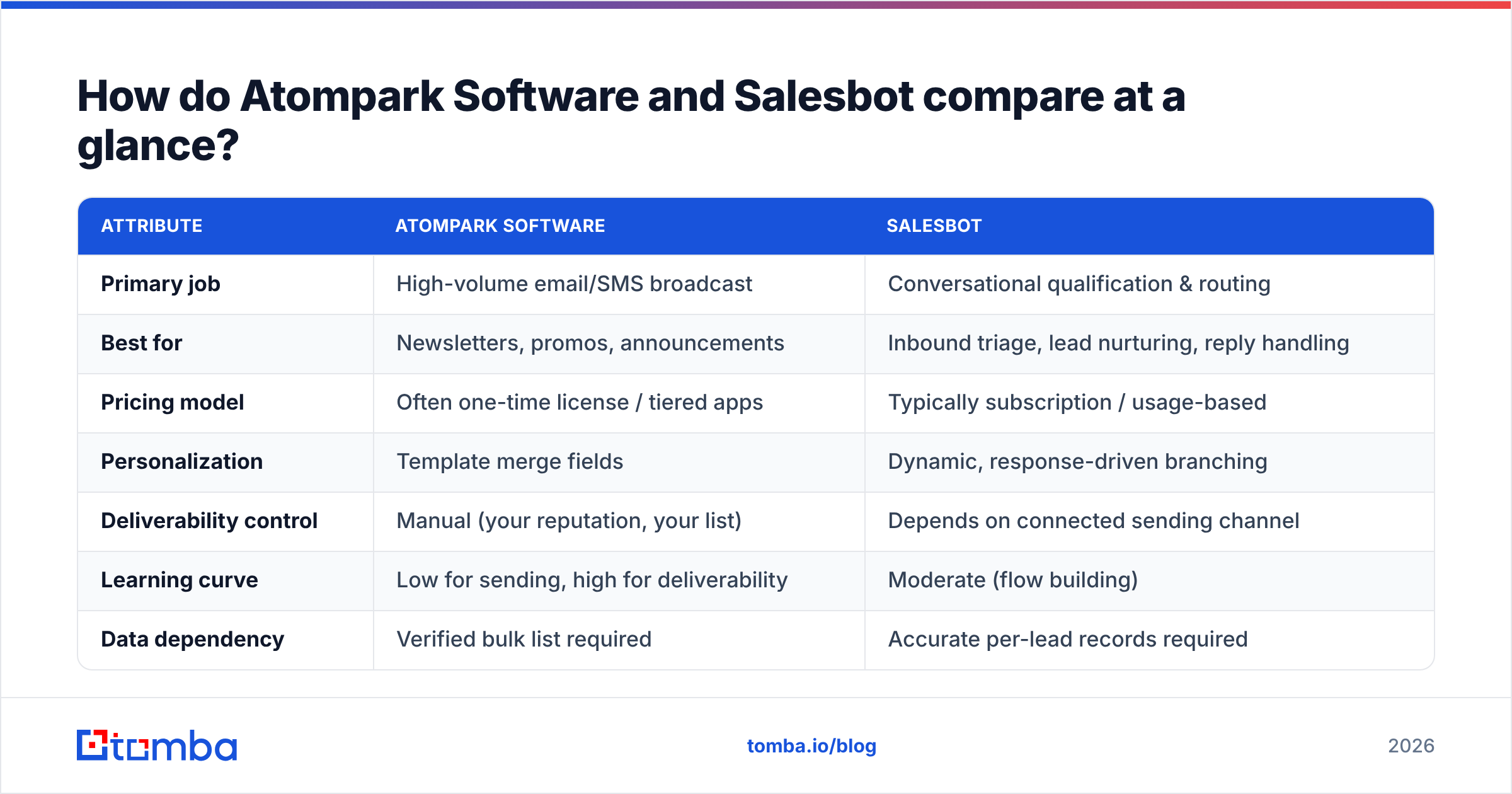
Here is the core split. Treat this as a positioning map, not a scorecard — the "winner" depends entirely on your motion.
| Attribute | Atompark Software | Salesbot |
|---|---|---|
| Primary job | High-volume email/SMS broadcast | Conversational qualification & routing |
| Best for | Newsletters, promos, announcements | Inbound triage, lead nurturing, reply handling |
| Pricing model | Often one-time license / tiered apps | Typically subscription / usage-based |
| Personalization | Template merge fields | Dynamic, response-driven branching |
| Deliverability control | Manual (your reputation, your list) | Depends on connected sending channel |
| Learning curve | Low for sending, high for deliverability | Moderate (flow building) |
| Data dependency | Verified bulk list required | Accurate per-lead records required |
| CRM integration | Limited / varies by app | Usually native or via connectors |
The pattern is clear: these tools sit at different stages. Atompark is an execution layer for one-to-many sends. Salesbot is an orchestration layer for one-to-one conversations. Many teams that grow eventually run something like both.
Which one fits your sales motion?#
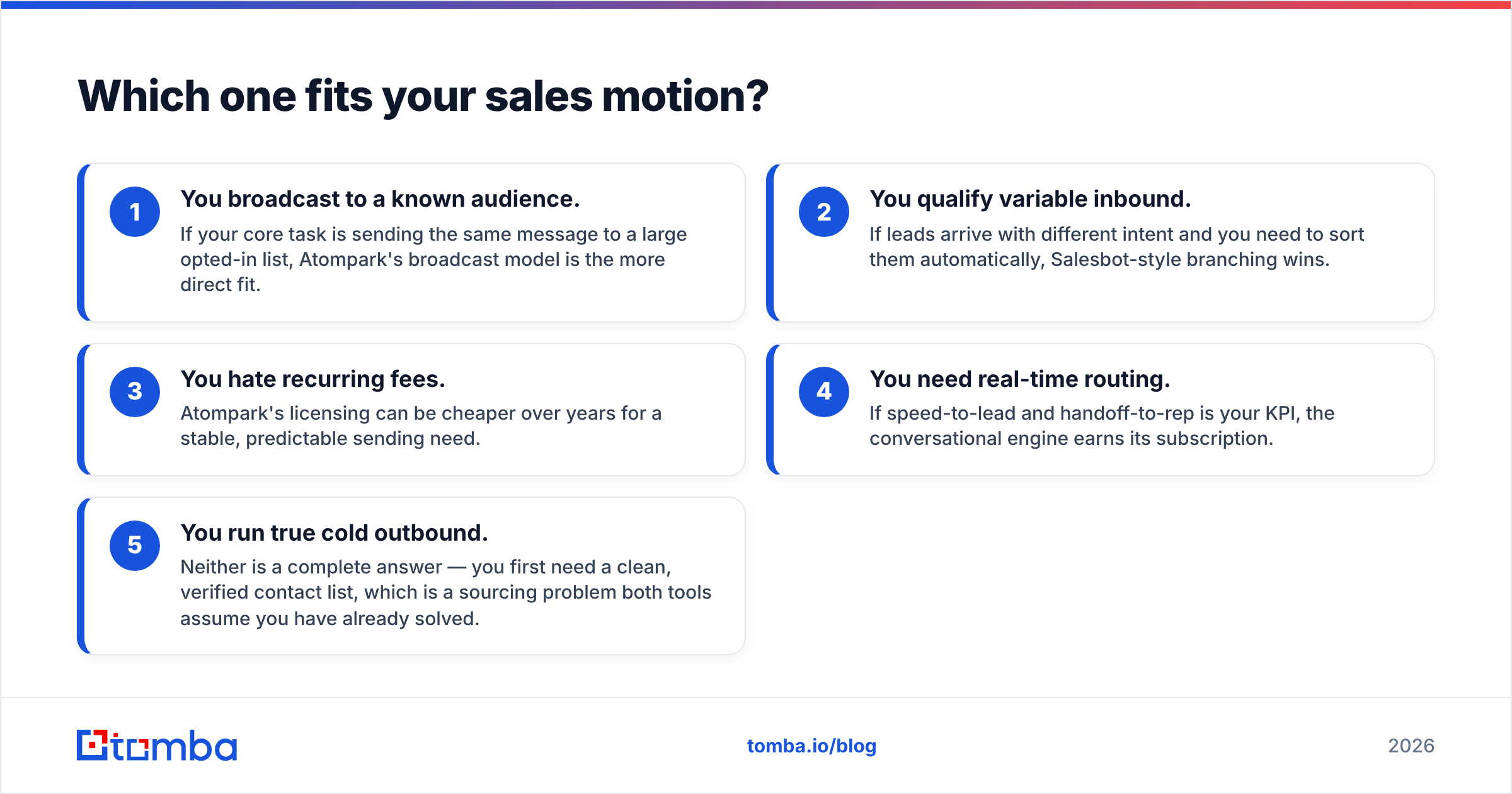
Pick based on where your real bottleneck is. Use these five checks:
- You broadcast to a known audience. If your core task is sending the same message to a large opted-in list, Atompark's broadcast model is the more direct fit.
- You qualify variable inbound. If leads arrive with different intent and you need to sort them automatically, Salesbot-style branching wins.
- You hate recurring fees. Atompark's licensing can be cheaper over years for a stable, predictable sending need.
- You need real-time routing. If speed-to-lead and handoff-to-rep is your KPI, the conversational engine earns its subscription.
- You run true cold outbound. Neither is a complete answer — you first need a clean, verified contact list, which is a sourcing problem both tools assume you have already solved.
That last point is where most comparisons stop too early. The tool you license or subscribe to is downstream of the data that flows through it.
Why does data quality decide the winner?#
Both tools inherit the quality of the list you feed them. A 50,000-contact broadcast against an unverified list produces bounces, spam complaints, and reputation damage that no sending app can undo. A conversational bot firing against mismatched records starts every interaction on the wrong foot.
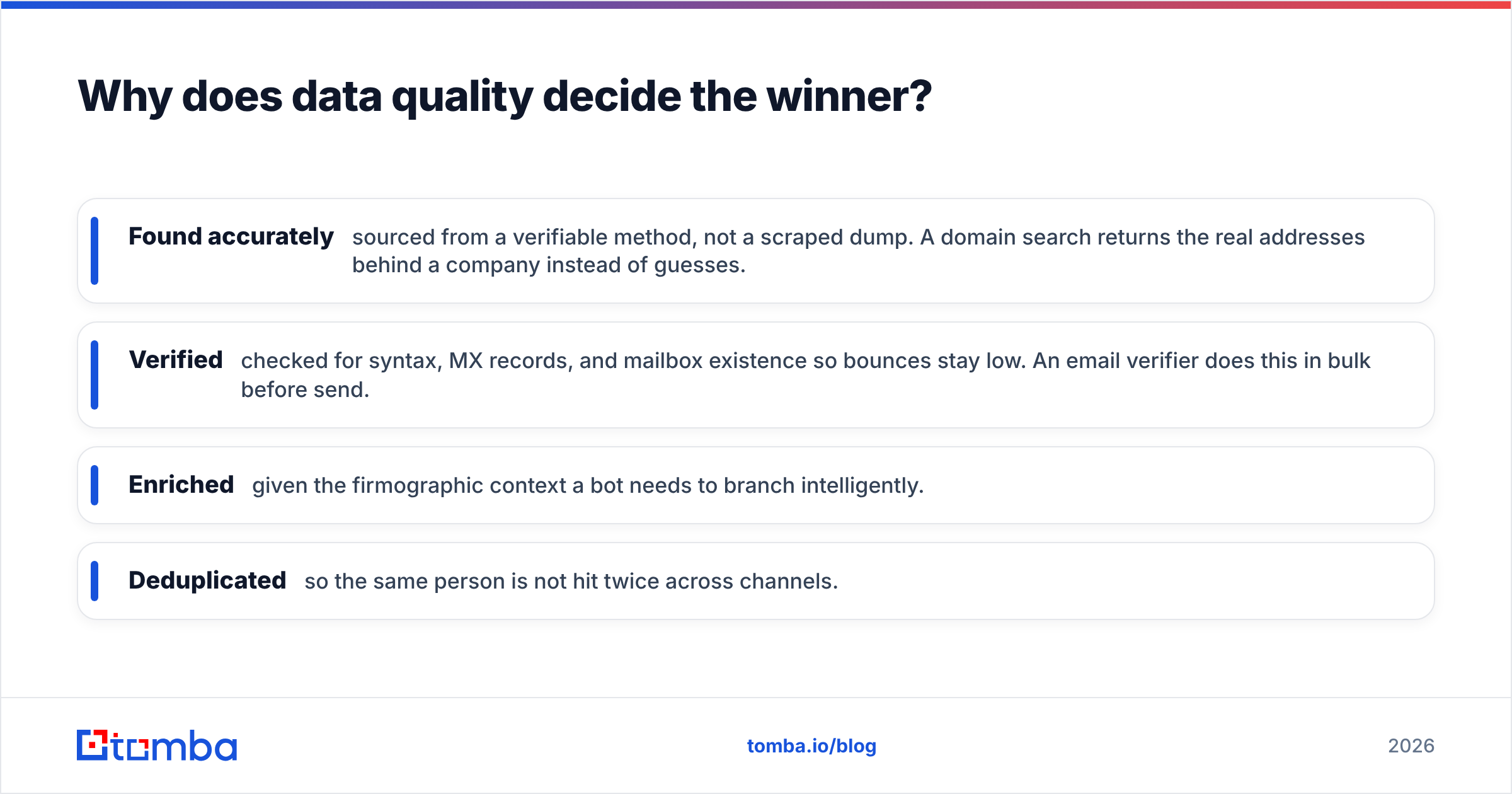
The fix is upstream. Before a contact enters Atompark or Salesbot, it should be:
- Found accurately — sourced from a verifiable method, not a scraped dump. A domain search returns the real addresses behind a company instead of guesses.
- Verified — checked for syntax, MX records, and mailbox existence so bounces stay low. An email verifier does this in bulk before send.
- Enriched — given the firmographic context a bot needs to branch intelligently.
- Deduplicated — so the same person is not hit twice across channels.
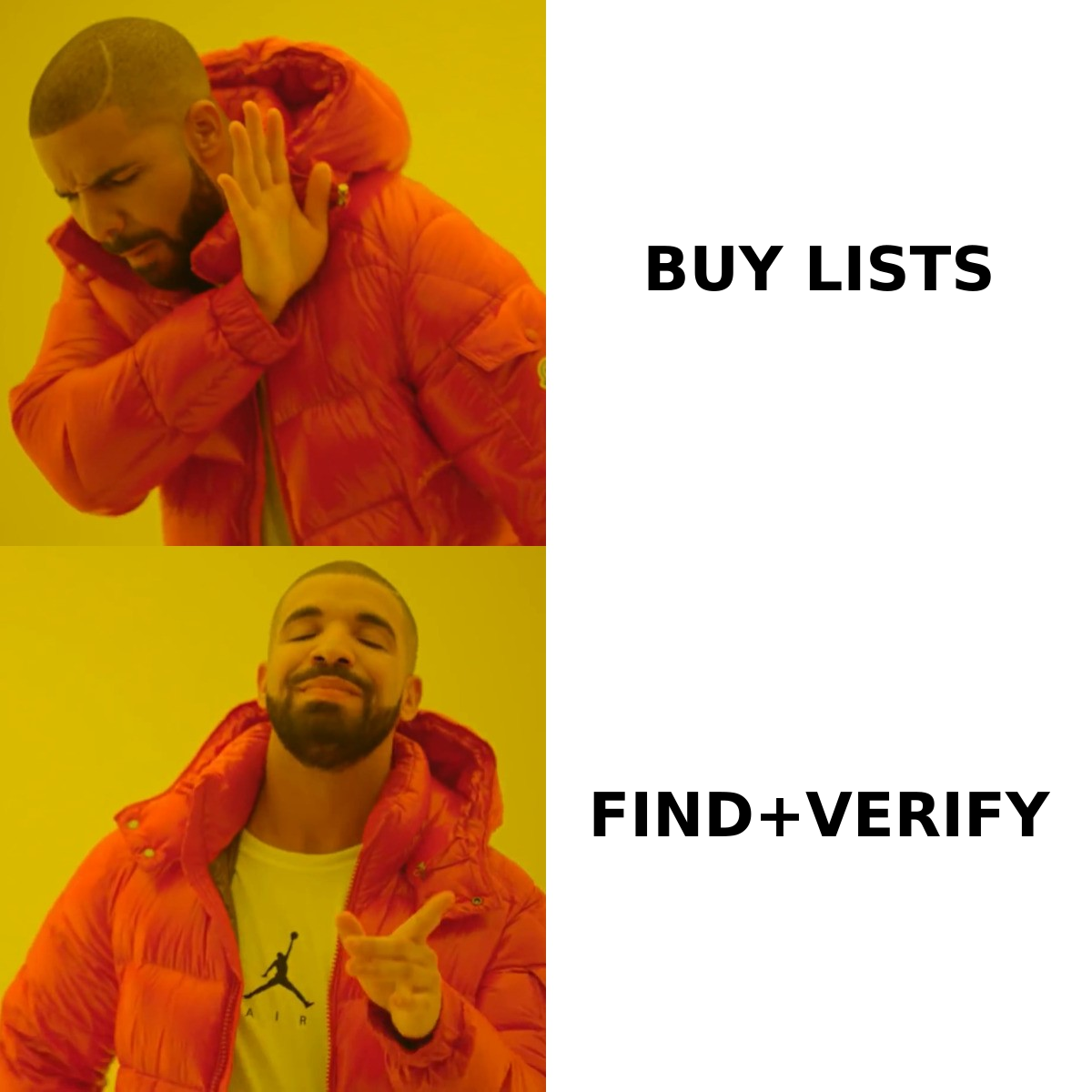
This is the layer Tomba occupies. It is not a broadcast engine and not a chatbot — it is the contact-data foundation that makes either one perform. Independent reviews on platforms like G2 consistently show that deliverability and reply rates track list quality more than sending volume, which is exactly why the data step is non-negotiable.
How do the tools handle deliverability and compliance?#
Deliverability is where Atompark users feel the most pain and where Salesbot users are partly insulated.
With a desktop or cloud mass sender, you own the sender reputation. If your SPF, DKIM, and DMARC records are misconfigured, or your list contains spam traps, mailbox providers will throttle or block you regardless of the tool. You can pressure-test your setup with an SPF checker before a major send, but the responsibility sits with you.
Conversational tools usually send through a connected channel (your inbox, an ESP, or a messaging API), which inherits that channel's reputation and rate limits. That can be safer at low volume but introduces its own caps — you cannot fire thousands of bot-driven messages per hour without tripping provider limits.
Compliance cuts across both. GDPR, CAN-SPAM, and CASL apply to broadcast and conversational outreach alike. Resources from established vendors such as HubSpot are useful for staying current on consent and opt-out rules, since the legal exposure is identical no matter which engine you choose.
What about pricing and total cost?#
Headline price rarely tells the real story. Factor in the data layer and the picture changes.
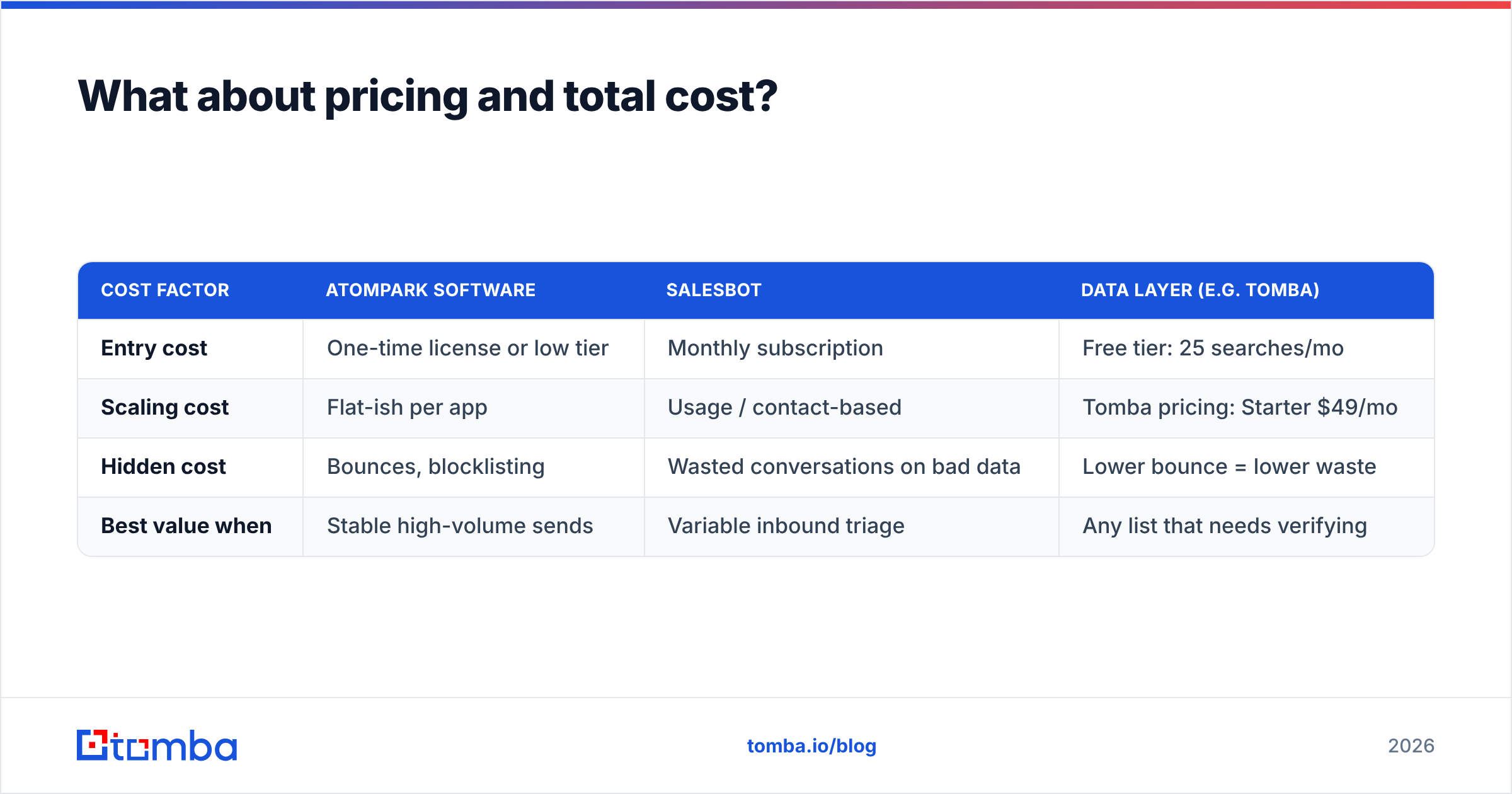
| Cost factor | Atompark Software | Salesbot | Data layer (e.g. Tomba) |
|---|---|---|---|
| Entry cost | One-time license or low tier | Monthly subscription | Free tier: 25 searches/mo |
| Scaling cost | Flat-ish per app | Usage / contact-based | Tomba pricing: Starter $49/mo |
| Hidden cost | Bounces, blocklisting | Wasted conversations on bad data | Lower bounce = lower waste |
| Best value when | Stable high-volume sends | Variable inbound triage | Any list that needs verifying |
A one-time Atompark license can look cheaper than a recurring Salesbot subscription on paper. But if either tool runs against an unverified list, the real cost shows up as bounced sends, damaged reputation, and reps chasing dead records. Spending a small amount to verify and enrich contacts first protects the larger spend on whichever engine you pick. For reference, Tomba's plans run from a free tier (25 searches/month) through Starter at $49/mo, Growth at $99/mo, and Pro at $249/mo — a fraction of the cost of a single ruined sender domain.
Can you use both Atompark and Salesbot together?#
Yes, and many teams effectively do — just under different product names. A common stack looks like this:
- Source and verify contacts with a dedicated data tool so every record is real before it moves downstream.
- Broadcast evergreen or seasonal campaigns through a bulk engine like Atompark for one-to-many reach.
- Qualify and route the replies and inbound with a Salesbot-style conversational layer.
In that workflow the two tools are complementary, not competitive. Atompark handles scale; Salesbot handles nuance. The connective tissue is clean data, which is why a bulk email finder or verification step sits at the top of the funnel feeding both.
The mistake is treating either engine as a substitute for the sourcing step. A bigger send and a smarter bot both amplify whatever list you give them — including its errors.
The verdict: Atompark Software vs Salesbot#
There is no universal winner because they are not playing the same game.
- Choose Atompark Software if your primary need is high-volume, one-to-many email or SMS broadcast and you prefer a license-style cost model. Just budget real attention for deliverability and list hygiene.
- Choose Salesbot if your priority is qualifying variable inbound, automating replies, and routing hot leads to reps in real time.
- Choose both, in sequence, if you run a mature funnel with broadcast at the top and conversational triage on the response.
But the decision underneath both decisions is the same: your results are capped by your contact data. The fastest, cheapest improvement most teams can make is not switching engines — it is feeding a verified, accurately sourced list into whichever one they already run.
That is the gap Tomba fills. Use the Tomba Email Finder to find professional email addresses by domain, name, or company, verify them in bulk, and enrich them with the context your sending engine or bot needs to actually convert. Start on the free tier, confirm the accuracy yourself, and feed clean data into Atompark, Salesbot, or both — so the tool you chose finally performs the way the demo promised.
// get started
Find, verify and enrich your first contacts today
Start on the free plan with 25 searches a month, then scale when your team is ready.
Free plan · No credit card required · GDPR & CCPA
// about the author