Atompark Software vs Tomba: Email Finder Showdown (2026)
Atompark's desktop email tools built a loyal base, but Tomba's API-first verification model has changed what accuracy looks like. Here's an honest 2026 breakdown of which one fits modern B2B prospecting.
Choosing between Atompark Software vs Tomba comes down to a single question: do you want desktop software that scrapes and blasts email, or an API-first platform built to find and verify business contacts with current data? They overlap on the surface, but they solve different problems for different decades of selling.
TL;DR#
- Atompark is a veteran desktop suite (Atomic Email Hunter, Atomic Mail Sender, Atomic Email Verifier) focused on extracting and sending bulk email from a Windows machine.
- Tomba is a cloud, email finder and verification platform with an API, browser extension, and real-time SMTP checks — built for B2B prospecting and CRM enrichment.
- For accuracy and deliverability in 2026, Tomba's live verification and confidence scoring outperform desktop scraping that pulls stale addresses off web pages.
- Atompark can be cheaper as a one-time license if you only need offline extraction; Tomba wins on data freshness, team workflows, and integrations.
- If your goal is qualified outbound — not bulk blasting — Tomba is the better fit. If you want a legacy all-in-one desktop blaster, Atompark still has a niche.
What is Atompark Software?#
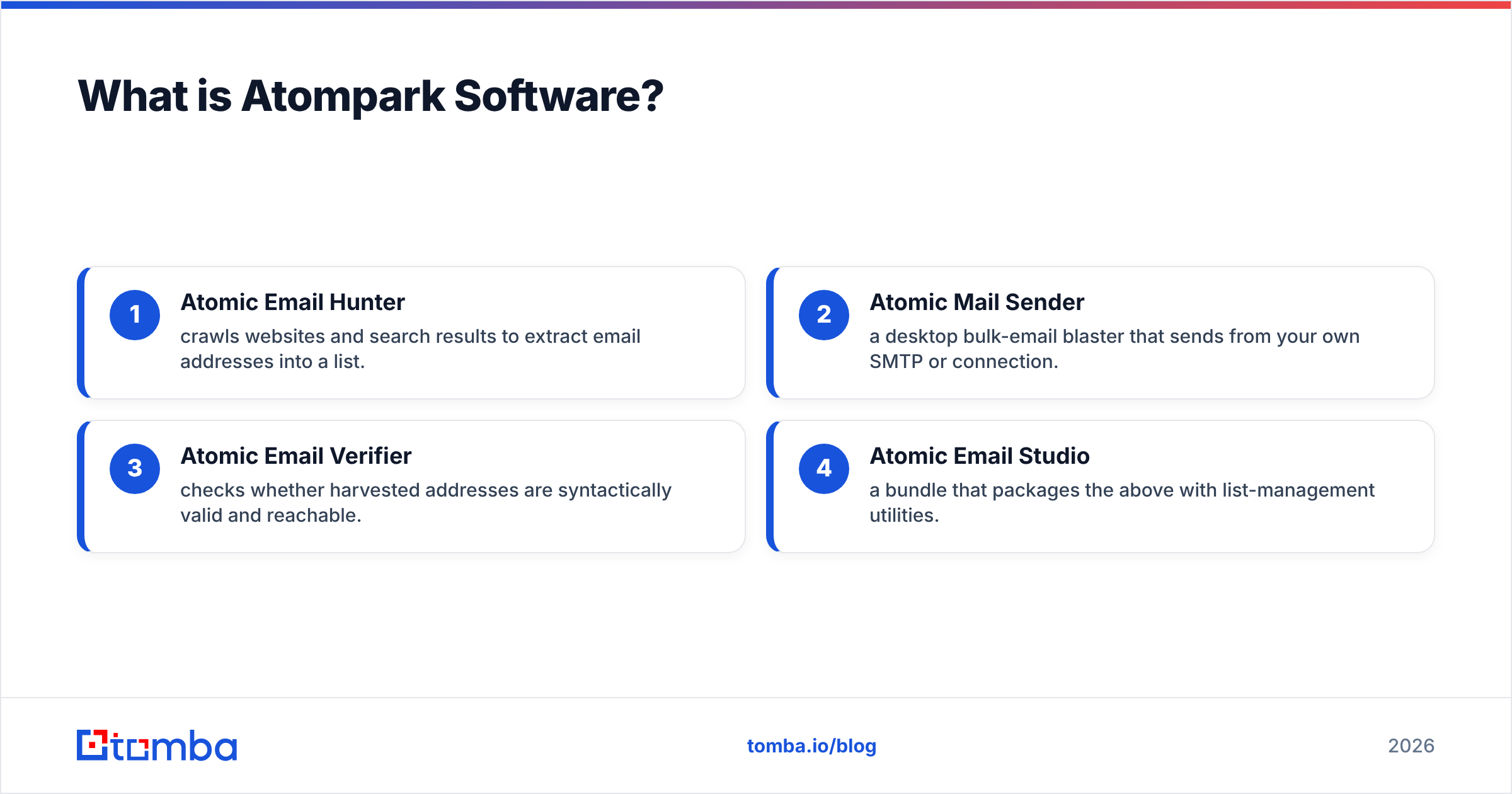
Atompark is one of the oldest names in email tooling, with a product line that dates back to the desktop era. Its flagship apps run locally on Windows:
- Atomic Email Hunter — crawls websites and search results to extract email addresses into a list.
- Atomic Mail Sender — a desktop bulk-email blaster that sends from your own SMTP or connection.
- Atomic Email Verifier — checks whether harvested addresses are syntactically valid and reachable.
- Atomic Email Studio — a bundle that packages the above with list-management utilities.
The model is classic shareware: buy a perpetual license (or subscription), install the .exe, and run extraction or sending from your own machine. You can read the full lineup on the official Atompark site. It appeals to solo operators who want to own their software outright and work offline.
The trade-off is that this design is rooted in a pre-API world. Email addresses scraped from public pages are only as fresh as the page, deliverability depends on your own IP reputation, and there's no shared cloud database refreshing contacts as people change jobs.
)
What is Tomba?#
Tomba is a cloud B2B contact-intelligence platform whose core is the email finder: give it a domain or a name plus company, and it returns the most likely professional email with a confidence score and the sources it matched against. Around that core sit an email verifier, domain search, catch-all verification, phone finder, and data enrichment.
Crucially, Tomba is API-first. The same lookups you run in the dashboard are available through the Tomba API, a CLI, a Chrome extension, and native integrations with HubSpot, Salesforce, Pipedrive, Zapier, and Google Sheets. That means a finding happens where your team already works — inside the CRM or the prospecting tool — instead of in a standalone desktop window.
The data model is the other big difference. Tomba doesn't just scrape a page once; it cross-references multiple sources and runs a real-time SMTP check at verification time, so a result reflects whether the mailbox accepts mail now, not whenever a crawler last visited.
Atompark Software vs Tomba: the core comparison#
Here's the head-to-head on the attributes that actually affect prospecting results.
| Attribute | Atompark Software | Tomba |
|---|---|---|
| Product type | Desktop apps (Windows) | Cloud platform + API |
| Primary use case | Bulk extraction & sending | B2B email finding & verification |
| How emails are sourced | Web/page scraping | Multi-source matching + pattern intelligence |
| Verification | Syntax + basic SMTP, offline | Real-time SMTP, catch-all detection, confidence score |
| API access | Limited / none | Full REST API, CLI, MCP |
| Integrations | Minimal | HubSpot, Salesforce, Pipedrive, Sheets,Zapier |
| Team collaboration | Single-machine license | Cloud workspace, shared credits |
| Free tier | Trial only | 25 searches/mo free |
| Entry price | Perpetual license / one-off | $49/mo Starter |
| Best for | Solo offline operators | Sales & RevOps teams |
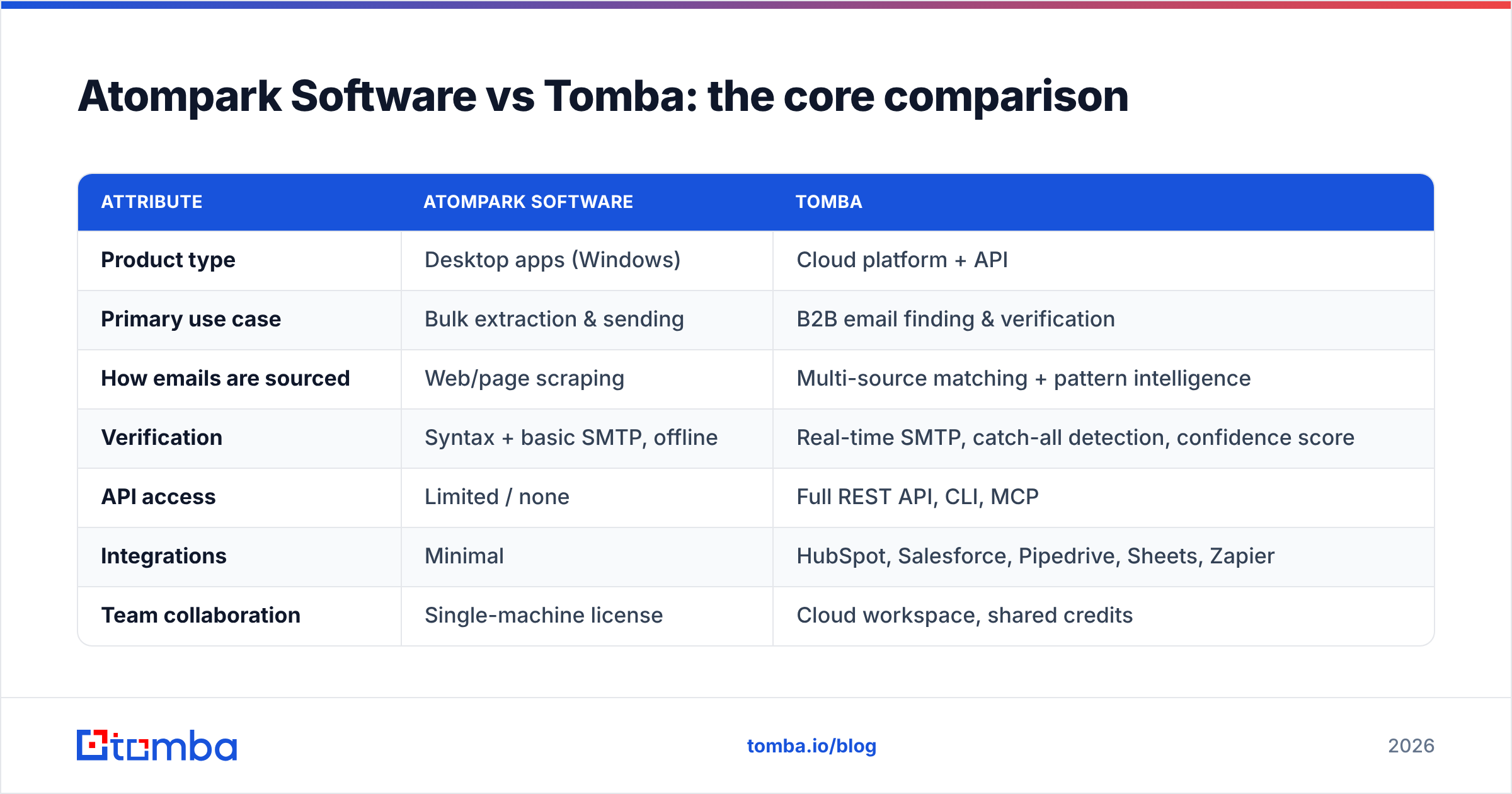
The pattern is clear: Atompark optimizes for ownership and offline control, Tomba optimizes for accuracy, freshness, and fitting into a modern revenue stack.
Is Tomba more accurate than Atompark?#
Yes — and accuracy is where the two philosophies diverge most. Scraping a webpage tells you an address existed on that page; it doesn't tell you the mailbox is live or that the person still works there. In B2B, roughly a third of contact data decays every year as people change roles, so a scraped list ages fast.

Tomba attacks the problem at the moment of use. Every returned email carries a confidence score, and the verifier runs a live SMTP handshake plus catch-all detection so you can route risky addresses away from your main sending domain. That protects email deliverability — a bounce rate above 3-4% is what gets a sending domain throttled, and desktop scraping with offline verification tends to produce exactly the kind of stale, risky lists that trigger it.
If your outbound depends on hitting the inbox, the verification model matters more than the price tag. A cheaper tool that fills your list with bounces costs you sender reputation, which is far more expensive to repair than a subscription.
How does pricing compare?#
This is the one area where Atompark can look cheaper on paper, and it deserves an honest read.
Atompark sells perpetual or subscription licenses per app. If you buy Atomic Email Hunter once and only need occasional offline extraction, your lifetime cost can be low. But you pay per app, updates and major versions can cost extra, and there's no shared cloud database refreshing your data.
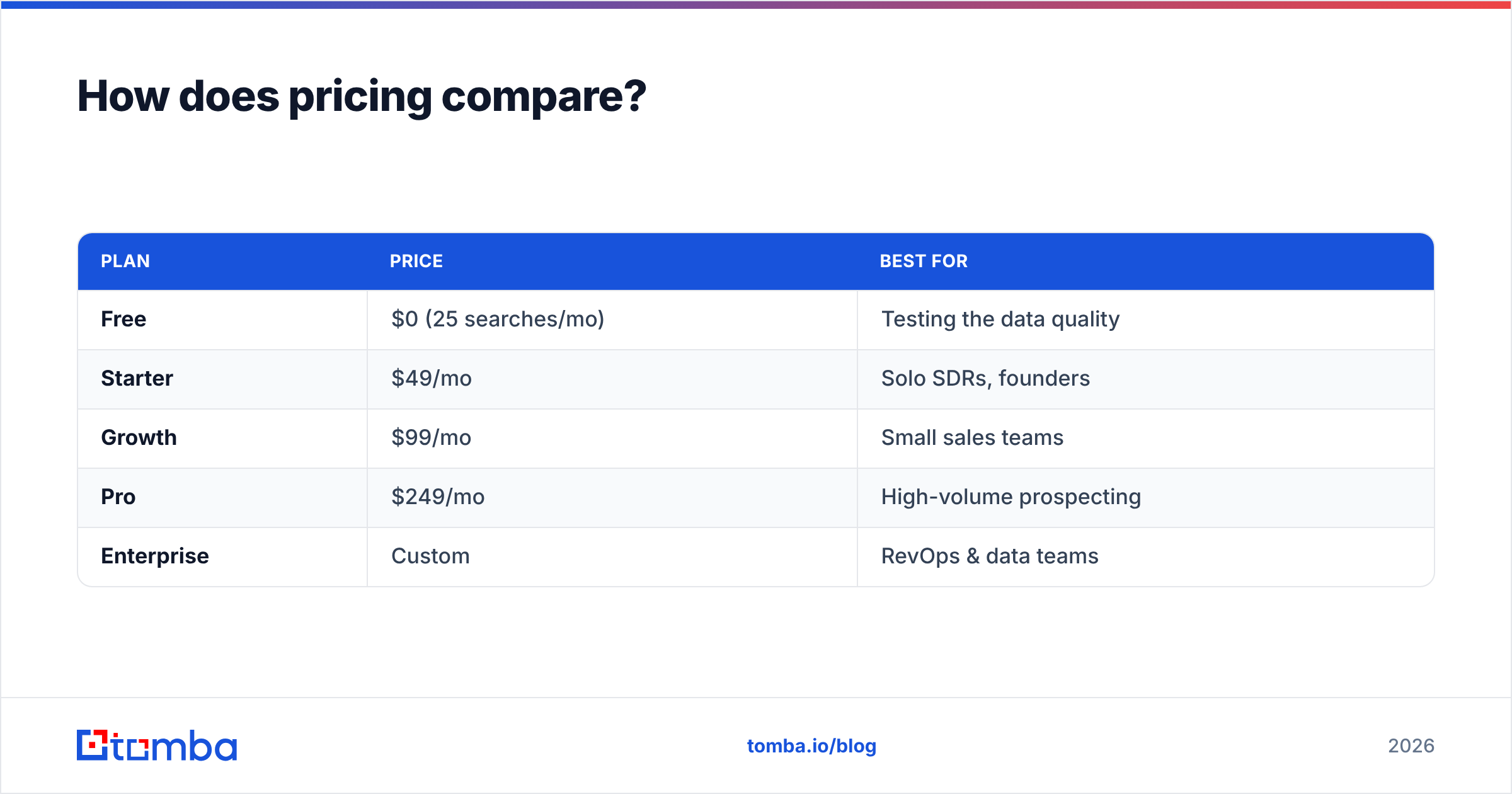
Tomba uses transparent monthly tiers (full details on the Tomba pricing page):
| Plan | Price | Best for |
|---|---|---|
| Free | $0 (25 searches/mo) | Testing the data quality |
| Starter | $49/mo | Solo SDRs, founders |
| Growth | $99/mo | Small sales teams |
| Pro | $249/mo | High-volume prospecting |
| Enterprise | Custom | RevOps & data teams |
The right way to compare cost is per usable contact, not per license. If 40% of a scraped list bounces or is outdated, the "cheap" tool was more expensive once you count wasted send volume and reputation risk. Tomba's free tier lets you measure that difference on your own target accounts before paying.
)
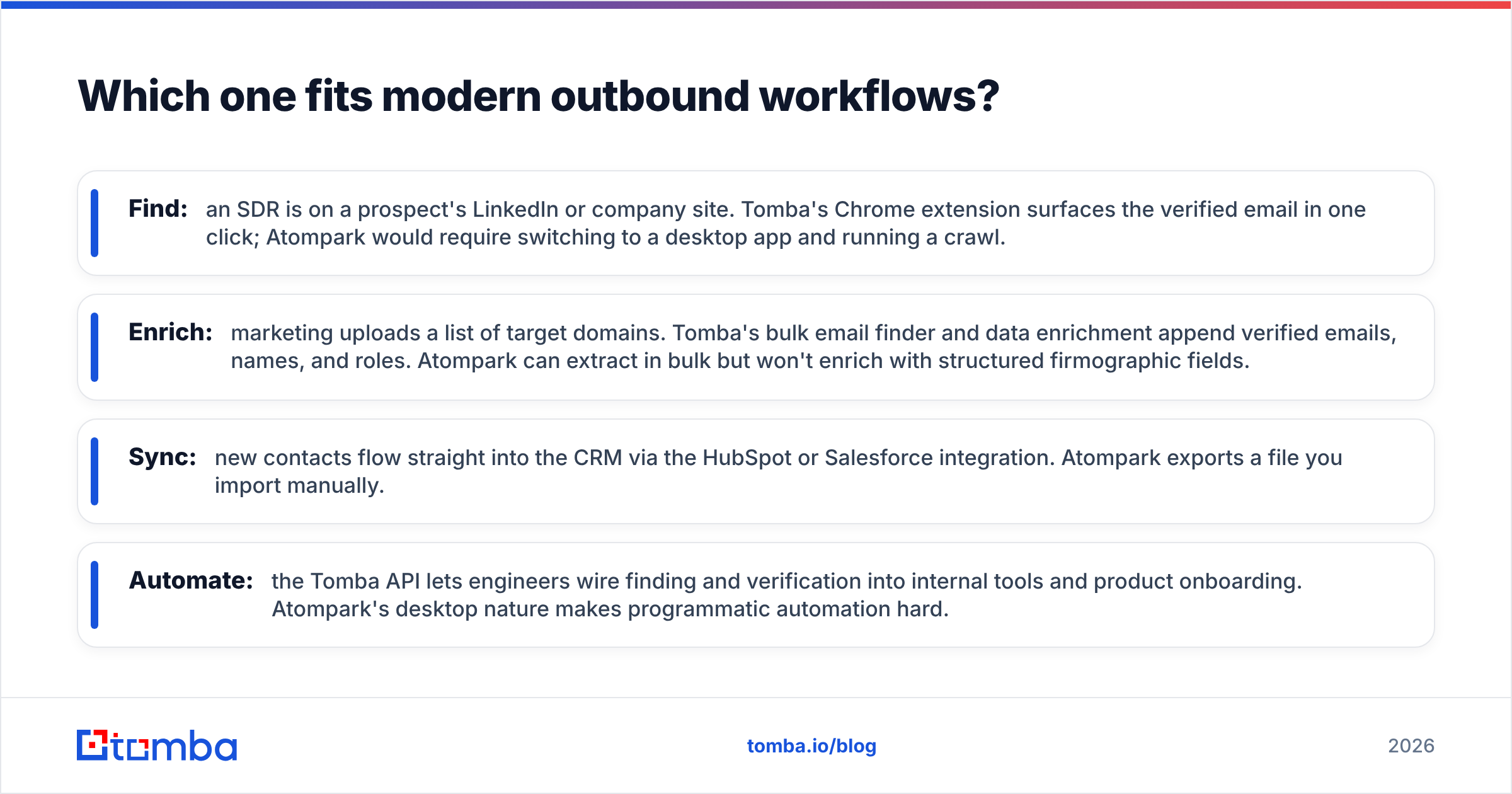
Which one fits modern outbound workflows?#
Workflow is where Tomba pulls clearly ahead for teams. Consider a typical 2026 prospecting motion:
- Find: an SDR is on a prospect's LinkedIn or company site. Tomba's Chrome extension surfaces the verified email in one click; Atompark would require switching to a desktop app and running a crawl.
- Enrich: marketing uploads a list of target domains. Tomba's bulk email finder and data enrichment append verified emails, names, and roles. Atompark can extract in bulk but won't enrich with structured firmographic fields.
- Sync: new contacts flow straight into the CRM via the HubSpot or Salesforce integration. Atompark exports a file you import manually.
- Automate: the Tomba API lets engineers wire finding and verification into internal tools and product onboarding. Atompark's desktop nature makes programmatic automation hard.
For a single user doing occasional, offline list-building, Atompark's self-contained model is fine. For anyone running repeatable, team-based outbound where data flows between tools, the cloud-and-API approach removes the manual export/import friction that quietly kills productivity.
What about compliance and deliverability risk?#
Bulk extraction and bulk sending from the same desktop suite is a workflow that regulators and mailbox providers have grown hostile to. Scraping large volumes of addresses and blasting them from your own IP is the fastest route to spam complaints, blacklisting, and GDPR/CAN-SPAM exposure.
Tomba's positioning is deliberately different: it finds and verifies contacts so you can run permission-aware, targeted outreach through a proper sending platform with warmup and rotation. Separating "find good data" from "send responsibly" is the healthier architecture in 2026, and it's why most modern teams pair a finder like Tomba with a dedicated cold-email tool rather than relying on an all-in-one blaster.
You can sanity-check vendor reputations on independent directories like G2 and Capterra before committing — read the reviews on data freshness and support response, not just the star rating.
When should you still choose Atompark?#
To be fair, Atompark isn't obsolete for everyone. Pick it if:
- You specifically want perpetual-license desktop software you own outright with no recurring fee.
- You work fully offline or in an environment where cloud tools are restricted.
- Your need is simple, occasional extraction rather than ongoing, verified, team-shared prospecting.
- You're comfortable managing your own SMTP and sender reputation for sending.
If those describe you, Atompark's longevity and one-time cost have real appeal.
When should you choose Tomba?#
Choose Tomba if any of these are true — which, for most B2B teams, they are:
- You need current, verified emails, not whatever a crawler scraped months ago.
- You want API, CRM, and spreadsheet integrations so data moves automatically.
- You care about deliverability and want confidence scores plus catch-all detection before you send.
- You run a team and need shared credits, a cloud workspace, and audit-friendly usage.
- You'd rather test for free (25 searches/mo) than buy a license blind.
Tomba is also a strong landing spot if you're migrating off other finders — its Apollo alternative and RocketReach alternative pages show how it stacks up against the broader category, not just Atompark.
Final verdict: Atompark Software vs Tomba#
For modern B2B prospecting, Tomba is the stronger choice — its real-time verification, confidence scoring, API, and integrations are built for how teams actually sell in 2026, and the free tier lets you prove the data quality on your own accounts before paying a cent. Atompark remains a reasonable pick for a narrow audience that wants offline, owned desktop software and only needs occasional extraction.
If your priority is putting accurate, verified contacts into your pipeline without babysitting a desktop app, start with the Tomba Email Finder. Run 25 free searches against your top target accounts, check the confidence scores and bounce rates against any list Atompark would build, and let the deliverability numbers decide. That single test usually settles the comparison faster than any feature table.
Ready to find emails that actually work?
Join 150,000+ professionals who stopped guessing and started sending. Free credits on signup — no credit card required.
Get the Tomba newsletter
Practical outbound tactics and product updates — once every two weeks.
About the author