Atompark Software vs ZoomInfo (2026): Which Wins for B2B?
Atompark Software ships bulk email senders; ZoomInfo sells a sales-intelligence database. They solve different problems at wildly different prices. Here's how the two actually compare in 2026 — and where a leaner stack beats both.
Atompark Software vs ZoomInfo looks like a fair fight — until you look closely. Then you see you're comparing a delivery van to a freight terminal. One sends bulk email from your desktop. The other is an enterprise data platform that costs as much as a salary. This guide breaks down what each tool does, what they cost in 2026, and where neither is the right pick.
TL;DR#
- Atompark Software is a suite of Windows desktop apps (Atomic Mail Sender, Email Studio, email extractors) built for sending high-volume email and scraping addresses. It's cheap and one-time-licensed, but it's not a verified-data provider.
- ZoomInfo is a cloud B2B sales-intelligence platform with a massive contact database, intent signals, and CRM integrations — priced for enterprise teams, often $15,000+/year.
- They barely overlap: Atompark is a sending/extraction tool, ZoomInfo is a data/intelligence tool. Choosing between them usually means you've mis-scoped the problem.
- If what you actually need is accurate, on-demand B2B emails without a desktop blaster or an enterprise contract, a focused finder like Tomba covers the gap from a free tier up to $249/mo.
- Read on for a side-by-side table, pricing reality checks, and a decision framework.
What is Atompark Software?#
Atompark Software is a long-running vendor of desktop email tools. It's best known for Atomic Mail Sender, Atomic Email Studio, and a family of email extractors and verifiers. The model is old-school in both the good and bad senses. You buy a license (often one-time), install it on Windows, and run mass-mailing campaigns or scrape addresses from web pages and search results.
Think of Atompark like a power drill you own outright. It's yours, it's cheap over time, and it does one mechanical job well — but it doesn't come with the building materials. Atompark gives you the engine to send and extract. It doesn't hand you a vetted, continuously-refreshed database of decision-makers.
The strengths are real for a specific buyer: low cost, offline control, no per-contact data fees, and granular sending settings. The weaknesses are just as real. Scraped lists are unverified by default. Deliverability is your problem. And blasting from your own SMTP can torch your sender reputation fast if you skip warmup and list hygiene.
What is ZoomInfo?#
ZoomInfo is a cloud-based B2B sales-intelligence platform. Its core asset is a giant database of company and contact records: emails, direct dials, org charts, and technographics. On top of that sit intent data, website-visitor tracking, and deep CRM and sales-engagement integrations.
Where Atompark sells you a tool, ZoomInfo sells you data and workflow. It's built for revenue teams that want to spot accounts showing buying intent, enrich their CRM automatically, and route fresh leads to reps. That power is why ZoomInfo shows up in nearly every B2B data and intelligence shortlist — and why it's priced the way it is.
The trade-off is cost and commitment. You sign annual contracts with seat-based pricing, and add-on modules push real-world spend well into five figures. For a two-person startup, that's a non-starter. For a 50-rep sales org, it can pay for itself in a quarter.
Atompark Software vs ZoomInfo: a head-to-head comparison#
Here's the uncomfortable truth: the Atompark Software vs ZoomInfo matchup sits at opposite ends of the stack. The table below lines them up on the attributes buyers actually weigh, with a focused email-finder added as a reference point.
| Attribute | Atompark Software | ZoomInfo | Focused finder (e.g. Tomba) |
|---|---|---|---|
| Primary job | Bulk send + email scraping | Sales intelligence + data | Find & verify B2B emails |
| Delivery model | Windows desktop apps | Cloud SaaS | Cloud + API + extensions |
| Data freshness | Scraped, unverified | Continuously refreshed | Verified on request |
| Pricing model | One-time license | Annual contract, per seat | Free tier + monthly plans |
| Entry cost | ~$30–$300 one-time | Often $15,000+/yr | Free, then $49/mo |
| Intent data | No | Yes | No |
| CRM integrations | Limited | Deep (Salesforce, HubSpot) | Native + Zapier/Make |
| Email verification | Basic add-on | Built-in | Dedicated verifier |
| Best for | DIY low-budget senders | Enterprise revenue teams | SMB/mid-market outreach |
| Compliance posture | User-managed | Enterprise-grade | GDPR-aware sourcing |
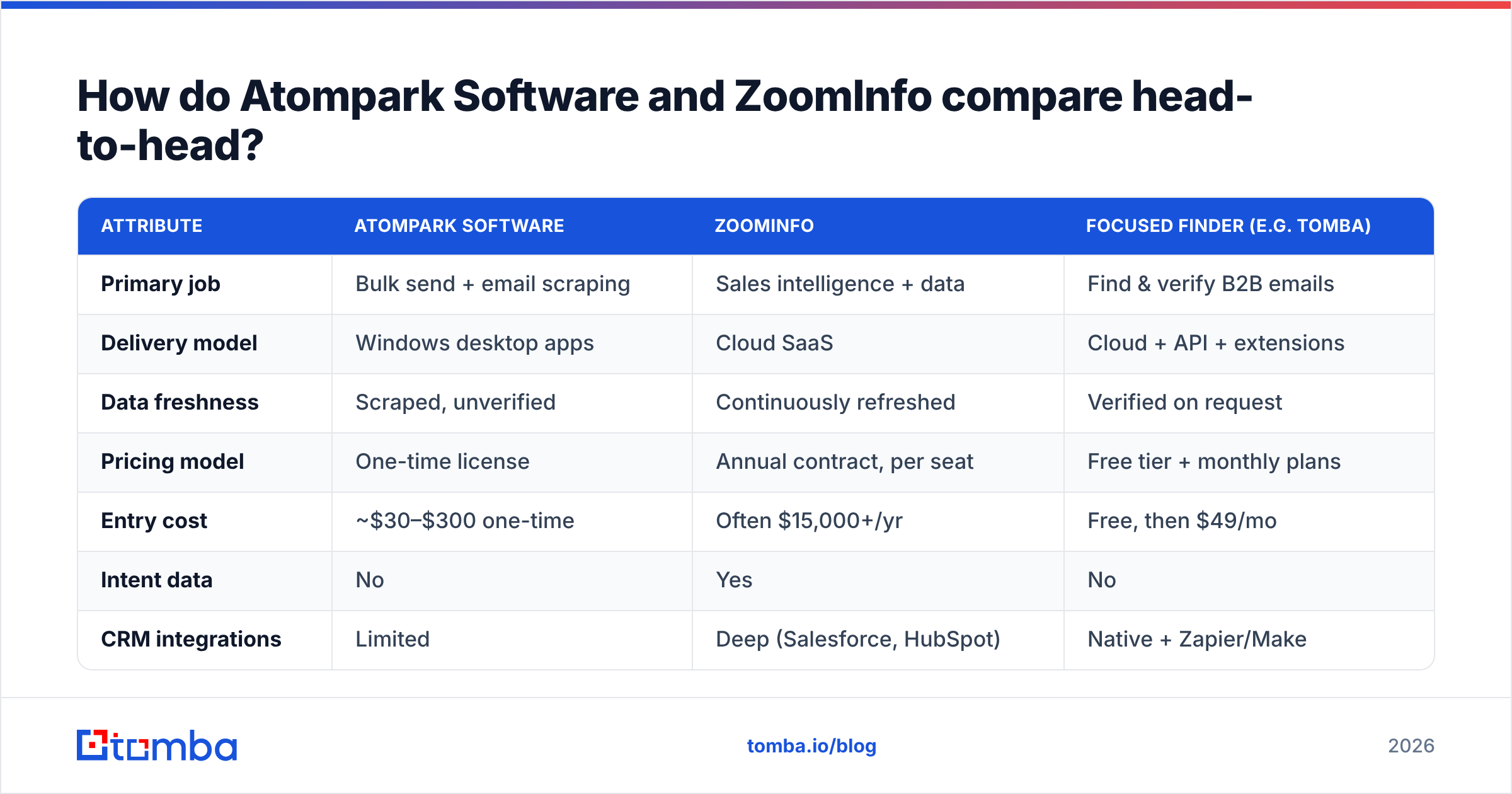
Two things jump out. First, the price gap is enormous. Atompark is a coffee-budget purchase; ZoomInfo is a headcount-level commitment. Second, neither is a clean "buy emails and send them safely" answer on its own. Atompark gives you sending without trustworthy data. ZoomInfo gives you trustworthy data, but bundles it into a platform you may not fully use.
Which one has better data accuracy?#
ZoomInfo wins on data, clearly — but you pay for it. Its records are sourced, machine-verified, and refreshed on a cycle. That's why enrichment and routing workflows depend on it. Atompark, by contrast, hands you whatever its extractor scraped. That data is only as good as the page it came from. A freshly scraped address has no verification status until you run it through a verifier.
That distinction matters more than feature checklists. Picture a list of 50,000 scraped addresses with a 30% bounce rate. It will damage your domain faster than 5,000 verified ones could ever help you. This is exactly where teams get burned. They treat extraction volume as a win, then discover the cost at the inbox.
Suppose accuracy is the deciding factor and ZoomInfo's price isn't realistic. The middle path is a dedicated email verifier plus an email finder that returns a confidence score per address. You get ZoomInfo-style hygiene on the contacts you actually need, without the database-wide licensing fee. For teams worried about wildcard domains, a catch-all verifier closes the last common gap.
What does each one cost in 2026?#
Pricing is where the two diverge hardest. So be honest about your budget before you shortlist.
Atompark Software uses a classic license model. Individual apps run roughly $30–$300 as one-time or tiered purchases, with optional upgrades. There's no per-contact data fee because there's no data product — you're paying for software, not records. For a solo operator or a tiny team, total cost of ownership is genuinely low.
**
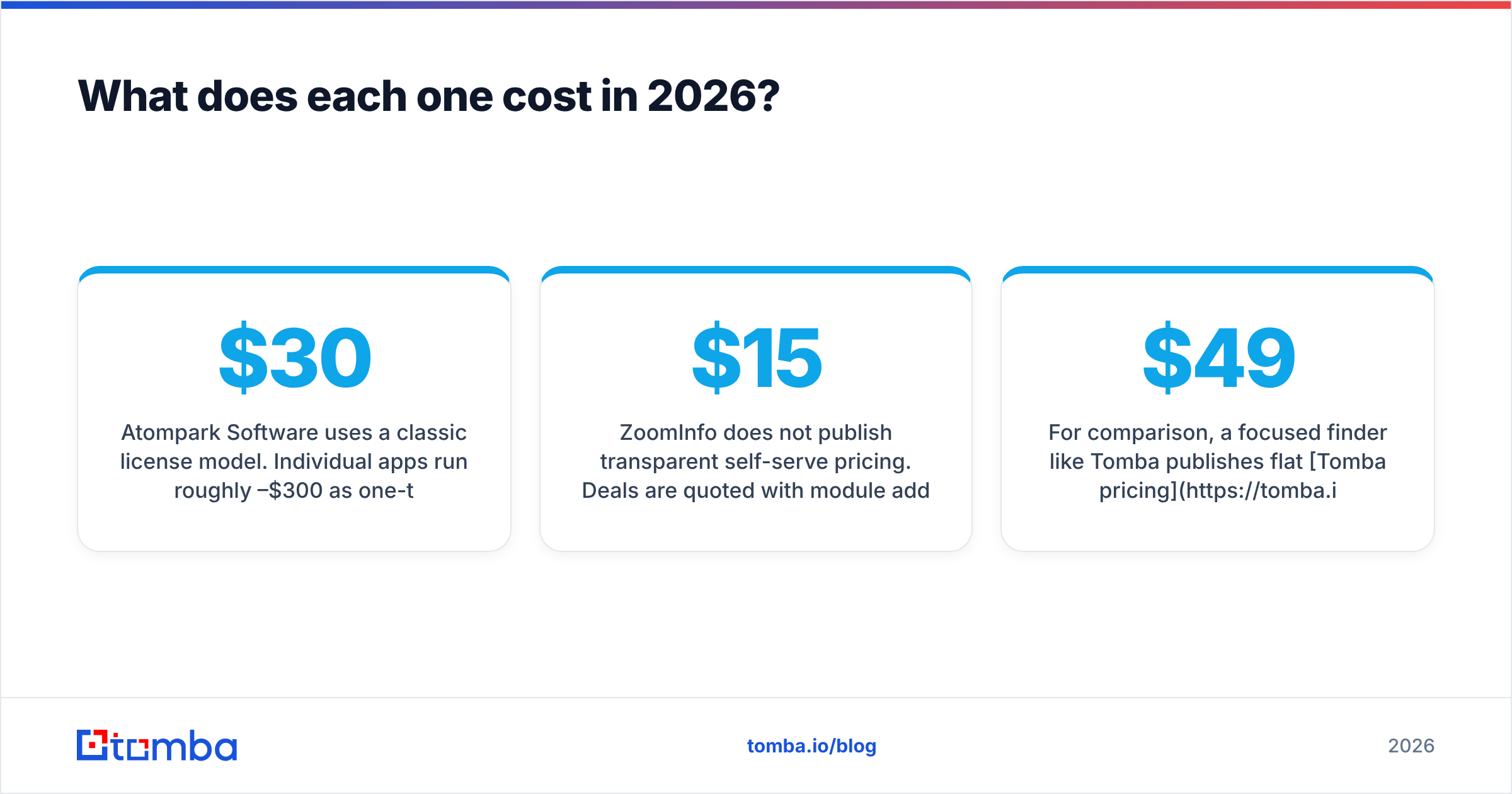
ZoomInfo** does not publish transparent self-serve pricing. Deals are quoted per seat with module add-ons (Sales, Marketing, Talent, intent, enrichment). Real-world annual spend commonly lands at $15,000 and up, scaling with seats and data volume. You'll talk to sales, negotiate, and sign an annual contract. Independent reviews on G2 repeatedly flag the cost and contract terms as the main friction.
For comparison, a focused finder like Tomba publishes flat Tomba pricing: a Free tier (25 searches/mo), Starter at $49/mo, Growth at $99/mo, Pro at $249/mo, and custom Enterprise. No annual lock-in is required to start, and you can scale credits as outreach grows.

Is Atompark or ZoomInfo better for cold outreach?#
Neither is ideal end-to-end — and the reason is structural. Atompark can send, but it gives you unverified data and puts all deliverability risk on you.
ZoomInfo gives you great data, but it isn't a sending platform. You still need an email tool, and you're paying enterprise rates for records you may only partly use.
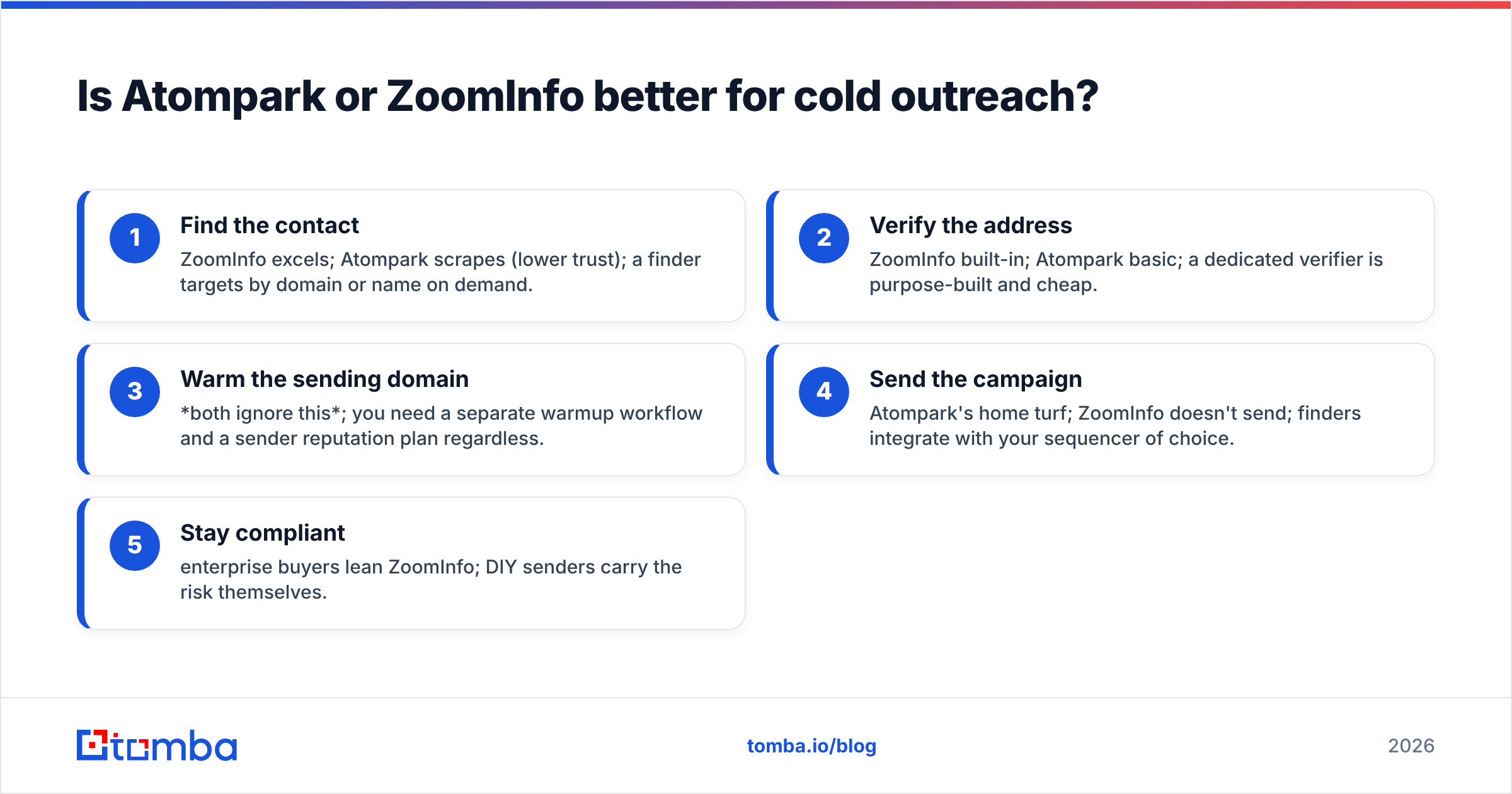
Modern cold outreach has three jobs: find the right contact, verify it, and send it safely from a warmed domain. Map that against these tools:
- Find the contact — ZoomInfo excels; Atompark scrapes (lower trust); a finder targets by domain or name on demand.
- Verify the address — ZoomInfo built-in; Atompark basic; a dedicated verifier is purpose-built and cheap.
- Warm the sending domain — both ignore this; you need a separate warmup workflow and a sender reputation plan regardless.
- Send the campaign — Atompark's home turf; ZoomInfo doesn't send; finders integrate with your sequencer of choice.
- Stay compliant — enterprise buyers lean ZoomInfo; DIY senders carry the risk themselves.
The takeaway is simple. If your real goal is reliable cold email at SMB or mid-market scale, the winning stack is usually a precise finder plus a verifier feeding a dedicated sequencer. It's not a desktop blaster, and it's not a five-figure intelligence suite. You can pull targeted lists with bulk email finder runs or a domain search and keep your data lean and verified.
Who should choose Atompark Software?#
Choose Atompark if you are a budget-first, hands-on operator. You want to own the tooling outright and you're comfortable managing deliverability yourself. It fits:
- Solopreneurs and very small teams with tight budgets.
- Users who prefer a one-time license over recurring SaaS fees.
- People who already have their own clean lists and just need a sender.
- Technical users who will warm domains, manage SMTP, and handle compliance manually.
It does not fit teams that need verified, continuously-updated contact data. Nor does it fit anyone who can't afford a damaged sending domain from unvetted scraped lists.
Who should choose ZoomInfo?#
Choose ZoomInfo if you run a funded revenue team that lives in the CRM and needs intelligence, not just addresses. It fits:
- Mid-market and enterprise sales orgs with real budget.
- Teams that need intent data, org charts, and automatic CRM enrichment.
- RevOps functions standardizing on one data source of truth.
- Companies where data freshness directly drives pipeline.
It does not fit bootstrapped teams, side projects, or anyone who only needs a few hundred verified emails a month. Paying enterprise rates for occasional lookups is the classic ZoomInfo over-buy. If that's you, a leaner Apollo alternative-style finder or a data enrichment tool covers the same job for a fraction of the spend.
Is there a better middle-ground alternative?#
Yes — for most SMB and mid-market teams, the honest answer is "neither, exactly." The gap between Atompark's unverified desktop sending and
ZoomInfo's enterprise contract is where most buyers actually live. You want accurate emails, on demand, at a price that scales with your outreach — without owning a database or a blaster.
That's the niche a focused finder fills. With Tomba you can:
- Find professional emails by name, company, or domain search with a confidence score on each.
- Verify emails before you send to protect deliverability.
- Enrich existing records via the Tomba API, Chrome extension, or Google Sheets add-on.
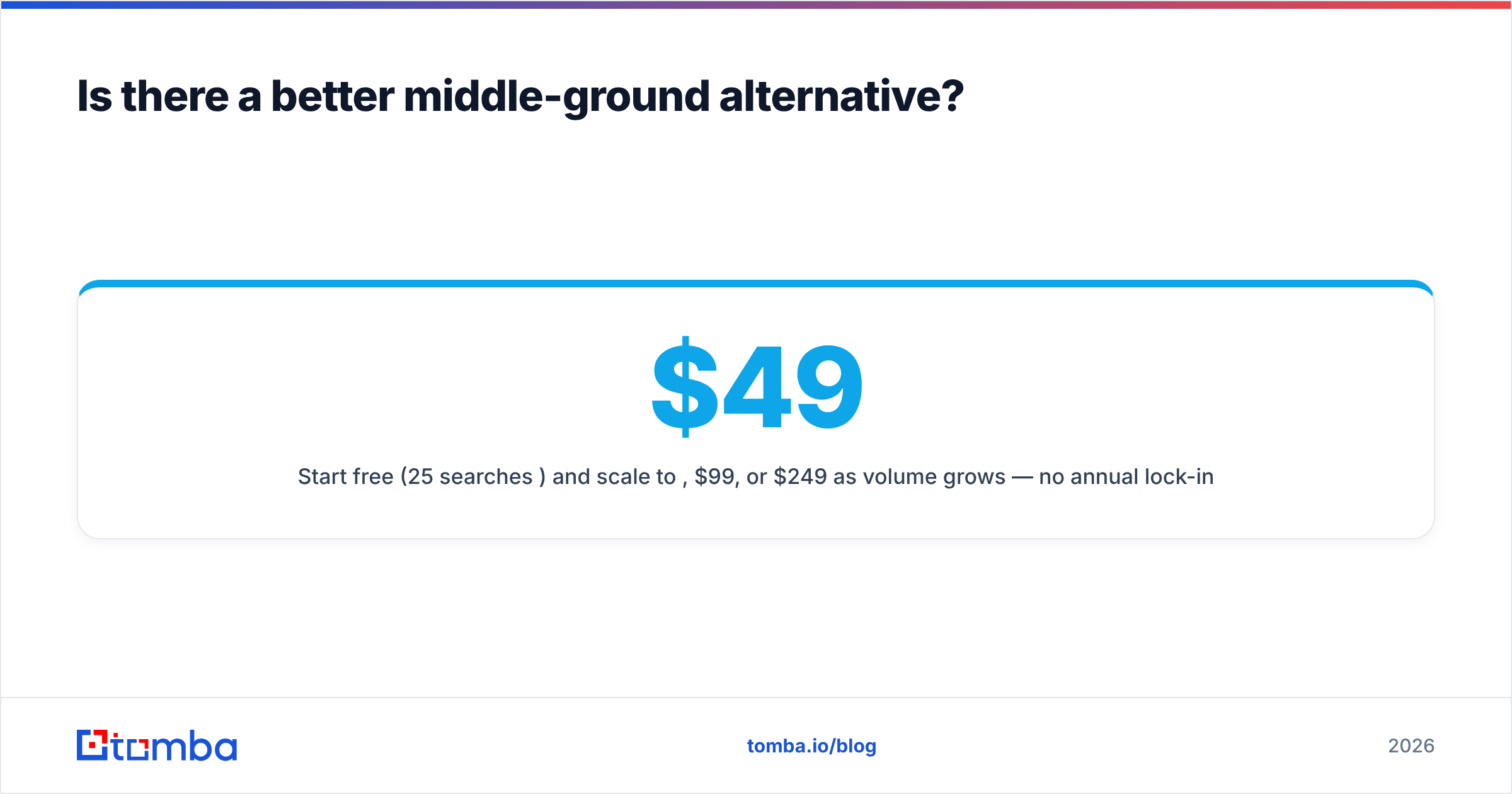
- Start free (25 searches/mo) and scale to $49, $99, or $249/mo as volume grows — no annual lock-in.
It won't give you ZoomInfo's intent signals, and it won't blast email like Atompark. But it nails the core job: get me the right, verified contact so I can reach out. It's faster to deploy, cheaper to run, and far safer for your domain than scraping.
The bottom line#
In the Atompark Software vs ZoomInfo debate, the two aren't really competitors; they're answers to different questions. Atompark is a cheap, DIY sending-and-scraping toolkit. ZoomInfo is a premium intelligence platform for well-funded teams. If you're choosing between them, step back. Decide whether you need data, sending, or both, and price each layer separately.
For most teams reading a comparison like this, the practical move is clear. Buy verified data only where you need it, and pair it with a sequencer you already trust. Start with the Tomba Email Finder — find and verify B2B emails by domain, name, or company on a free tier, then scale plans as your outbound grows. It's the leanest path to the accuracy ZoomInfo charges a fortune for, without the risk Atompark's scraped lists leave on your domain.
// get started
Find, verify and enrich your first contacts today
Start on the free plan with 25 searches a month, then scale when your team is ready.
Free plan · No credit card required · GDPR & CCPA
// about the author