Attio Pricing, Reviews, Pros and Cons: A 2026 CRM Breakdown
A neutral, numbers-first look at Attio pricing, real user reviews, and the honest pros and cons — so you know if this AI-native CRM fits your 2026 sales stack.
Attio gets pitched as the CRM that finally feels like modern software instead of a 2009 database with a paint job. That reputation is mostly earned — but "feels modern" and "fits your budget and workflow" are two different questions. This breakdown weighs Attio pricing, reviews, pros and cons with concrete numbers so you can decide before you migrate a whole team.
TL;DR#
- Attio is a flexible, AI-native CRM built around a live data model — great for teams that hate rigid, pre-baked sales pipelines.
- Pricing runs from a free plan to roughly $119/user/month (Enterprise, billed annually), with the popular Pro tier near $59/user/month.
- Reviews praise the speed, customization, and automatic enrichment, but flag a learning curve and costs that climb fast as seats and add-ons stack up.
- The biggest hidden cost is data quality: a beautiful CRM still needs accurate contact data flowing in, which is where a dedicated email finder earns its keep.
- Best fit: startups and RevOps teams that want to design their own CRM; weaker fit for tiny teams wanting plug-and-play simplicity on day one.
What is Attio and who is it for?#
Attio is a customer relationship management platform that treats your CRM like a spreadsheet-database hybrid you can reshape at will. Instead of forcing you into "Leads → Opportunities → Accounts," it lets you build custom objects, attributes, and workflows that mirror how your business actually sells.
Think of it like the difference between a pre-furnished apartment and an empty loft. A legacy CRM hands you the couch already bolted to the floor. Attio hands you the loft and the tools — you decide where everything goes. That freedom is the whole pitch, and it's also the source of most complaints.
It targets three groups in particular:
- Venture-backed startups that outgrew a shared spreadsheet but find Salesforce overkill.
- RevOps and operations teams who want to model unusual data relationships without a consultant.
- Product-led and agency businesses that need the CRM to bend around their process, not the reverse.
If you want a CRM that works in five minutes with zero setup, Attio will frustrate you. If you want one you can sculpt, it's one of the strongest options in 2026. You can read user sentiment directly on G2 before committing.

How much does Attio cost in 2026?#
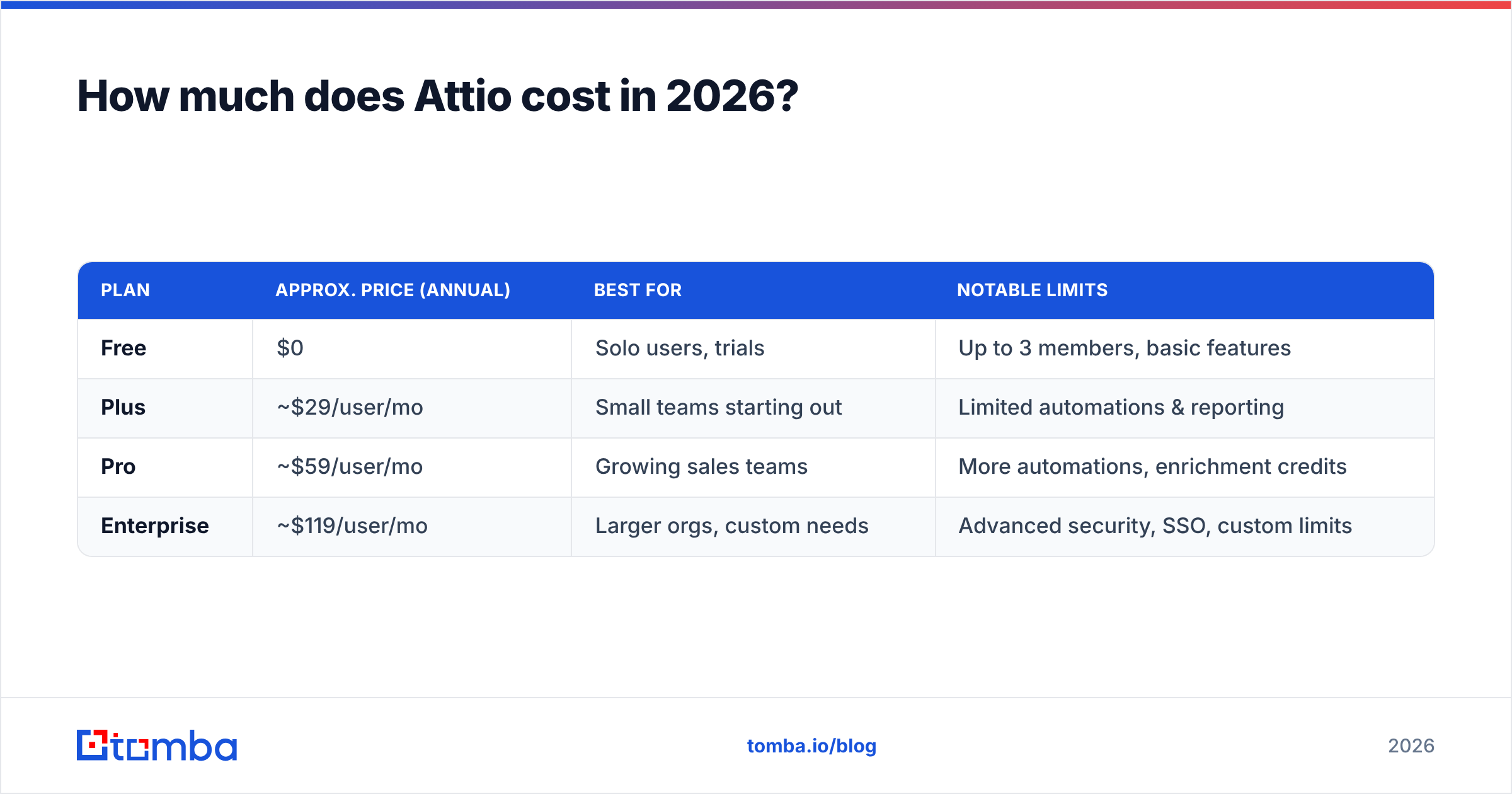
Attio uses per-seat, tiered pricing that is cheapest when billed annually. Prices below reflect publicly listed annual rates at the time of writing — always confirm current numbers on the official Attio pricing page, since SaaS tiers shift often.
| Plan | Approx. price (annual) | Best for | Notable limits |
|---|---|---|---|
| Free | $0 | Solo users, trials | Up to 3 members, basic features |
| Plus | ~$29/user/mo | Small teams starting out | Limited automations & reporting |
| Pro | ~$59/user/mo | Growing sales teams | More automations, enrichment credits |
| Enterprise | ~$119/user/mo | Larger orgs, custom needs | Advanced security, SSO, custom limits |
A few cost realities that reviews repeatedly surface:
- Monthly billing costs more. Like most CRMs, choosing month-to-month inflates the per-seat price meaningfully versus annual.
- Seats multiply fast. At ~$59/user, a 10-person team is ~$7,000/year on Pro before any add-ons — modest next to Salesforce, but not "cheap."
- Enrichment and AI features can sit behind higher tiers or credit limits, so the sticker price is rarely the all-in price.
Compared with Tomba's transparent, non-seat-based pricing for data tooling — Free (25 searches), Starter $49/mo, Growth $99/mo, Pro $249/mo — Attio's per-user model rewards small teams and penalizes large ones. They solve different problems, but the contrast matters when you're budgeting the full stack.
What do Attio reviews actually say?#
Aggregate sentiment across review sites in 2026 is genuinely positive, usually landing in the mid-4-star range. The praise and complaints cluster tightly.
What reviewers love:
- Speed and UX. "It feels like Notion or Linear" is the most common compliment. The interface is fast and keyboard-friendly.
- Flexibility. Custom objects and attributes let teams model deals, partners, investors, or anything else without hacks.
- Automatic enrichment. Attio pulls company and contact context automatically, reducing manual data entry.
- Real-time sync. Email and calendar integrations keep records current without nagging reps.
What reviewers criticize:
- Learning curve. The blank-canvas freedom means setup takes real thought; new users feel lost without a template.
- Cost creep. Per-seat pricing plus add-ons gets expensive at scale.
- Reporting gaps. Some teams find dashboards and forecasting less mature than legacy CRMs like Salesforce.
- Data accuracy ceilings. Built-in enrichment is convenient but not exhaustive; reps still hit missing or stale emails.
That last point is the one most teams underestimate. A CRM is only as useful as the contact data inside it, and no native enrichment catches everything.
Attio pros and cons at a glance#
Here's the honest ledger, stripped of marketing gloss.
| Dimension | Pros | Cons |
|---|---|---|
| Setup | Highly customizable, modern UI | Steep learning curve, little hand-holding |
| Pricing | Free tier + reasonable entry plans | Per-seat costs climb at scale |
| Data | Auto-enrichment, real-time sync | Coverage gaps on niche contacts |
| Reporting | Flexible views and lists | Forecasting less mature than incumbents |
| Fit | Ideal for startups & RevOps | Overkill for very small/simple teams |
The pattern is consistent: Attio trades simplicity for power. Whether that trade is worth it depends entirely on whether someone on your team will invest the hours to configure it well.
Is Attio better than HubSpot or Pipedrive?#
It depends on what you optimize for. None of these is objectively "best" — they target different buyers.
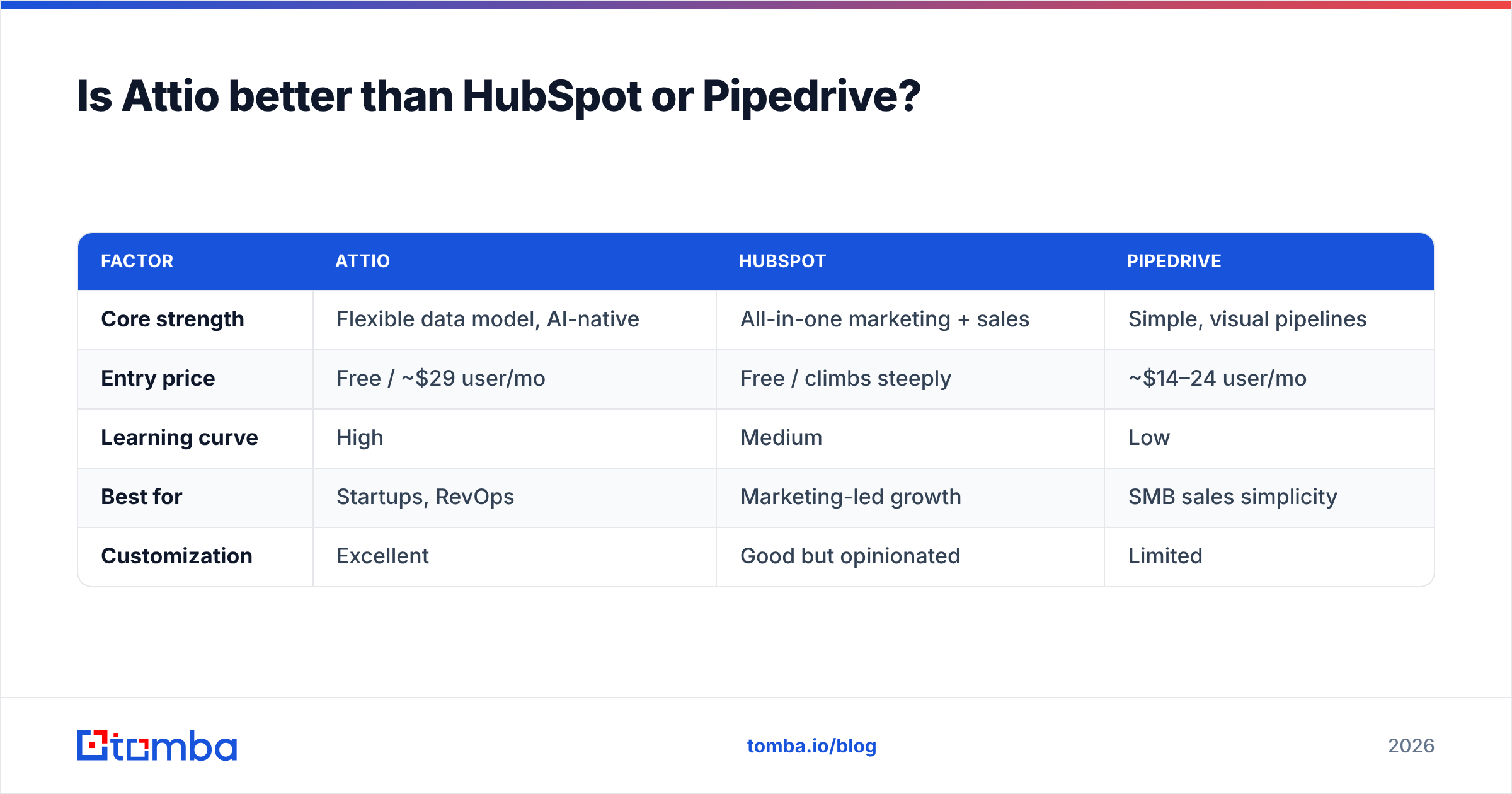
| Factor | Attio | HubSpot | Pipedrive |
|---|---|---|---|
| Core strength | Flexible data model, AI-native | All-in-one marketing + sales | Simple, visual pipelines |
| Entry price | Free / ~$29 user/mo | Free / climbs steeply | ~$14–24 user/mo |
| Learning curve | High | Medium | Low |
| Best for | Startups, RevOps | Marketing-led growth | SMB sales simplicity |
| Customization | Excellent | Good but opinionated | Limited |
- Choose Attio if you want to design the CRM around an unusual or evolving process.
- Choose HubSpot if you need marketing automation, content, and CRM in one suite — see HubSpot's CRM for the all-in-one angle.
- Choose Pipedrive if you want a dead-simple visual pipeline your reps adopt instantly.
Whatever you pick, the CRM stores data — it doesn't go find new contacts for you. That's a separate job, and pretending the CRM handles it is the most expensive assumption teams make.

What's the hidden cost no Attio review mentions?#
Empty fields. The most beautiful CRM in the world is worthless if half your contact records lack a verified email or direct phone number. Attio's native enrichment helps, but it's a convenience layer, not a dedicated data engine — and reviews quietly confirm reps still hit dead ends on harder-to-find prospects.
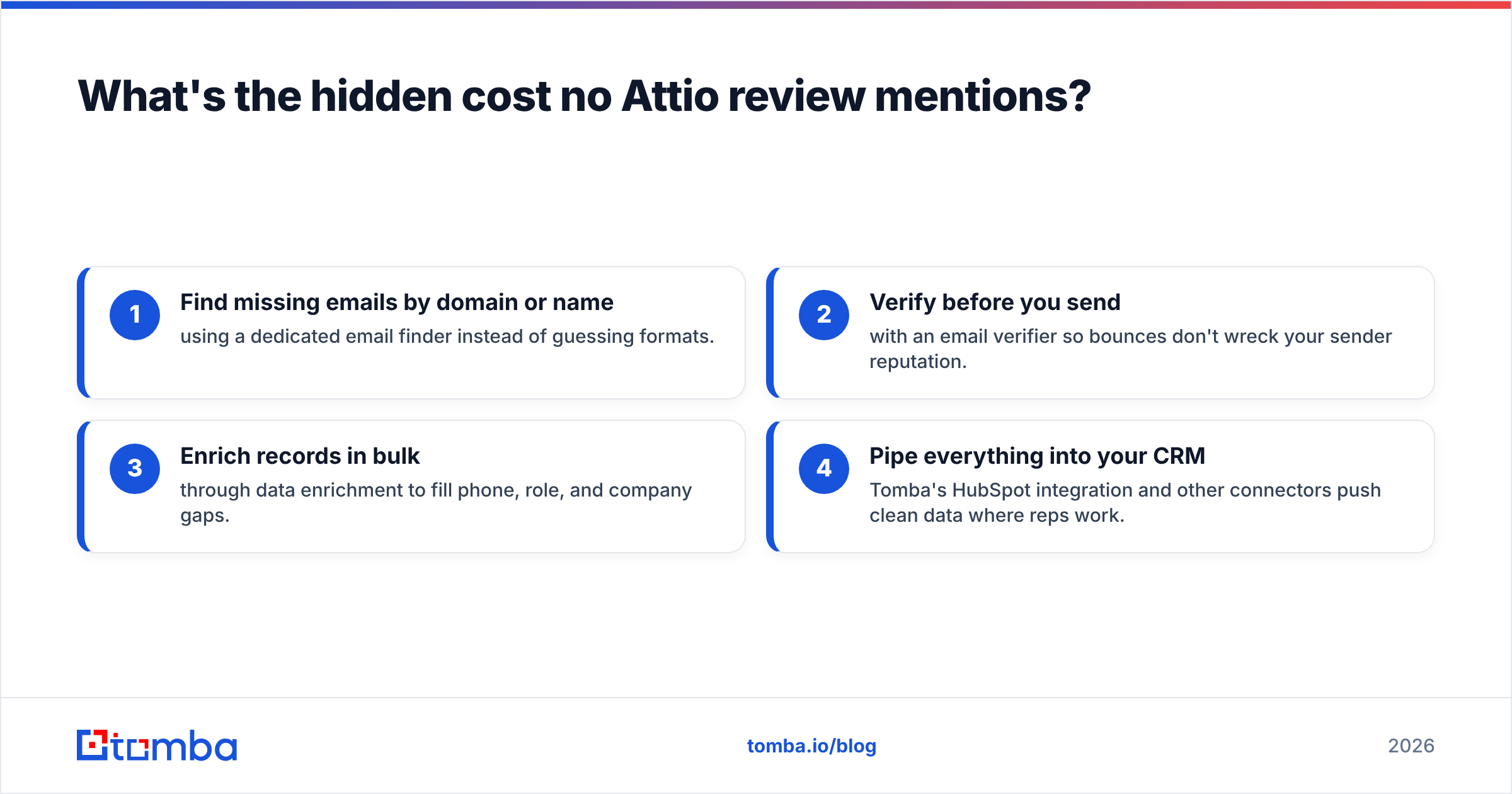
This is where your data layer matters more than your CRM layer. A focused tool that finds and verifies contacts feeds clean records into whatever CRM you run. A few ways teams close that gap:
- Find missing emails by domain or name using a dedicated email finder instead of guessing formats.
- Verify before you send with an email verifier so bounces don't wreck your sender reputation.
- Enrich records in bulk through data enrichment to fill phone, role, and company gaps.
- Pipe everything into your CRM — Tomba's HubSpot integration and other connectors push clean data where reps work.
The cost math is simple: paying ~$59/seat for a CRM and then feeding it stale data is like buying a sports car and filling it with watered-down fuel. The container is premium; the contents decide performance.
How do you decide if Attio is worth it?#
Run a short, honest checklist before you migrate.
- Do you have someone to configure it? Attio rewards an owner who'll build the data model. No owner, no payoff.
- What's your seat count trajectory? At 5 seats it's affordable; at 50 it's a real line item — model the annual cost first.
- How mature is your reporting need? If forecasting is mission-critical today, test Attio's dashboards against your actual deal data before switching.
- Where will clean data come from? Decide your enrichment and verification stack up front, not after records go stale.
- Can you trial it for free? Use the free plan to model real objects, not toy data, before paying.
If most answers point toward "we want control and we'll invest in setup," Attio is one of the smartest CRM bets in 2026. If you're a two-person team that wants to send emails tomorrow, a simpler tool plus a strong data layer will serve you better and faster.
The bottom line on Attio pricing, reviews, pros and cons#
Attio is a genuinely modern CRM with a flexible data model, fair entry pricing, and strong reviews — held back mainly by a learning curve and per-seat costs that scale with your team. It's an excellent home for your customer data, provided you bring an owner to shape it and a plan to keep records clean.
But the CRM is only half the equation. Whatever platform you land on, it needs a steady flow of accurate, verified contacts to be worth the subscription. Start there: use the Tomba Email Finder to find and verify professional emails by domain, name, or company, then push them straight into Attio, HubSpot, or Pipedrive. Get the data right, and any good CRM — including Attio — finally earns its price tag.
Ready to find emails that actually work?
Join 150,000+ professionals who stopped guessing and started sending. Free credits on signup — no credit card required.
Get the Tomba newsletter
Practical outbound tactics and product updates — once every two weeks.
About the author