Attio vs Folk 2026: Which B2B CRM Actually Wins?
Attio vs Folk in 2026: a side-by-side breakdown of pricing, data model, automation, and which modern CRM fits founders, agencies, and revenue teams.
Choosing between Attio and Folk usually comes down to one question: do you want a CRM that scales into a full revenue platform, or one that stays light, fast, and relationship-first? Both ditch the bloated Salesforce playbook, but they bet on different futures.
This is a neutral breakdown — features, pricing, data model, and the use cases where each one actually pulls ahead.
TL;DR — Attio vs Folk in one screen#
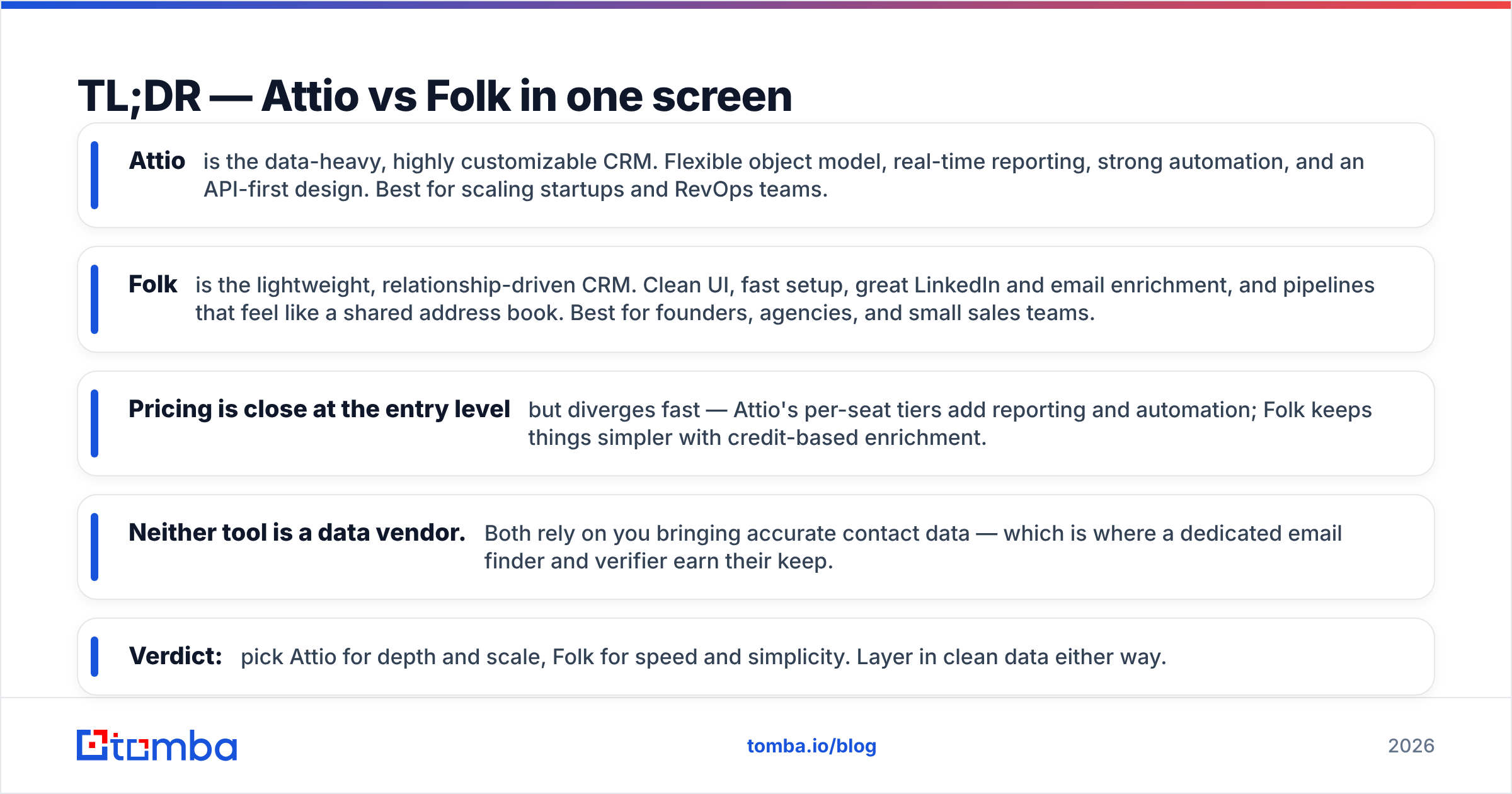
- Attio is the data-heavy, highly customizable CRM. Flexible object model, real-time reporting, strong automation, and an API-first design. Best for scaling startups and RevOps teams.
- Folk is the lightweight, relationship-driven CRM. Clean UI, fast setup, great LinkedIn and email enrichment, and pipelines that feel like a shared address book. Best for founders, agencies, and small sales teams.
- Pricing is close at the entry level but diverges fast — Attio's per-seat tiers add reporting and automation; Folk keeps things simpler with credit-based enrichment.
- Neither tool is a data vendor. Both rely on you bringing accurate contact data — which is where a dedicated email finder and verifier earn their keep.
- Verdict: pick Attio for depth and scale, Folk for speed and simplicity. Layer in clean data either way.
What is Attio?#
Attio is a modern CRM built around a flexible, database-style data model. Think of it less like a rigid sales pipeline and more like Notion or Airtable that happens to know what a "deal" and a "company" are. Every record is an object you can shape, link, and report on.
That flexibility is the headline. You define custom objects, attributes, and relationships, then build pipelines, dashboards, and automations on top. Attio syncs your email and calendar automatically, enriches company records, and exposes everything through a genuinely solid API. For teams that outgrow spreadsheets but hate the weight of legacy CRMs, it's a natural landing spot.
The trade-off: that power has a learning curve. Setting up Attio well takes thought, and the most useful features (reporting, advanced automation) sit on higher tiers.
What is Folk?#
Folk is a lightweight CRM designed around relationships, not process. It pulls contacts from LinkedIn, Gmail, and other sources into clean, shared lists, then layers light pipeline tracking and personalized outreach on top. The whole product is built to feel effortless — you can be useful inside Folk within an hour.
Folk's standout is its enrichment and outreach loop. A browser extension grabs prospects from LinkedIn, the built-in enrichment fills in details, and you can send personalized one-to-many emails without leaving the tool. For agencies, founders, and small teams that live in their network, it removes a lot of friction.
The trade-off is the ceiling. Folk deliberately avoids the deep customization and reporting that data-hungry teams eventually want. It's a sharp tool for a specific job, not an everything platform.
How do Attio and Folk compare on features and pricing?#
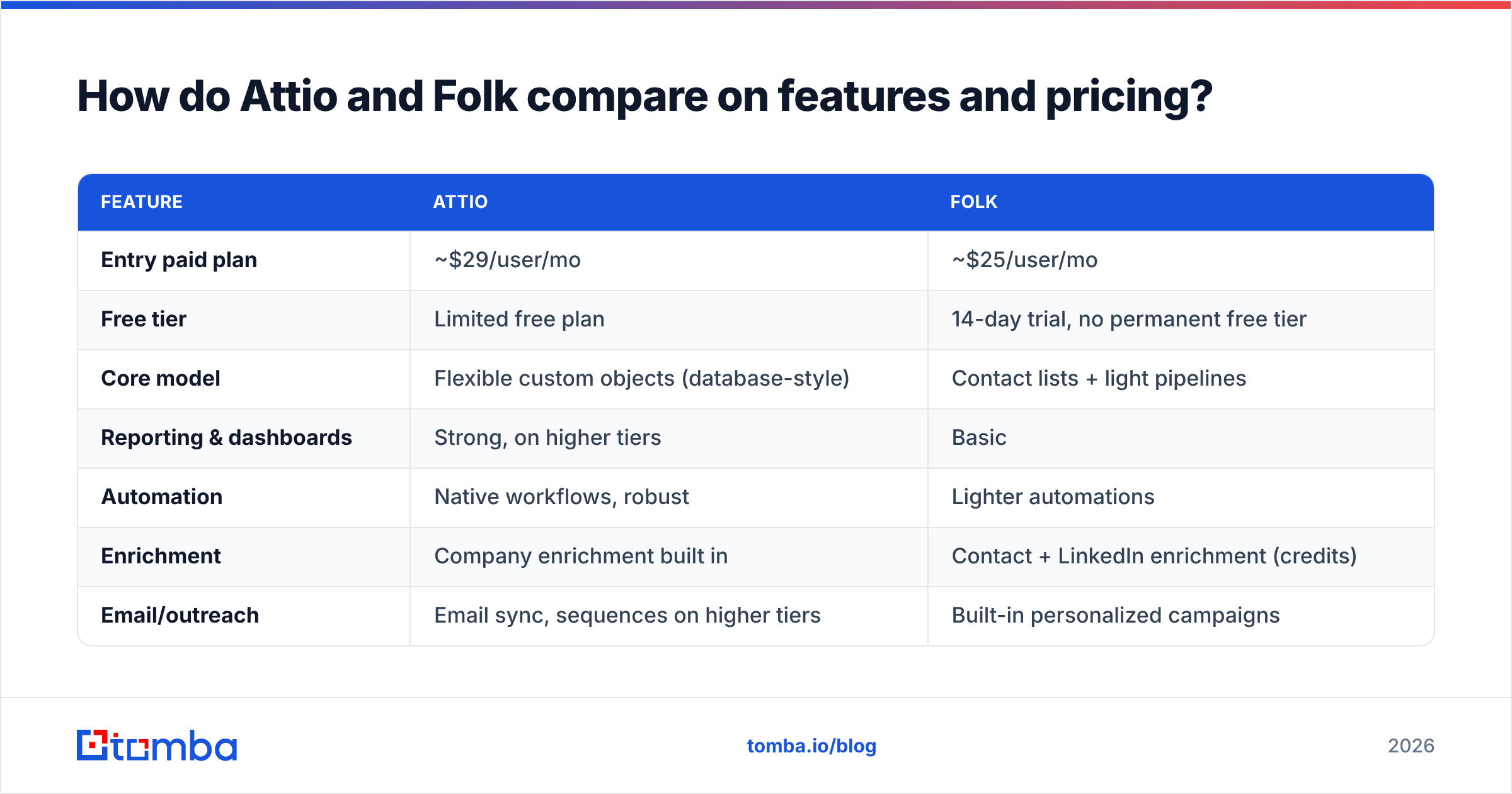
Here's the side-by-side. Prices reflect publicly listed 2026 plans and shift over time, so confirm on each vendor's site before you buy.
| Feature | Attio | Folk |
|---|---|---|
| Entry paid plan | ~$29/user/mo | ~$25/user/mo |
| Free tier | Limited free plan | 14-day trial, no permanent free tier |
| Core model | Flexible custom objects (database-style) | Contact lists + light pipelines |
| Reporting & dashboards | Strong, on higher tiers | Basic |
| Automation | Native workflows, robust | Lighter automations |
| Enrichment | Company enrichment built in | Contact + LinkedIn enrichment (credits) |
| Email/outreach | Email sync, sequences on higher tiers | Built-in personalized campaigns |
| API & integrations | API-first, deep integrations | Growing integration list |
| Best for | Scaling startups, RevOps | Founders, agencies, small teams |
A quick read of the table: Attio wins on depth, reporting, and extensibility; Folk wins on speed-to-value and out-of-the-box outreach. Neither pricing column is the whole story — Attio's value shows up when you use the data model and automation hard, while Folk's value is in the hours you don't spend configuring anything.
When should you choose Attio over Folk?#
Pick Attio when these describe you:
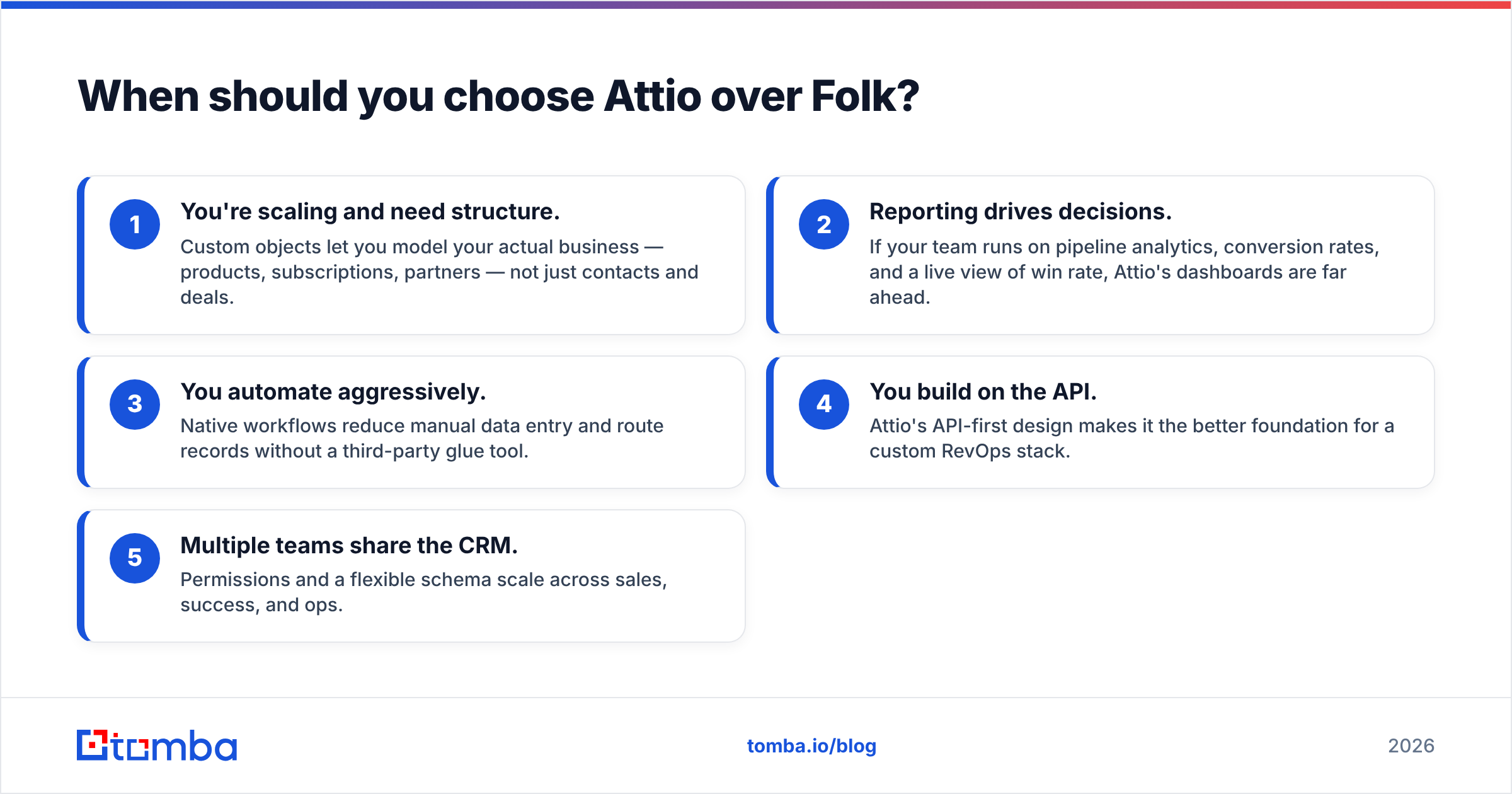
- You're scaling and need structure. Custom objects let you model your actual business — products, subscriptions, partners — not just contacts and deals.
- Reporting drives decisions. If your team runs on pipeline analytics, conversion rates, and a live view of win rate, Attio's dashboards are far ahead.
- You automate aggressively. Native workflows reduce manual data entry and route records without a third-party glue tool.
- You build on the API. Attio's API-first design makes it the better foundation for a custom RevOps stack.
- Multiple teams share the CRM. Permissions and a flexible schema scale across sales, success, and ops.
If you want the broader context of what a CRM should do as you grow, Attio is the safer long-term bet.
When should you choose Folk over Attio?#
Pick Folk when these describe you:
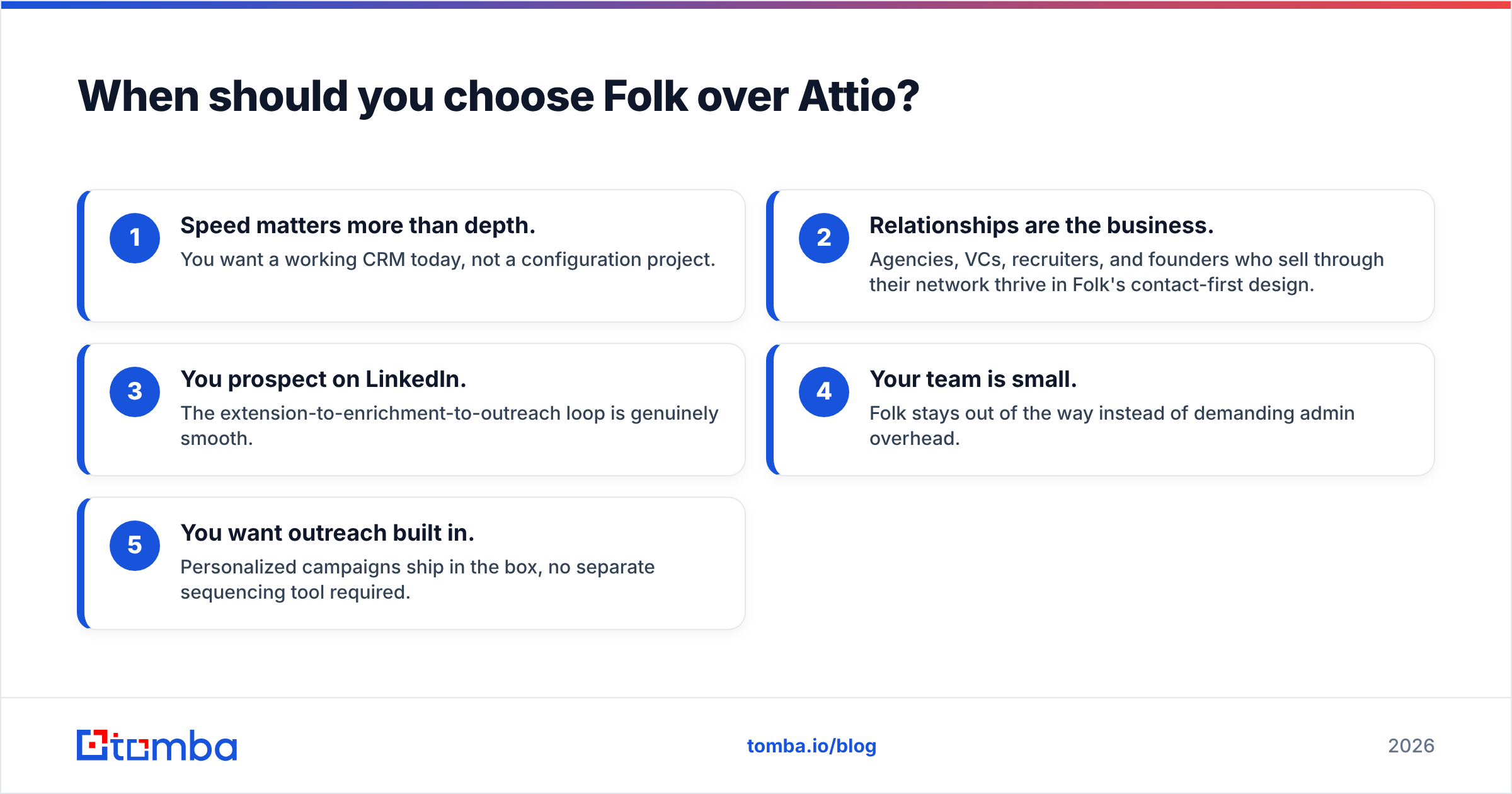
- Speed matters more than depth. You want a working CRM today, not a configuration project.
- Relationships are the business. Agencies, VCs, recruiters, and founders who sell through their network thrive in Folk's contact-first design.
- You prospect on LinkedIn. The extension-to-enrichment-to-outreach loop is genuinely smooth.
- Your team is small. Folk stays out of the way instead of demanding admin overhead.
- You want outreach built in. Personalized campaigns ship in the box, no separate sequencing tool required.
Folk is the better fit for lean teams that value momentum over reporting granularity.
What do Attio and Folk both get wrong?#
Neither tool is a data provider — and that gap matters more than most comparison posts admit.
A CRM organizes contacts; it doesn't guarantee those contacts are real, current, or reachable. Attio's company enrichment and Folk's contact enrichment help, but both lean on third-party sources and stop short of verifying that an email will actually land. Push a list of stale or guessed addresses into either CRM and you'll feel it downstream: bounced campaigns, hurt sender reputation, and pipelines full of contacts you can't reach.
That's the part you own. Whichever CRM you pick, you still need a reliable way to find and verify email addresses before they enter the system.
This is where a dedicated layer helps. Use an email verifier to scrub lists before import, and a domain search to pull the right contacts at a target company instead of guessing. Both Attio and Folk integrate cleanly with external data tools through their APIs and native connectors — so the smart setup is CRM for relationships and pipeline, plus a specialist for accurate contact data.
How do they handle integrations and data flow?#
Both CRMs assume they're one node in a larger stack rather than the whole thing.
Attio's API-first approach makes it the more programmable of the two. If your team uses tools like HubSpot for marketing or Salesforce elsewhere in the org, Attio's connectors and webhooks make two-way sync practical. It's built to be the operational hub of a custom RevOps setup.
Folk's integrations are growing and cover the essentials — Gmail, LinkedIn, calendar, and a respectable list of automation connectors — but it's optimized for the in-app experience rather than acting as a programmable backbone. For most small teams that's exactly right; for engineering-led RevOps it can feel limiting.
On the data side, the pattern is the same for both: enrich and verify before the record lands. Running contacts through data enrichment and validation upstream keeps either CRM clean instead of letting bad records pile up.
Attio vs Folk: which is better in 2026?#
There's no single winner — there's a winner for your situation.
- Choose Attio if you're scaling, you live in dashboards, you automate heavily, and you want a CRM that can become the backbone of a custom revenue stack. It rewards investment.
- Choose Folk if you're a founder, agency, or small team that sells through relationships and wants a fast, clean, low-maintenance CRM with built-in outreach.
For an outside read, both tools carry strong, consistent reviews on G2, and you can sanity-check the latest feature claims directly on attio.com and folk.app. Pricing and tier names change often, so treat any comparison table — including this one — as a starting point, not gospel.
The decision most teams get wrong isn't Attio vs Folk. It's assuming the CRM will fix their data. It won't. Both are excellent at organizing contacts and pipeline; neither is built to guarantee those contacts are accurate.
The data layer both CRMs need#
Whether you land on Attio or Folk, the bottleneck is the same: getting verified, reachable contacts into the system in the first place. That's the job of the Tomba Email Finder. Find professional email addresses by domain, name, or company, verify them before they ever touch your pipeline, and push clean records into either CRM through the Tomba API or a native connector.
Start free with 25 searches a month, then scale on the Starter plan at $49/mo as your outreach grows — full Tomba pricing sits alongside the email verifier, domain search, and enrichment tools. Pick the CRM that fits your team, and let Tomba make sure every contact in it is one you can actually reach.
// get started
Find, verify and enrich your first contacts today
Start on the free plan with 25 searches a month, then scale when your team is ready.
Free plan · No credit card required · GDPR & CCPA
// about the author