Attio vs HubSpot 2026: Which CRM Actually Fits Your Team?
Attio vs HubSpot in 2026: a neutral, feature-by-feature breakdown of pricing, data models, automation, and which CRM fits startups versus scaling revenue teams.
Choosing between Attio and HubSpot is really a choice between two philosophies. Attio is a flexible, data-native CRM built for teams that want to model their business like a spreadsheet on steroids. HubSpot is an all-in-one growth suite that bundles CRM, marketing, service, and content into one sprawling platform. Both are excellent. They are excellent at different things.
This guide breaks down where each one wins, what they actually cost in 2026, and how to decide without a 14-day trial rabbit hole.
TL;DR — Attio vs HubSpot at a glance#
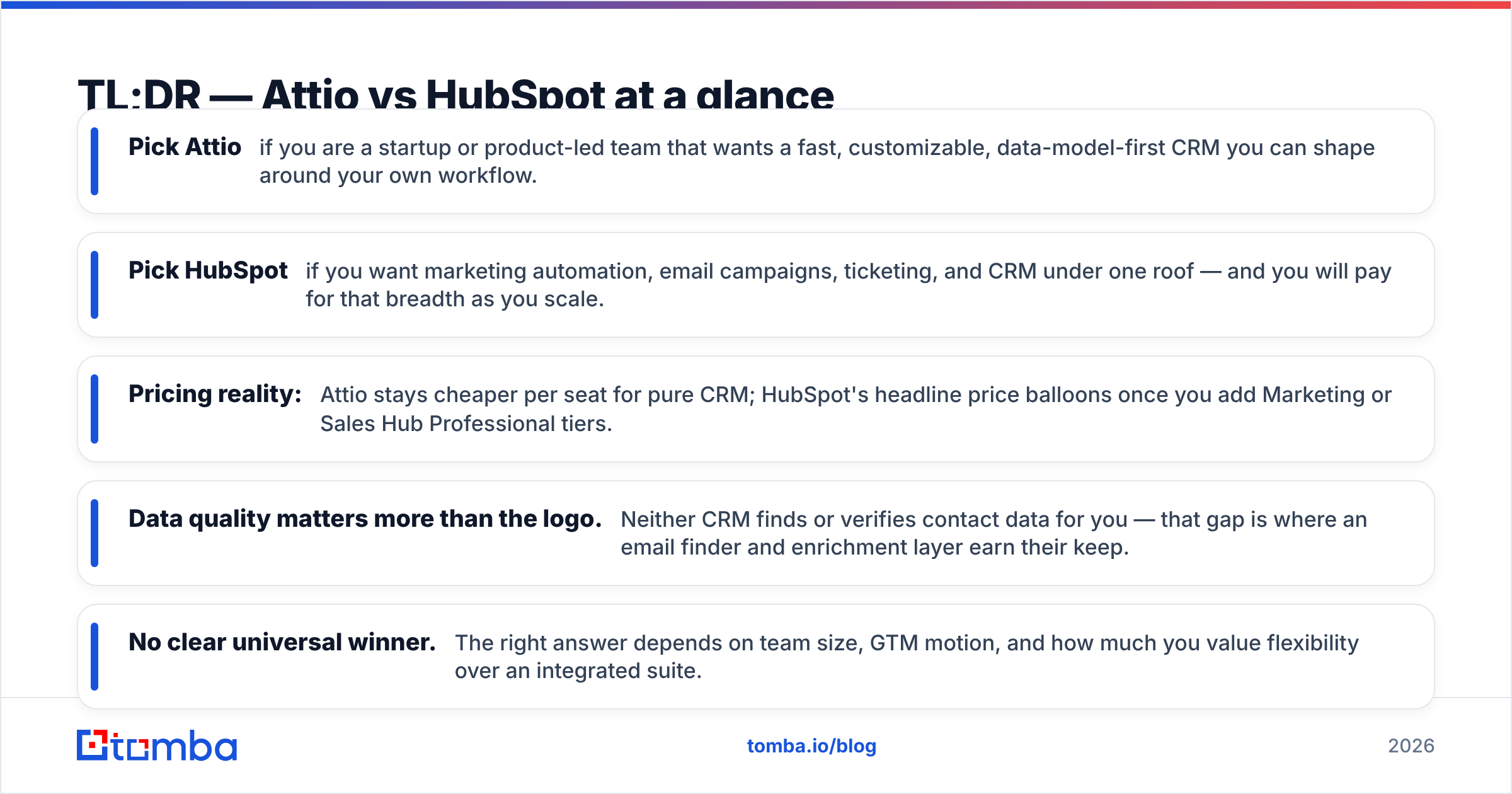
- Pick Attio if you are a startup or product-led team that wants a fast, customizable, data-model-first CRM you can shape around your own workflow.
- Pick HubSpot if you want marketing automation, email campaigns, ticketing, and CRM under one roof — and you will pay for that breadth as you scale.
- Pricing reality: Attio stays cheaper per seat for pure CRM; HubSpot's headline price balloons once you add Marketing or Sales Hub Professional tiers.
- Data quality matters more than the logo. Neither CRM finds or verifies contact data for you — that gap is where an email finder and enrichment layer earn their keep.
- No clear universal winner. The right answer depends on team size, GTM motion, and how much you value flexibility over an integrated suite.
What is Attio and who is it for?#
Attio is a CRM that treats your data like a relational database you can actually see and edit. Instead of forcing you into rigid "Contacts," "Companies," and "Deals" objects, Attio lets you build custom objects, attributes, and relationships that mirror how your business really works. Think of it as Notion's flexibility meeting Salesforce's structure.
It is built for speed. The interface is keyboard-driven, real-time collaborative, and feels closer to a modern productivity app than a legacy sales tool. Attio auto-enriches records from email and calendar data, so a new contact often populates itself the moment you email them.
Attio's sweet spot is startups, venture firms, agencies, and product-led companies — teams that change their process often and don't want to file a support ticket every time they need a new field. You can read more about the platform on Attio's official site.
What is HubSpot and who is it for?#
HubSpot started as a marketing automation tool and grew into a full customer platform. The CRM is free at the entry level, but the real value lives in its "Hubs" — Marketing, Sales, Service, Content, and Operations — that share one contact database.
That integration is the pitch. A lead fills out a form (Marketing Hub), gets scored and routed (Sales Hub), and if they churn, files a ticket (Service Hub) — all against the same record. For a marketing-led organization that runs newsletters, landing pages, and nurture sequences, HubSpot removes a lot of duct tape.
HubSpot suits SMBs and mid-market companies with a content and inbound motion, marketing teams that need native email campaigns, and orgs that prefer one vendor over a stack of point solutions. The trade-off is rigidity and cost, which we will get to. The full tier breakdown lives on HubSpot's pricing page.
How do Attio and HubSpot compare feature by feature?#
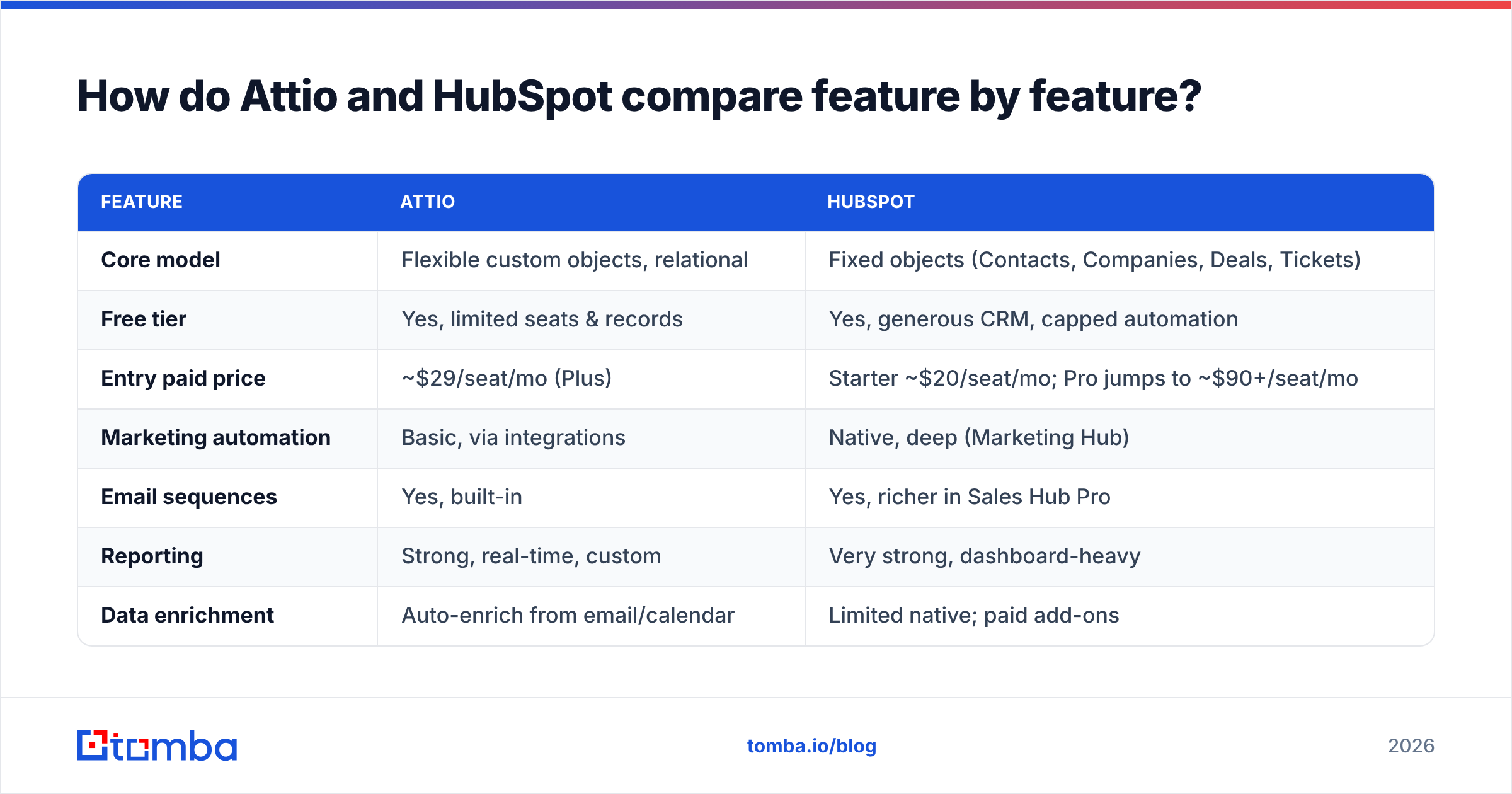
Here is the head-to-head on the attributes that usually decide the call.
| Feature | Attio | HubSpot |
|---|---|---|
| Core model | Flexible custom objects, relational | Fixed objects (Contacts, Companies, Deals, Tickets) |
| Free tier | Yes, limited seats & records | Yes, generous CRM, capped automation |
| Entry paid price | ~$29/seat/mo (Plus) | Starter ~$20/seat/mo; Pro jumps to ~$90+/seat/mo |
| Marketing automation | Basic, via integrations | Native, deep (Marketing Hub) |
| Email sequences | Yes, built-in | Yes, richer in Sales Hub Pro |
| Reporting | Strong, real-time, custom | Very strong, dashboard-heavy |
| Data enrichment | Auto-enrich from email/calendar | Limited native; paid add-ons |
| Learning curve | Low to moderate | Moderate to steep |
| Best for | Startups, PLG, agencies, VC | Inbound-led SMB & mid-market |
The pattern is clear. Attio wins on flexibility, speed, and per-seat economics. HubSpot wins on breadth — if you genuinely use the marketing and service sides, the integrated suite is hard to replicate by gluing tools together.
Is Attio cheaper than HubSpot?#
For pure CRM, yes — usually by a wide margin. Attio's paid plans scale on a per-seat basis without forcing you into expensive bundles. HubSpot's free CRM is genuinely free, but the moment you need automation depth, reporting beyond the basics, or marketing email at volume, you are pushed toward Professional tiers that can run several hundred dollars per seat per month, often with mandatory onboarding fees.
The honest nuance: HubSpot's "expensive" price buys you tools you would otherwise pay three or four separate vendors for. If you only need a CRM, you are overpaying. If you need CRM plus marketing plus service, the math gets closer.
A few cost factors people forget:
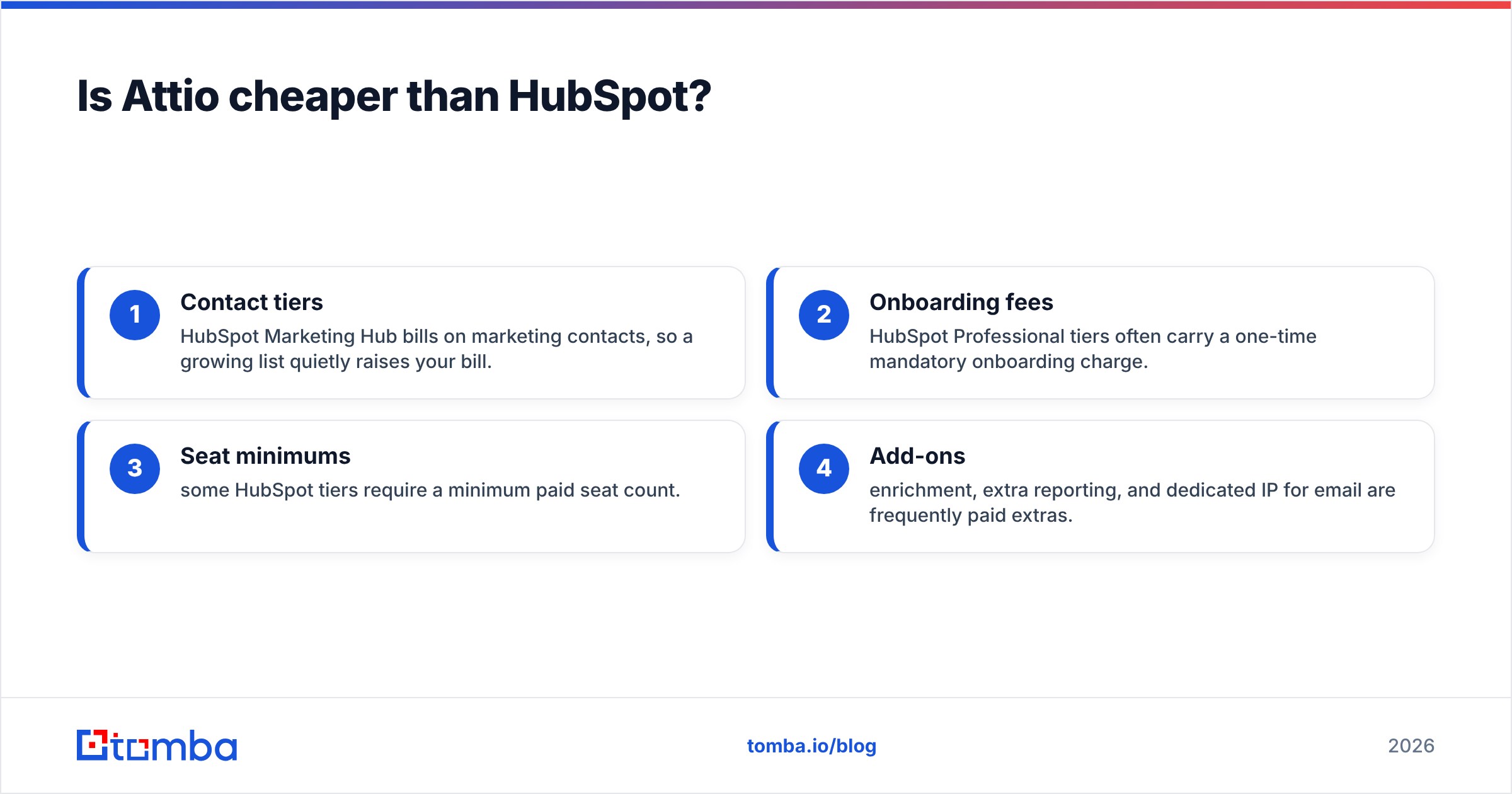
- Contact tiers — HubSpot Marketing Hub bills on marketing contacts, so a growing list quietly raises your bill.
- Onboarding fees — HubSpot Professional tiers often carry a one-time mandatory onboarding charge.
- Seat minimums — some HubSpot tiers require a minimum paid seat count.
- Add-ons — enrichment, extra reporting, and dedicated IP for email are frequently paid extras.
Compare that to the simpler per-seat math most teams find easier to forecast. Whichever side you land on, build your model on real list sizes, not the headline number.
Which CRM handles data quality better?#
Neither — and this is the part both vendors quietly downplay. A CRM is a system of record, not a system of truth. Attio auto-enriches from your inbox and calendar, which is genuinely useful, but it can only enrich people you already email. HubSpot's native enrichment is thin unless you pay for add-ons or pipe in a third-party data source.
That leaves a gap on the front end of your funnel: finding net-new, accurate contact data before it ever reaches the CRM. If your reps are guessing email formats or importing stale lists, neither Attio nor HubSpot will save you — they will faithfully store bad data and report on it confidently.
This is where a dedicated data layer matters. Running prospects through an email verifier before import keeps bounce rates down and protects sender reputation. Pulling clean contacts straight from a company website with domain search means your CRM starts with verified records instead of question marks. Garbage in, garbage out applies to every CRM ever built.

Attio vs HubSpot for automation and workflows#
HubSpot's automation is mature and visual. Workflows can branch on dozens of conditions, trigger emails, rotate leads, create tasks, and sync across hubs. For marketing-heavy nurture sequences, it is one of the best in its class. The catch is that the powerful automation sits behind Professional and Enterprise tiers.
Attio's automation is younger but moving fast. It is built for operational workflows — auto-creating records, syncing relationships, triggering Slack alerts, routing deals. It leans on integrations (and a clean API) rather than trying to be a marketing engine itself. If your automation needs are RevOps-flavored rather than campaign-flavored, Attio often feels lighter and more intuitive.
A useful rule of thumb:
- Marketing automation (emails, forms, nurture, scoring): HubSpot wins.
- Operational automation (data hygiene, routing, internal alerts, API-driven flows): Attio is competitive and frequently simpler.
Both connect to the wider stack. If you live in tools like Zapier, Make, or your own scripts, you can wire either CRM into your enrichment and outreach pipeline. Tomba's HubSpot integration and broader integrations library, for example, let you push verified contacts into whichever system you choose.
Attio vs HubSpot for reporting and analytics#
HubSpot's reporting is a genuine strength. Custom dashboards, attribution reporting, forecasting, and revenue analytics are deep, especially on higher tiers. For a leadership team that wants pipeline and marketing attribution in one place, it delivers.
Attio's reporting is real-time and flexible, built on the same customizable data model that powers the rest of the app. Because you can define your own objects and attributes, your reports can reflect non-standard motions — community-led growth, usage-based expansion, multi-product deals — without contortions. It is less about pre-built marketing dashboards and more about slicing your own data your way.
If you need marketing attribution out of the box, HubSpot. If you need bespoke pipeline analytics on a model you designed, Attio.
Which should you choose in 2026?#
Decide based on your motion, not the brand.
Choose Attio if:
- You are a startup, agency, VC, or PLG company that values flexibility.
- Your process changes often and you hate filing tickets to add a field.
- You want strong per-seat economics for a pure, modern CRM.
- Your team is technical enough to appreciate a clean API and custom data model.
Choose HubSpot if:
- Marketing automation and email campaigns are central to your GTM.
- You want CRM, marketing, and service under one vendor.
- You run an inbound, content-led motion and need native landing pages and forms.
- You will actually use the Hubs you pay for — otherwise you are overpaying.
There is no shame in the boring answer: many teams start on Attio for speed and switch to HubSpot when marketing complexity demands it, or start on HubSpot's free CRM and migrate to Attio when the rigidity gets frustrating. Both migrations happen constantly. Browse real user breakdowns on G2 before you commit — pay attention to reviewers who match your company size and industry.
Whichever you pick, remember the part the CRM debate distracts from: your pipeline is only as good as the contact data feeding it. The flashiest workflow in either tool still fails if the email bounces.
The piece both CRMs leave to you#
Attio and HubSpot are systems of record. They organize, automate, and report on the contacts you give them — they do not find those contacts, and they do not guarantee the data is accurate. That front-of-funnel job is yours.
That is exactly where Tomba's Email Finder fits into either stack. Find verified professional emails by name, company, or domain; confirm them before they hit your CRM; and feed clean, deliverable records into Attio or HubSpot from day one. Pair it with bulk data enrichment to fill gaps the CRM can't, and you spend your time selling instead of fixing dirty records. Check the Tomba pricing plans — starting free at 25 searches a month, with Starter at $49/mo — and let your CRM do what it is good at while Tomba handles the data it depends on.
// get started
Find, verify and enrich your first contacts today
Start on the free plan with 25 searches a month, then scale when your team is ready.
Free plan · No credit card required · GDPR & CCPA
// about the author