How to Attract High Ticket Clients in 2026 (B2B Playbook)
High-ticket clients don't respond to spray-and-pray outreach. Here's the 2026 playbook for building a short list of premium accounts and landing them with precision.
High-ticket clients are not just bigger versions of your regular buyers. They buy differently, evaluate longer, and expect a level of precision in your outreach that most pipelines never deliver. If you are still running the same volume playbook you use for $200/month deals, you will keep losing the $50,000 ones.
This guide breaks down how to attract high ticket clients in 2026 — the targeting, the data, the messaging, and the follow-through that separate teams who close premium accounts from teams who chase them.
TL;DR#
- High-ticket selling is a precision game, not a volume game. Twenty perfectly-researched accounts beat 2,000 cold blasts.
- Your targeting is only as good as your data. Build a tight Ideal Client Profile, then enrich it with verified contacts and direct lines.
- Personalization at the decision-maker level is what earns the first reply — generic "Hi {{first_name}}" templates get deleted.
- Authority and proof (case studies, niche positioning, referrals) shorten the long sales cycles high-ticket buyers demand.
- Tooling matters: accurate email and phone data, enrichment, and a clean CRM workflow remove the friction that kills premium deals.
What counts as a high-ticket client?#
A high-ticket client is one whose lifetime value justifies a fundamentally different acquisition approach. The exact dollar figure varies by industry — for a freelance consultant it might be a $15,000 retainer; for an enterprise SaaS vendor it might be a $250,000 annual contract. What stays constant is the economics: each client is worth enough that you can afford to spend hours, not seconds, winning them.
That changes everything about your strategy:
- Buying committees, not buyers. High-ticket deals usually involve 3–7 stakeholders. You are selling to a CFO, a champion, and an end-user simultaneously.
- Longer cycles. Gartner research consistently shows complex B2B purchases stretch across months and dozens of interactions.
- Higher proof bar. Premium buyers want evidence — references, ROI models, security reviews — before they commit.
- Lower tolerance for noise. A decision-maker who controls a large budget gets pitched constantly. Generic outreach is an instant disqualifier.
Because the economics reward depth, the winning motion inverts the usual funnel: you start narrow, go deep, and let quality compound.
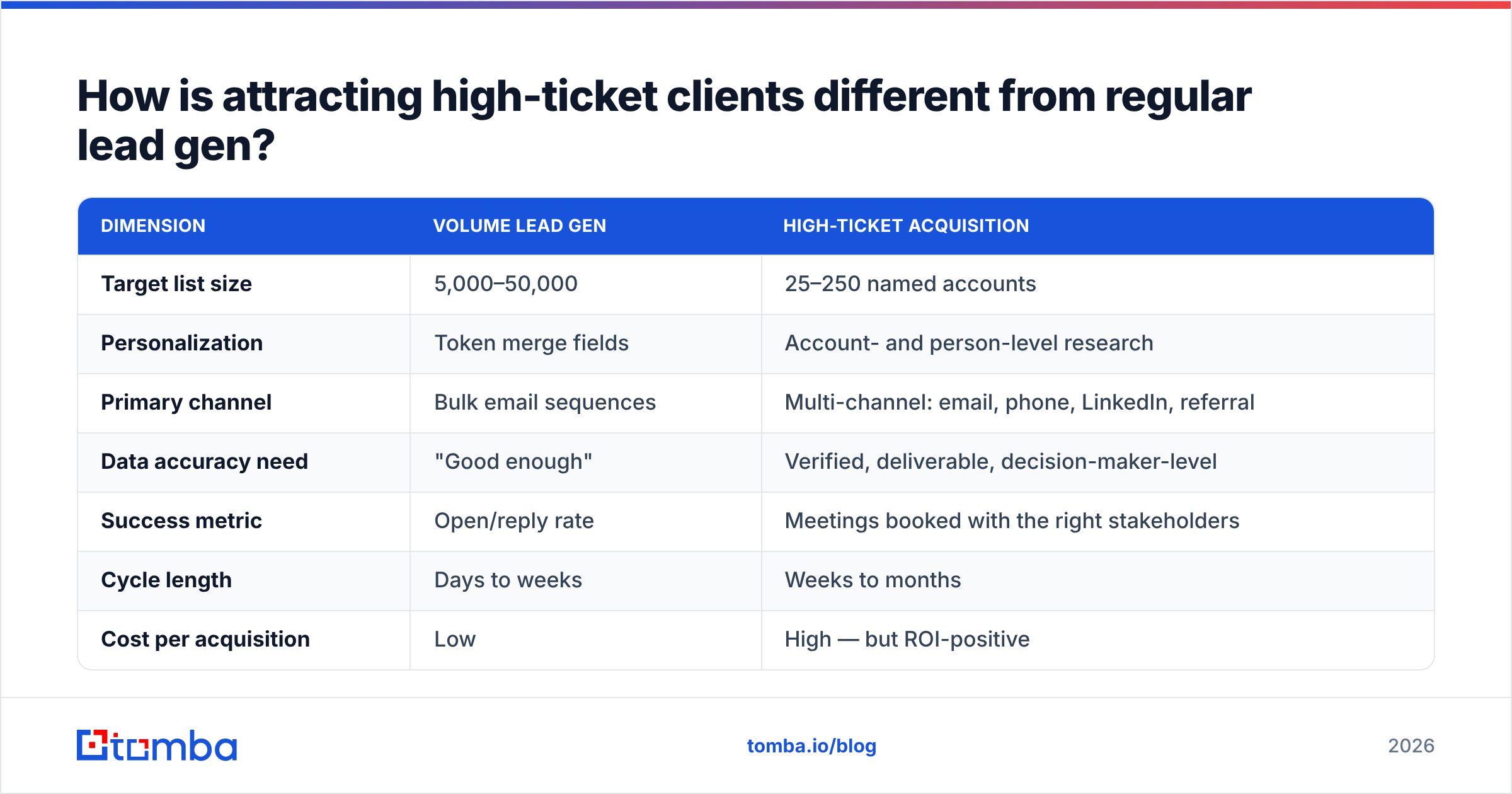
How is attracting high-ticket clients different from regular lead gen?#
The biggest mistake teams make is applying high-volume tactics to high-value targets. Below is how the two motions actually differ.
| Dimension | Volume Lead Gen | High-Ticket Acquisition |
|---|---|---|
| Target list size | 5,000–50,000 | 25–250 named accounts |
| Personalization | Token merge fields | Account- and person-level research |
| Primary channel | Bulk email sequences | Multi-channel: email, phone, LinkedIn, referral |
| Data accuracy need | "Good enough" | Verified, deliverable, decision-maker-level |
| Success metric | Open/reply rate | Meetings booked with the right stakeholders |
| Cycle length | Days to weeks | Weeks to months |
| Cost per acquisition | Low | High — but ROI-positive |
Notice the data row. When you email 50,000 people, a 5% bounce rate is an annoyance. When your entire quarter depends on reaching 40 specific VPs, one wrong email address is a missed deal. That is why high-ticket teams invest disproportionately in data accuracy — the cost of a bad record is enormous relative to the size of the list.
Step 1: Build a razor-sharp Ideal Client Profile#
You cannot attract high ticket clients you have not defined. Start by analyzing your three to five most profitable existing clients and reverse-engineer what they share:
- Firmographics — industry, company size, revenue band, geography, tech stack.
- Trigger events — funding rounds, leadership changes, expansion, new compliance requirements.
- Pain depth — the problem must be expensive enough to justify a premium price.
- Decision structure — who signs, who champions, who can veto.
The goal is a list so specific that anyone on your team could look at a company and instantly say "yes, that's us" or "no." Vague ICPs produce vague outreach, and vague outreach never lands a whale.
Once the profile is set, translate it into a sourced account list. Tools like G2 and industry databases help you surface companies matching your criteria, and a B2B database lets you move from company names to the actual humans inside them.
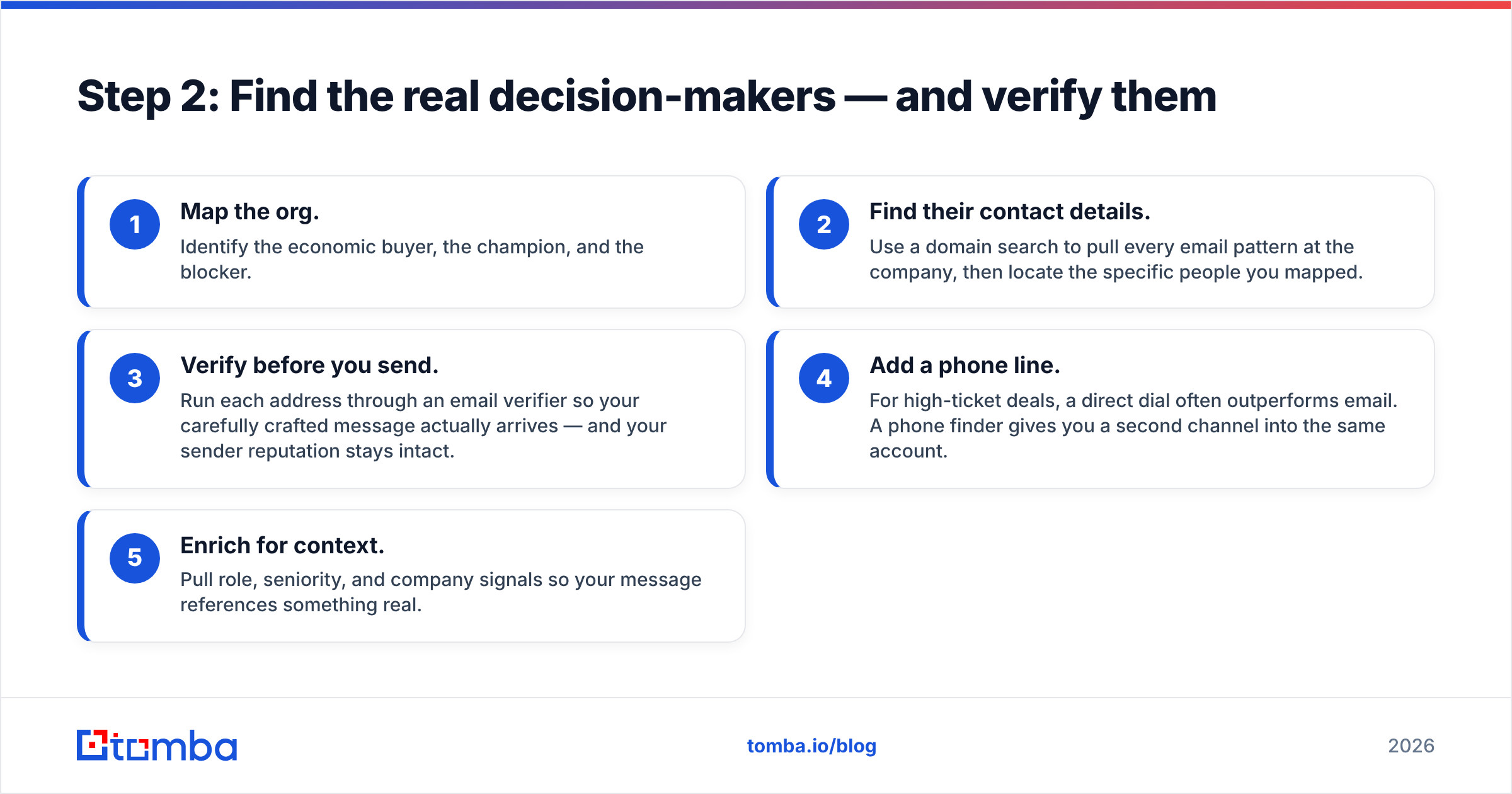
Step 2: Find the real decision-makers — and verify them#
A named account is useless until you can reach the person who controls the budget. This is where most high-ticket campaigns quietly fail: the rep finds a contact, not the contact, and burns their best message on someone who can't say yes.
Your data workflow for each target account should look like this:
- Map the org. Identify the economic buyer, the champion, and the blocker.
- Find their contact details. Use a domain search to pull every email pattern at the company, then locate the specific people you mapped.
- Verify before you send. Run each address through an email verifier so your carefully crafted message actually arrives — and your sender reputation stays intact.
- Add a phone line. For high-ticket deals, a direct dial often outperforms email. A phone finder gives you a second channel into the same account.
- Enrich for context. Pull role, seniority, and company signals so your message references something real.
This is precision plumbing. None of it is glamorous, but it is the difference between a 1% reply rate and a 15% one. Forrester and other analysts have long noted that data quality is among the strongest predictors of pipeline efficiency — bad data doesn't just waste sends, it routes effort to the wrong people.
Step 3: Earn authority before you ask#
High-ticket buyers do not respond to interruption alone; they respond to credibility. Before — and during — outreach, you need to look like the obvious choice in your niche. The most reliable authority builders:
- Narrow positioning. "We help Series B fintechs pass SOC 2 in 60 days" beats "We do compliance consulting." Specificity signals expertise.
- Proof assets. Case studies with named outcomes, ROI calculators, and short reference videos remove perceived risk.
- Visible expertise. Consistent, substantive content on LinkedIn and your blog keeps you in the consideration set when a trigger event hits.
- Warm paths. A referral from a peer collapses the trust-building phase. Systematically ask happy clients for one introduction each.
Authority is what makes your cold outreach feel warm. When a VP recognizes your name or your firm's niche reputation, your email moves from "spam" to "worth two minutes."

Step 4: Personalize at the decision-maker level#
Generic personalization is dead for premium accounts. Merge tags are table stakes; the bar now is research-driven relevance. Every first-touch message to a high-ticket prospect should answer: why this person, why this company, why now?
A workable structure for the opening message:
- Specific trigger — reference the funding round, the new hire, the product launch.
- Relevant insight — a one-line observation that shows you understand their world.
- Proof-anchored value — tie your offer to a result you delivered for a similar company.
- Frictionless ask — a low-commitment next step, not a hard pitch.
You can scale this without sacrificing quality by separating research from sending. Enrich each account once, store the insights in your CRM via a HubSpot integration or similar, and let reps personalize from a prepared brief instead of researching from scratch every time. HubSpot's own data on outreach repeatedly shows that relevance, not volume, drives reply rates — see their sales benchmarks for the broader pattern.
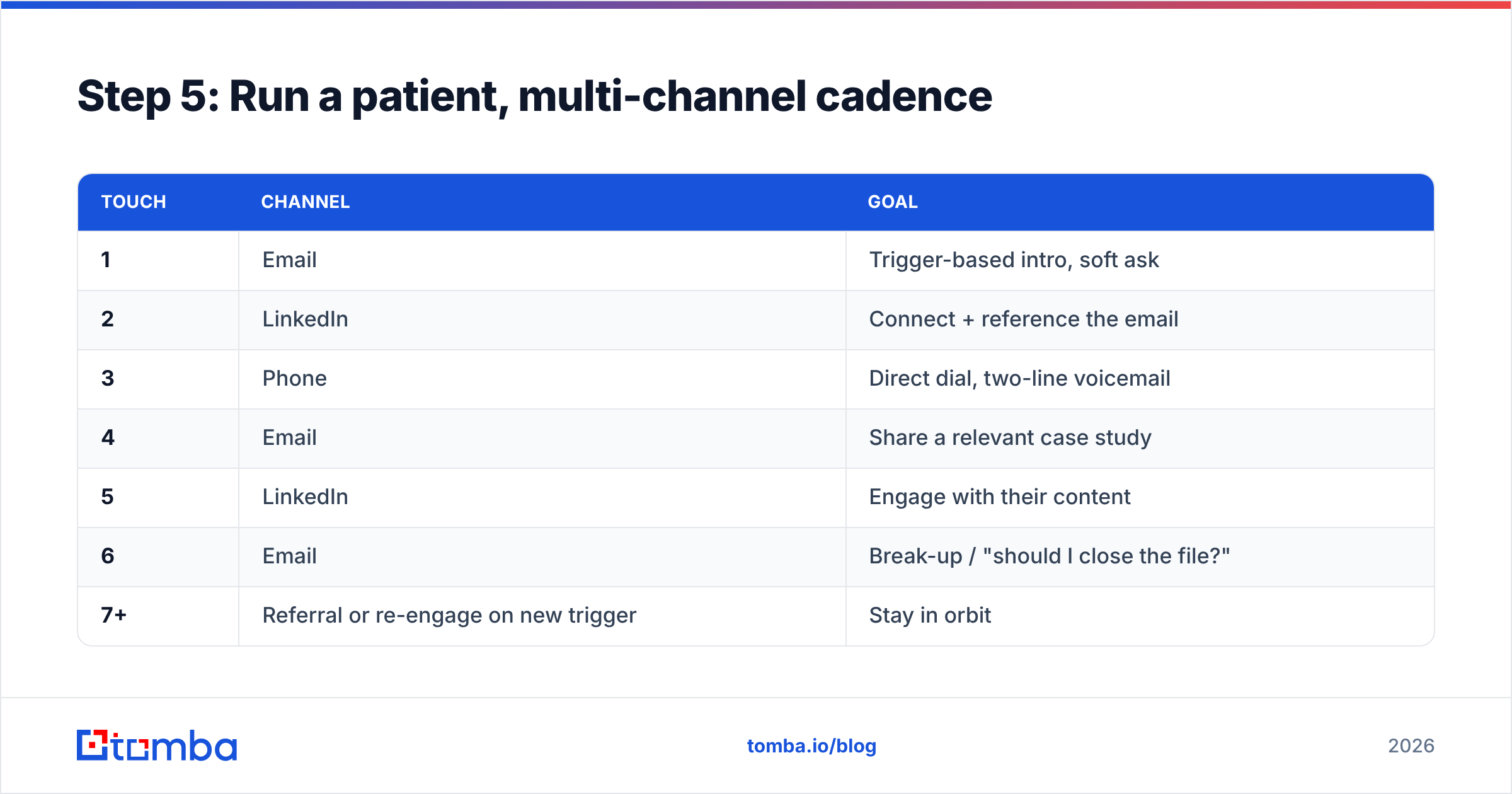
Step 5: Run a patient, multi-channel cadence#
High-ticket deals are won on the seventh touch, not the first. Build a sequence that mixes channels and respects the longer cycle:
| Touch | Channel | Goal |
|---|---|---|
| 1 | Trigger-based intro, soft ask | |
| 2 | Connect + reference the email | |
| 3 | Phone | Direct dial, two-line voicemail |
| 4 | Share a relevant case study | |
| 5 | Engage with their content | |
| 6 | Break-up / "should I close the file?" | |
| 7+ | Referral or re-engage on new trigger | Stay in orbit |
The key discipline is consistency without annoyance. Each touch should add value or context, never just "bumping this to the top of your inbox." Because the deals are large, you can afford the time this takes — and your competitors usually won't.
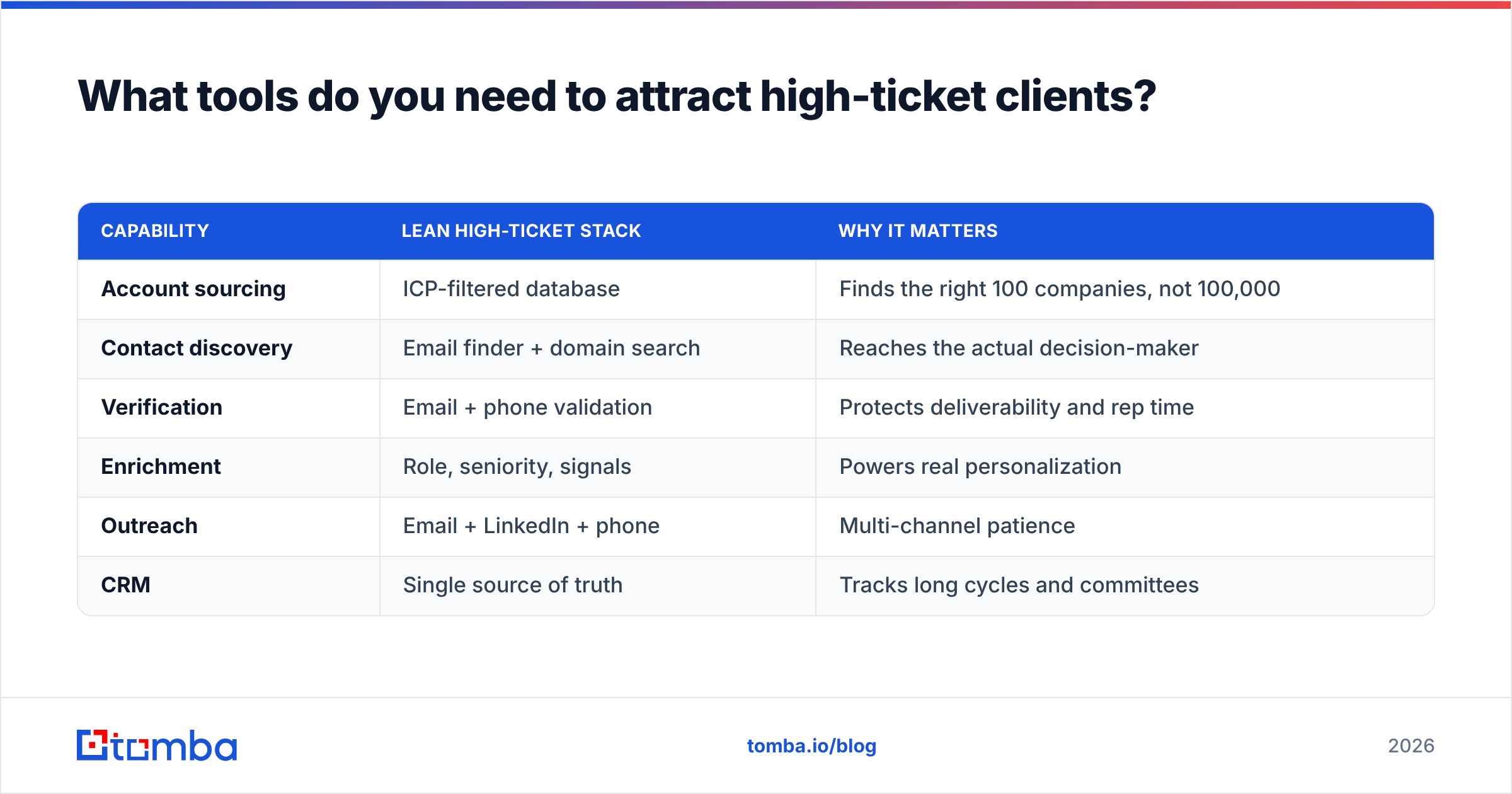
What tools do you need to attract high-ticket clients?#
You do not need a 40-tool stack. You need a clean spine of data and workflow. Here is the minimum effective setup compared against the bloated alternative.
| Capability | Lean High-Ticket Stack | Why it matters |
|---|---|---|
| Account sourcing | ICP-filtered database | Finds the right 100 companies, not 100,000 |
| Contact discovery | Email finder + domain search | Reaches the actual decision-maker |
| Verification | Email + phone validation | Protects deliverability and rep time |
| Enrichment | Role, seniority, signals | Powers real personalization |
| Outreach | Email + LinkedIn + phone | Multi-channel patience |
| CRM | Single source of truth | Tracks long cycles and committees |
The throughline is data integrity. Every downstream tactic — the personalization, the cadence, the proof — depends on actually reaching the person you intended. That is why teams selling premium offers treat their contact data as core infrastructure, not an afterthought. If you want to understand how that accuracy is built, Tomba's data sources page is a useful primer, and the pricing details show where the cost sits for a focused, low-volume motion.
How many high-ticket leads do you actually need?#
This is the mindset shift that ties everything together. If your average deal is $50,000 and you close one in five qualified conversations, you need roughly five strong conversations to add $50,000 in pipeline-to-close. That is not a list of 10,000 names — it is a list of perhaps 50 well-researched accounts worked properly.
Run the math for your own numbers:
- Target revenue ÷ average deal size = deals needed
- Deals needed ÷ close rate = qualified conversations needed
- Qualified conversations ÷ meeting-to-qualified rate = meetings needed
- Meetings needed ÷ reply-to-meeting rate = replies needed
- Replies needed ÷ reply rate = accounts to contact
When you work backward, the required list is almost always smaller than instinct suggests — and the leverage sits entirely in your reply rate and close rate, both of which are functions of targeting and data quality. Improve those two levers and you need fewer prospects, not more.
Common mistakes that repel high-ticket clients#
- Pitching too early. Premium buyers want a conversation, not a brochure on touch one.
- Bad data. Bounced emails and wrong-number dials signal sloppiness — fatal when you're asking for a large check.
- Discounting reflexively. Cutting price to win a high-ticket deal often destroys the perceived value that justified it.
- One-channel dependence. Email-only cadences miss the buyers who live on the phone or LinkedIn.
- No follow-through. Giving up at touch three when the deal closes at touch eight.
Each of these is avoidable with discipline and a clean data foundation.
Final takeaway and next step#
Attracting high-ticket clients in 2026 comes down to one principle: go narrow and go deep. Define a precise Ideal Client Profile, reach the real decision-makers with verified data, build genuine authority in your niche, and work a patient multi-channel cadence. Fewer, better-targeted touches will out-earn any volume blast.
The foundation under all of it is accurate, deliverable contact data — because every personalized message, every direct dial, and every long-cycle follow-up depends on actually reaching the right person. Start there.
Ready to build your high-ticket target list? Use the Tomba Email Finder to turn your named accounts into verified, decision-maker-level contacts — then enrich, verify, and reach them with the precision premium deals demand. Spin up a free account, find your first 25 ideal prospects, and put this playbook to work today.
// get started
Find, verify and enrich your first contacts today
Start on the free plan with 25 searches a month, then scale when your team is ready.
Free plan · No credit card required · GDPR & CCPA
// about the author