Audience Data Providers in 2026: A B2B Buyer's Guide
Audience data providers fuel your targeting, ads, and outbound — but quality varies wildly. Here's how to compare types, accuracy, and cost in 2026.
TL;DR
- Audience data providers sell or license the contact, firmographic, and behavioral data you use to target ads, build lists, and route outbound — and quality ranges from excellent to actively harmful.
- The three buckets that matter are first-party (yours), second-party (a partner's), and third-party (aggregated and resold). Each has a different accuracy and compliance profile.
- The single biggest cost of bad data is invisible: wasted ad spend, bounced sends, damaged sender reputation, and reps chasing ghosts.
- Verify before you trust. A provider's "500M contacts" headline means nothing if 30% bounce — always test deliverability on a sample.
- For B2B contact data specifically, a focused finder-and-verifier stack like Tomba beats a bloated "everything" database you only use 5% of.
What are audience data providers?#
An audience data provider is a company that collects, structures, and licenses information about people and organizations so you can find, segment, and reach the right buyers. Think of it like a wholesale produce market: you don't grow the tomatoes yourself, you buy them from a supplier — but the supplier's freshness, sourcing, and honesty about quality decide whether your restaurant succeeds.
In B2B, "audience data" usually means some mix of:
- Identity data — names, job titles, work emails, phone numbers, LinkedIn profiles.
- Firmographic data — company size, industry, revenue, location, tech stack.
- Intent and behavioral data — what topics an account is researching, which pages they visited, recent hiring or funding signals.
- Demographic and psychographic data — more common in B2C, but increasingly blended into B2B for ad targeting.
The provider's job is to keep that data accurate, deduplicated, and compliant. The buyer's job — yours — is to figure out which provider actually does that, versus which one is reselling a stale list with a confident sales deck.
What are the main types of audience data providers?#
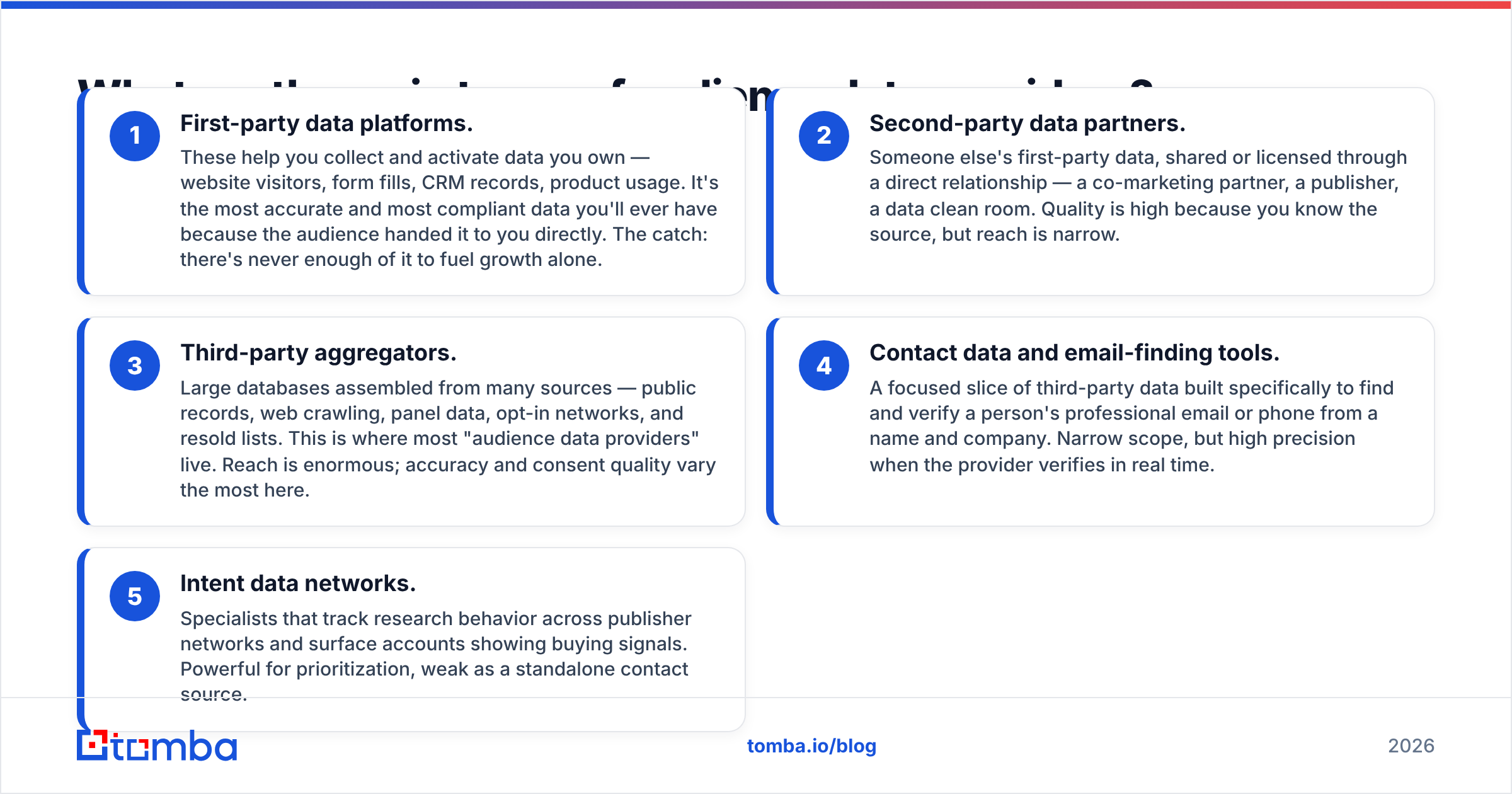
Not all data is sourced the same way, and the source is the strongest predictor of quality. Here are the categories you'll evaluate.
- First-party data platforms. These help you collect and activate data you own — website visitors, form fills, CRM records, product usage. It's the most accurate and most compliant data you'll ever have because the audience handed it to you directly. The catch: there's never enough of it to fuel growth alone.
- Second-party data partners. Someone else's first-party data, shared or licensed through a direct relationship — a co-marketing partner, a publisher, a data clean room. Quality is high because you know the source, but reach is narrow.
- Third-party aggregators. Large databases assembled from many sources — public records, web crawling, panel data, opt-in networks, and resold lists. This is where most "audience data providers" live. Reach is enormous; accuracy and consent quality vary the most here.
- Contact data and email-finding tools. A focused slice of third-party data built specifically to find and verify a person's professional email or phone from a name and company. Narrow scope, but high precision when the provider verifies in real time.
- Intent data networks. Specialists that track research behavior across publisher networks and surface accounts showing buying signals. Powerful for prioritization, weak as a standalone contact source.
If you want a primer on how providers actually assemble these records, Tomba documents its own data sources openly, which is a good model for the transparency you should demand from any vendor.
How do you compare audience data providers?#
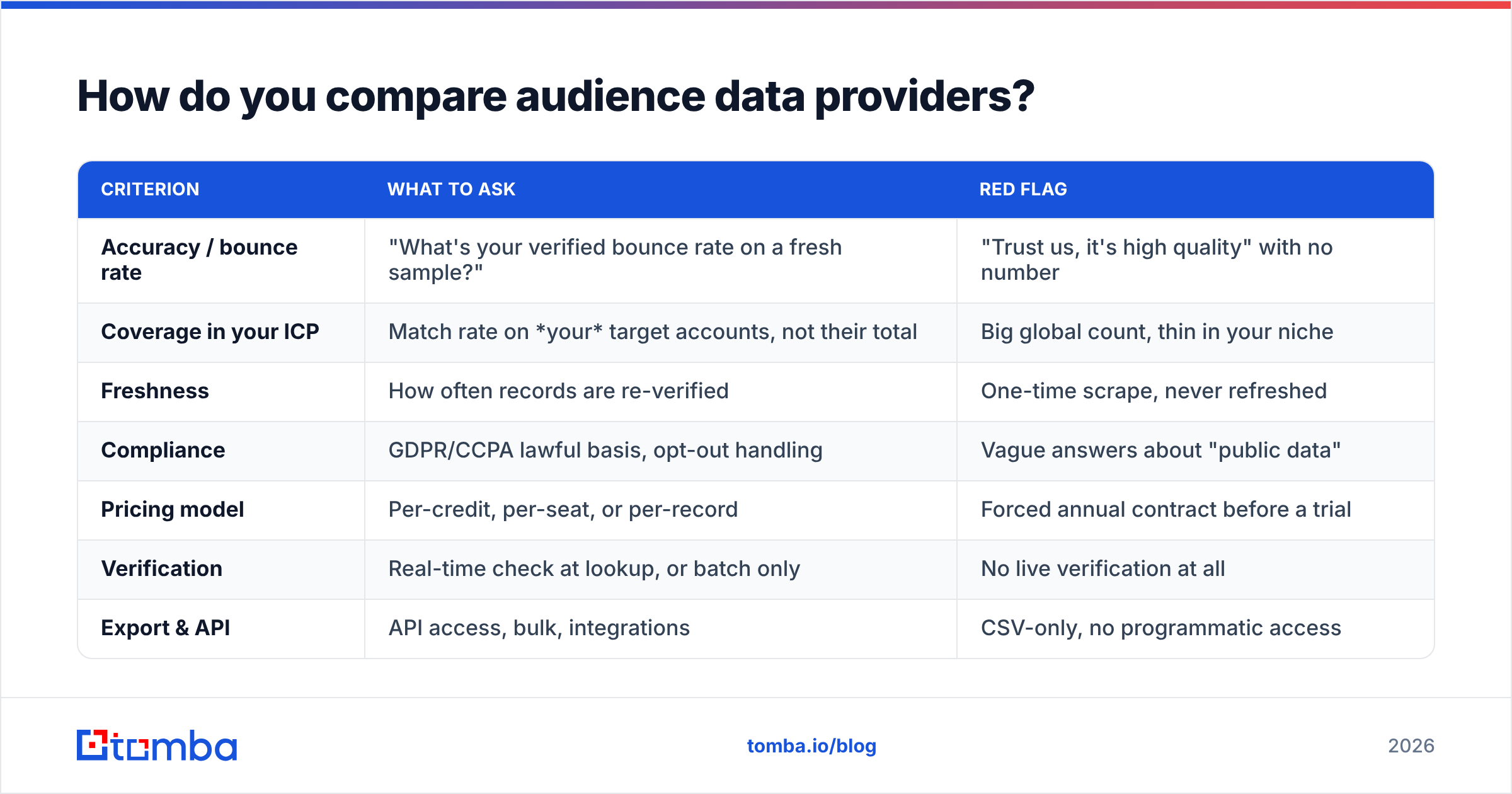
Compare on outcomes, not headline counts. A database of 500 million contacts is worthless if half are stale. Below is a practical scorecard you can run against any vendor before you sign.
| Criterion | What to ask | Red flag |
|---|---|---|
| Accuracy / bounce rate | "What's your verified bounce rate on a fresh sample?" | "Trust us, it's high quality" with no number |
| Coverage in your ICP | Match rate on your target accounts, not their total | Big global count, thin in your niche |
| Freshness | How often records are re-verified | One-time scrape, never refreshed |
| Compliance | GDPR/CCPA lawful basis, opt-out handling | Vague answers about "public data" |
| Pricing model | Per-credit, per-seat, or per-record | Forced annual contract before a trial |
| Verification | Real-time check at lookup, or batch only | No live verification at all |
| Export & API | API access, bulk, integrations | CSV-only, no programmatic access |
The two rows that separate good providers from bad ones are accuracy and freshness. Everything else is negotiable; deliverability is not. A list that looks impressive in a spreadsheet but bounces at 25% will quietly burn your sender reputation and drag down every campaign that follows.
This is also why the "single giant platform" pitch often disappoints. As analyst firms like Gartner have noted across the martech category, buyers consistently over-pay for breadth they never activate. You end up renting 50 data fields to use 4.

Why does data quality matter more than data quantity?#
Because bad data costs you twice — once when you buy it, and again every time you use it.
Here's the chain reaction. You buy a list of 10,000 "decision makers." Twenty percent of the emails are dead. You send anyway. Mailbox providers see the bounces, your domain reputation drops, and now even your good emails start landing in spam. Your reps work leads that were never real. Your CRM fills with duplicates. Your attribution breaks. The $0.10-per-record list just cost you a quarter of pipeline.
Independent review sites like G2 are full of these stories — vendors with great reach and brutal bounce rates. That's why a verify-first workflow beats a buy-everything workflow:
- Find the contact from a name and domain.
- Verify the email is live before it ever enters a campaign.
- Enrich the record with firmographics only after it passes verification.
- Re-verify on a schedule, because data decays roughly 2–3% per month as people change jobs.
You can run exactly that loop with a focused stack: an email finder to source the address, an email verifier to confirm it, and data enrichment to fill in the rest. The result is a smaller, cleaner audience that actually converts — which beats a massive one that poisons your domain.
How much do audience data providers cost in 2026?#
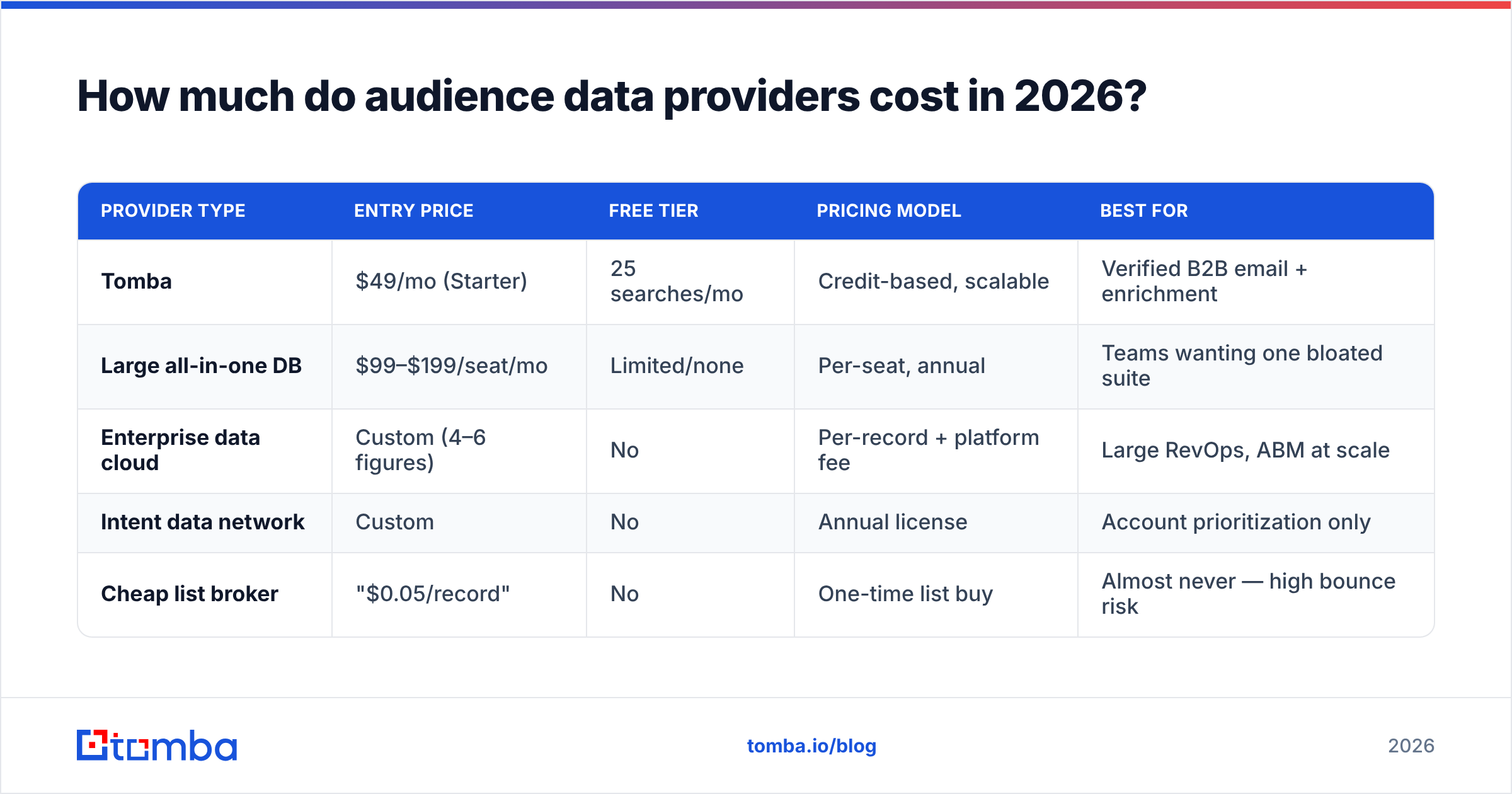
Pricing splits into two philosophies: pay for access (seats/subscriptions) or pay for usage (credits/records). Usage-based pricing is friendlier when you're starting out because you're not subsidizing data you never query.
Here's a representative comparison of how the contact-data slice prices in 2026. Tomba's numbers are exact; the others are typical category ranges, since most enterprise data vendors quote custom.
| Provider type | Entry price | Free tier | Pricing model | Best for |
|---|---|---|---|---|
| Tomba | $49/mo (Starter) | 25 searches/mo | Credit-based, scalable | Verified B2B email + enrichment |
| Large all-in-one DB | $99–$199/seat/mo | Limited/none | Per-seat, annual | Teams wanting one bloated suite |
| Enterprise data cloud | Custom (4–6 figures) | No | Per-record + platform fee | Large RevOps, ABM at scale |
| Intent data network | Custom | No | Annual license | Account prioritization only |
| Cheap list broker | "$0.05/record" | No | One-time list buy | Almost never — high bounce risk |
Tomba's published pricing runs Free (25 searches/mo), Starter at $49/mo, Growth at $99/mo, Pro at $249/mo, and custom Enterprise. The key isn't the lowest sticker price — it's the cost per usable contact after verification. A $0.05 record that bounces is infinitely more expensive than a $0.10 record that lands.
When you model budget, ignore the headline rate and ask: "What will I pay per contact that is real, reachable, and in my ICP?" That single question reorders most vendor shortlists.
When should you use third-party data versus building your own?#
Use third-party providers to expand reach and your own first-party data to convert it — they're complementary, not competing.
Lean on first-party data when:
- You have strong inbound and product signals already.
- Compliance scrutiny is high and you need airtight consent.
- Your ICP is narrow and you can reach it through owned channels.
Bring in third-party audience data providers when:
- You're entering a new market or segment with no existing relationships.
- Outbound is a core motion and you need fresh, verified contacts at volume.
- You need to enrich thin CRM records to make routing and scoring work.
Most B2B teams run a hybrid: first-party for the warm core, a precise contact-data provider for net-new outbound, and an intent layer to decide who to hit first. The mistake is buying a giant third-party database and treating it as a CRM — it isn't one, and it'll rot.
For the outbound layer specifically, a domain search to map an account's contacts, plus bulk find-and-verify for whole lists, gives you net-new audience without the enterprise data-cloud invoice.
What questions should you ask before signing with a provider?#
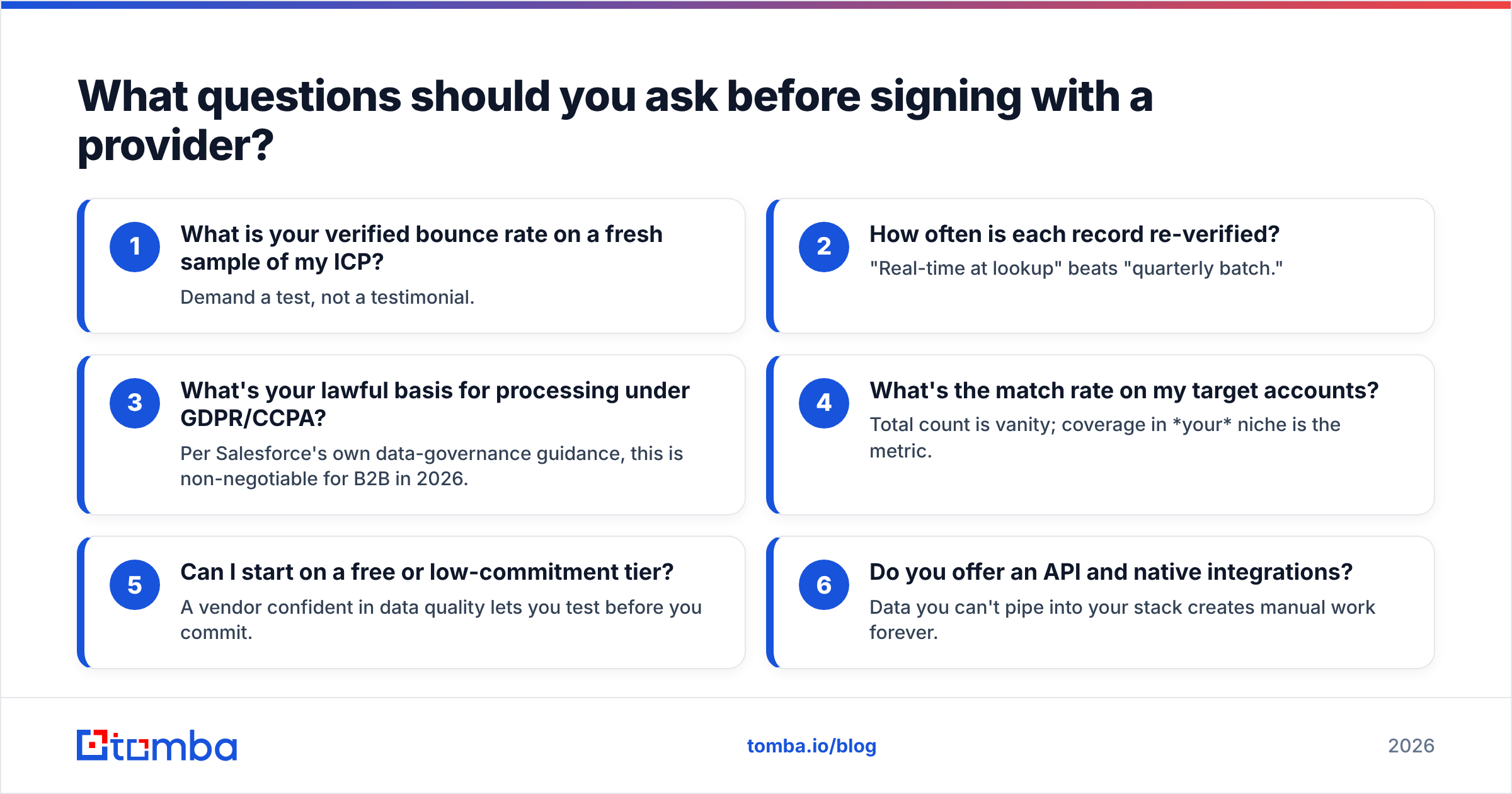
Run this checklist on the sales call. The good vendors answer in numbers; the weak ones answer in adjectives.
- What is your verified bounce rate on a fresh sample of my ICP? Demand a test, not a testimonial.
- How often is each record re-verified? "Real-time at lookup" beats "quarterly batch."
- What's your lawful basis for processing under GDPR/CCPA? Per Salesforce's own data-governance guidance, this is non-negotiable for B2B in 2026.
- What's the match rate on my target accounts? Total count is vanity; coverage in your niche is the metric.
- Can I start on a free or low-commitment tier? A vendor confident in data quality lets you test before you commit.
- Do you offer an API and native integrations? Data you can't pipe into your stack creates manual work forever.
If a provider dodges question one, walk. Everything downstream depends on deliverability, and a vendor unwilling to be measured on it is telling you something.
The bottom line#
Audience data providers are a leverage point, not a magic button. The winners in 2026 aren't the teams with the biggest databases — they're the teams with the cleanest ones, refreshed often and verified before every send. Buy for accuracy and freshness, pay per usable contact, and keep your first-party data at the center.
If your priority is net-new, verified B2B contacts without the enterprise-suite overhead, start with the Tomba Email Finder. Find professional emails by domain, name, or company, verify them in real time, and enrich the records that pass — on a free tier first, then a $49/mo plan that scales with your pipeline instead of your headcount. Clean data in, real conversations out.
// get started
Find, verify and enrich your first contacts today
Start on the free plan with 25 searches a month, then scale when your team is ready.
Free plan · No credit card required · GDPR & CCPA
// about the author