How to Build an Audience Persona That Converts in 2026
An audience persona is only useful if it changes who you target and what you say. Here's how to build data-backed personas in 2026 — and skip the fiction.
Most audience personas are fiction. Someone names a fake buyer "Marketing Mary," gives her a stock photo and a coffee habit, pins the slide to a wall, and never looks at it again. That document does not change a single targeting decision or email subject line — which means it was a waste of an afternoon.
A real audience persona is different. It is a tight, evidence-backed model of one segment of your market that you actually use to decide who to contact, what to say, and where to find them. This guide shows you how to build that version in 2026 — the one that earns its place in your workflow.
TL;DR#
- An audience persona is a research-backed profile of a specific buyer segment, used to drive targeting and messaging — not a decorative slide.
- Skip demographics-only personas. The parts that move pipeline are jobs-to-be-done, triggers, objections, and buying channels.
- Build personas from real data: customer interviews, CRM win/loss patterns, and verified contact data — not assumptions.
- Validate every persona against your actual pipeline. If it does not match who buys, it is wrong.
- You need accurate contact data to turn a persona into outreach. A reliable email finder is the bridge between "who" and "reach them."
What is an audience persona?#
An audience persona is a semi-fictional profile that represents a distinct slice of the people you sell to or market toward. Think of it like a casting brief for a film: you are not describing one real actor, you are describing the type of person who should walk through the door — their motivations, their constraints, and the lines that will land with them.
The "semi-fictional" part matters. A persona is a generalization, but it should be built entirely from real signals: interviews, support tickets, sales-call recordings, closed-won deals, and verified firmographic data. The fiction is only the composite character; the inputs are facts.
People use a few overlapping terms, and it helps to keep them straight:
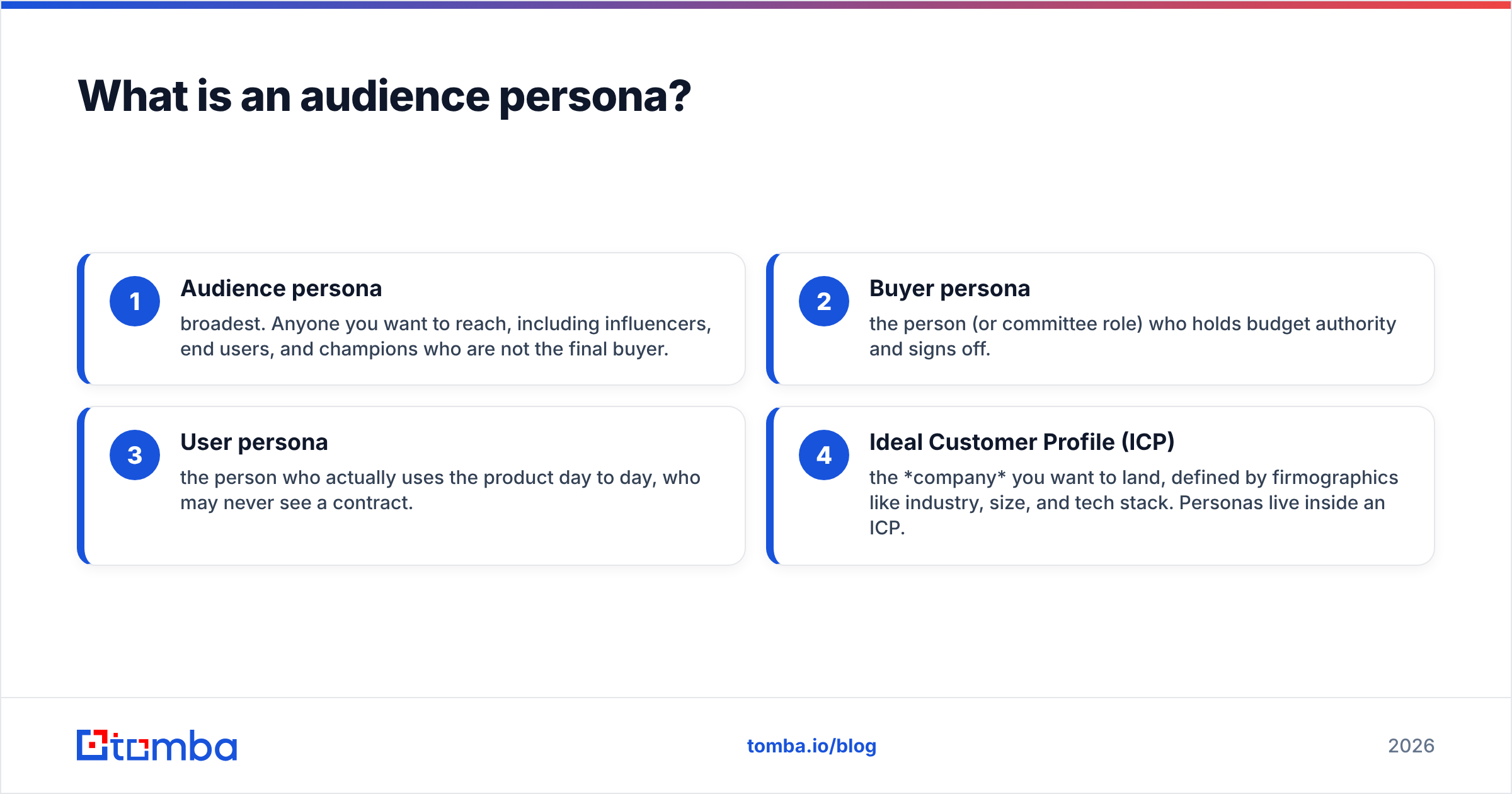
- Audience persona — broadest. Anyone you want to reach, including influencers, end users, and champions who are not the final buyer.
- Buyer persona — the person (or committee role) who holds budget authority and signs off.
- User persona — the person who actually uses the product day to day, who may never see a contract.
- Ideal Customer Profile (ICP) — the company you want to land, defined by firmographics like industry, size, and tech stack. Personas live inside an ICP.
In B2B you almost always need several personas per deal, because buying is a committee sport. Gartner's research puts the typical B2B buying group at six to ten people, each with their own questions and veto power. One persona cannot represent all of them.
Why do most audience personas fail?#
They fail because they are built backward — invented in a conference room, then never tested against reality. Here are the failure patterns worth naming so you can avoid them:
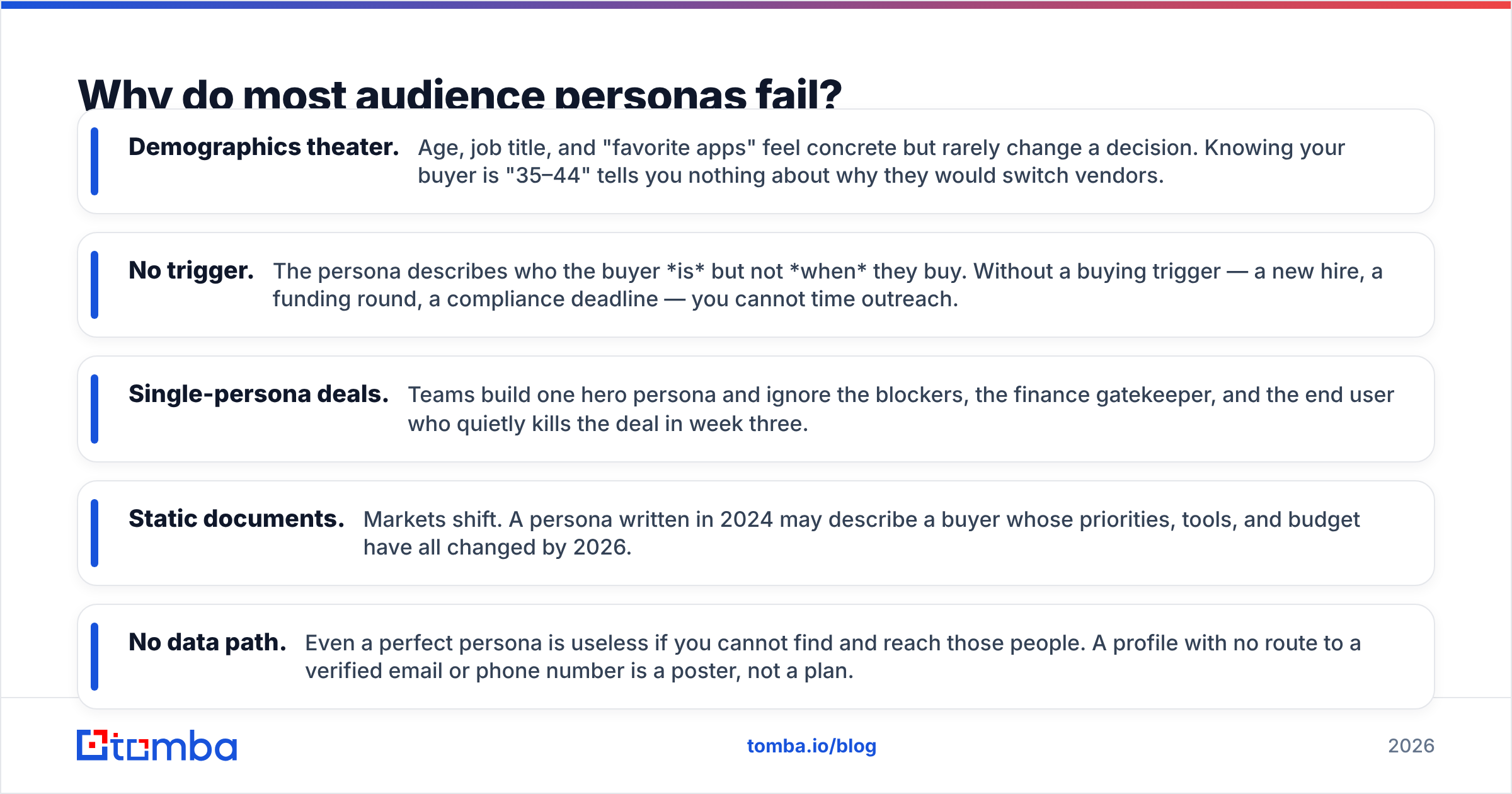
- Demographics theater. Age, job title, and "favorite apps" feel concrete but rarely change a decision. Knowing your buyer is "35–44" tells you nothing about why they would switch vendors.
- No trigger. The persona describes who the buyer is but not when they buy. Without a buying trigger — a new hire, a funding round, a compliance deadline — you cannot time outreach.
- Single-persona deals. Teams build one hero persona and ignore the blockers, the finance gatekeeper, and the end user who quietly kills the deal in week three.
- Static documents. Markets shift. A persona written in 2024 may describe a buyer whose priorities, tools, and budget have all changed by 2026.
- No data path. Even a perfect persona is useless if you cannot find and reach those people. A profile with no route to a verified email or phone number is a poster, not a plan.
The fix for all five is the same: build from evidence, include the full committee, attach a trigger, and connect each persona to a real contact-data source.
What goes into a high-converting audience persona?#
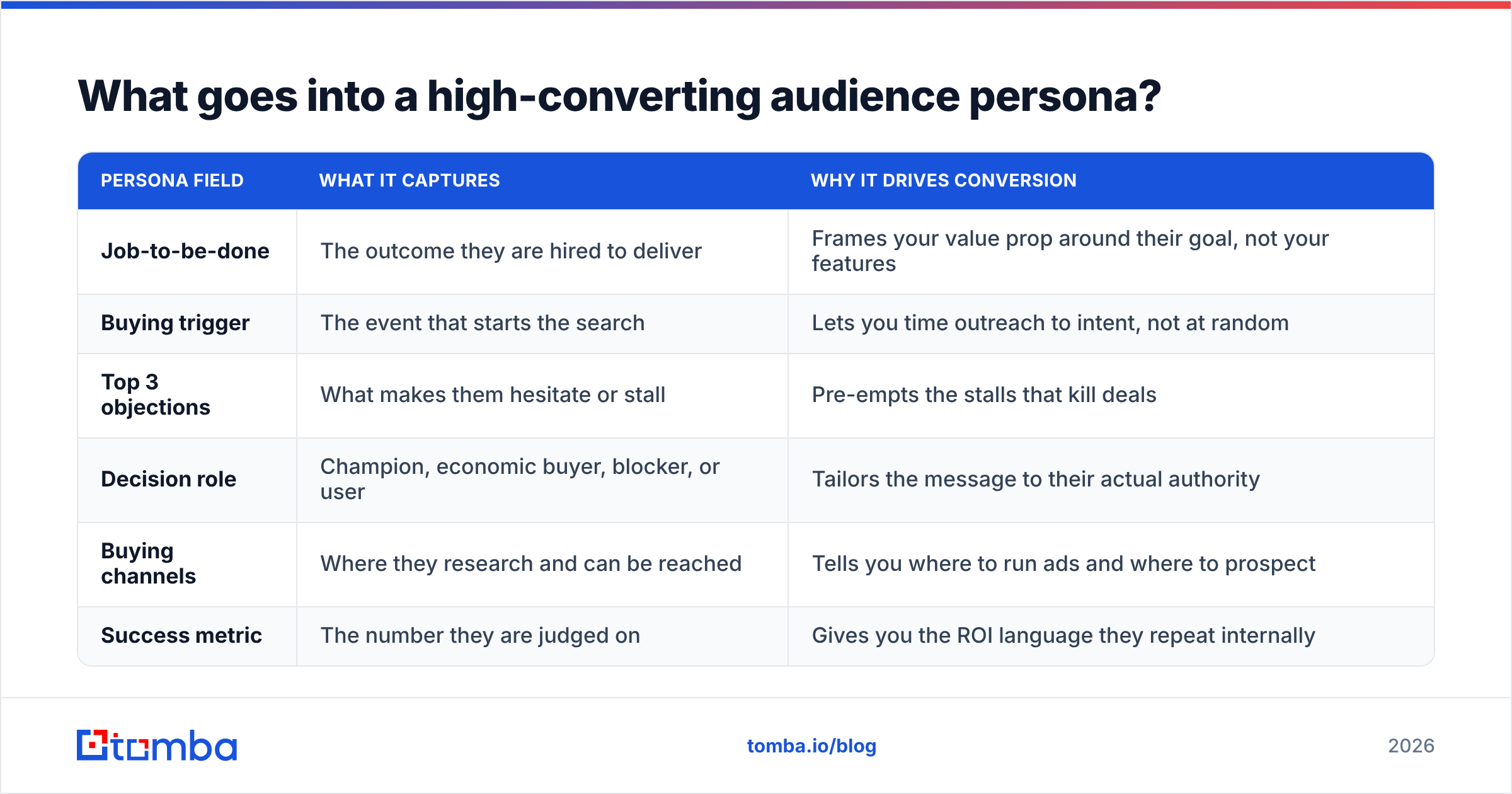
Strip away the stock photos and the persona reduces to a handful of fields that genuinely change how you sell. Here is the framework, ordered by how much each field affects pipeline.
| Persona field | What it captures | Why it drives conversion |
|---|---|---|
| Job-to-be-done | The outcome they are hired to deliver | Frames your value prop around their goal, not your features |
| Buying trigger | The event that starts the search | Lets you time outreach to intent, not at random |
| Top 3 objections | What makes them hesitate or stall | Pre-empts the stalls that kill deals |
| Decision role | Champion, economic buyer, blocker, or user | Tailors the message to their actual authority |
| Buying channels | Where they research and can be reached | Tells you where to run ads and where to prospect |
| Success metric | The number they are judged on | Gives you the ROI language they repeat internally |
Notice what is not on the list: hobbies, a fabricated name, or a personality quiz result. Those make personas feel human but do not help you write a better cold email or pick a better account.
The most underused field is buying trigger. A persona that says "VP of Sales at a 200-person SaaS company" is inert. A persona that adds "starts evaluating new tools within 60 days of hiring two or more reps" is actionable — now you know exactly when to reach out, and you can pull a list of companies that just posted those roles.
How do you build an audience persona step by step?#
Building a persona is research, then synthesis, then validation. Do not skip the validation step — it is the one that separates a useful persona from a wall poster.
Step 1: Mine your existing customers#
Start with who already buys. Pull your closed-won deals from the last 12 months and look for clusters: industries that repeat, titles that show up in the buying committee, company sizes that close fastest. Your CRM already holds a persona — it is just buried in the deal records.
Step 2: Interview real buyers#
Talk to 8–12 recent customers. Ask what problem made them start looking, who else was involved in the decision, and what almost stopped them from buying. Five interviews will surface most of the patterns; the rest confirm them. Record the exact phrases they use — that language becomes your copy.
Step 3: Layer in firmographic and intent data#
Interviews give you depth; data gives you scale. Use a B2B database and your analytics to quantify what the interviews suggested. If buyers keep mentioning a specific trigger, confirm how many accounts in your market match it right now.
Step 4: Write the persona tight#
One page per persona, maximum. Fill the six fields from the table above, add two or three verbatim quotes, and stop. If a field does not change a targeting or messaging decision, cut it.
Step 5: Attach a data path#
For each persona, document how you will actually reach them: the titles to search, the domain search you will run to map a company's contacts, and the verification step before you send. A persona without a contact-data plan is a hypothesis you can never test.
Step 6: Validate against pipeline#
After 30–60 days of using the persona, check it against reality. Are the people who respond and buy the people the persona predicted? If not, the persona is wrong — revise it. Personas are living documents, not founding myths.

Audience persona vs ICP vs segment: what's the difference?#
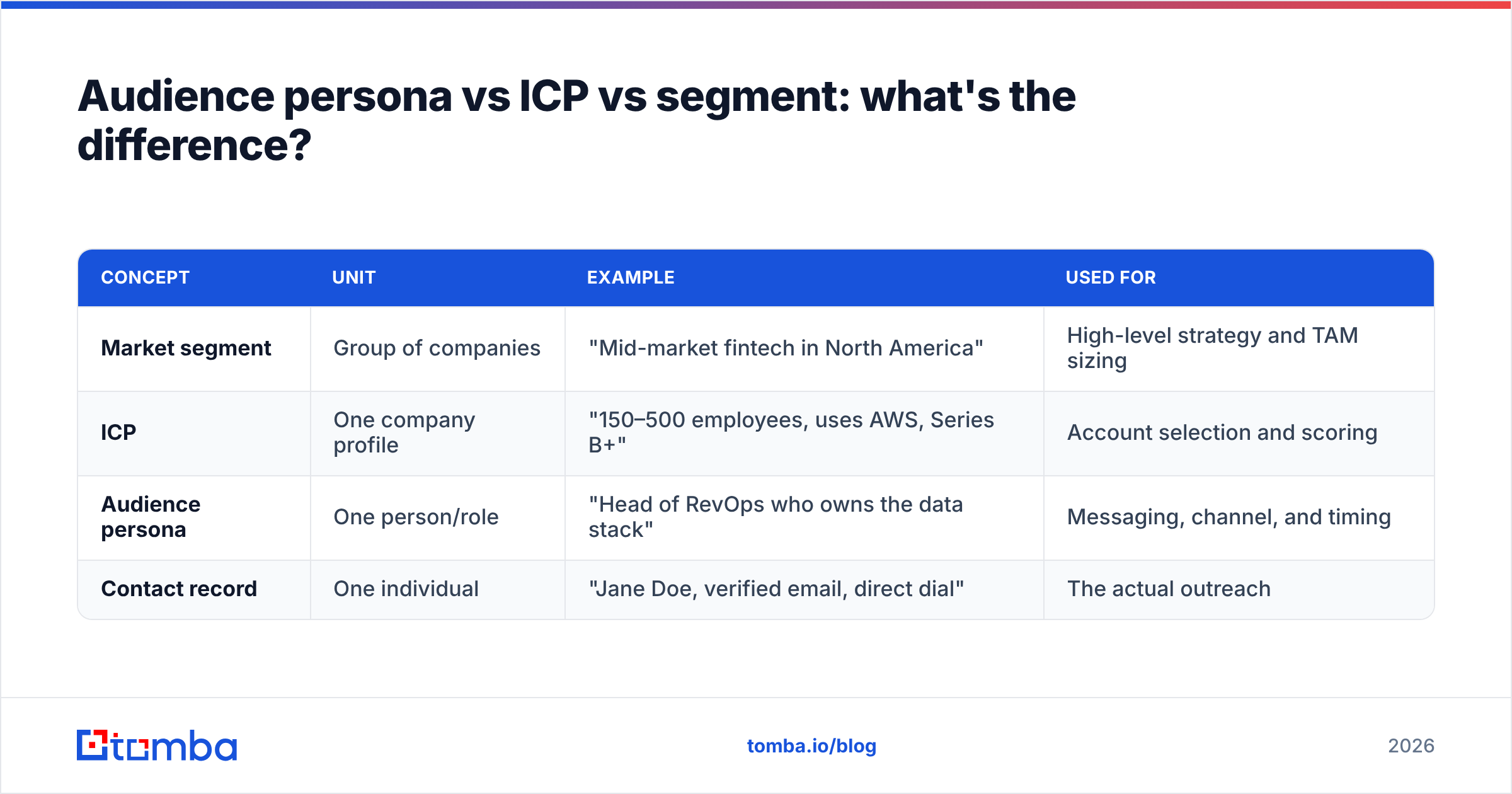
These three terms get used interchangeably, and the confusion costs teams real targeting precision. Here is how they nest.
| Concept | Unit | Example | Used for |
|---|---|---|---|
| Market segment | Group of companies | "Mid-market fintech in North America" | High-level strategy and TAM sizing |
| ICP | One company profile | "150–500 employees, uses AWS, Series B+" | Account selection and scoring |
| Audience persona | One person/role | "Head of RevOps who owns the data stack" | Messaging, channel, and timing |
| Contact record | One individual | "Jane Doe, verified email, direct dial" | The actual outreach |
Read it top to bottom and it is a funnel from abstract to concrete: a segment contains many ICPs, an ICP contains several personas, and each persona resolves to many real contact records. Most teams stall at the persona layer because they never connect it to that final row — the verified contact. That is the gap an email finder closes.
How do you turn an audience persona into outreach?#
A persona is a hypothesis about who will buy. Outreach is how you test it. The translation has three moves.
First, build the list. Use your persona's titles and firmographics to filter accounts, then find the right people inside each one. A bulk email finder lets you go from a list of target companies to a list of named, reachable contacts in one pass instead of hunting profiles one at a time.
Second, verify before you send. Persona accuracy means nothing if your emails bounce. High bounce rates wreck your sender reputation and land future sends in spam. Run every address through an email verifier so your hard-won persona list actually reaches inboxes.
Third, write to the persona, not the database row. The persona's job-to-be-done becomes your opening line, the trigger becomes your reason for reaching out now, and the top objection becomes the thing you defuse before they raise it. This is where the research pays off — your copy stops sounding like a template and starts sounding like you understand their week.
If you want to benchmark your targeting against how the broader market researches buyers, vendor communities like G2 and analyst firms like Gartner publish ongoing data on B2B buying behavior that is worth checking your assumptions against.
How many audience personas do you actually need?#
Fewer than you think. Three to five active personas covers most B2B companies. Each one should map to a distinct buying motivation or committee role — not a slightly different job title.
A common mistake is creating a new persona for every title variation: "VP of Marketing," "Director of Marketing," "Head of Growth." If those three people share the same job-to-be-done, trigger, and objections, they are one persona with three title filters, not three personas. Splitting them just triples your maintenance work without improving targeting.
The opposite mistake is collapsing genuinely different buyers into one. Your economic buyer and your end user have opposite priorities — the buyer cares about ROI and risk, the user cares about whether the tool is annoying to use. Forcing them into one persona produces messaging that lands with neither.
A simple rule: create a separate persona only when the change would alter your message, channel, or timing. If two groups get the same email at the same time through the same channel, they are the same persona.
How often should you refresh your personas?#
Review active personas every quarter and rebuild them annually. Markets move, and a persona built on 2024 buying behavior may misfire badly in 2026 when budgets, tooling, and priorities have all shifted.
Set two triggers for an off-cycle refresh. The first is a product change — a new feature or pricing tier can unlock a buyer you previously could not serve. The second is a pipeline surprise — if a segment you never targeted starts closing, that is the market handing you a new persona for free. Listen to it.
Treat your personas the way you treat your contact data: as something that decays. The names, titles, and companies in your CRM go stale at roughly 25–30% per year as people change jobs, which is exactly why ongoing data enrichment matters. The same decay applies to the assumptions in your personas. A profile you never revisit is quietly getting less accurate every month.
Turn your personas into a reachable list#
A persona is only as good as your ability to act on it. Once you know exactly who you are targeting — the title, the trigger, the objection — you still need their actual contact details to do anything about it.
That is where Tomba's Email Finder fits. Feed it the names and domains your persona points you toward, and it returns verified professional email addresses you can actually send to. Start on the free tier (25 searches a month) to test it against one persona, then scale up through the Starter plan at $49/mo once you see the list quality. Pair it with the built-in verifier and your persona research stops being a slide and starts being pipeline.
Build the persona from real data. Then go reach the real people behind it.
// get started
Find, verify and enrich your first contacts today
Start on the free plan with 25 searches a month, then scale when your team is ready.
Free plan · No credit card required · GDPR & CCPA
// about the author