Automated Sales Forecasting in 2026: The Complete Guide
Manual forecasts are wrong more often than they're right. Here's how automated sales forecasting works in 2026, which tools to use, and how to set it up without garbage data.
Most sales forecasts are fiction with a confidence interval. A rep eyeballs a deal, picks a close date that lines up with quarter-end, slaps "75%" on it because that feels right, and a VP rolls 200 of those guesses into a number they present to the board. Then reality lands 23% lower and everyone acts surprised.
Automated sales forecasting exists to kill that ritual. Instead of asking humans to predict the future from memory, it reads the signals already sitting in your CRM — email replies, meeting cadence, deal age, historical win rates by segment — and produces a forecast that updates itself every night. This guide covers what it actually is, how it works, where it breaks, and how to stand it up in 2026 without poisoning the model with bad data.
TL;DR#
- Automated sales forecasting uses historical pipeline data and machine learning to predict revenue, instead of relying on rep gut-feel and quarter-end optimism.
- Teams that automate forecasting routinely cut forecast error from 20-30% down to single digits — but only if the underlying CRM data is clean.
- The biggest failure mode is garbage in, garbage out: missing contacts, stale stages, and duplicate accounts wreck model accuracy faster than any algorithm can fix.
- Top tools in 2026 split into CRM-native (Salesforce, HubSpot), dedicated revenue platforms (Clari, Gong), and BI-driven custom models.
- The cheapest accuracy win is upstream: enrich and verify your contact and account data before it ever reaches the forecast.
What is automated sales forecasting?#
Automated sales forecasting is the practice of predicting future revenue using software that analyzes your pipeline data automatically, rather than having managers manually tally deals and apply subjective probabilities.
Think of it like a weather forecast versus a farmer licking a finger and holding it up. The farmer's method works sometimes, but it doesn't scale, it can't explain itself, and two farmers in the same field disagree. A weather model ingests thousands of measurements and gives you a probability you can plan around. Automated forecasting does the same thing for revenue: it treats every deal as a data point with dozens of features and lets a model — not a mood — assign the likelihood it closes.
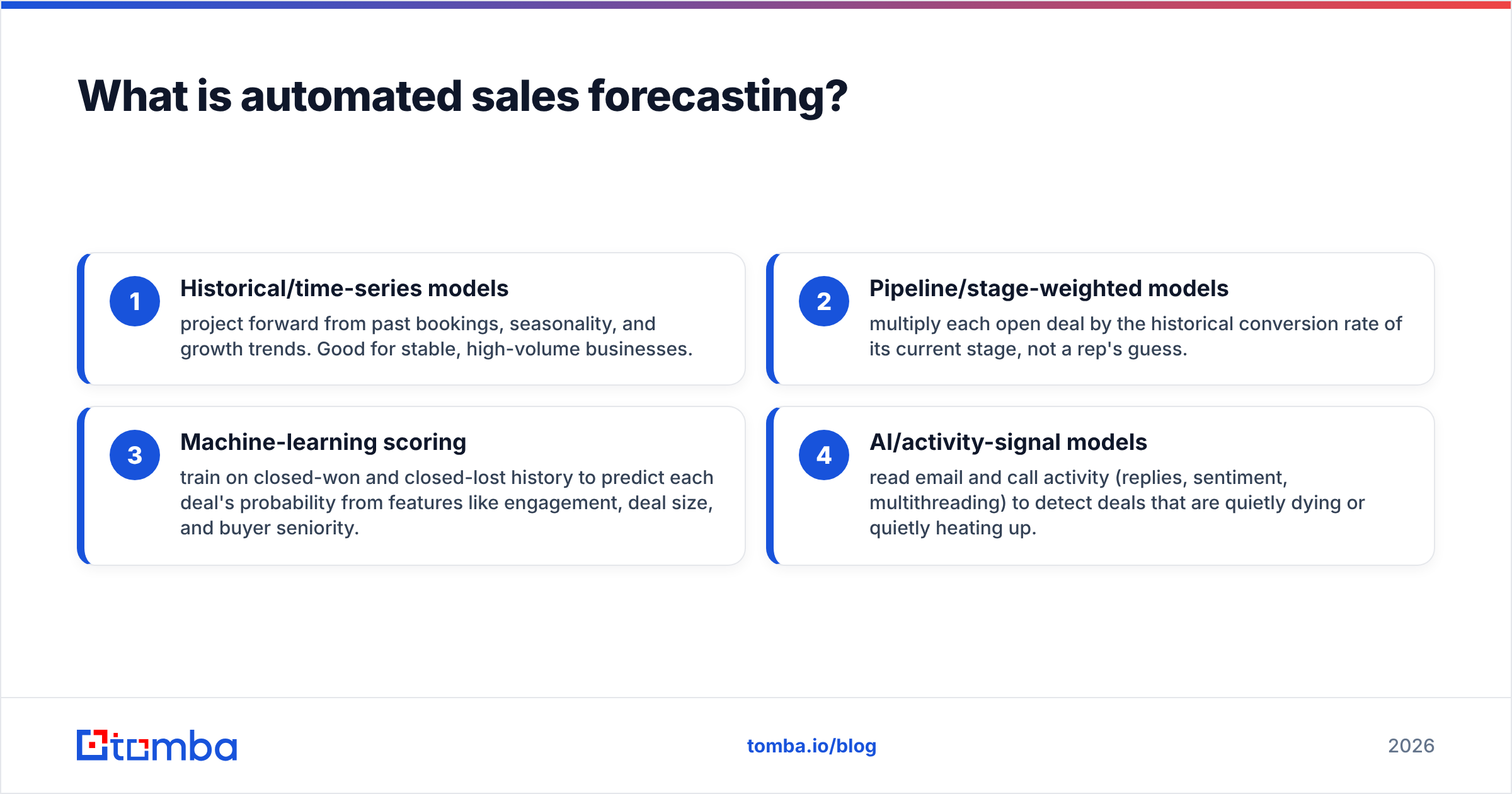
Technically, these systems pull from your CRM and activity tools, then apply one or more of these methods:
- Historical/time-series models — project forward from past bookings, seasonality, and growth trends. Good for stable, high-volume businesses.
- Pipeline/stage-weighted models — multiply each open deal by the historical conversion rate of its current stage, not a rep's guess.
- Machine-learning scoring — train on closed-won and closed-lost history to predict each deal's probability from features like engagement, deal size, and buyer seniority.
- AI/activity-signal models — read email and call activity (replies, sentiment, multithreading) to detect deals that are quietly dying or quietly heating up.
Most modern platforms blend these. The output is a single number with a confidence range, plus a deal-by-deal breakdown you can interrogate.
Why are manual sales forecasts so unreliable?#
Manual forecasts fail because they depend on two things humans are bad at: consistency and honesty about uncertainty. According to HubSpot's sales research, a large share of reps miss quota, and the forecast that rolls up from their individual calls inherits every optimistic bias underneath it.
Here's the chain of errors a manual process accumulates:
- Recency bias — a rep's last good call inflates their confidence on the next deal.
- Sandbagging and happy-ears — reps under-commit to protect themselves or over-commit to look good, depending on incentives.
- Stage inflation — deals sit at "negotiation" for weeks because nobody wants to move them backward.
- Date stacking — close dates cluster suspiciously on the last day of the quarter.
- Stale records — a contact left the company three months ago and the deal is dead, but nobody updated the CRM.
That last one matters more than people admit. A forecast is only as good as the contact and account data feeding it. If half your pipeline points at people who no longer work there, no algorithm saves you. This is why clean data enrichment is a forecasting problem, not just a marketing one.
How does automated sales forecasting actually work?#
At a high level, an automated forecast moves through four stages — and you can map each to where it usually breaks.
- Ingest — the system syncs deals, contacts, accounts, and activity from your CRM and email/calendar tools. Breaks when: records are duplicated or missing key fields.
- Engineer features — it turns raw records into predictive signals: deal age, number of contacts engaged, days since last reply, buyer title, segment.
- Score and aggregate — a model assigns each open deal a probability, then sums probability-weighted value into a period forecast with a confidence band.
- Explain and alert — it flags at-risk deals, surfaces why a deal's score dropped, and tracks forecast accuracy over time so the model improves.
The dirty secret is that 80% of forecasting value comes from the first two stages, not the algorithm. A mediocre model on clean data beats a brilliant model on dirty data every time. That's why teams serious about forecasting invest in a reliable B2B database and keep contact records current — the prediction is downstream of the data quality.
What are the best automated sales forecasting tools in 2026?#
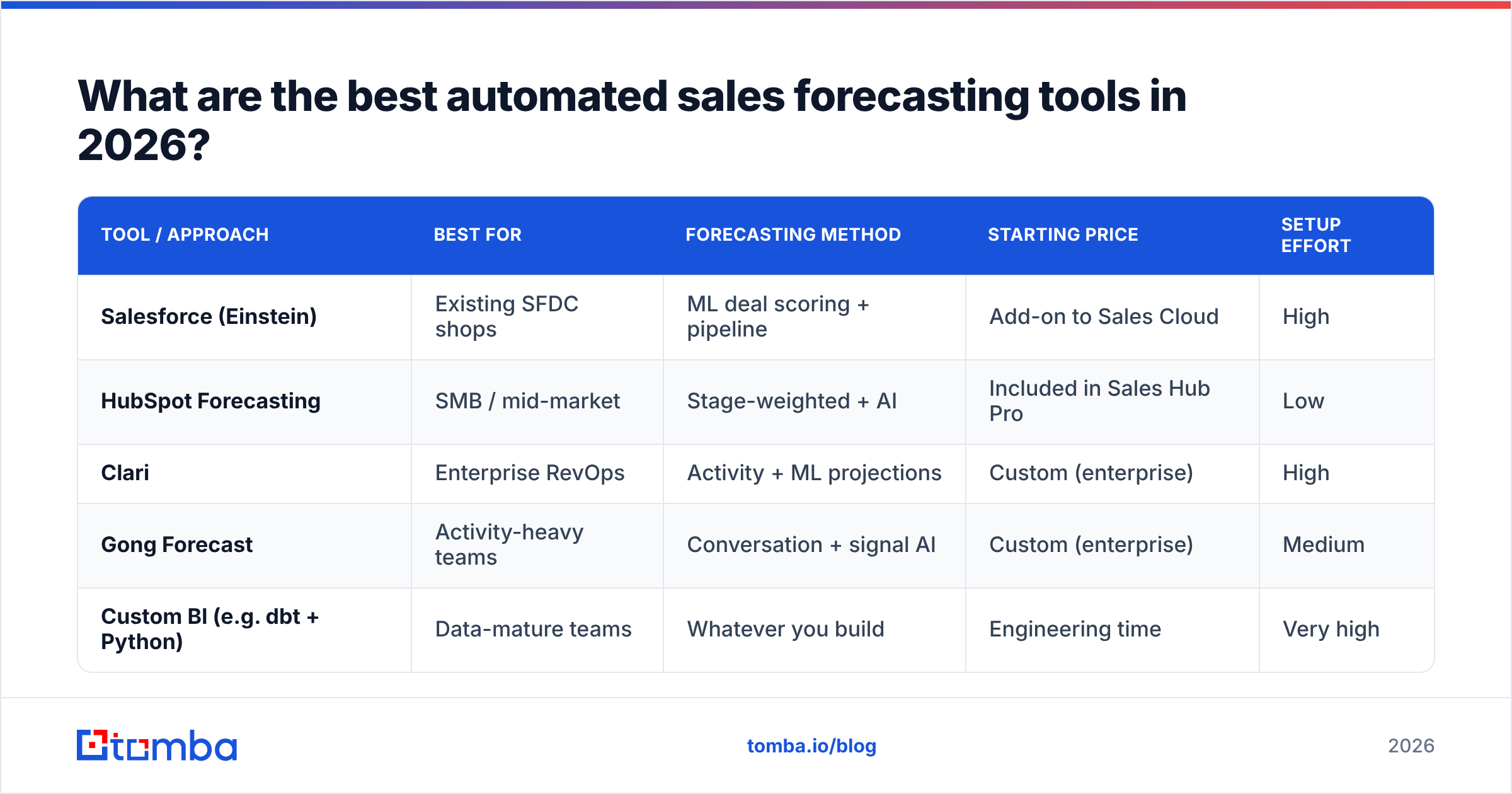
The market splits into three camps. CRM-native tools are cheapest and "good enough" for most teams. Dedicated revenue platforms add deep activity analysis. Custom BI gives you full control if you have a data team. Here's how the main options compare.
| Tool / Approach | Best for | Forecasting method | Starting price | Setup effort |
|---|---|---|---|---|
| Salesforce (Einstein) | Existing SFDC shops | ML deal scoring + pipeline | Add-on to Sales Cloud | High |
| HubSpot Forecasting | SMB / mid-market | Stage-weighted + AI | Included in Sales Hub Pro | Low |
| Clari | Enterprise RevOps | Activity + ML projections | Custom (enterprise) | High |
| Gong Forecast | Activity-heavy teams | Conversation + signal AI | Custom (enterprise) | Medium |
| Custom BI (e.g. dbt + Python) | Data-mature teams | Whatever you build | Engineering time | Very high |
A few honest caveats:
- CRM-native is underrated. If you're already on HubSpot or Salesforce, turn on the built-in forecasting before you buy anything. Most teams never outgrow it.
- Dedicated platforms earn their cost on activity data. Clari and Gong shine because they read the behavioral signals — multithreading, response latency, sentiment — that a stage field can't capture.
- Custom is a trap unless you have the team. Building your own model is satisfying and almost always more expensive than it looks once you factor in maintenance.
Independent reviews on G2 are a sane place to sanity-check vendor claims before you commit to a contract.
How accurate is automated sales forecasting?#
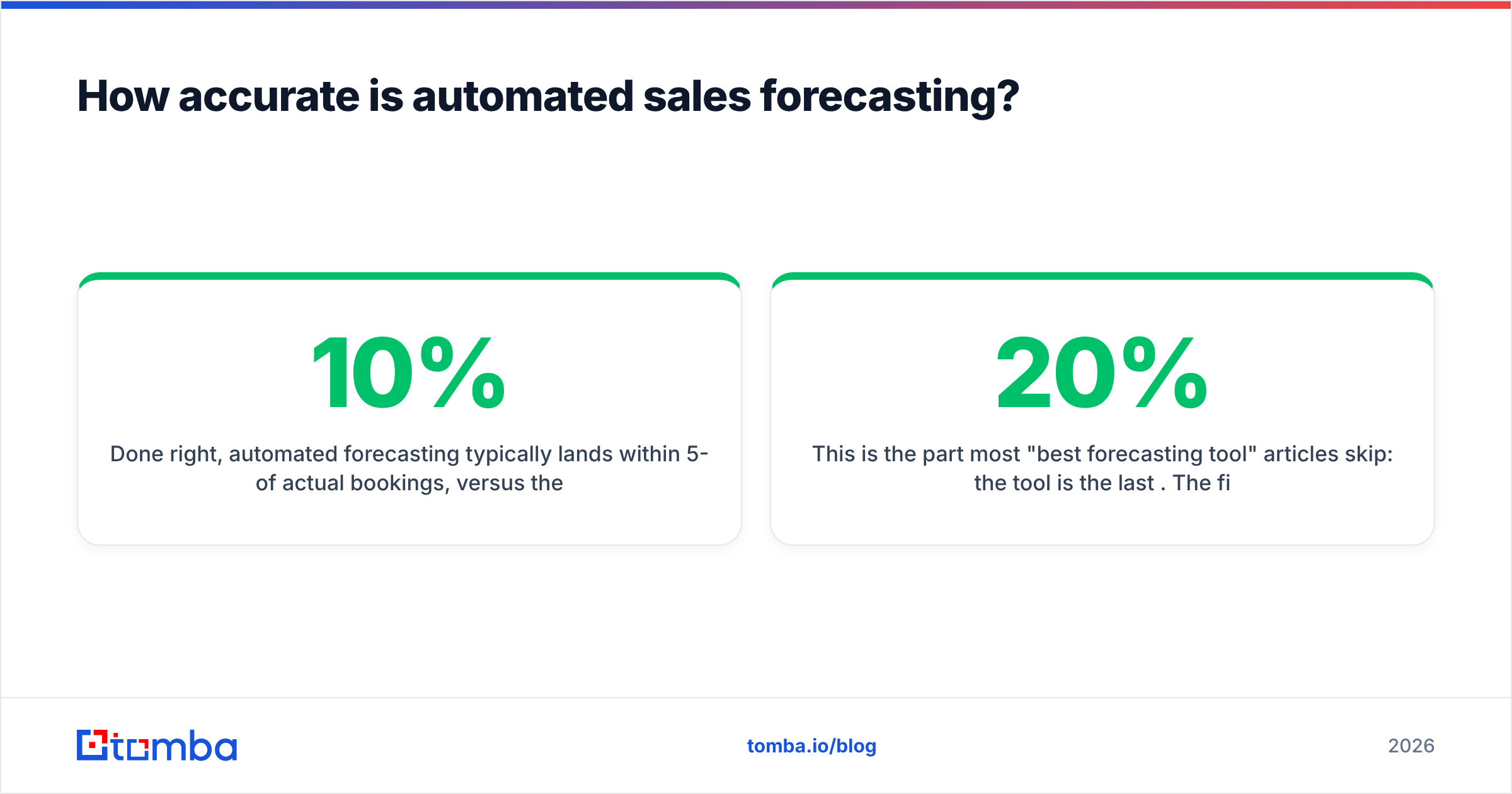
Done right, automated forecasting typically lands within 5-10% of actual bookings, versus the 20-30% error common in manual rollups. But "done right" is carrying a lot of weight in that sentence.
Accuracy depends on three things in order of impact:
- Data completeness — what fraction of your deals have accurate contacts, stages, amounts, and close dates. This is the single biggest lever.
- History depth — ML models need a few hundred closed deals minimum to learn patterns. New teams get worse predictions until they accumulate history.
- Model fit — a high-velocity SMB business and a six-month enterprise cycle need different models. One size predicts neither well.
Notice that two of the three are about data, not algorithms. Forrester and Gartner have both pointed out for years that CRM data decay — contacts changing jobs, companies merging, emails going dead — is the quiet killer of analytics initiatives. People change jobs constantly, and every departure rots a record in your pipeline. If you forecast on top of that decay without cleaning it, your model confidently predicts revenue from deals that can't close.
This is the part most "best forecasting tool" articles skip: the tool is the last 20%. The first 80% is keeping the data underneath it true.
How do you keep forecast data clean enough to trust?#
Clean forecast data comes from continuous hygiene, not an annual cleanup. The goal is simple: every open deal should point at real people at real companies with current contact details. Here's the workflow that keeps it that way.
- Verify contacts at entry. When a deal is created, confirm the buyer's email is real and deliverable. A bounced contact is a dead deal hiding in your forecast. An email verifier catches these before they skew the numbers.
- Enrich thin records. Deals with one contact and no title are unpredictable. Adding the full buying committee, seniority, and company firmographics gives the model real features to score on.
- Re-verify quarterly. Run open-pipeline contacts through verification on a schedule. Job changes are the top cause of silent deal death.
- Deduplicate accounts. Two records for the same company double-count pipeline and inflate the forecast. Merge them.
- Find the missing stakeholders. Single-threaded deals are forecast risk. Use domain search to find the other decision-makers at the account so your engagement signals reflect the real buying group.
None of this is glamorous, but it's where the accuracy actually comes from. A forecasting model is a mirror — it reflects the quality of what you put in front of it. Feed it verified, enriched, deduplicated data and it gives you a number you can take to the board. Feed it decay and it gives you a confident lie.
What's the ROI of automating your forecast?#
The return shows up in three places, and only one of them is the forecast number itself.
Time saved. Manual forecasting eats hours of every manager's week — chasing reps for updates, reconciling spreadsheets, rebuilding the rollup. Automation reclaims that time. For a 20-rep org with frontline managers, that's easily several days of management capacity returned every month.
Better resource allocation. When you trust the forecast, you can act on it earlier — pull deals forward, reallocate reps to at-risk accounts, adjust hiring. A forecast you don't trust just gets ignored, which is the same as not having one.
Earlier risk detection. The highest-value output isn't the quarterly number — it's the alert three weeks out that a marquee deal went quiet. Catching a slipping deal early is the difference between saving it and explaining the miss.
The cost side is mostly the tool subscription plus the data hygiene investment. And the data investment pays for itself beyond forecasting — the same verified, enriched contact data powers your outbound, your routing, and your revenue operations reporting. You're not buying clean data for the forecast alone; the forecast is just the first place its absence hurts.
How do you get started without over-engineering it?#
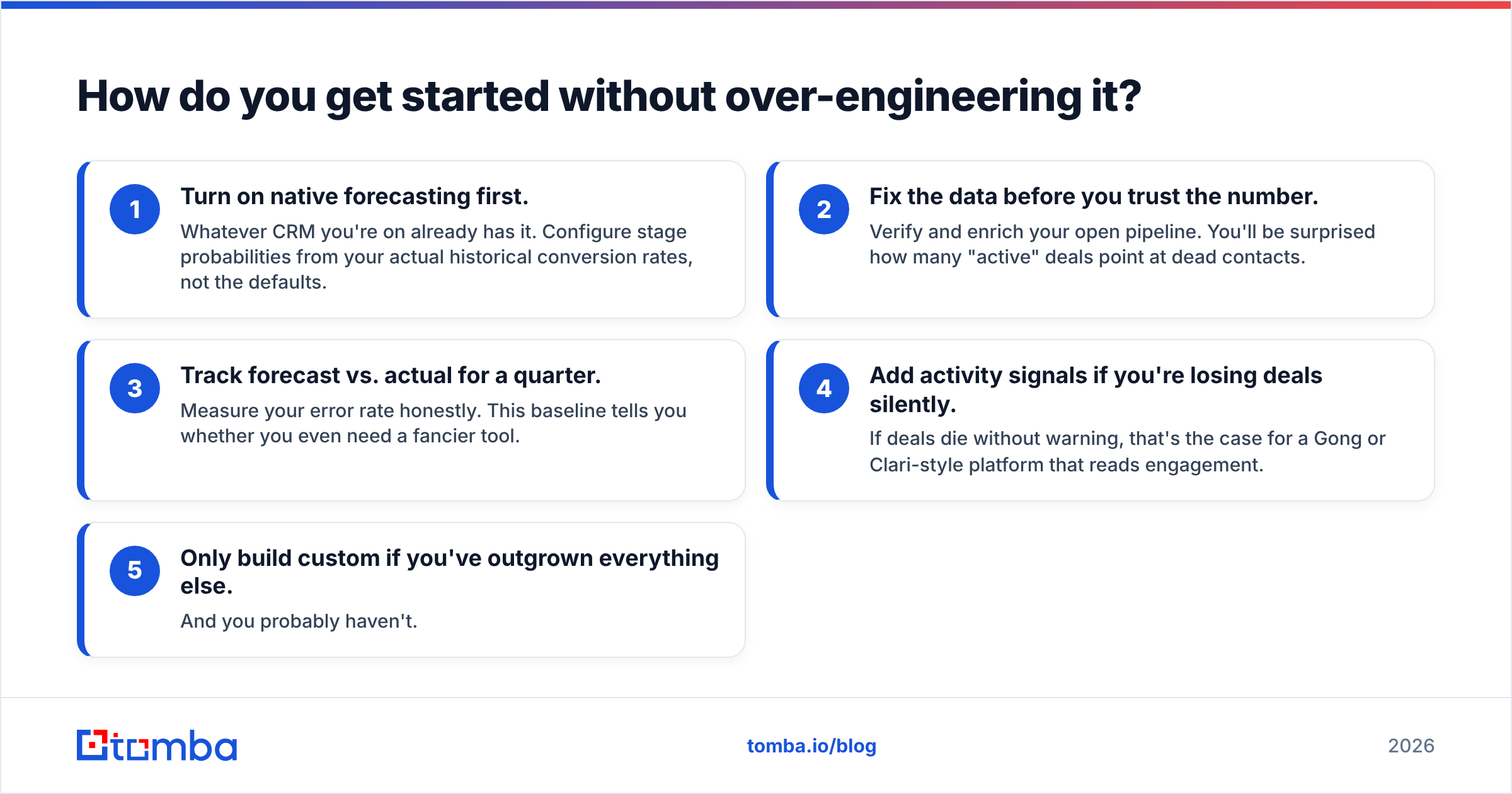
Start small and prove value before you buy an enterprise platform. A sane rollout looks like this:
- Turn on native forecasting first. Whatever CRM you're on already has it. Configure stage probabilities from your actual historical conversion rates, not the defaults.
- Fix the data before you trust the number. Verify and enrich your open pipeline. You'll be surprised how many "active" deals point at dead contacts.
- Track forecast vs. actual for a quarter. Measure your error rate honestly. This baseline tells you whether you even need a fancier tool.
- Add activity signals if you're losing deals silently. If deals die without warning, that's the case for a Gong or Clari-style platform that reads engagement.
- Only build custom if you've outgrown everything else. And you probably haven't.
The teams that succeed treat forecasting as a data-quality discipline with a software layer on top — not a software purchase that magically fixes a messy CRM.
The bottom line#
Automated sales forecasting turns revenue prediction from a monthly guessing game into a system that updates itself and explains its own reasoning. The technology is mature and, in 2026, mostly commoditized — your CRM probably already does 80% of what you need. The differentiator isn't the algorithm. It's whether the pipeline feeding it is clean: verified contacts, enriched accounts, deduplicated records, current data.
That's the part you control, and it's the part that decides whether your forecast is a planning tool or an expensive horoscope.
If your forecast is only as good as your contact data, start there. Tomba's Email Finder helps you find and verify the real decision-makers behind every deal — so the people in your pipeline actually exist, your engagement signals are real, and your forecast predicts revenue instead of wishful thinking. Pair it with the email verifier to keep open-pipeline contacts deliverable, and check Tomba pricing — the Free tier gives you 25 searches a month to test it against your own pipeline before you commit. Clean data first; the forecast follows.
// get started
Find, verify and enrich your first contacts today
Start on the free plan with 25 searches a month, then scale when your team is ready.
Free plan · No credit card required · GDPR & CCPA
// about the author