Autonomous AI Agents for Sales: The 2026 Buyer's Guide
Autonomous AI agents for sales can prospect, enrich, and follow up without a rep clicking a button. Here's what they actually do in 2026, where they break, and how to deploy them.
TL;DR
- Autonomous AI agents for sales are software workers that plan and execute multi-step sales tasks — research, enrichment, outreach, follow-up — with minimal human clicks, not just chatbots that answer one prompt.
- In 2026 the realistic sweet spot is the top and middle of the funnel: list building, data enrichment, reply triage, and meeting booking. Closing is still human.
- The single biggest failure point is data quality. An agent acting on stale or unverified contacts just burns your domain reputation faster.
- True "set it and forget it" autonomy is oversold. Most teams run agents in a human-in-the-loop mode with guardrails.
- Feed agents verified emails and enriched records (something like a find emails API) and they get dramatically more reliable.
What are autonomous AI agents for sales?#
An autonomous AI agent for sales is a system that takes a goal — "book 10 qualified demos with Series B fintech CFOs" — and then decides the steps to reach it, executes them across tools, and adapts based on results. The key word is autonomous: it loops without a human approving every action.
Think of the difference between a calculator and an intern. A calculator (a normal AI feature) answers exactly what you type. An intern (an agent) takes a vague objective, breaks it into tasks, fetches what they need, asks for help when stuck, and reports back. The agent version of a sales intern can read a target account, find the right contact, look up a verified email, draft a personalized opener, send it, watch for a reply, and schedule the meeting — chaining tools together on its own.
Technically, these agents combine a large language model (the planner), a set of tools or APIs (the hands), a memory store (so they don't repeat themselves), and a control loop that decides what to do next. Gartner has been tracking this shift under the "agentic AI" label, and most major CRMs now ship some flavor of it.
How are sales AI agents different from chatbots and automation?#
The market blurs three things that are not the same. Here's the honest separation.
- Rules-based automation —
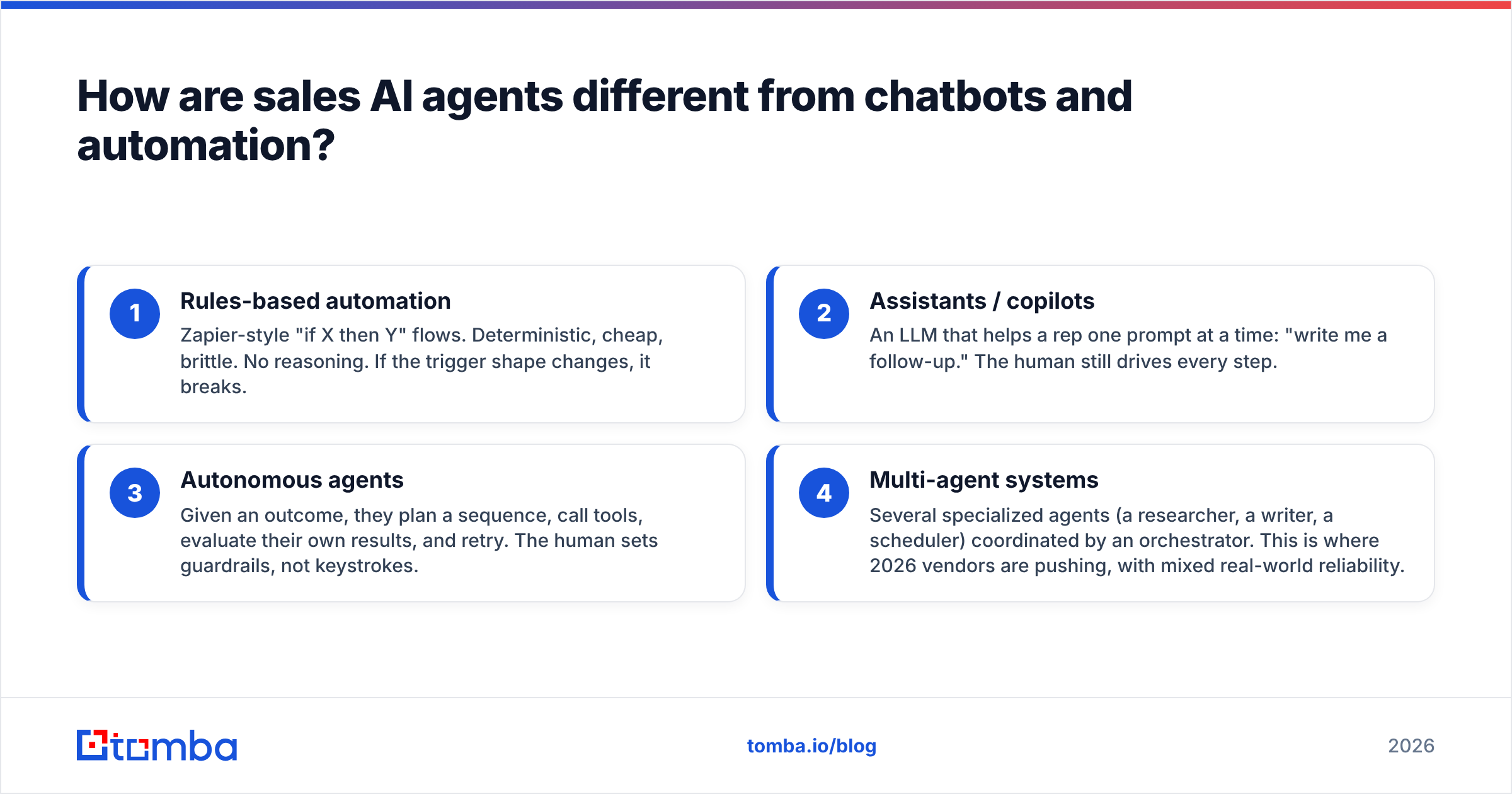
Zapier-style "if X then Y" flows. Deterministic, cheap, brittle. No reasoning. If the trigger shape changes, it breaks. 2. Assistants / copilots — An LLM that helps a rep one prompt at a time: "write me a follow-up." The human still drives every step. 3. Autonomous agents — Given an outcome, they plan a sequence, call tools, evaluate their own results, and retry. The human sets guardrails, not keystrokes. 4. Multi-agent systems — Several specialized agents (a researcher, a writer, a scheduler) coordinated by an orchestrator. This is where 2026 vendors are pushing, with mixed real-world reliability.
The practical takeaway: most products marketed as "AI sales agents" in 2026 are really copilots with a few automated steps. Genuine autonomy — where the system runs a full play unsupervised for days — exists, but you should demand a demo on your data before believing the label.
What can autonomous AI sales agents actually do in 2026?#
Here's where they earn their keep today, ranked roughly by how reliable they are.
- Account and contact research. Agents pull firmographics, recent news, tech stack, and org charts, then summarize why an account fits your ICP. This is mature and genuinely time-saving.
- List building and data enrichment. Agents assemble target lists and fill in missing fields. This works only as well as the underlying data source — more on that below.
- Reply triage and routing. Classifying inbound replies (interested / not now / referral / unsubscribe) and routing them is reliable and high-ROI.
- Personalized first-touch drafting. Agents write openers grounded in the research they gathered. Good as a draft; still needs a quick human scan.
- Meeting booking and follow-up sequencing. Watching a thread, proposing times, and nudging non-responders works well with clear rules.
- CRM hygiene. Logging activity, deduping records, updating stages. Boring, valuable, and a strong fit for autonomy.
What they still cannot reliably do: run a discovery call, negotiate price, read a room, or own a complex multi-threaded deal. Closing remains human. Treat any vendor promising "AI that closes deals" as marketing, not product.
Where do autonomous AI sales agents break?#
The failure modes are predictable, so you can plan around them.
Bad data poisons everything. An agent that sends to unverified addresses doesn't just waste sends — it hammers your sender reputation and can land your domain on a blocklist. Autonomy multiplies the consequence of every bad record. This is why clean inputs matter more in an agent setup than in a manual one: nobody is eyeballing the list before it goes out.
Hallucinated personalization. Agents will confidently invent a "recent funding round" or misattribute a role if their research source is thin. A wrong-sounding first line kills reply rates faster than a generic one.
Compounding errors in long chains. Each step has a small error rate; ten steps multiply it. A 95%-accurate step run ten times succeeds end-to-end only ~60% of the time. Long unsupervised plans drift.
Compliance and tone risk. Unsupervised sending raises GDPR, CAN-SPAM, and brand-voice questions. You need logging, opt-out handling, and rate limits baked in.
)
The fix for most of these is the same: human-in-the-loop checkpoints plus verified data. Let the agent do the heavy lifting, but gate the irreversible actions (sending, CRM writes at scale) behind a quick review or a confidence threshold.
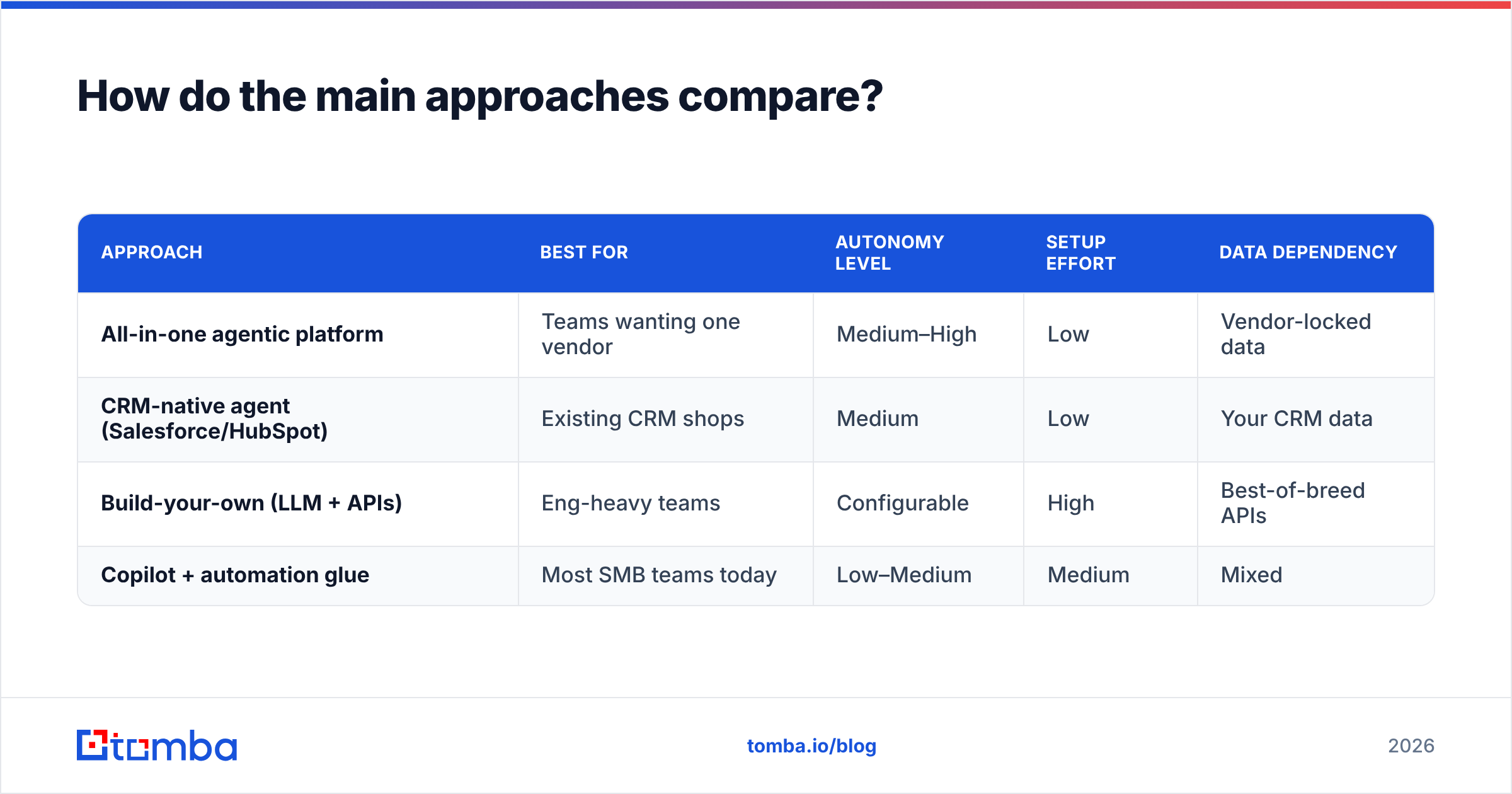
How do the main approaches compare?#
There are four broad ways teams get autonomous behavior in 2026. None is strictly best — it depends on your stack and risk tolerance.
| Approach | Best for | Autonomy level | Setup effort | Data dependency |
|---|---|---|---|---|
| All-in-one agentic platform | Teams wanting one vendor | Medium–High | Low | Vendor-locked data |
| CRM-native agent (Salesforce/HubSpot) | Existing CRM shops | Medium | Low | Your CRM data |
| Build-your-own (LLM + APIs) | Eng-heavy teams | Configurable | High | Best-of-breed APIs |
| Copilot + automation glue | Most SMB teams today | Low–Medium | Medium | Mixed |
A few honest notes on the table. All-in-one platforms demo beautifully but often run on a closed contact database whose freshness you can't audit. CRM-native agents (see HubSpot's and Salesforce's Agentforce push) keep your data in one place but inherit whatever quality is already in your CRM. Build-your-own gives you the most control and lets you wire in best-of-breed data via APIs — at the cost of real engineering time.
If you go the build-your-own or copilot route, the data layer is the part you should not cheap out on. An agent calling a verified email finder and email verifier before every send will out-perform a flashier agent running on a stale internal list every time.
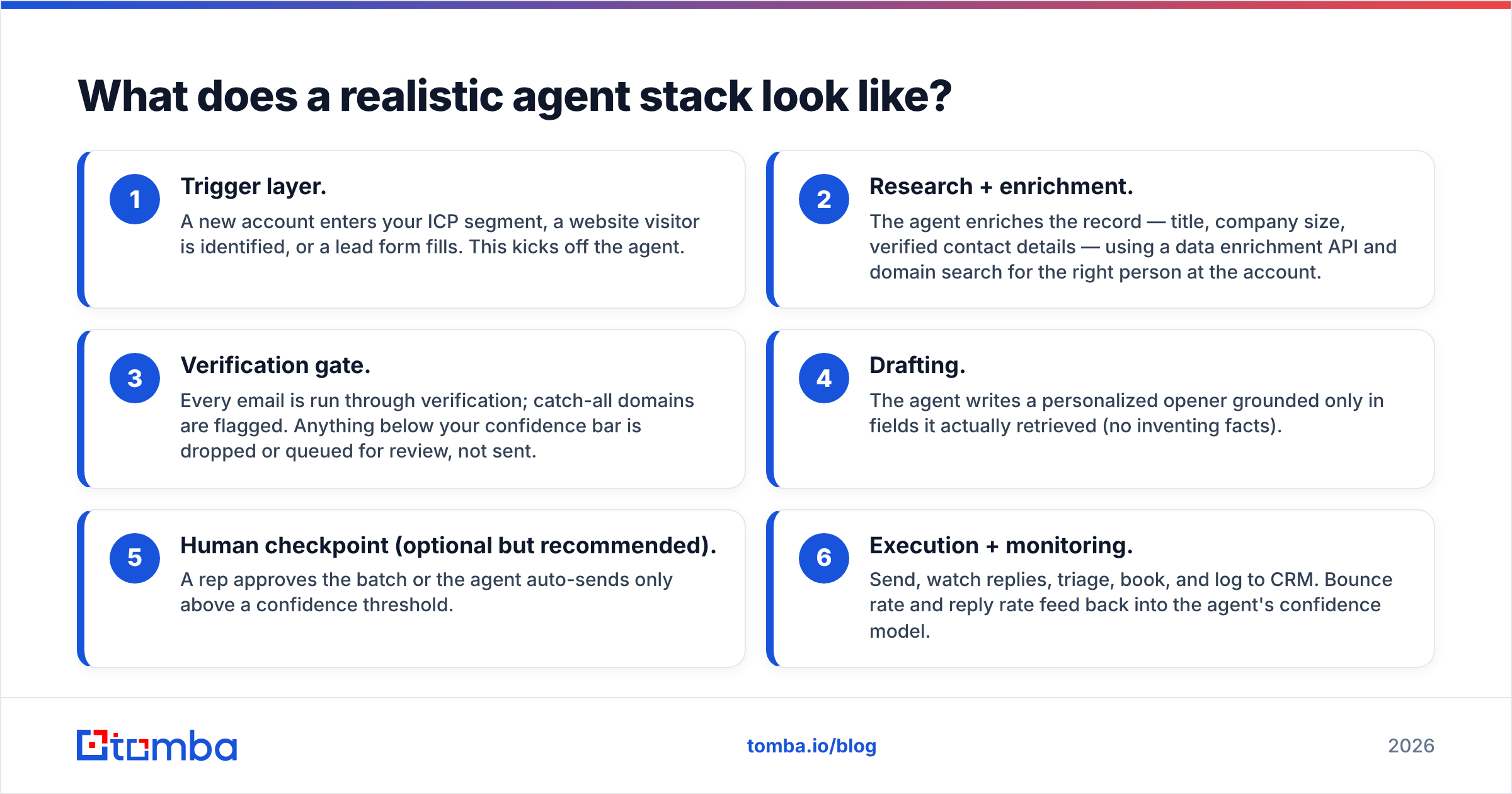
What does a realistic agent stack look like?#
Here's a grounded reference architecture you can actually ship, not a hype diagram.
- Trigger layer. A new account enters your ICP segment, a website visitor is identified, or a lead form fills. This kicks off the agent.
- Research + enrichment. The agent enriches the record — title, company size, verified contact details — using a data enrichment API and domain search for the right person at the account.
- Verification gate. Every email is run through verification; catch-all domains are flagged. Anything below your confidence bar is dropped or queued for review, not sent.
- Drafting. The agent writes a personalized opener grounded only in fields it actually retrieved (no inventing facts).
- Human checkpoint (optional but recommended). A rep approves the batch or the agent auto-sends only above a confidence threshold.
- Execution + monitoring. Send, watch replies, triage, book, and log to CRM. Bounce rate and reply rate feed back into the agent's confidence model.
The verification gate in step 3 is the cheapest insurance you can buy. Cutting unverifiable contacts before send is what keeps your email deliverability healthy while the agent operates at volume.
How much do autonomous sales agents cost?#
Pricing splits into the agent platform and the data feeding it. Platforms range from roughly $50–$150 per seat per month for copilots up to four- and five-figure monthly contracts for enterprise multi-agent suites. The data layer is usually priced per credit or per lookup.
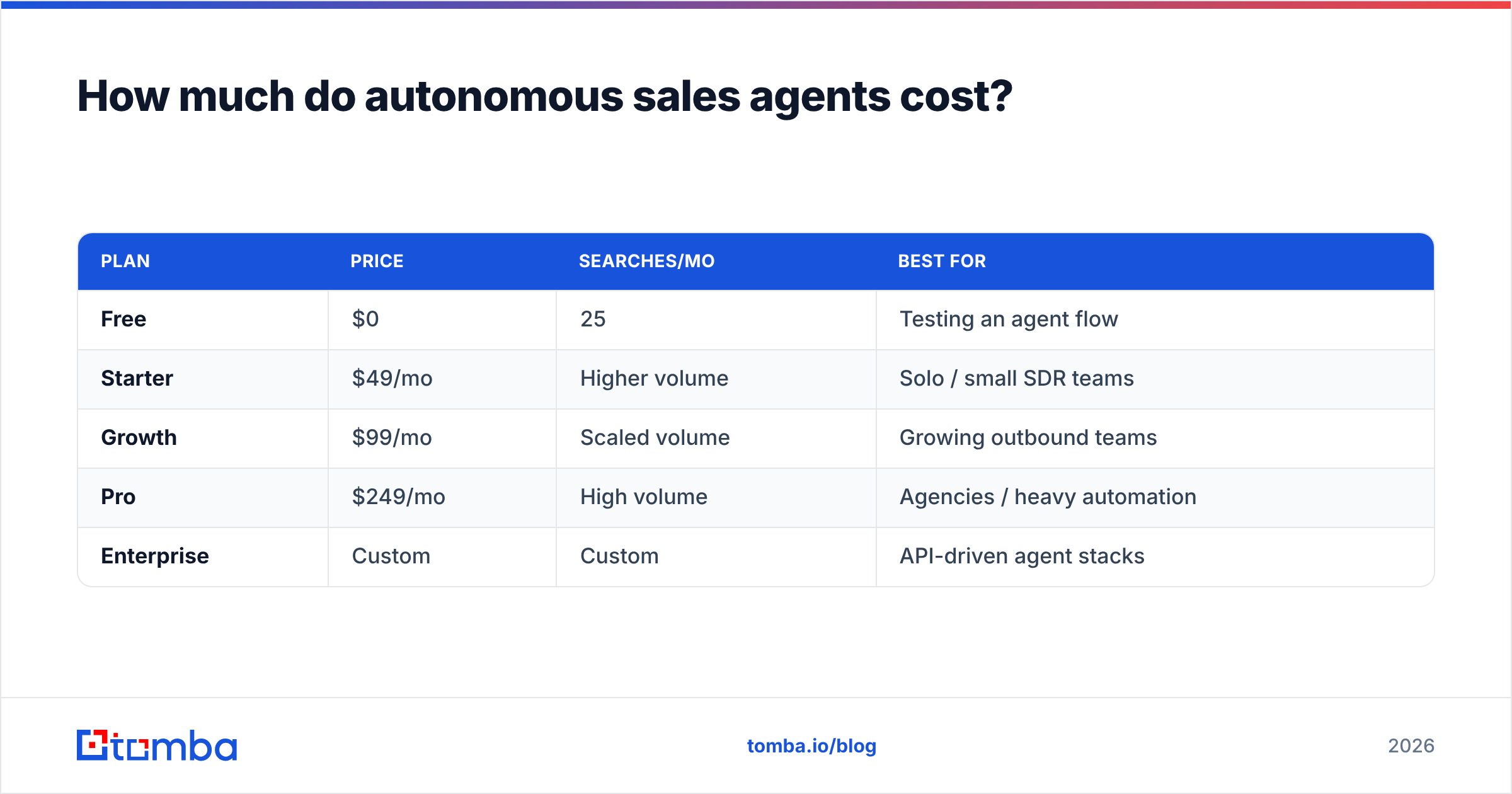
For the data side specifically, here's where Tomba sits, since clean inputs are the non-negotiable part:
| Plan | Price | Searches/mo | Best for |
|---|---|---|---|
| Free | $0 | 25 | Testing an agent flow |
| Starter | $49/mo | Higher volume | Solo / small SDR teams |
| Growth | $99/mo | Scaled volume | Growing outbound teams |
| Pro | $249/mo | High volume | Agencies / heavy automation |
| Enterprise | Custom | Custom | API-driven agent stacks |
You can see the full breakdown on the Tomba pricing page. The point isn't the exact numbers — it's that the data layer is a small fraction of total agent cost, yet it determines whether the whole system works. Underfunding it to save $50/mo is the classic false economy.
How do you deploy autonomous AI agents for sales safely?#
A short, opinionated rollout that avoids the common disasters:
- Start narrow. Pick one repetitive play (inbound lead enrichment + routing is ideal) and automate that fully before expanding.
- Verify before you act. Wire an email verifier and catch-all verifier into the path so the agent never sends to a risky address.
- Keep a human gate on irreversible steps for the first month. Watch where the agent would have been wrong.
- Instrument everything. Track bounce rate, reply rate, and meeting rate per agent decision. If bounces creep up, the data source — not the model — is usually the culprit.
- Set hard rate limits and opt-out handling so an agent can't run away with your domain reputation.
- Review weekly, expand monthly. Promote the agent to more autonomy only on plays where the metrics earn it.
You can review your own checks before scaling using a free email checker to spot-test what the agent is producing.
Are autonomous AI agents worth it for sales teams?#
Yes — for the specific jobs they're good at, and only if you feed them clean data. The teams winning with agents in 2026 aren't the ones with the fanciest model; they're the ones who narrowed the scope, kept a human on the kill switch, and verified every contact before the agent touched it. The teams getting burned skipped the data layer and let an unsupervised agent torch their domain.
Treat autonomous agents as force multipliers on the top and middle of the funnel, not as replacements for sellers. The reasoning is improving fast, but the constraint that decides your results is still the quality of the contacts and accounts you point them at.
Get the data layer right first#
Before you evaluate a single agent platform, fix your data foundation — because the smartest agent in the world fails on a bad list. Start with the Tomba Email Finder to source verified professional emails by name, company, or domain, then plug it straight into your agent via the Tomba API. Spin up the free tier with 25 searches, confirm the accuracy on your own ICP, and let your autonomous agents run on contacts you can actually trust. Clean inputs are the difference between an agent that books meetings and one that gets you blocklisted.
// get started
Find, verify and enrich your first contacts today
Start on the free plan with 25 searches a month, then scale when your team is ready.
Free plan · No credit card required · GDPR & CCPA
// about the author