Autonomous Sales Agent in 2026: What It Is and How to Deploy One
An autonomous sales agent runs prospecting, outreach, and follow-up with little human input. Here's how the tech works in 2026 — and where it still needs a human.
An autonomous sales agent is software that can plan and execute a multi-step sales workflow — research a lead, find a contact, draft a personalized message, send it, watch for a reply, and decide the next action — with minimal human approval at each step. In 2026 the term gets stretched to cover everything from a glorified email scheduler to a genuine goal-seeking AI. This guide cuts through that.
TL;DR#
- An autonomous sales agent decides and acts across a workflow (prospect → enrich → reach out → follow up), unlike a copilot that only suggests.
- The three building blocks are a reasoning model, tools/APIs (data, email, CRM), and a memory/state layer that tracks each deal.
- Autonomy is a spectrum: most production "agents" in 2026 run at Level 2–3 (human approves the plan, agent executes), not full Level 5.
- The fastest way to break one is bad data and bad deliverability — agents send faster, so garbage scales faster too.
- Start narrow: point an agent at one repeatable motion (inbound triage, list enrichment, first-touch follow-up) before handing it the whole pipeline.
What is an autonomous sales agent?#
Think of the difference between cruise control and a self-driving car. Cruise control holds a speed you set — useful, but you steer, brake, and decide everything. A self-driving system takes a destination and makes the thousand small decisions to get there. A copilot is cruise control. An autonomous sales agent is closer to the self-driving car: you give it a goal ("book 5 qualified demos with Series B fintech CTOs this week"), and it sequences the work itself.
Technically, an autonomous agent is a loop wrapped around a large language model. The model receives a goal and the current state, decides which tool to call next (search a database, find an email, send a message, update the CRM), reads the result, and loops again until the goal is met or it hits a stop condition. Gartner groups this under "agentic AI" and projects it will handle a growing share of routine GTM execution by 2028 — but warns that most deployments still need tight guardrails (gartner.com).
The key word is act. A tool that writes you a draft is a copilot. A tool that writes the draft, checks the address against a verifier, sends it, and schedules a follow-up if no reply lands in four days — that's an agent.
How is an autonomous agent different from a copilot or RPA?#
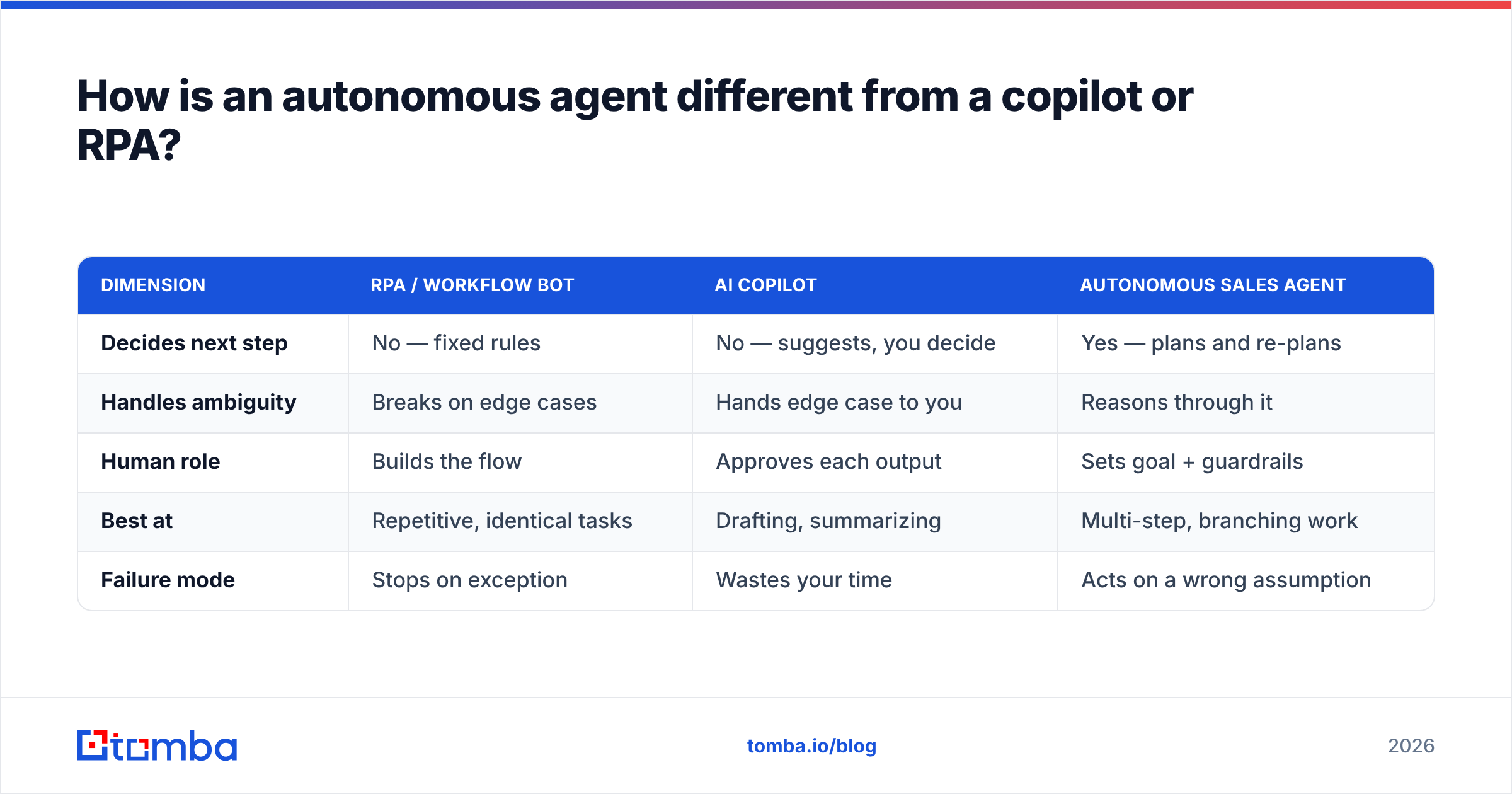
These three terms get blurred in vendor decks. They are not the same thing.
| Dimension | RPA / Workflow bot | AI Copilot | Autonomous Sales Agent |
|---|---|---|---|
| Decides next step | No — fixed rules | No — suggests, you decide | Yes — plans and re-plans |
| Handles ambiguity | Breaks on edge cases | Hands edge case to you | Reasons through it |
| Human role | Builds the flow | Approves each output | Sets goal + guardrails |
| Best at | Repetitive, identical tasks | Drafting, summarizing | Multi-step, branching work |
| Failure mode | Stops on exception | Wastes your time | Acts on a wrong assumption |
RPA (robotic process automation) follows a hard-coded script: if this field, click that button. It is fast and predictable but snaps the moment reality deviates. A copilot — like the assistants now baked into most CRMs — is great at generating a draft or summarizing a call, but it waits for you to push the button. The autonomous agent is the only one of the three that owns a sequence of decisions and adapts mid-flight.
What are the core components of an autonomous sales agent?#
Every credible agent stack has four layers. If a vendor is missing one, you're looking at a copilot in agent clothing.
- The reasoning engine. An LLM (or several) that interprets the goal, plans steps, and chooses tools. This is the "brain," but on its own it can only talk — it can't do anything.
- The tool layer. APIs the agent calls to affect the world: a data provider to find and enrich contacts, an email-sending service, a CRM, a calendar. This is where a clean data enrichment source matters — the agent is only as smart as the records it acts on.
- The memory and state layer. Per-lead and per-account context so the agent remembers what it already sent, what was said on the last call, and where each deal sits. Without it, the agent re-introduces itself to the same prospect twice.
- The guardrail layer. Rules and approvals that cap what the agent may do unsupervised — send limits, do-not-contact lists, tone constraints, and a human checkpoint before anything irreversible.
A practical example of the tool layer in action: before an agent emails a prospect, it should pull a verified address. Wiring a find email addresses call plus an email verification check into the loop is what separates a deliverable agent from a spam cannon. The model writes the copy; the tools make sure it lands.
What levels of autonomy exist in 2026?#
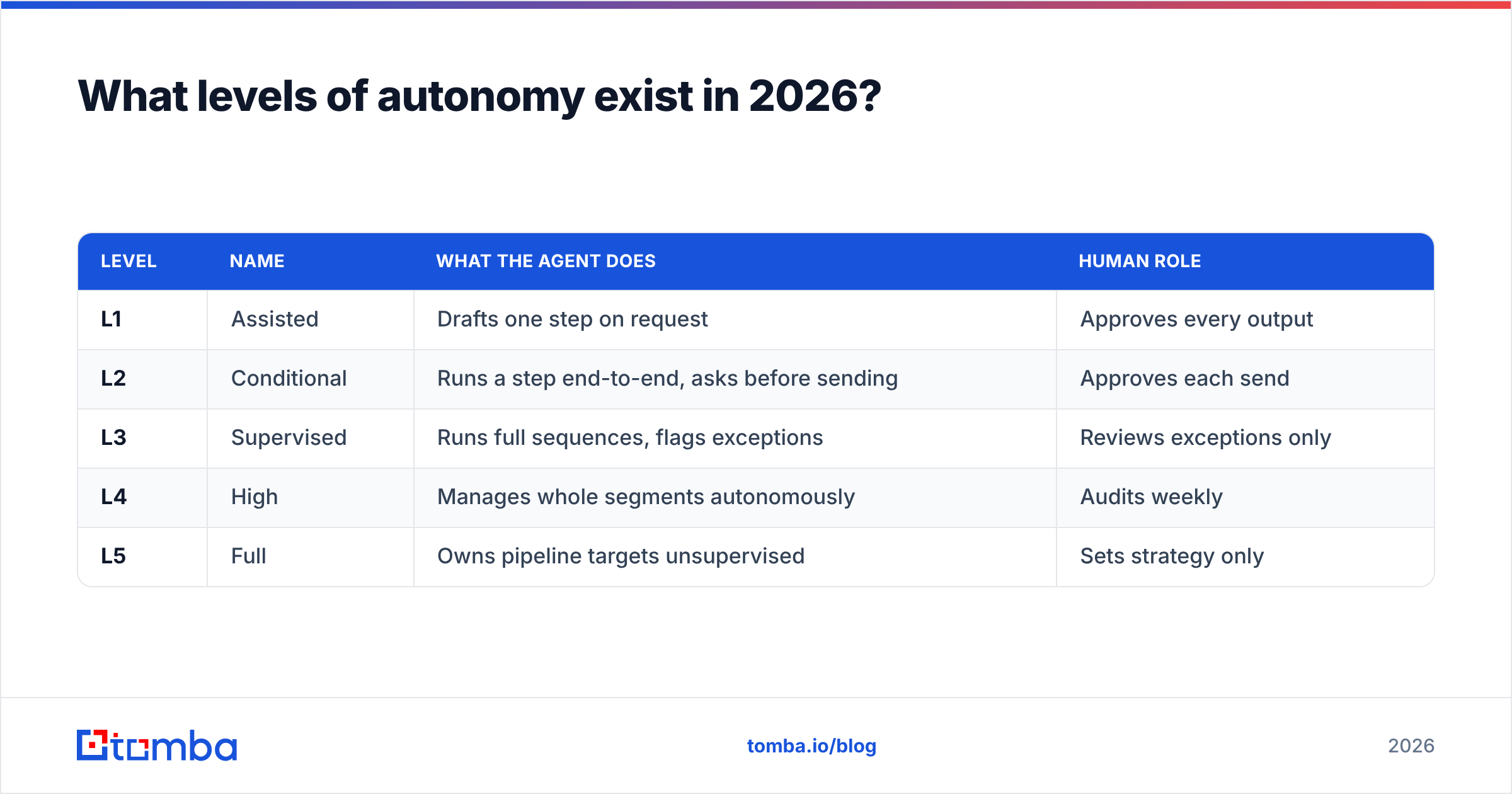
Borrowing from the self-driving analogy, autonomy is a ladder, not a switch. Most teams overestimate where their tooling sits.
| Level | Name | What the agent does | Human role |
|---|---|---|---|
| L1 | Assisted | Drafts one step on request | Approves every output |
| L2 | Conditional | Runs a step end-to-end, asks before sending | Approves each send |
| L3 | Supervised | Runs full sequences, flags exceptions | Reviews exceptions only |
| L4 | High | Manages whole segments autonomously | Audits weekly |
| L5 | Full | Owns pipeline targets unsupervised | Sets strategy only |
In 2026, the honest answer is that nearly all reliable production deployments live at L2–L3. The technology can technically run at L4, but deliverability risk, compliance exposure, and the cost of one bad send to a key account keep sensible teams supervising. Vendors selling "fully autonomous AI SDRs" are usually describing L3 with marketing on top. That's not a knock — L3 is genuinely valuable — but set expectations accordingly.
Where do autonomous sales agents actually work today?#
Not everywhere. They shine in motions that are high-volume, well-defined, and forgiving of small errors, and they struggle in low-volume, high-stakes, relationship-driven deals.
Strong fits in 2026:
- Inbound lead triage. Enrich a new signup, score it against your ICP, and route or reply within seconds.
- List building and enrichment. Turn a thin list of company names into verified contacts with roles, emails, and B2B phone numbers.
- First-touch and follow-up sequences. Personalize an opener from public data, then chase non-responders on a cadence.
- Data hygiene. Continuously re-verify and de-dupe CRM records so reps don't burn sends on dead addresses.
Weak fits:
- Complex enterprise deals with six stakeholders and a custom contract.
- Brand-sensitive accounts where one tone-deaf message costs you a logo.
- Anything requiring genuine trust-building — agents simulate rapport; they don't build it.
HubSpot's research on AI in sales makes the same point: AI lifts productivity most on the repetitive top-of-funnel work, freeing reps for the human-heavy bottom of the funnel (hubspot.com).
How do you deploy an autonomous sales agent without wrecking deliverability?#
This is where most projects quietly fail. An agent that sends 10x faster than a human also burns your domain reputation 10x faster if the inputs are bad. Speed amplifies whatever you feed it.
Follow this order:
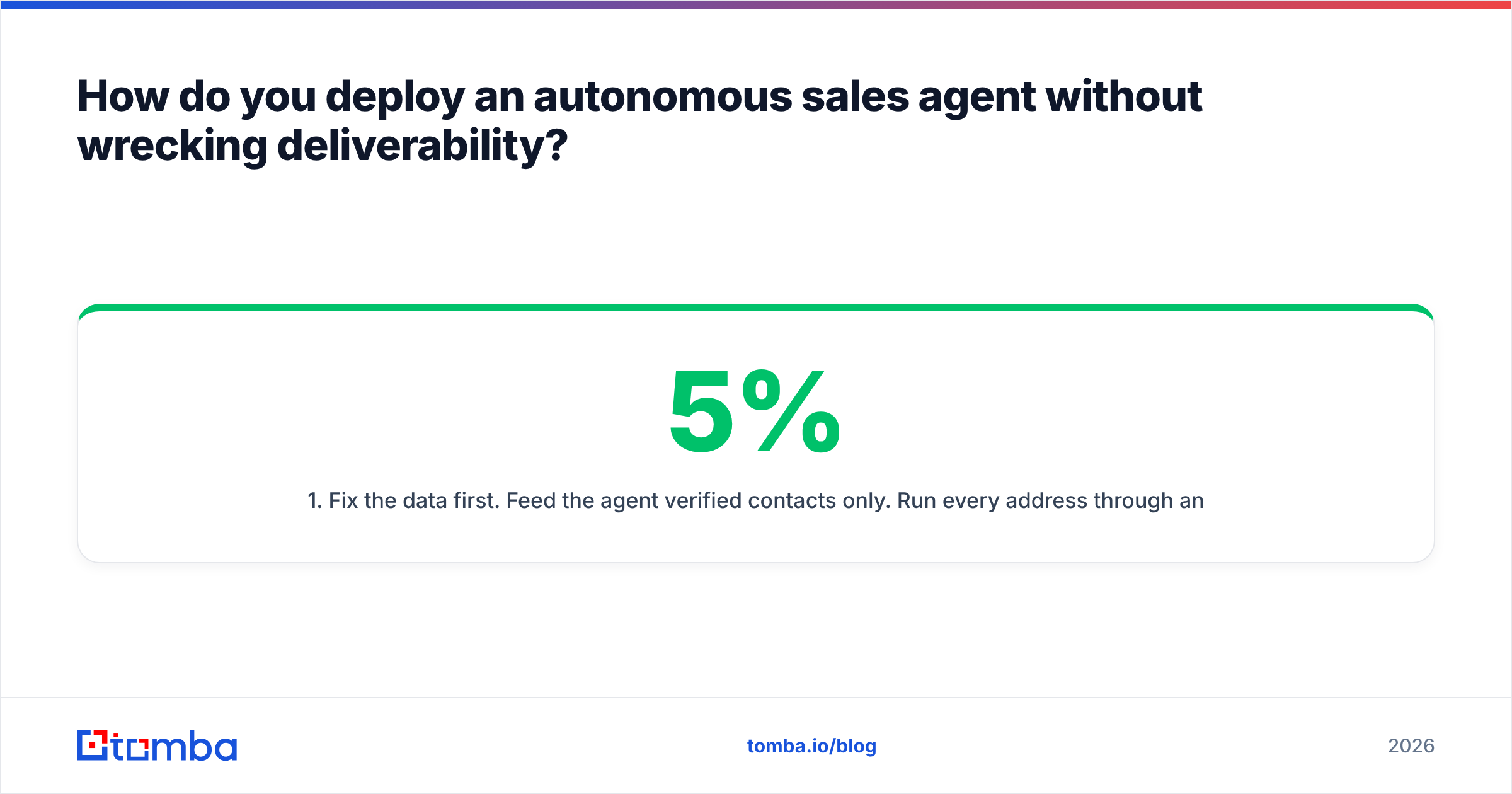
- Fix the data first. Feed the agent verified contacts only. Run every address through an email verifier before it enters a sequence. A 5% invalid rate that a human would shrug off becomes a deliverability cliff at agent scale.
- Warm and protect the sending domain. Use a separate domain for outbound, authenticate it (SPF, DKIM, DMARC), and respect daily send caps. Don't let the agent decide its own volume.
- Constrain the autonomy level. Start at L2 — agent drafts and queues, human approves the batch. Graduate to L3 only after you trust the output on a sample.
- Instrument everything. Log every decision the agent makes and every message it sends. You cannot debug a black box, and you'll need the audit trail for compliance.
- Define hard stops. Do-not-contact lists, competitor domains, existing-customer suppression, and a kill switch. The agent should never be able to email a churned account a cold pitch.
Salesforce's guidance on agentic deployment echoes the "narrow then widen" approach — pick one bounded use case, prove it, then expand scope (salesforce.com).
How much does an autonomous sales agent cost?#
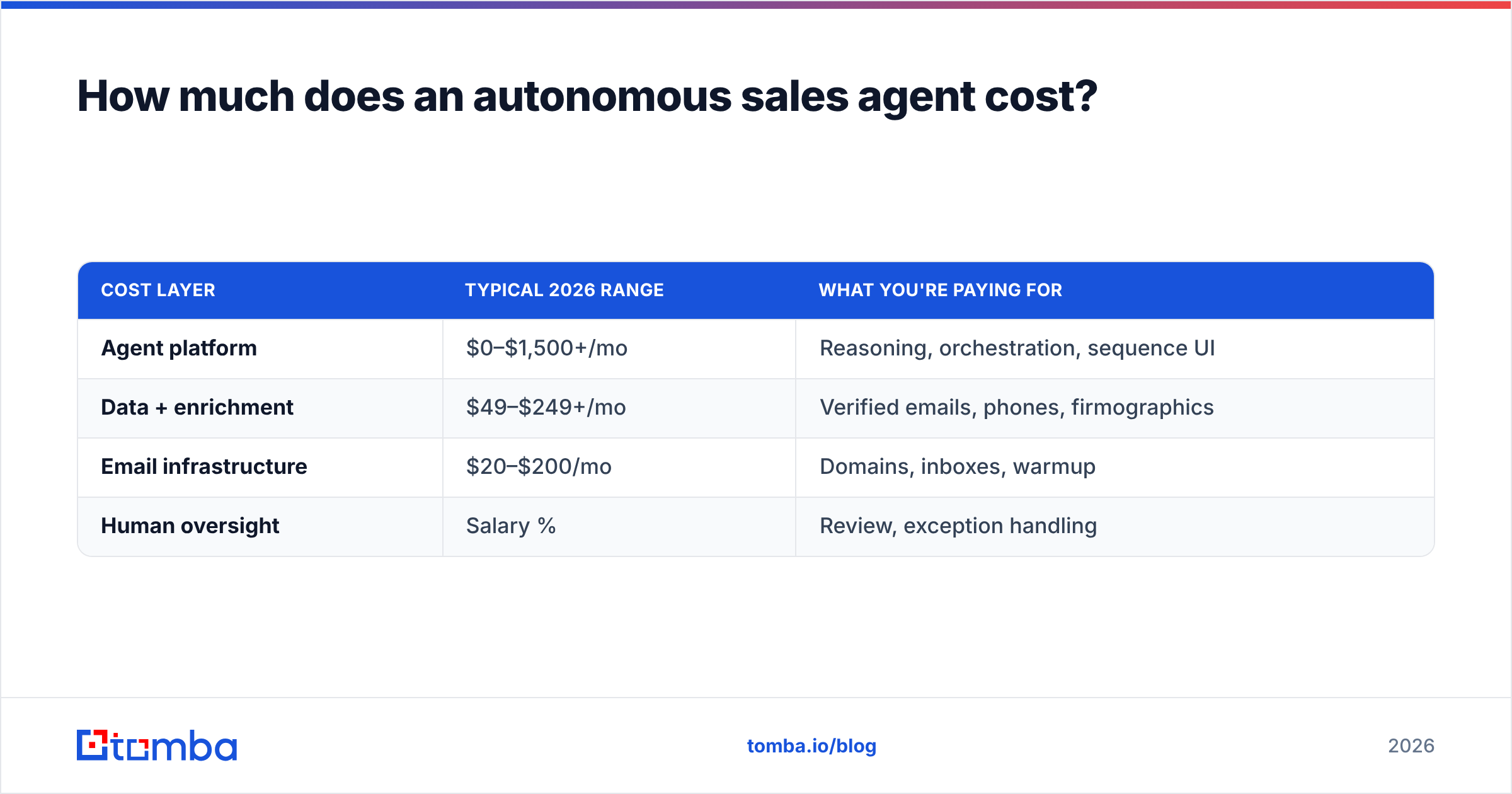
Pricing splits into two buckets: the agent/orchestration platform and the data and verification that feed it. Many buyers price the first and forget the second, then wonder why results are thin.
| Cost layer | Typical 2026 range | What you're paying for |
|---|---|---|
| Agent platform | $0–$1,500+/mo | Reasoning, orchestration, sequence UI |
| Data + enrichment | $49–$249+/mo | Verified emails, phones, firmographics |
| Email infrastructure | $20–$200/mo | Domains, inboxes, warmup |
| Human oversight | Salary % | Review, exception handling |
For the data layer specifically, a credible email-finding and verification source doesn't need to be expensive. Tomba pricing runs a Free tier at 25 searches/month, then Starter at $49/mo, Growth at $99/mo, and Pro at $249/mo — and exposes a email finder API so an agent can call find-and-verify programmatically inside its loop. The point isn't that data is the biggest line item; it's that under-investing here is the most common reason agent deployments underperform. You can check independent reviews of any tool on g2.com before committing.
What should you look for in an autonomous sales agent stack?#
A short checklist to separate real agentic tooling from rebranded automation:
- API-first data access — the agent must be able to find, verify, and enrich contacts via API, not a manual export. A bulk email finder and programmatic verification are table stakes.
- Native verification in the loop — sending without a verify step is a non-starter at scale.
- Transparent decision logs — you can see why the agent took each action.
- Granular guardrails — per-segment send limits, suppression lists, tone controls.
- CRM write-back — actions sync to your CRM so reps and agents share one source of truth.
- Human-in-the-loop checkpoints — configurable approval gates by risk level.
If a platform can't show you its decision logs, you don't have an autonomous agent — you have an opaque automation you can't audit.
Will autonomous agents replace SDRs?#
No — they'll reshape the role. The closer analogy is the spreadsheet and the accountant. Spreadsheets didn't eliminate accountants; they killed the manual ledger work and pushed accountants up into analysis and advice. Autonomous sales agents are doing the same to the SDR motion: the manual prospecting, list-scrubbing, and first-touch grind moves to the agent, while the human moves up into discovery calls, objection handling, and relationship work that no model can fake.
The teams winning in 2026 aren't the ones replacing reps with agents. They're the ones pairing a small number of skilled reps with agents that handle the volume — and feeding both with clean, verified data. The bottleneck was never sending capacity. It was always good targets, reached reliably.
The bottom line#
An autonomous sales agent is a real, useful technology in 2026 — as long as you treat it as a supervised L2–L3 system, constrain its scope, and obsess over the data and deliverability that feed it. The model is the easy part now. The hard part is making sure every contact it acts on is real, current, and verified.
That's the layer to get right first. Start your agent's tool stack with the Tomba Email Finder — find professional email addresses by domain, name, or company, verify them in the same flow, and wire it into your agent via API. Spin up the free tier, point it at one narrow motion, and let the data prove itself before you scale the autonomy.
// get started
Find, verify and enrich your first contacts today
Start on the free plan with 25 searches a month, then scale when your team is ready.
Free plan · No credit card required · GDPR & CCPA
// about the author