Autonomous SDR Software in 2026: A Practical Buyer's Guide
Autonomous SDR software promises to research, write, and send outbound on autopilot. Here's what it actually does in 2026, where it breaks, and how to buy.
TL;DR
- Autonomous SDR software uses AI agents to handle the repetitive parts of outbound prospecting — list building, research, copywriting, sending, and reply triage — with minimal human input.
- It is not a replacement for a sales team in 2026. It is a force multiplier that fails loudly when the underlying contact data is wrong.
- The biggest hidden cost is bad data: an autonomous agent emailing stale or fabricated addresses burns your domain reputation faster than any human could.
- Pricing ranges from roughly $50/mo for data-and-sending tooling to $1,000+/mo for full agent platforms like Artisan or 11x.
- The smartest 2026 stack pairs an autonomous workflow with a verified data source so the agent acts on real, deliverable contacts.
What is autonomous SDR software?#
Autonomous SDR software is a category of AI tools that automate the work a Sales Development Representative normally does by hand: finding accounts, identifying the right contacts, researching them, writing personalized messages, sending across email and LinkedIn, and routing replies. Think of it as cruise control for outbound — you still set the destination and watch the road, but the system handles the steady-state driving.
The "autonomous" label is doing a lot of heavy lifting in marketing copy this year. In practice, tools sit on a spectrum. On one end you have assisted automation: sequencers and AI writers that speed up a human rep. On the other end you have agentic platforms branded as "AI SDRs" or "digital workers" that claim to run an entire pipeline-generation motion with a human only approving the occasional edge case.
What unites them is a loop: source a list → enrich and research → generate copy → send → learn from replies → repeat. Every vendor in the space is selling some version of that loop. The differences are in how much you trust the machine at each step, and — more importantly — how clean the data feeding the loop actually is.
How does an autonomous SDR agent actually work?#
Under the hood, most 2026 platforms chain together the same components. Understanding the pipeline tells you exactly where each tool is strong and where it leaks.
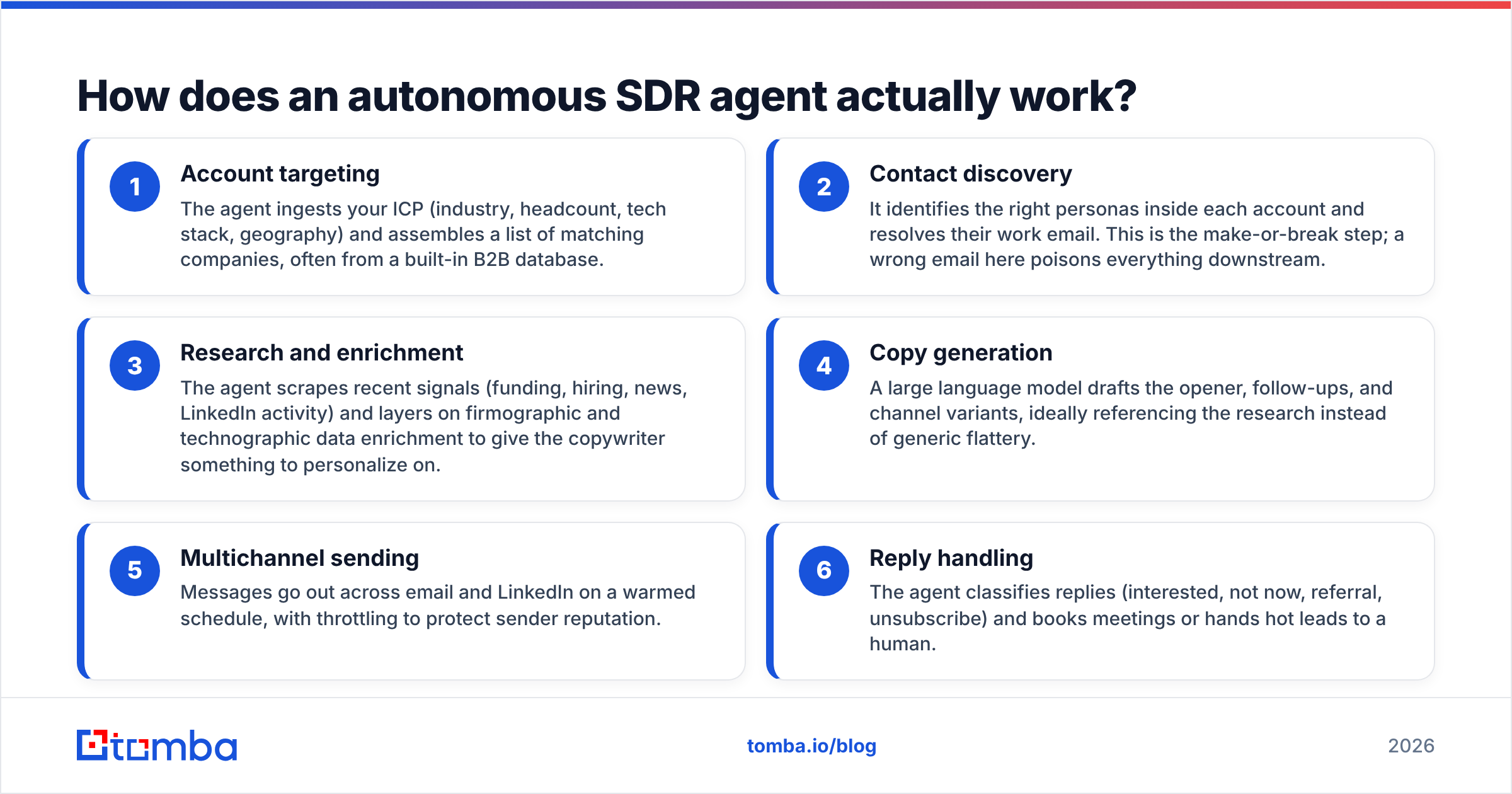
- Account targeting — The agent ingests your ICP (industry, headcount, tech stack, geography) and assembles a list of matching companies, often from a built-in B2B database.
- Contact discovery — It identifies the right personas inside each account and resolves their work email. This is the make-or-break step; a wrong email here poisons everything downstream.
- Research and enrichment — The agent scrapes recent signals (funding, hiring, news, LinkedIn activity) and layers on firmographic and technographic data enrichment to give the copywriter something to personalize on.
- Copy generation — A large language model drafts the opener, follow-ups, and channel variants, ideally referencing the research instead of generic flattery.
- Multichannel sending — Messages go out across email and LinkedIn on a warmed schedule, with throttling to protect sender reputation.
- Reply handling — The agent classifies replies (interested, not now, referral, unsubscribe) and books meetings or hands hot leads to a human.
The chain is only as strong as its weakest link, and in nearly every post-mortem I've seen, the weak link is step 2. An eloquent, well-researched email sent to an address that bounces is worse than useless — it actively damages your email deliverability.
Is autonomous SDR software better than hiring human SDRs?#
Short answer: not yet, and probably not as a straight swap. The honest framing is "different tool for different jobs," not "robot beats human."
Autonomous software wins on volume, consistency, cost per touch, and tirelessness. It does not get demotivated, it works nights, and it scales from 50 to 5,000 contacts without a hiring cycle. Where it still loses is judgment — reading a nuanced reply, navigating a complex multi-stakeholder deal, knowing when a clever-but-risky angle is worth trying.
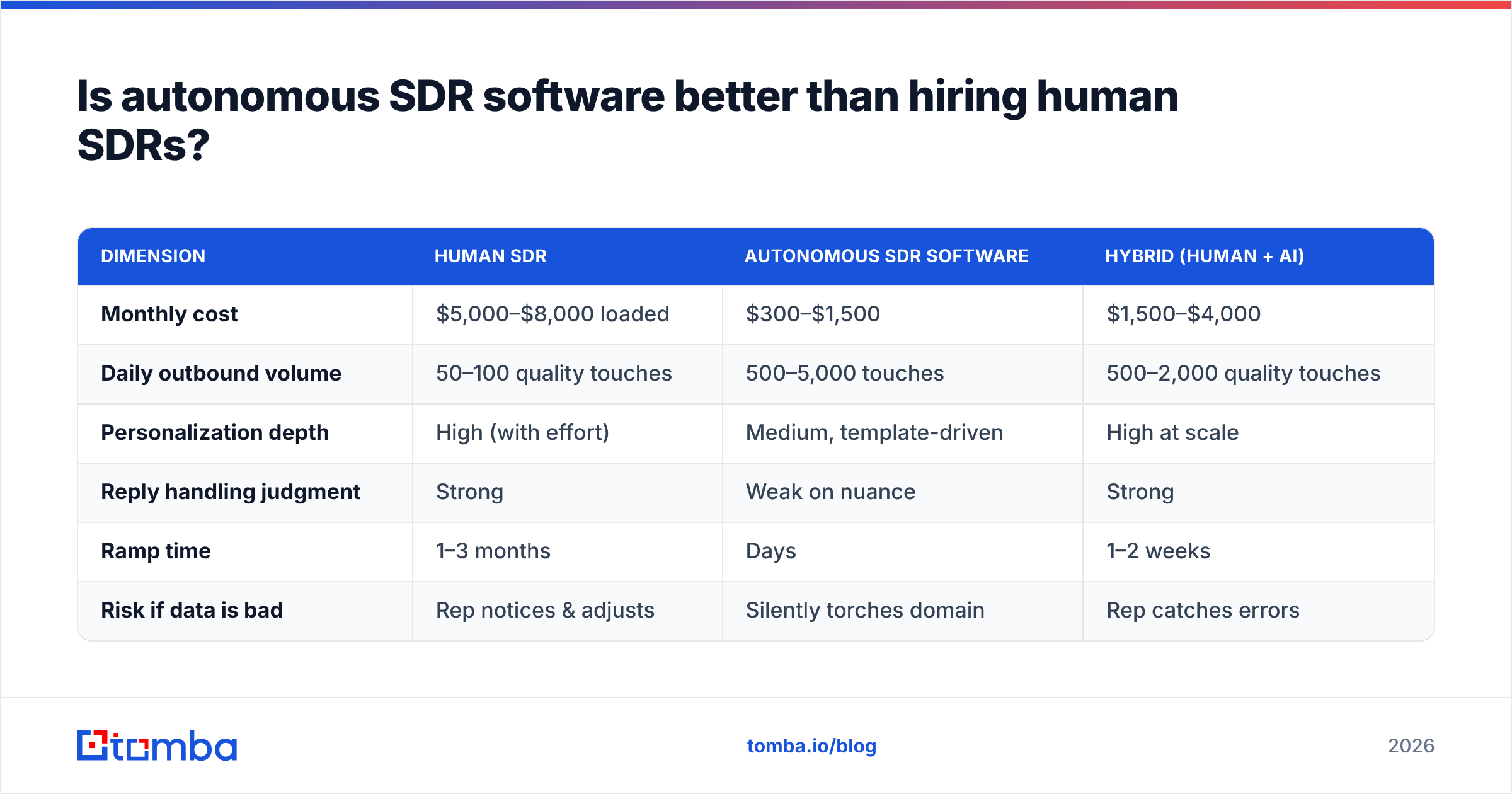
Here is the comparison most buyers actually need:
| Dimension | Human SDR | Autonomous SDR software | Hybrid (human + AI) |
|---|---|---|---|
| Monthly cost | $5,000–$8,000 loaded | $300–$1,500 | $1,500–$4,000 |
| Daily outbound volume | 50–100 quality touches | 500–5,000 touches | 500–2,000 quality touches |
| Personalization depth | High (with effort) | Medium, template-driven | High at scale |
| Reply handling judgment | Strong | Weak on nuance | Strong |
| Ramp time | 1–3 months | Days | 1–2 weeks |
| Risk if data is bad | Rep notices & adjusts | Silently torches domain | Rep catches errors |
The pattern that wins in 2026 is the right-hand column. Let the agent do the grinding — sourcing, first drafts, sending cadence — and keep a human in the loop for reply judgment and account strategy. That keeps the volume advantage while capping the downside of a fully unattended machine making confident mistakes.
Which autonomous SDR tools lead the market in 2026?#
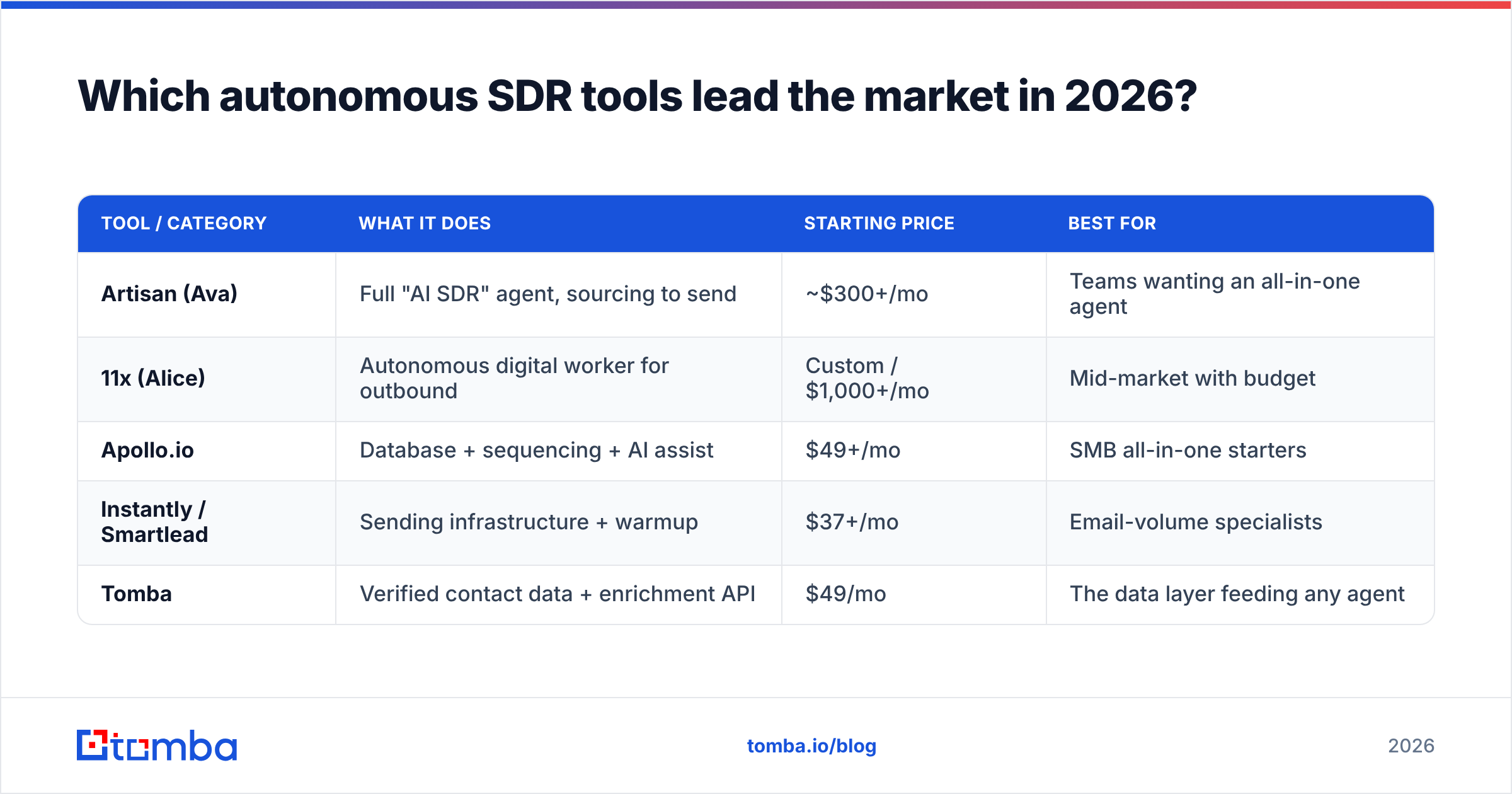
The market splits into three buckets: full agentic platforms, AI-augmented sequencers, and the data layer that every one of them depends on. No single vendor owns all three well, which is why most real stacks combine them.
| Tool / category | What it does | Starting price | Best for |
|---|---|---|---|
| Artisan (Ava) | Full "AI SDR" agent, sourcing to send | ~$300+/mo | Teams wanting an all-in-one agent |
| 11x (Alice) | Autonomous digital worker for outbound | Custom / $1,000+/mo | Mid-market with budget |
| Apollo.io | Database + sequencing + AI assist | $49+/mo | SMB all-in-one starters |
| Instantly / Smartlead | Sending infrastructure + warmup | $37+/mo | Email-volume specialists |
| Tomba | Verified contact data + enrichment API | $49/mo | The data layer feeding any agent |
A few honest caveats. The flashy agent platforms (Artisan, 11x) demo beautifully but live and die on the contact data you feed them; several teams report that the "autonomous" results only match the demo once they bolt on a dedicated verification source. Apollo bundles data and sending but its database quality varies by region and seniority. The sending tools are excellent at deliverability mechanics but bring no data of their own. If you want a deeper look at how the pure-data vendors stack up, the Apollo alternative breakdown is a useful neutral reference, as is the independent review pool on G2's sales intelligence category.
Why does data quality decide whether autonomous SDR software works?#
Because an autonomous agent removes the human safety check that used to catch bad data — so garbage in becomes garbage sent, at scale, automatically.
When a human rep gets a bounced email, they notice, pause, and fix the list. An autonomous system, unless explicitly designed otherwise, just keeps firing. Send 2,000 emails where 18% bounce and you don't get 2,000 imperfect attempts — you get a flagged domain, throttled inboxes, and a sender reputation hole that takes weeks to climb out of. The autonomy that was supposed to save you time becomes the thing that quietly destroys your channel.
This is why the unglamorous data layer matters more than the agent's prompt engineering. Before a single message goes out, the contacts should be:
- Found accurately — real, current work emails resolved from name and domain, not guessed patterns. A proper email finder returns a confidence score, not a hopeful permutation.
- Verified for deliverability — every address run through an email verifier to strip invalids, traps, and risky catch-alls before sending.
- Enriched with real signals — so the AI copy references something true, not a hallucinated detail.
Vendors like HubSpot have published repeatedly on how list hygiene drives deliverability and reply rates; their guidance on email bounce rates is worth reading before you turn any agent loose. The takeaway is the same everywhere: the model is not your bottleneck. The data is.
What should you look for when buying autonomous SDR software?#
Evaluate on the boring fundamentals, not the demo magic. Here is a buyer checklist that separates tools that hold up from tools that look good on a sales call.
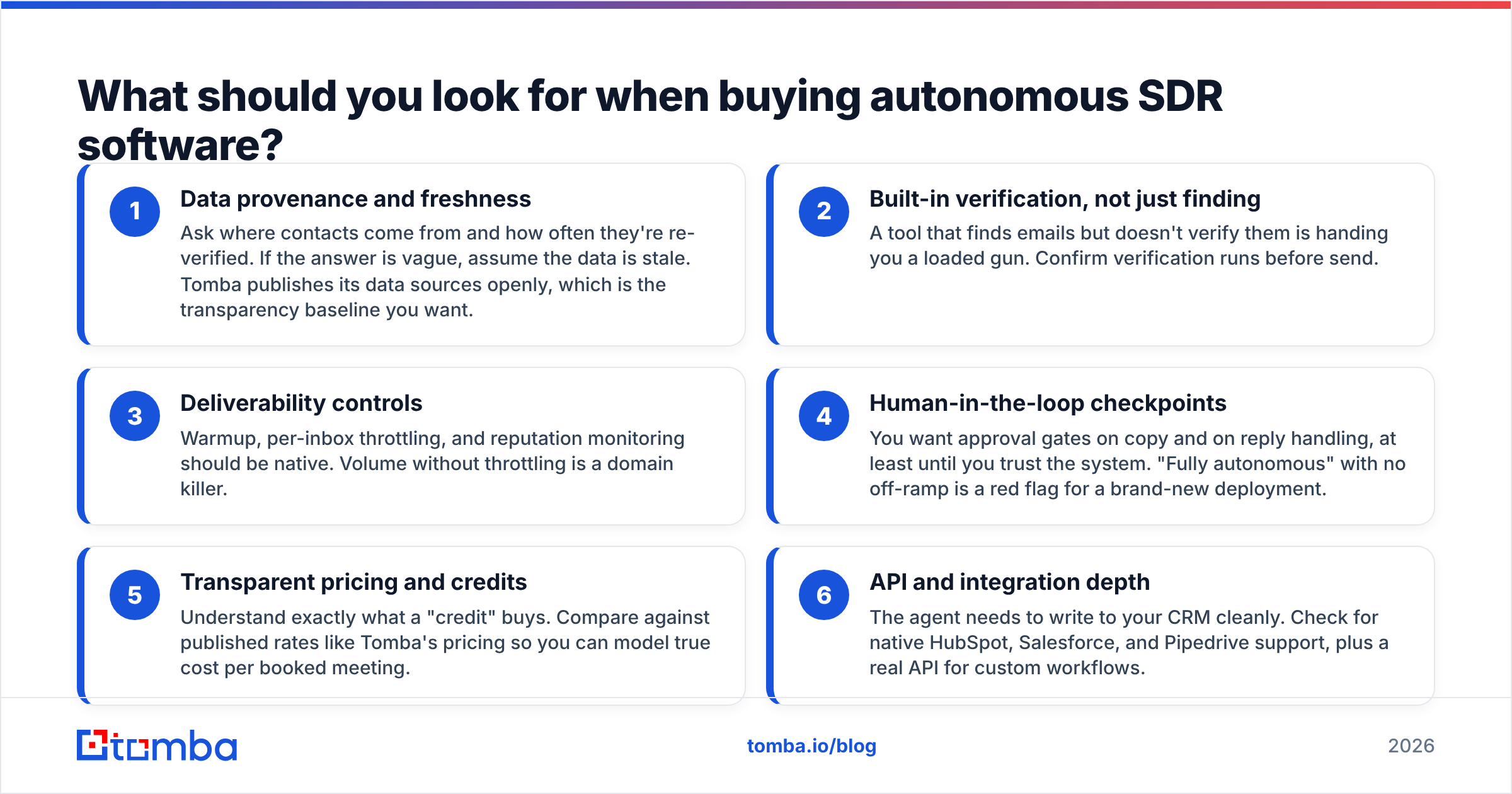
- Data provenance and freshness — Ask where contacts come from and how often they're re-verified. If the answer is vague, assume the data is stale. Tomba publishes its data sources openly, which is the transparency baseline you want.
- Built-in verification, not just finding — A tool that finds emails but doesn't verify them is handing you a loaded gun. Confirm verification runs before send.
- Deliverability controls — Warmup, per-inbox throttling, and reputation monitoring should be native. Volume without throttling is a domain killer.
- Human-in-the-loop checkpoints — You want approval gates on copy and on reply handling, at least until you trust the system. "Fully autonomous" with no off-ramp is a red flag for a brand-new deployment.
- Transparent pricing and credits — Understand exactly what a "credit" buys. Compare against published rates like Tomba's pricing so you can model true cost per booked meeting.
- API and integration depth — The agent needs to write to your CRM cleanly. Check for native HubSpot, Salesforce, and Pipedrive support, plus a real API for custom workflows.
If a vendor scores well on automation but poorly on items 1 and 2, walk away or plan to bolt a dedicated data source onto it. That bolt-on is almost always cheaper than the deliverability damage of going without.
How do you build a practical autonomous SDR stack in 2026?#
The most reliable architecture this year is modular: a sending-and-orchestration layer, an intelligence layer, and a verified-data layer underneath both. You can buy a single platform that claims all three, but you'll usually get better results — and better economics — by pairing a capable agent or sequencer with a dedicated data provider.
A field-tested setup looks like this:
- Data layer: A verified contact source with domain search and bulk verification to feed clean, deliverable contacts into everything above it.
- Orchestration layer: A sequencer or agent platform that handles cadence, multichannel sending, and warmup.
- Intelligence layer: The LLM-driven research and copy generation, grounded in the enrichment data so it personalizes on facts.
- Connective tissue: A Tomba API or native integration so enrichment and verification happen inside your existing CRM and automation flows rather than as a manual export-import dance.
This separation is deliberate. When the autonomous agent inevitably needs tuning, you can swap or upgrade one layer without rebuilding the whole machine. And because the data layer is independent, you can verify and enrich contacts for any tool you adopt next — the investment doesn't get stranded.
Will autonomous SDRs replace sales teams?#
No — and the vendors quietly know it. The realistic 2026 outcome is that autonomous software absorbs the mechanical 60–70% of SDR work (list building, research drafts, first-touch sending, reply sorting) while humans move up the stack into strategy, complex conversations, and closing. The headcount math changes; the need for human judgment doesn't disappear.
The teams getting real ROI treat autonomy as leverage on a clean foundation, not as a magic pipeline button. They obsess over data quality, keep a human reviewing the agent's decisions early on, and measure cost per booked meeting rather than raw send volume. The ones getting burned bought the "set it and forget it" pitch, fed the agent unverified lists, and watched their domain reputation crater within a month.
The bottom line#
Autonomous SDR software is genuinely useful in 2026 — but only as good as the contacts it acts on. The agent is the engine; verified data is the fuel. Get the fuel wrong and the better engine just crashes faster.
Before you wire up any AI SDR platform, build the data layer first. Use the Tomba Email Finder to resolve accurate, confidence-scored work emails by name or domain, verify them so your autonomous agent only ever sends to real, deliverable inboxes, and enrich them so your AI copy personalizes on facts instead of guesses. Start free with 25 searches a month, then scale on the Starter plan at $49/mo when your outbound engine is ready to run. Feed your agent clean data, and the autonomy finally works the way the demo promised.
// get started
Find, verify and enrich your first contacts today
Start on the free plan with 25 searches a month, then scale when your team is ready.
Free plan · No credit card required · GDPR & CCPA
// about the author