Best Avaya Alternatives in 2026: Top UCaaS & Contact Center Picks
Avaya's licensing is heavy and its cloud migration is messy. Here are the 8 best Avaya alternatives in 2026, compared on price, features, and fit.
If you are reading this, you have probably already opened an Avaya renewal quote and felt your stomach drop. Maybe a maintenance contract jumped again, or a "cloud migration" path turned out to mean re-buying half your stack. Either way, you want out, and you want a shortlist that does not waste your week.
Below is a direct, vendor-by-vendor comparison of the strongest Avaya alternatives in 2026 — what each one is good at, what it costs, and which kind of team should actually pick it.
TL;DR — The Short Version#
- Best all-round Avaya alternative: RingCentral — mature UCaaS, deep integrations, predictable per-seat pricing.
- Best for contact centers: 8x8 or Genesys Cloud — strong omnichannel routing and analytics without on-prem hardware.
- Best for AI-first calling teams: Dialpad — real-time transcription and coaching baked in.
- Best value for SMBs: Nextiva or Zoom Phone — clean pricing, fast setup, low admin overhead.
- Don't forget the data layer: A new phone system is only as good as the contacts you feed it — pair any of these with a reliable phone finder and verified B2B records.
Why Are Teams Looking for Avaya Alternatives in 2026?#
Avaya is not a bad platform. It is a legacy platform carrying legacy baggage, and that is a different problem.
Think of it like keeping a 20-year-old diesel generator running in the basement. It still produces power, but every part is proprietary, the technician who understands it is retiring, and the fuel keeps getting more expensive. At some point you stop repairing and you switch to grid power.
The most common reasons buyers leave Avaya:
- Licensing complexity. Per-feature, per-port, and per-agent licensing makes true cost hard to predict, and audits get painful.
- Cloud migration friction. Moving from on-prem Aura or IP Office to Avaya's cloud often means re-architecting, not flipping a switch.
- Hardware lock-in. Proprietary handsets and gateways tie you to one vendor's roadmap.
- Slower innovation cadence. Cloud-native rivals ship AI transcription, sentiment, and omnichannel routing faster.
- Post-bankruptcy uncertainty. Avaya restructured in recent years, and many buyers simply want a vendor with a cleaner balance sheet. You can read Avaya's own positioning and judge fit for yourself.
What Should an Avaya Alternative Actually Replace?#
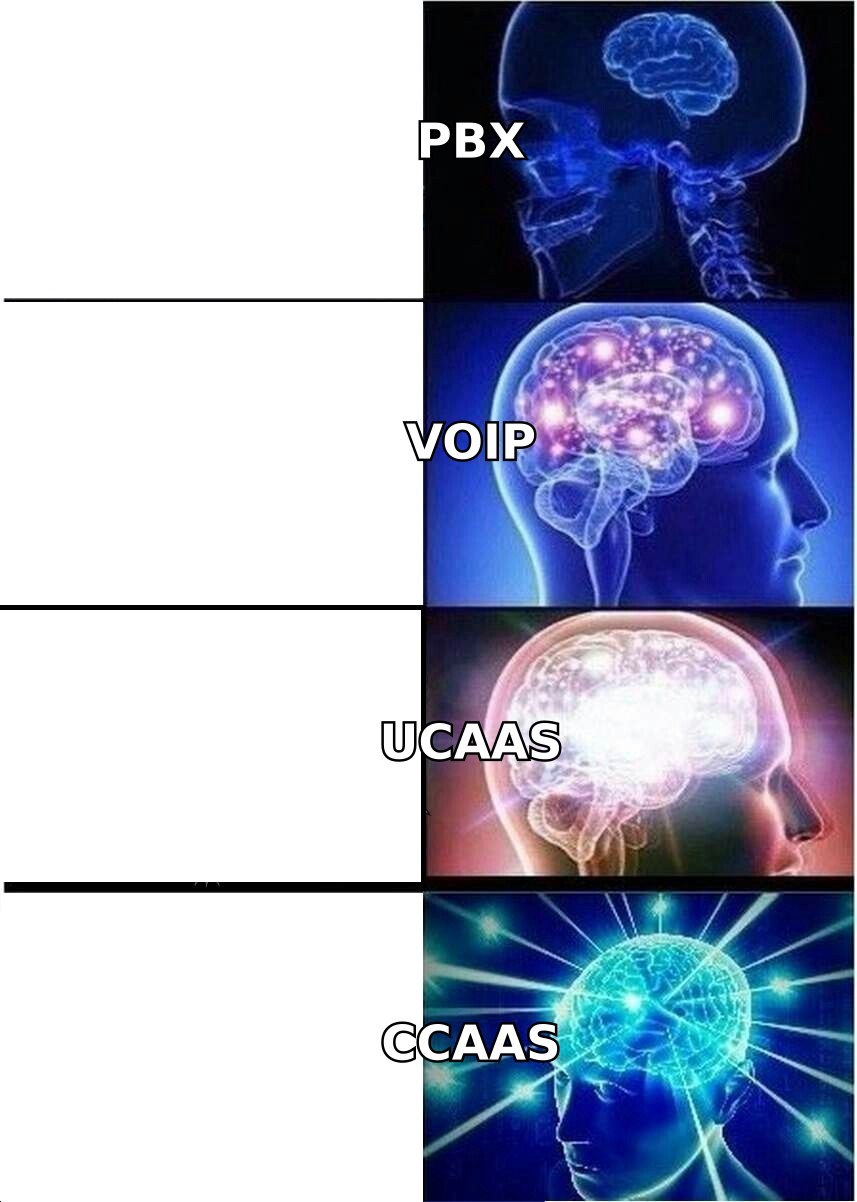
Avaya spans two product worlds, and your replacement depends on which one you run:
- UCaaS (Unified Communications as a Service) — internal calling, video, messaging, presence. Replaces IP Office / Aura for general business phones.
- CCaaS (Contact Center as a Service) — inbound/outbound queues, IVR, agent routing, omnichannel, workforce management. Replaces Avaya Call Center / Elite.
Map your needs before you shop. Here is the core decision framework:
- You mostly need internal phones + video. Prioritize UCaaS leaders: RingCentral, Zoom Phone, Nextiva, Dialpad.
- You run a revenue or support call center. Prioritize CCaaS depth: 8x8, Genesys Cloud, Five9.
- You want one vendor for both. RingCentral and 8x8 ship combined UCaaS + CCaaS suites.
- You are AI-curious. Dialpad and Genesys lead on native AI features today.
- You are price-sensitive and small. Zoom Phone and Nextiva win on simplicity and cost.
Which Avaya Alternatives Are Best in 2026?#
Here is the head-to-head comparison. Prices are entry business tiers and move with seat count and contract length, so treat them as directional, not quotes.
| Platform | Best for | Entry price (per user/mo) | UCaaS | CCaaS | Native AI |
|---|---|---|---|---|---|
| RingCentral | All-round UCaaS + CC | ~$30 | Yes | Add-on | Yes |
| 8x8 | Combined UC + contact center | ~$28 | Yes | Yes | Yes |
| Dialpad | AI-first calling teams | ~$27 | Yes | Add-on | Yes (core) |
| Nextiva | SMB simplicity | ~$25 | Yes | Add-on | Partial |
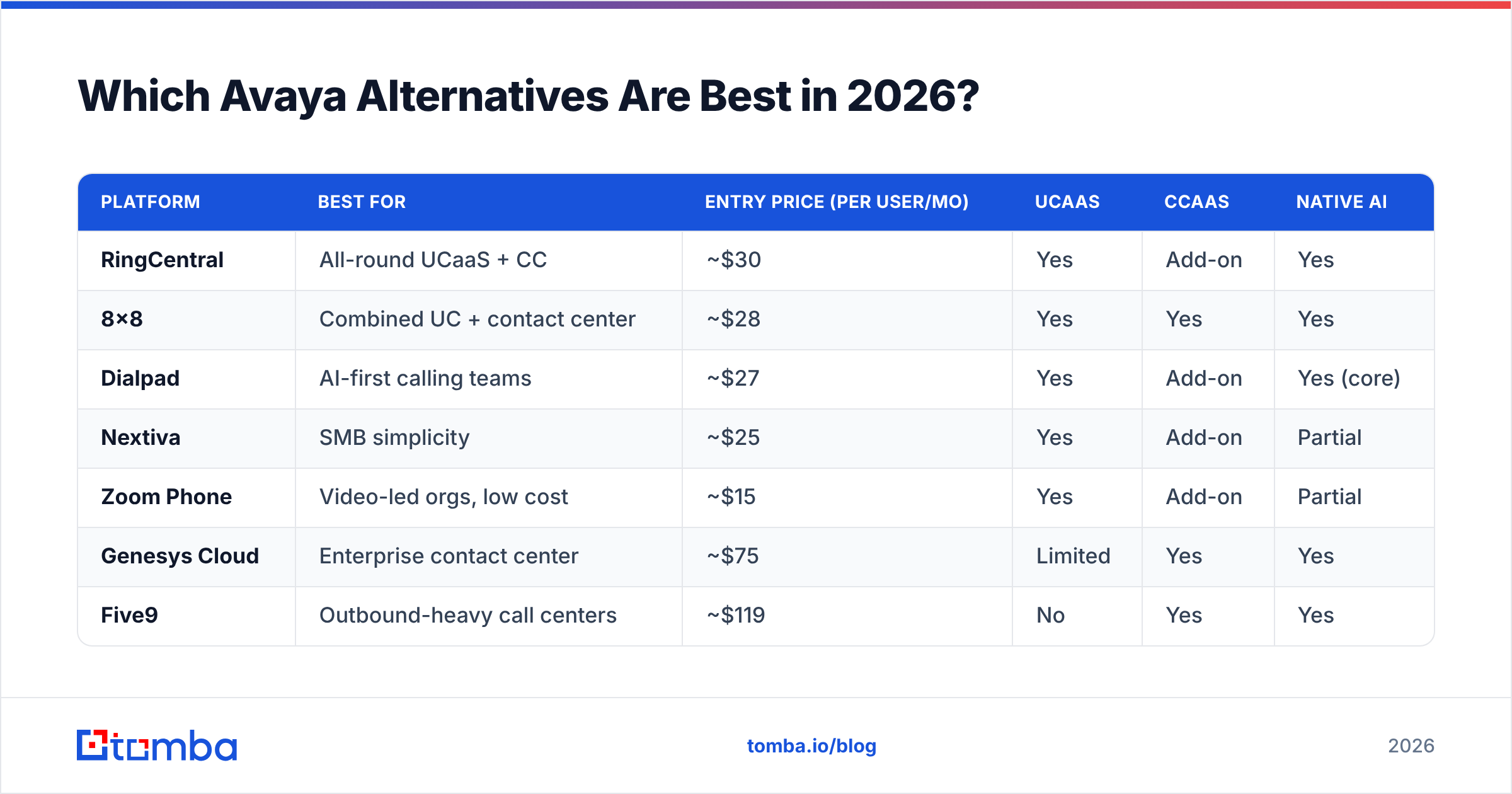
Zoom Phone | Video-led orgs, low cost | ~$15 | Yes | Add-on | Partial | | Genesys Cloud | Enterprise contact center | ~$75 | Limited | Yes | Yes | | Five9 | Outbound-heavy call centers | ~$119 | No | Yes | Yes | | Microsoft Teams Phone | Microsoft 365 shops | ~$8 (add-on) | Yes | Via partners | Partial |
RingCentral — The Safe Default#
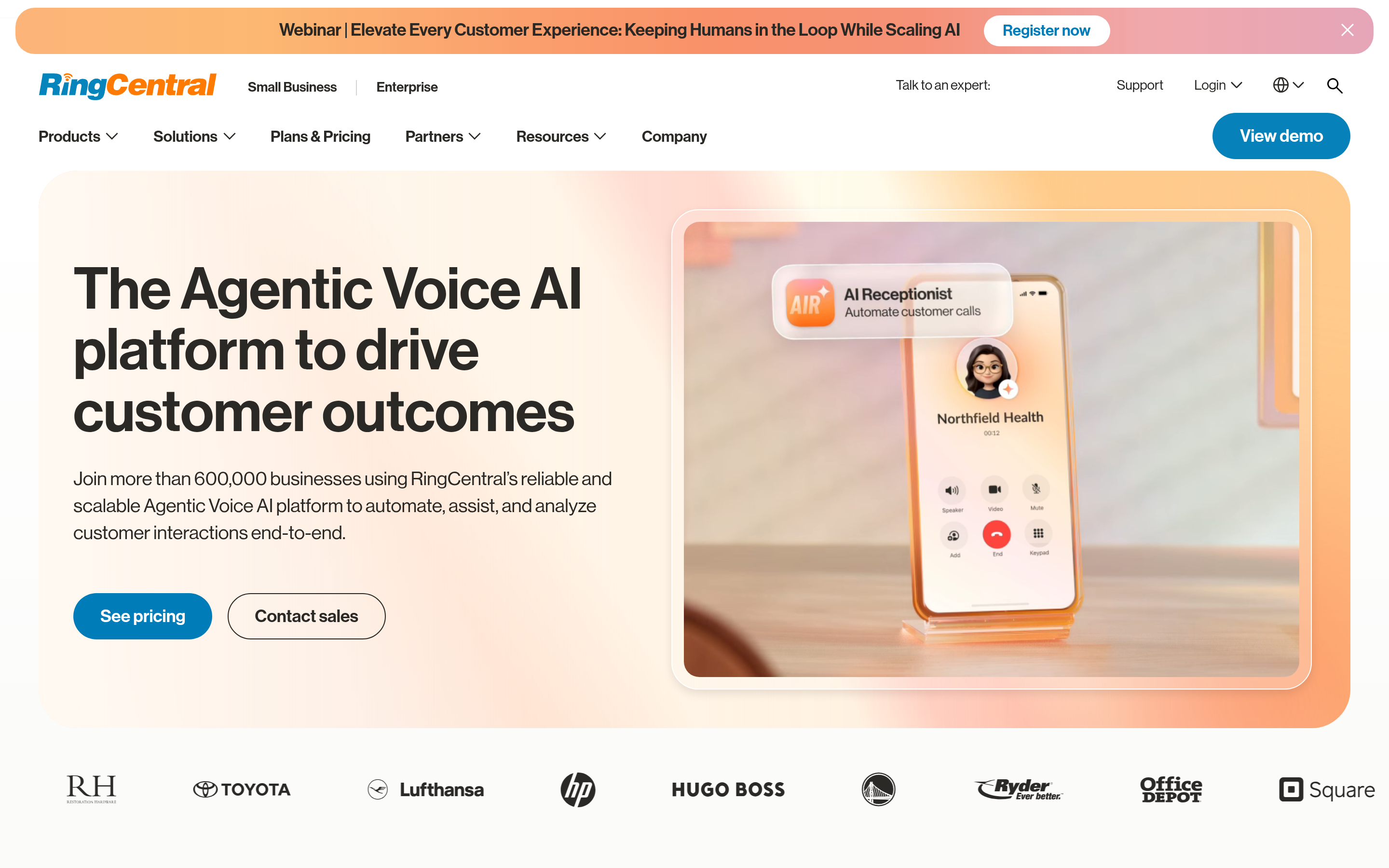
RingCentral is the closest thing to a no-regret swap from Avaya. It does UCaaS extremely well, has one of the deepest integration libraries in the category (Salesforce, HubSpot, Microsoft, Google), and its contact center add-on covers most mid-market needs. Per-seat pricing is predictable, which by itself solves one of Avaya's biggest pain points. See independent reviews on G2 before committing.
Trade-off: advanced contact center features sit behind higher tiers, so total cost climbs for large CC deployments.
8x8 — One Platform for UC and Contact Center#
8x8 is the strongest pick if you genuinely need both unified comms and a real contact center under one roof and one bill. Global calling plans are generous, and omnichannel routing is solid for the price.
Trade-off: the admin console has a learning curve, and some reporting feels dated compared to Genesys.
Dialpad — Built Around AI#
Dialpad treats AI as the product, not a bolt-on. Live transcription, real-time agent coaching, and call summaries are core, not premium upsells. For sales and support teams that live on the phone, this changes daily workflow.
Trade-off: contact center depth is lighter than Genesys or Five9 for very large operations.
Nextiva and Zoom Phone — The SMB Sweet Spot#
If you have 5–100 employees and want to stop thinking about phones, Nextiva and Zoom Phone are the pragmatic answers. Zoom Phone in particular is cheap and obvious if your team already lives in Zoom meetings. Nextiva leans into a unified customer-experience pitch with good support.
Trade-off: both are UCaaS-first; heavy contact-center teams will outgrow the entry tiers.
Genesys Cloud and Five9 — Enterprise Contact Center#
For large, complex contact centers, Genesys Cloud and Five9 are the serious Avaya CCaaS replacements. Genesys leads on omnichannel and workforce engagement; Five9 is a powerhouse for outbound dialing.
Trade-off: price and implementation complexity are real. These are projects, not signups.
How Do You Migrate Off Avaya Without Breaking Things?#
Conclusion first: migrate in waves, never in one weekend. A phased cutover is the difference between a smooth transition and a Monday morning where no calls connect.
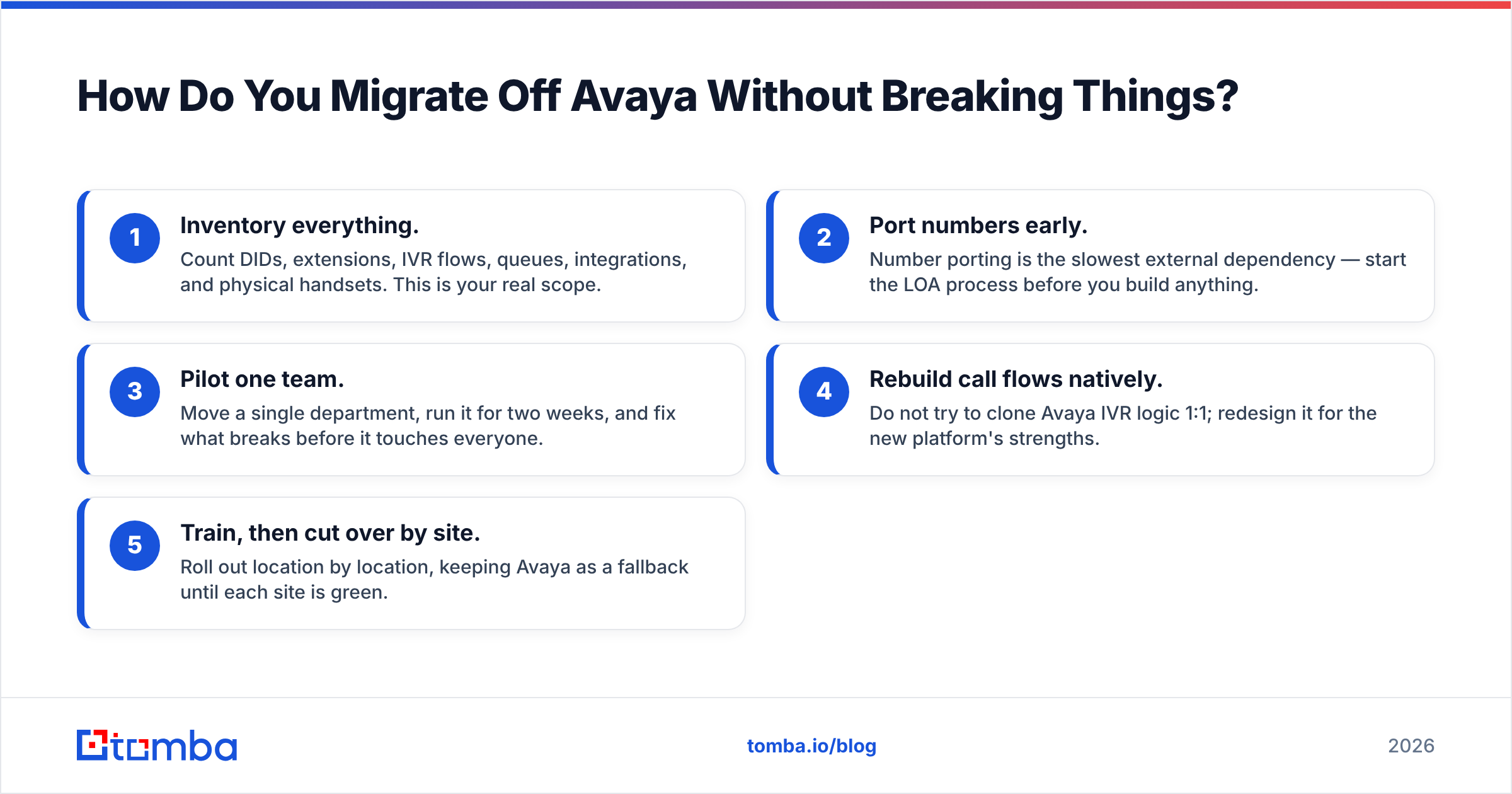
A practical sequence:
- Inventory everything. Count DIDs, extensions, IVR flows, queues, integrations, and physical handsets. This is your real scope.
- Port numbers early. Number porting is the slowest external dependency — start the LOA process before you build anything.
- Pilot one team. Move a single department, run it for two weeks, and fix what breaks before it touches everyone.
- Rebuild call flows natively. Do not try to clone Avaya IVR logic 1:1; redesign it for the new platform's strengths.
- Train, then cut over by site. Roll out location by location, keeping Avaya as a fallback until each site is green.
A switch is also the ideal moment to clean your contact data. Phone systems do not fix bad numbers — they just dial them faster. Before you import, run your list through a phone validator and enrich missing fields with data enrichment so your new platform starts with clean records instead of inheriting a decade of decay.
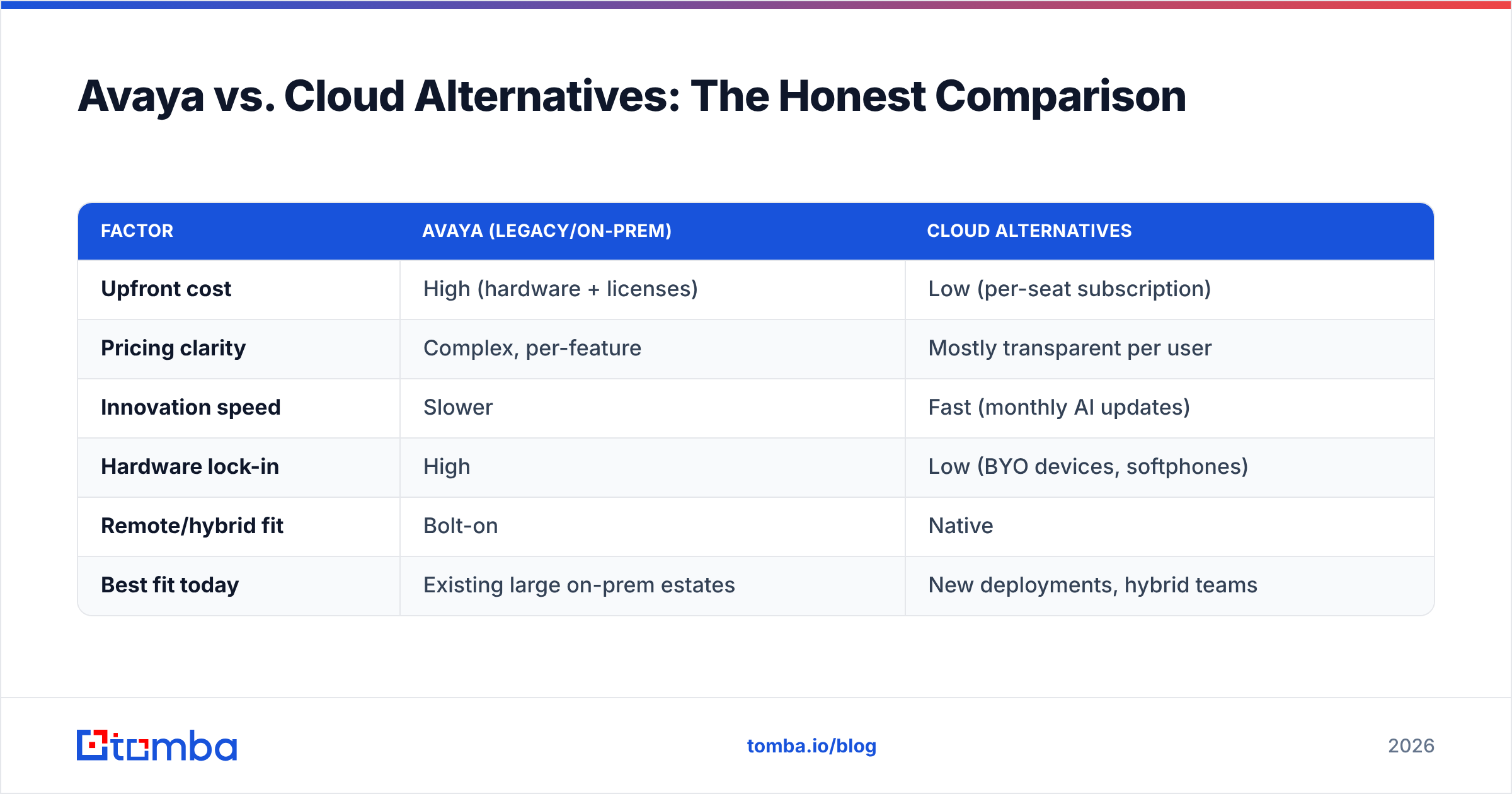
Avaya vs. Cloud Alternatives: The Honest Comparison#
| Factor | Avaya (legacy/on-prem) | Cloud alternatives |
|---|---|---|
| Upfront cost | High (hardware + licenses) | Low (per-seat subscription) |
| Pricing clarity | Complex, per-feature | Mostly transparent per user |
| Innovation speed | Slower | Fast (monthly AI updates) |
| Hardware lock-in | High | Low (BYO devices, softphones) |
| Remote/hybrid fit | Bolt-on | Native |
| Best fit today | Existing large on-prem estates | New deployments, hybrid teams |
The pattern is clear. If you already own a fully depreciated Avaya estate that works, there is no emergency. If you are buying, renewing, or scaling, the cloud-native options win on cost predictability, hybrid support, and AI velocity. Forrester and Gartner both track this UCaaS/CCaaS shift if you want analyst backing for the internal business case.
What Do These Tools Cost Compared to Your Data Stack?#
A phone platform is only one line item in your outbound budget. The other line item is the data that decides who you call.
You can buy the best dialer on earth, but if your reps are dialing wrong numbers and unverified contacts, your connect rate stays flat. That is where the communications budget and the data budget meet. Tomba sits on the data side of that equation — not as a phone system, but as the layer that fills it with accurate, verified contact information.
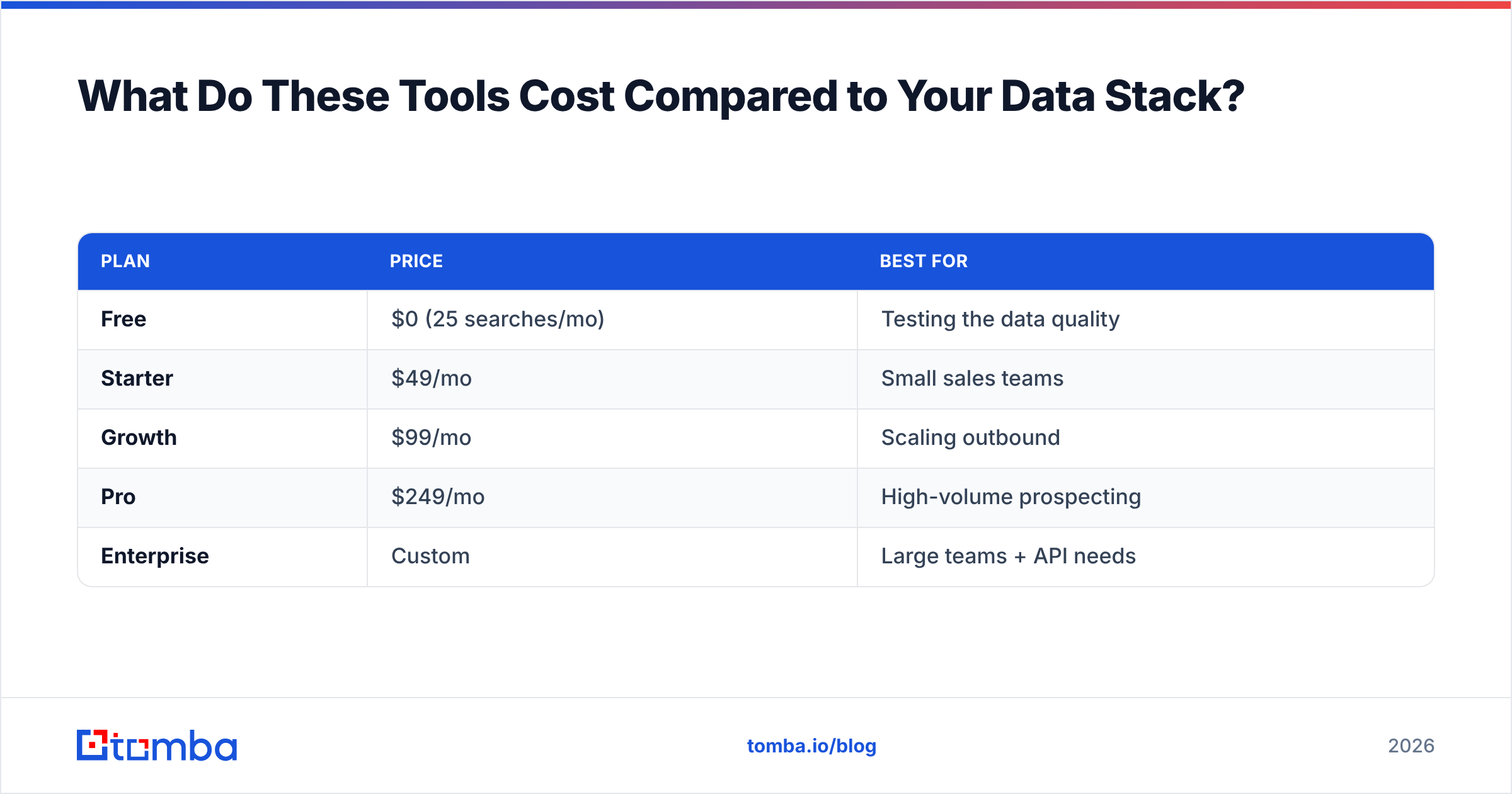
Tomba's pricing is straightforward and far simpler than legacy telecom licensing:
| Plan | Price | Best for |
|---|---|---|
| Free | $0 (25 searches/mo) | Testing the data quality |
| Starter | $49/mo | Small sales teams |
| Growth | $99/mo | Scaling outbound |
| Pro | $249/mo | High-volume prospecting |
| Enterprise | Custom | Large teams + API needs |
You can see full Tomba pricing for current limits. The point is not that Tomba replaces Avaya — it does not. The point is that a phone-system migration is the perfect time to also fix the contact data feeding it, using a verified B2B database instead of stale CRM exports.
How to Choose the Right Avaya Alternative#
Run this quick filter and you will land on a shortlist of two or three in under ten minutes:
- Under 100 employees, UCaaS only: Zoom Phone or Nextiva.
- Mid-market, want UC + light contact center: RingCentral.
- Need serious omnichannel contact center: 8x8 or Genesys Cloud.
- Outbound dialing at scale: Five9.
- AI-driven sales/support calls: Dialpad.
- Heavy Microsoft 365 shop: Teams Phone with a CCaaS partner.
Then validate with a pilot. Every vendor on this list offers trials or proof-of-concept programs — use them with your real call flows, not a demo script.
Frequently Asked Questions#
Is there a free Avaya alternative? Not for full business phone service — voice connectivity has real carrier costs. However, Zoom Phone and Microsoft Teams Phone offer the lowest entry points, and most vendors provide free trials. For the contact-data side, Tomba offers a free tier with 25 searches per month.
What is the easiest Avaya alternative to set up? For SMBs, Zoom Phone and Nextiva are the fastest to deploy. For larger contact centers, expect a structured implementation regardless of vendor.
Can I keep my existing phone numbers? Yes. All major alternatives support number porting from Avaya. Start the porting process early, as it is the slowest part of any migration.
Do I need a separate tool for contact data? If you do outbound sales or proactive support, yes. Your phone platform dials numbers; it does not find or verify them. Tools like the phone finder handle that layer.
The Bottom Line#
There is no single "best" Avaya alternative — there is the best one for your size, your contact-center depth, and your appetite for AI. RingCentral is the safe all-rounder, 8x8 wins on combined UC and contact center, Dialpad leads on AI, and Zoom Phone or Nextiva are the value SMB picks.
Whichever platform you pick, give it good fuel. Start your migration with clean, verified contact data so your new system improves connect rates instead of just dialing bad numbers faster. Spin up the Tomba Email Finder and pair it with verified phone data to make sure every contact you load into your new phone system is one worth calling.
Ready to find emails that actually work?
Join 150,000+ professionals who stopped guessing and started sending. Free credits on signup — no credit card required.
Get the Tomba newsletter
Practical outbound tactics and product updates — once every two weeks.
About the author