Avaya vs RingCentral 2026: Full Business Phone Comparison
Avaya vs RingCentral compared on pricing, cloud architecture, reliability, and sales-team fit so you can pick the right business phone system in 2026.
TL;DR
- RingCentral is a cloud-native UCaaS platform that is faster to deploy, priced per user per month, and built for distributed sales and support teams.
- Avaya comes from the on-premise PBX world and now sells cloud (Avaya Experience Platform) plus hybrid setups — strong for large contact centers with existing Avaya hardware.
- Pick RingCentral if you want predictable subscription pricing, fast rollout, and modern integrations. Pick Avaya if you run a big regulated contact center or need to protect a legacy hardware investment.
- Neither tool finds or verifies the contacts you dial — that is a separate data problem your phone system does not solve.
- Below: a full feature-and-price table, reliability notes, and where each fits a real sales motion.
What are Avaya and RingCentral?#
Short answer: both are business communication platforms, but they come from opposite ends of the market. Avaya built its reputation on enterprise on-premise PBX (private branch exchange) hardware and contact-center software. RingCentral was born in the cloud as a UCaaS (Unified Communications as a Service) provider — phone, video, SMS, and team messaging delivered over the internet with no rack of equipment in your closet.
That origin story explains almost every difference you will run into. Avaya optimizes for the large, often regulated enterprise that already owns Avaya gear and wants continuity. RingCentral optimizes for the company that wants to switch on phones for a 20- or 200-person team this week without a hardware project.
Here is the practical split of what each platform leans into:
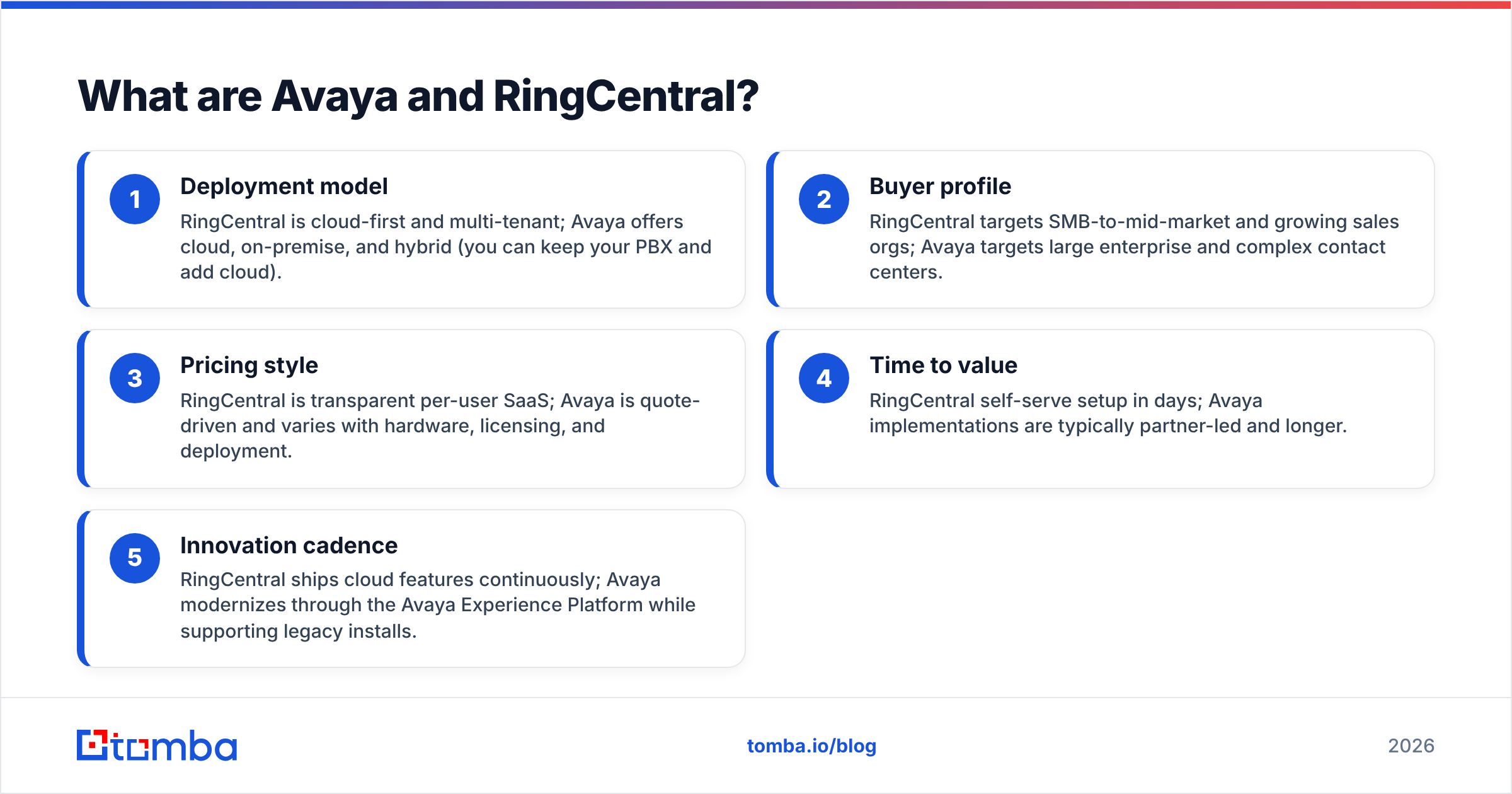
- Deployment model — RingCentral is cloud-first and multi-tenant; Avaya offers cloud, on-premise, and hybrid (you can keep your PBX and add cloud).
- Buyer profile — RingCentral targets SMB-to-mid-market and growing sales orgs; Avaya targets large enterprise and complex contact centers.
- Pricing style — RingCentral is transparent per-user SaaS; Avaya is quote-driven and varies with hardware, licensing, and deployment.
- Time to value — RingCentral self-serve setup in days; Avaya implementations are typically partner-led and longer.
- Innovation cadence — RingCentral ships cloud features continuously; Avaya modernizes through the Avaya Experience Platform while supporting legacy installs.
How do Avaya and RingCentral compare on features and price?#
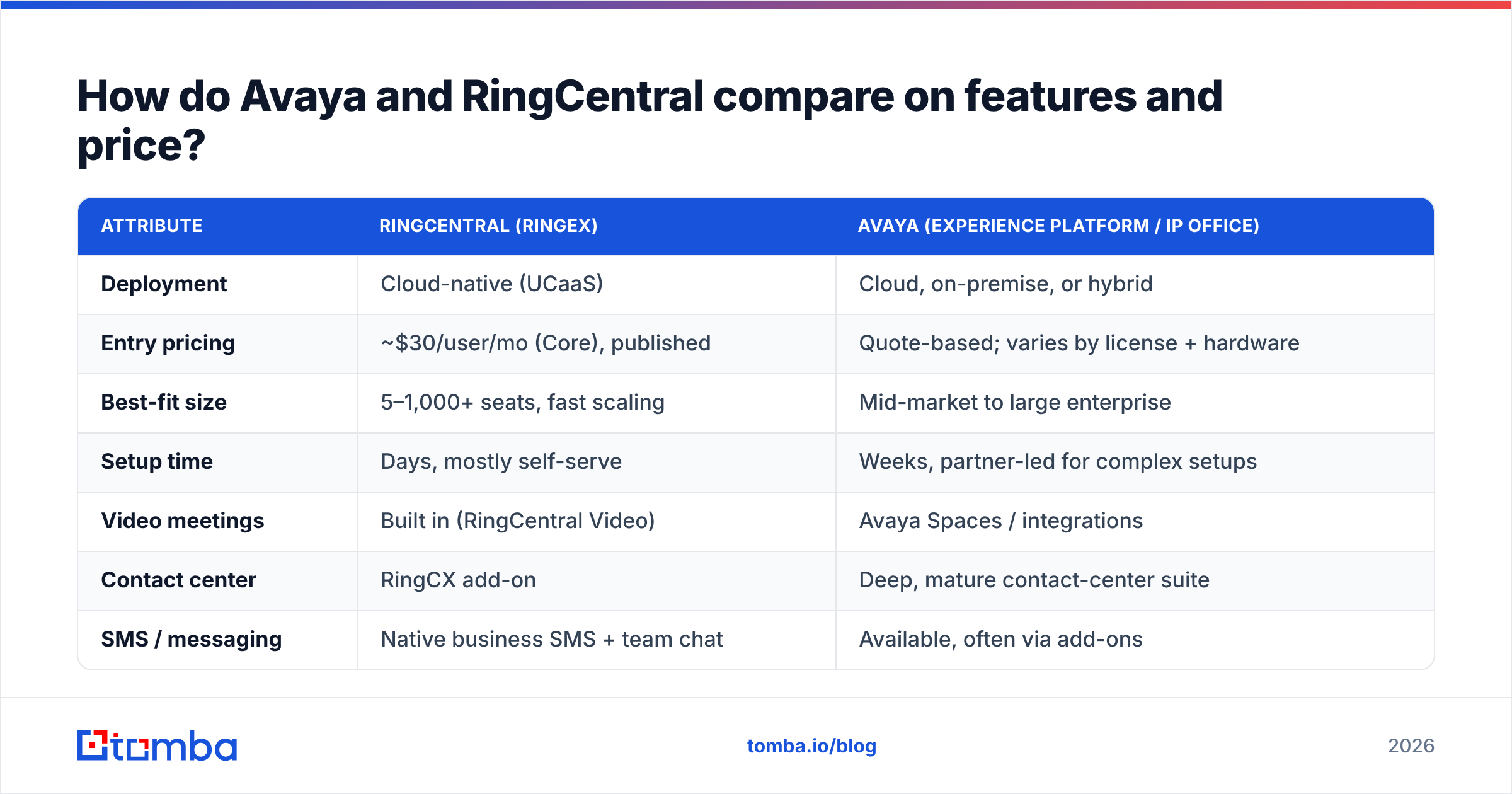
The table below is the fastest way to see the trade-offs. Prices are list/published starting points for 2026 and shift with seat count, contracts, and contact-center add-ons — always confirm a quote for your volume.
| Attribute | RingCentral (RingEX) | Avaya (Experience Platform / IP Office) |
|---|---|---|
| Deployment | Cloud-native (UCaaS) | Cloud, on-premise, or hybrid |
| Entry pricing | ~$30/user/mo (Core), published | Quote-based; varies by license + hardware |
| Best-fit size | 5–1,000+ seats, fast scaling | Mid-market to large enterprise |
| Setup time | Days, mostly self-serve | Weeks, partner-led for complex setups |
| Video meetings | Built in (RingCentral Video) | Avaya Spaces / integrations |
| Contact center | RingCX add-on | Deep, mature contact-center suite |
| SMS / messaging | Native business SMS + team chat | Available, often via add-ons |
| Published uptime SLA | 99.999% target | Depends on deployment + support tier |
| Integrations | 300+ (Salesforce, HubSpot, MS Teams) | Strong enterprise integrations, CPaaS APIs |
| Contract flexibility | Monthly or annual | Typically longer enterprise contracts |
A few honest caveats. Avaya's quote-driven model is not automatically more expensive — at large scale with existing hardware it can be competitive, and the contact-center depth is genuinely strong. RingCentral's per-seat pricing is easier to forecast but adds up fast if you bolt on video, contact center (RingCX), and add-on numbers across hundreds of users. Read both vendors' own pages: RingCentral and Avaya, and cross-check buyer reviews on G2 before committing.
Is RingCentral better than Avaya for reliability and cloud?#
For most teams that want pure cloud, RingCentral has the simpler reliability story; for hybrid enterprises, Avaya's flexibility wins. RingCentral publishes a 99.999% uptime target and runs a fully managed multi-tenant cloud, so patching, scaling, and failover are the vendor's problem, not yours. That is the whole point of UCaaS: you trade control for operational simplicity.
Avaya's reliability depends heavily on how you deploy. An on-premise Avaya system's uptime is a function of your own data center, power, and redundancy. The Avaya Experience Platform (the cloud offering) moves that burden to Avaya, but many existing Avaya customers run hybrid — and hybrid means you own part of the resilience equation.
So the real question is not "which is more reliable" in the abstract. It is "who do you want responsible for uptime?" If the answer is "the vendor, fully," RingCentral is the cleaner fit. If you have an on-prem investment, strict data-residency rules, or a contact center you cannot risk re-platforming overnight, Avaya's hybrid path is the safer transition. Analyst coverage from firms like Gartner tracks both in the UCaaS and CCaaS Magic Quadrants if you want third-party positioning.
Which one fits a sales or outbound team?#
For a sales team that lives in a CRM and dials all day, RingCentral usually wins on speed and integration depth. The native Salesforce and HubSpot integrations, click-to-dial, call logging, and analytics map cleanly onto an outbound motion. New reps can be provisioned in minutes, and the per-seat model scales with headcount.
Avaya shines when the "sales" team is really a large contact center — high call volume, complex routing, workforce management, omnichannel queues, and compliance recording. If you run hundreds of agents with intricate IVR flows, Avaya's contact-center maturity is hard to match, and that is exactly the use case it was engineered for.
But here is the part both vendors quietly assume you have already solved: the contacts you dial. A phone system routes and records calls. It does not tell you whether the number belongs to the right decision-maker, whether the line is still active, or what that prospect's verified email is for follow-up. That is a data layer that sits upstream of Avaya or RingCentral.
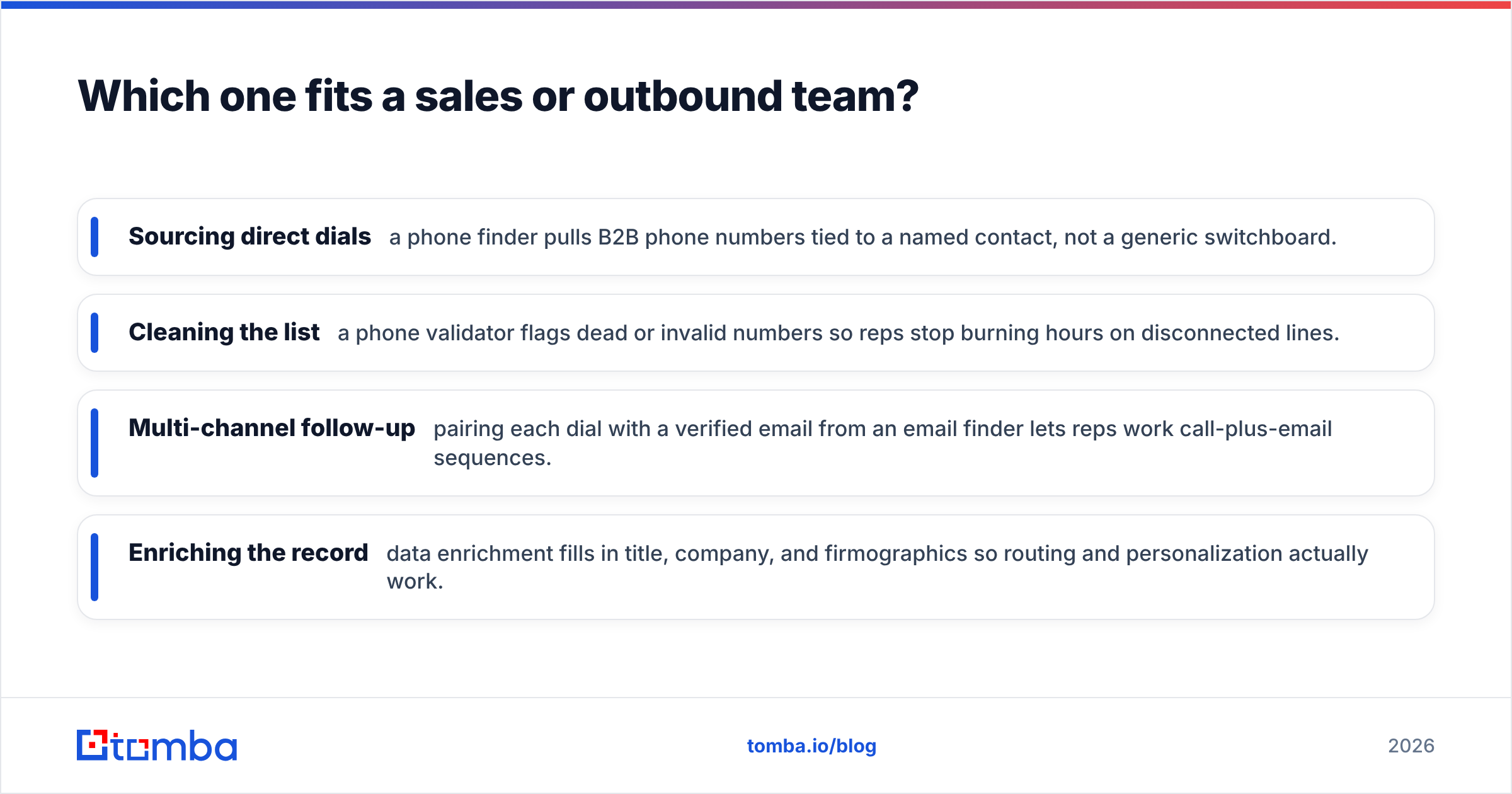
That is where a prospecting data stack matters more than the dial tone. Before a single call connects, you need accurate numbers and emails:
- Sourcing direct dials — a phone finder pulls B2B phone numbers tied to a named contact, not a generic switchboard.
- Cleaning the list — a phone validator flags dead or invalid numbers so reps stop burning hours on disconnected lines.
- Multi-channel follow-up — pairing each dial with a verified email from an email finder lets reps work call-plus-email sequences.
- Enriching the record — data enrichment fills in title, company, and firmographics so routing and personalization actually work.
A great phone platform plus a dirty contact list still produces a low connect rate. The dial tone is necessary but not sufficient.
What are the main pros and cons of each?#
RingCentral pros: transparent per-user pricing, fast self-serve setup, 99.999% uptime target, deep CRM integrations, native video and SMS, monthly contract option. RingCentral cons: add-ons (video tiers, RingCX, extra numbers) inflate the bill at scale, and very large/regulated contact centers may outgrow some configurations.
Avaya pros: mature, deep contact-center features, hybrid and on-prem options for data-residency or legacy needs, strong enterprise support, protects existing Avaya hardware investment. Avaya cons: quote-driven pricing is less transparent, implementations are longer and usually partner-led, and the cloud transition can be complex if you are migrating off old PBX gear.
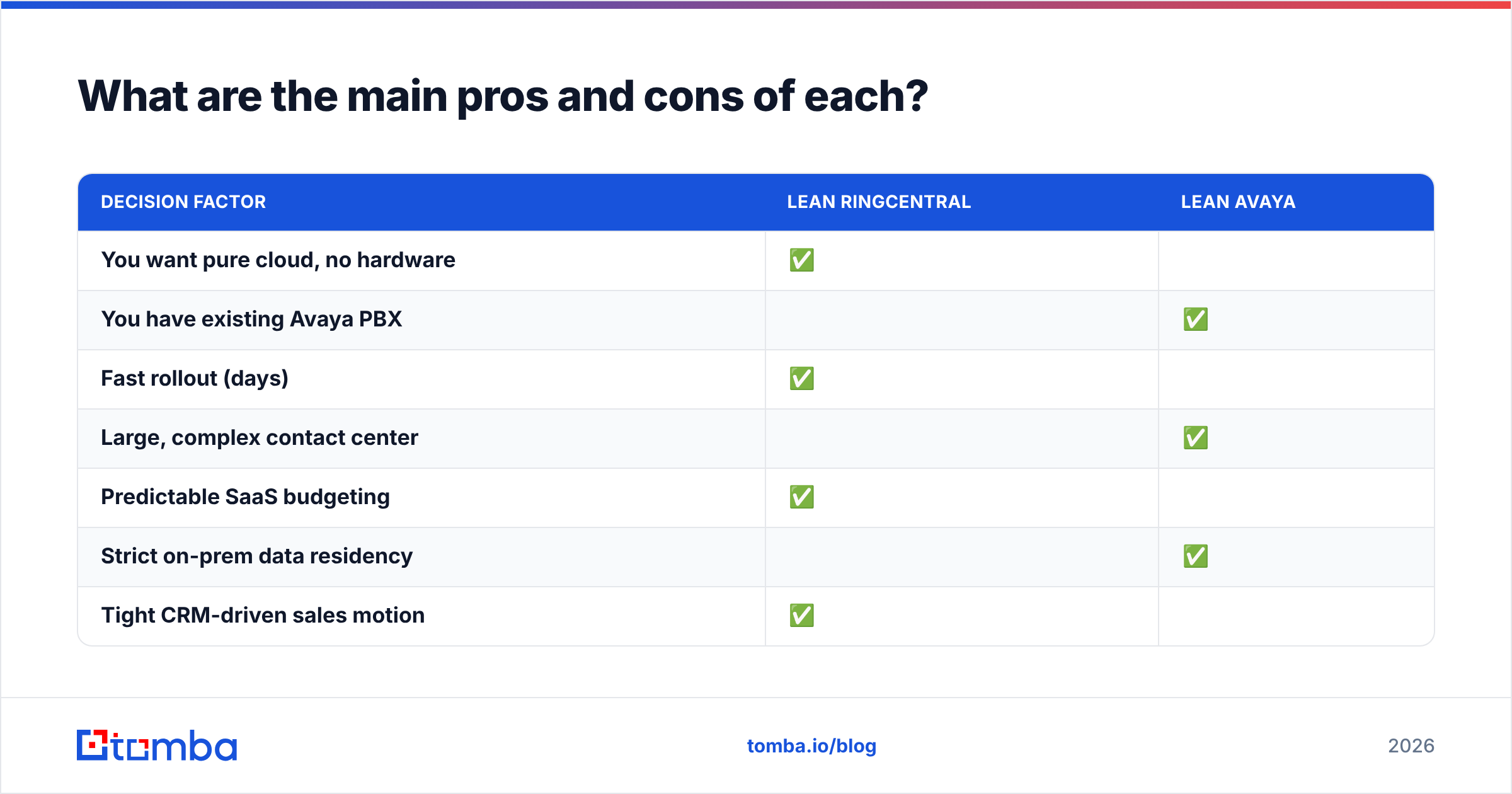
| Decision factor | Lean RingCentral | Lean Avaya |
|---|---|---|
| You want pure cloud, no hardware | ✅ | |
| You have existing Avaya PBX | ✅ | |
| Fast rollout (days) | ✅ | |
| Large, complex contact center | ✅ | |
| Predictable SaaS budgeting | ✅ | |
| Strict on-prem data residency | ✅ | |
| Tight CRM-driven sales motion | ✅ |
How do you choose between Avaya and RingCentral?#
Start with two questions: do you already own Avaya hardware, and how complex is your contact center? If you have no legacy gear and a straightforward sales/support need, RingCentral is the lower-friction, more predictable choice — you can stand it up this week. If you own Avaya infrastructure, run a large regulated contact center, or need on-prem control, Avaya's hybrid path protects your investment and matches your complexity.
Then weigh three more practical factors:
- Total cost at your real seat count. Model RingCentral with the add-ons you will actually use (video tier, RingCX, extra numbers) versus an Avaya quote for the same capability. Compare 3-year totals, not month-one stickers.
- Implementation appetite. Do you have time and a partner for a multi-week Avaya rollout, or do you need phones live now? Time-to-value is a real cost.
- Integration fit. Check that your CRM, helpdesk, and analytics tools are first-class citizens. RingCentral's 300+ integrations are a strength here; confirm Avaya's connectors match your stack.
Whichever you pick, remember the platform only carries the conversation — it does not generate the pipeline. The biggest lever on connect rate and reply rate is the quality of the contact data feeding the dialer and the inbox. Tools that route calls and tools that find and verify the people you call are complementary, not interchangeable. If you want to see how data tooling is priced relative to a phone platform, the Tomba pricing page lays out plans from a free tier (25 searches/mo) up to Pro at $249/mo.
Frequently asked questions#
Is RingCentral cheaper than Avaya? Usually more predictable, not always cheaper. RingCentral publishes per-user pricing starting around $30/user/mo; Avaya is quote-based and can be competitive at enterprise scale with existing hardware. Compare total cost at your seat count and contract length.
Can Avaya run in the cloud like RingCentral? Yes. The Avaya Experience Platform is its cloud offering, and Avaya also supports hybrid and on-premise. RingCentral is cloud-only, which is simpler but less flexible for legacy migrations.
Which is better for a small sales team? RingCentral, in most cases — faster setup, transparent pricing, and tight CRM integrations suit small, fast-moving teams. Avaya's strengths show up at large contact-center scale.
Do these platforms find phone numbers or emails for me? No. Both route and manage communications; neither sources or verifies prospect contact data. That requires a dedicated data tool layered on top.
Bottom line: get the data right before you dial#
Avaya versus RingCentral comes down to cloud simplicity versus enterprise flexibility. RingCentral wins on speed, transparent pricing, and integrations for most growing sales teams; Avaya wins on contact-center depth, hybrid deployment, and protecting existing infrastructure. Choose based on your hardware reality, contact-center complexity, and rollout timeline.
But before you obsess over the dial tone, fix the list. The fastest connect rates come from accurate, verified contacts — not from the phone system alone. Use the Tomba Email Finder to source and verify professional emails by name, company, or domain, then pair every dial with a clean follow-up email. Start free with 25 searches a month and feed your RingCentral or Avaya seats the kind of data that actually converts.
// get started
Find, verify and enrich your first contacts today
Start on the free plan with 25 searches a month, then scale when your team is ready.
Free plan · No credit card required · GDPR & CCPA
// about the author