Average Bounce Rate For Email Campaigns: 2026 Benchmarks
What counts as a healthy bounce rate in 2026, how hard and soft bounces differ, and the exact steps to push your number below 2% before it wrecks your sender reputation.
TL;DR
- The average bounce rate for email campaigns sits around 2% to 5% across industries in 2026; anything consistently above 2% is a warning sign and above 5% puts your sender reputation at real risk.
- Hard bounces (dead or invalid addresses) hurt you far more than soft bounces (temporary issues like full inboxes). Keep hard bounces under 0.5%.
- Mailbox providers like Gmail and Outlook now treat high bounce rates as a spam signal, so a bad number quietly drags down your inbox placement for every recipient.
- The single biggest lever is list hygiene: verifying addresses before you send removes 90%+ of preventable bounces.
- This guide gives you 2026 benchmarks by industry, the math behind the metric, and a repeatable process to get below the danger line.
What is email bounce rate and how is it calculated?#
Your bounce rate is the percentage of emails that never reached the inbox because the receiving server rejected them. Think of it like undeliverable physical mail: you sent 1,000 letters, the post office returned 30 stamped "no such address," and your bounce rate is 3%.
The formula is simple:
Bounce rate = (bounced emails ÷ total emails sent) × 100
Send 10,000 emails, get 250 bounces, and you're at 2.5%. Most email service providers calculate this automatically, but the number only matters if you understand what's driving it — because not all bounces are created equal, and the type of bounce determines how much damage it does to your sender reputation.
A clean list keeps this number low without any effort. A list full of guessed, scraped, or aged addresses inflates it fast — and once mailbox providers notice, the penalty follows you into future campaigns.
What is the average bounce rate for email campaigns in 2026?#
The short answer: aim for under 2%. Across most published benchmarks, the average bounce rate for email campaigns lands between 2% and 5%, but "average" and "healthy" are not the same thing. Plenty of senders sit at the average and still erode their deliverability.
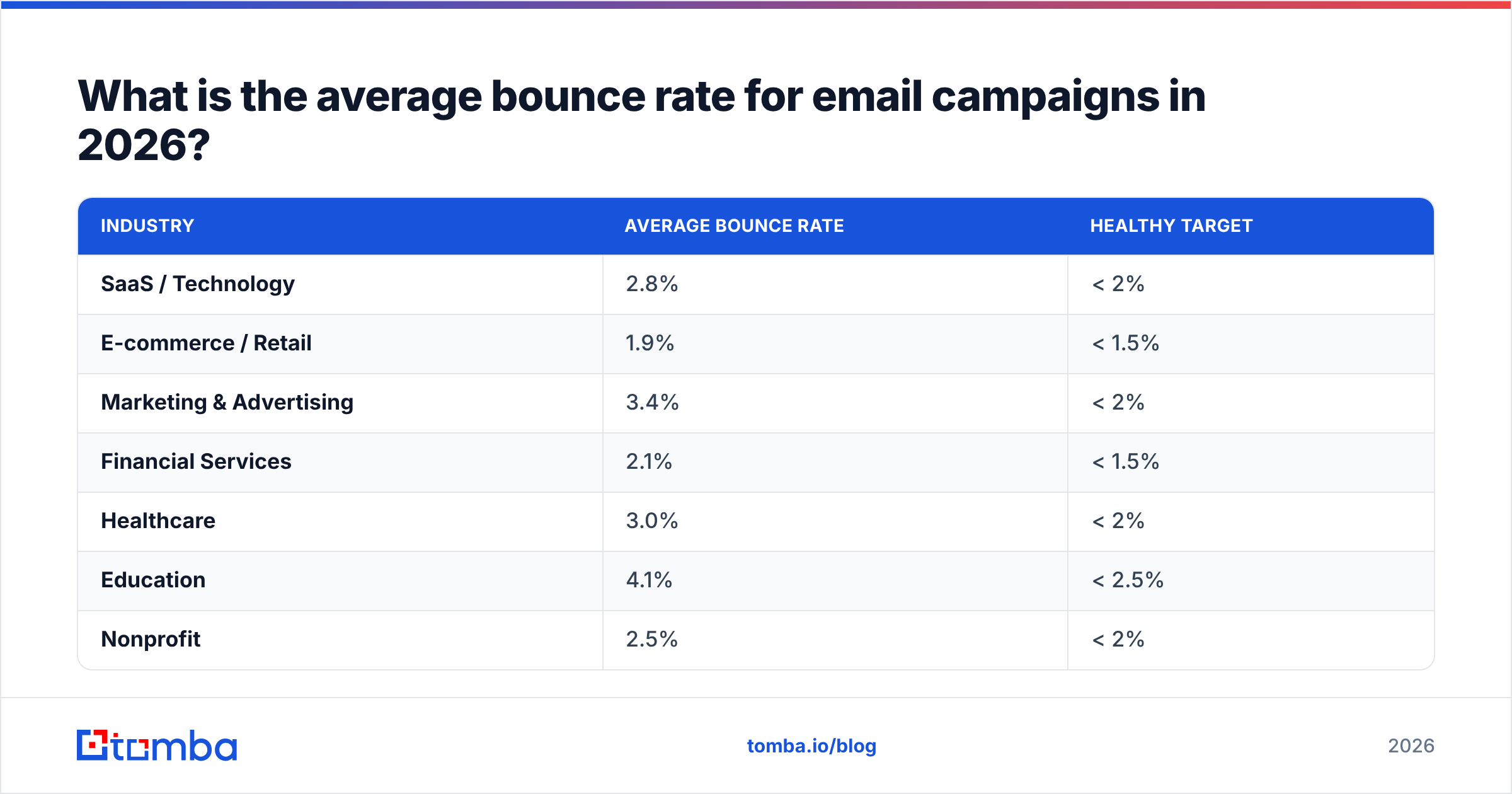
Here's how the numbers break down by industry in 2026. These are blended figures from major ESP benchmark reports and reflect typical opt-in marketing lists, not cold outbound:
| Industry | Average bounce rate | Healthy target |
|---|---|---|
| SaaS / Technology | 2.8% | < 2% |
| E-commerce / Retail | 1.9% | < 1.5% |
| Marketing & Advertising | 3.4% | < 2% |
| Financial Services | 2.1% | < 1.5% |
| Healthcare | 3.0% | < 2% |
| Education | 4.1% | < 2.5% |
| Nonprofit | 2.5% | < 2% |
| Real Estate | 3.7% | < 2.5% |
Two patterns stand out. First, industries with older or partner-sourced lists (education, real estate) run hotter. Second, the healthy target is almost always tighter than the published average — because the average is dragged up by senders who don't clean their lists. You want to be in the bottom quartile, not the middle.
For context, Mailchimp's published benchmarks have shown overall hard-bounce rates near 0.4% and soft bounces near 0.6% for engaged lists — proof that sub-1% is achievable when hygiene is tight.
What's the difference between hard bounces and soft bounces?#
This distinction is the most important thing to understand about bounce rate, because mailbox providers weigh the two completely differently.
A hard bounce is permanent. The address doesn't exist, the domain is dead, or the server has permanently blocked you. There is no retry that fixes it — the address is gone. Hard bounces are the ones that destroy reputation.
A soft bounce is temporary. The mailbox is full, the message is too large, or the server is briefly down. Your ESP typically retries soft bounces for 24–72 hours before giving up.
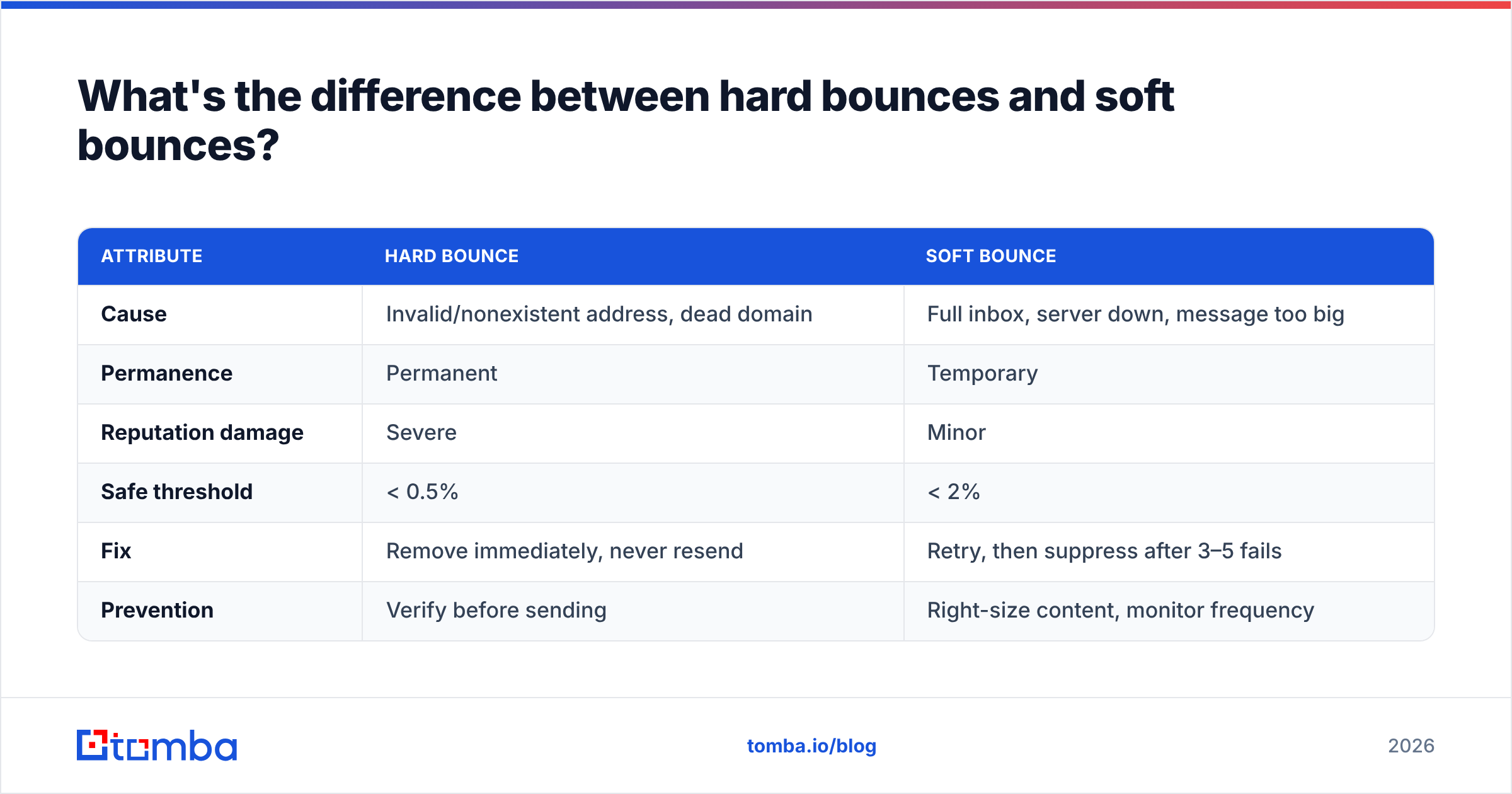
Here's how they compare and what to do about each:
| Attribute | Hard bounce | Soft bounce |
|---|---|---|
| Cause | Invalid/nonexistent address, dead domain | Full inbox, server down, message too big |
| Permanence | Permanent | Temporary |
| Reputation damage | Severe | Minor |
| Safe threshold | < 0.5% | < 2% |
| Fix | Remove immediately, never resend | Retry, then suppress after 3–5 fails |
| Prevention | Verify before sending | Right-size content, monitor frequency |
The rule of thumb: one hard bounce is worth roughly ten soft bounces in terms of how mailbox providers judge you. If your overall bounce rate is 3% but it's almost all soft bounces from a one-day outage, you're probably fine. If it's 3% hard bounces, you have a list-quality emergency.
A quick way to audit this: pull your last campaign report and separate the two categories. If hard bounces exceed 0.5% of total sends, stop and clean before your next send.
Why does a high bounce rate hurt more than just one campaign?#
Because mailbox providers treat bounce rate as a trust signal — and trust compounds.
When Gmail, Outlook, or Yahoo see you repeatedly emailing addresses that don't exist, they conclude one of two things: either you bought a list, or you don't maintain it. Both are hallmarks of spammers. The result is throttling (your mail gets delayed), foldering (you land in spam), and in severe cases blocking (your mail is rejected outright).
The cruel part is that this penalty applies to your good recipients too. A bloated bounce rate means even your most engaged subscribers start seeing your emails in spam. You're not just losing the dead addresses — you're poisoning placement for everyone.
This is why email deliverability experts treat bounce rate as a leading indicator, not a vanity metric. It's the canary in the coal mine: a rising bounce rate today predicts an inbox-placement collapse next month.
Industry resources like Validity's deliverability research consistently link bounce spikes to subsequent reputation drops. The mechanism is the same everywhere — providers reward senders who only mail real, active humans.

How do you lower your average bounce rate?#
You lower bounce rate by fixing the inputs, not by reacting to the outputs. Here are the highest-impact moves, in order of effort-to-payoff:
Verify every address before you send. This is the 80/20. Running your list through an email verifier catches invalid syntax, dead domains, and nonexistent mailboxes before they ever bounce. For large lists, bulk verification processes thousands of addresses in one pass.
Use double opt-in for new subscribers. When someone confirms via a clicked link, you guarantee the address is real and the inbox is monitored. This single change can cut new-subscriber bounces to near zero.
Handle catch-all domains carefully. Catch-all servers accept every address, so a standard verifier can't confirm whether a specific mailbox exists. A dedicated catch-all verifier applies deeper checks so these don't silently inflate your risk.
Suppress repeat soft bouncers. If an address soft-bounces 3–5 times across campaigns, treat it as dead and remove it. Persistent soft bounces are often hard bounces in disguise.
Re-engage or remove dormant contacts. Addresses that haven't opened in 6–12 months are more likely to be abandoned. Run a re-engagement campaign, then prune the non-responders.
Authenticate your domain. Proper SPF, DKIM, and DMARC records won't fix invalid addresses, but they ensure legitimate mail isn't bounced for authentication failures. Confirm your setup with a tool like an SPF checker.
Do the first item alone and most senders see their bounce rate fall below 2% within one campaign cycle. The rest keeps it there.
How does list verification actually prevent bounces?#
Verification works by checking an address against reality before you commit your sender reputation to it. Instead of finding out an address is dead when the server rejects it (a recorded bounce), you find out beforehand and simply don't send.
A quality verification pass runs several layers:
- Syntax check — is the address even formatted correctly?
- Domain/MX check — does the domain exist and accept mail?
- Mailbox check — does this specific inbox exist on the server?
- Risk scoring — is it a disposable address, a role account (
info@,sales@), or a known complainer?
Each layer removes a category of bounce before it can happen. The combined effect is dramatic: a list that would have bounced at 7% can drop to under 1% after a thorough verification pass, with zero damage to your reputation because none of those dead addresses ever received a send.
If you're building lists from scratch rather than cleaning existing ones, sourcing from a verified-at-discovery tool helps too. An email finder that validates addresses at the point of capture means fewer bad records enter your CRM in the first place — prevention beats cleanup. You can see how Tomba's data sources prioritize verified, professionally-sourced addresses over scraped guesses.
What bounce rate is too high, and when should you stop sending?#
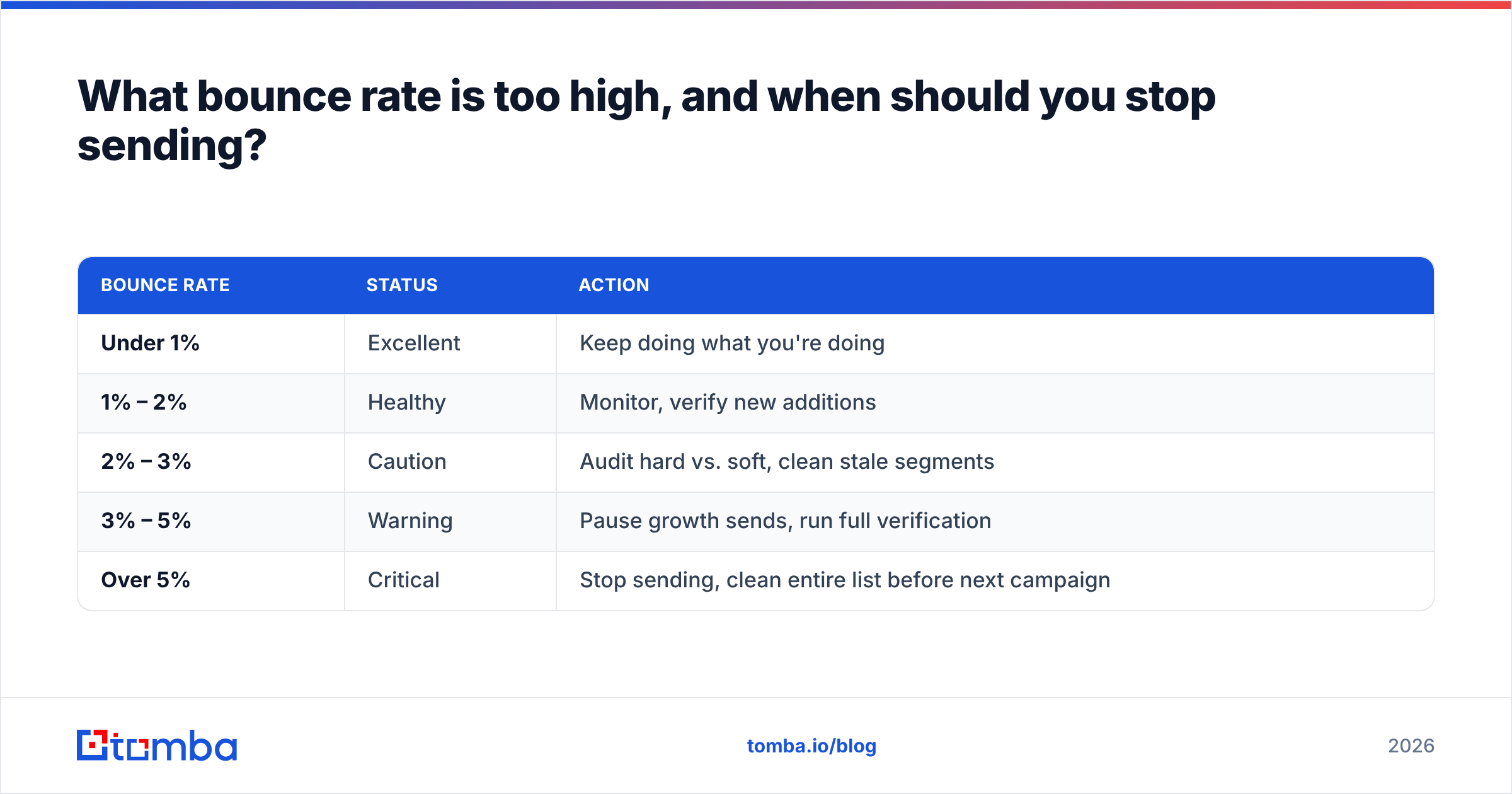
Stop and clean your list the moment a single campaign bounces above 5%. That's the hard line. Most ESPs will warn or suspend accounts that cross it repeatedly, because it signals list abuse.
Here's a practical threshold guide:
| Bounce rate | Status | Action |
|---|---|---|
| Under 1% | Excellent | Keep doing what you're doing |
| 1% – 2% | Healthy | Monitor, verify new additions |
| 2% – 3% | Caution | Audit hard vs. soft, clean stale segments |
| 3% – 5% | Warning | Pause growth sends, run full verification |
| Over 5% | Critical | Stop sending, clean entire list before next campaign |
Cold outbound deserves a special note. Cold email lists naturally bounce higher than warm opt-in lists, which is exactly why verification is non-negotiable for prospecting. If you're sending cold, your tolerance for unverified addresses should be zero — one bad campaign can blacklist a sending domain you've spent months warming up.
The smartest senders treat the 2% mark as their personal ceiling, not the 5% provider limit. By the time you hit 5%, the reputation damage is already done; aiming for 2% keeps you safely in inbox-placement territory.
How often should you clean your email list?#
Set a recurring schedule rather than waiting for bounce rates to spike. A good cadence:
- Before every cold campaign — always verify, no exceptions.
- Monthly for high-volume marketing lists (sending weekly or more).
- Quarterly for lower-volume lists (sending monthly).
- Immediately after any import, event signup, or list purchase.
Email addresses decay at roughly 2–3% per month as people change jobs, abandon inboxes, and switch providers. A list that was pristine in January is meaningfully degraded by June if you never touch it. Regular hygiene isn't optional maintenance — it's the cost of keeping your deliverability alive.
You can automate most of this. Connecting verification into your stack via the Tomba API or a CRM integration means new contacts get checked on entry, and you never ship a campaign to a stale list again.
The bottom line on bounce rates#
The average bounce rate for email campaigns may sit at 2–5%, but "average" is a trap. Your goal is the bottom quartile — under 2% overall, under 0.5% hard bounces — because that's where inbox placement, sender reputation, and campaign ROI all stay healthy. Everything above that line is borrowed time.
The fix isn't complicated: verify before you send, separate hard from soft bounces, suppress the dead weight, and clean on a schedule. Do that consistently and bounce rate stops being a problem you react to and becomes a number you barely think about.
Ready to get your bounce rate under control? Start by cleaning your existing list — run it through Tomba's email verifier to strip out invalid and risky addresses, then keep new contacts clean from the start with the Tomba Email Finder, which validates professional addresses at the point of discovery. The Free tier gives you 25 searches a month to test it, and paid plans start at $49/mo — check the full Tomba pricing to find the tier that matches your sending volume. A verified list is the cheapest deliverability insurance you'll ever buy.
// get started
Find, verify and enrich your first contacts today
Start on the free plan with 25 searches a month, then scale when your team is ready.
Free plan · No credit card required · GDPR & CCPA
// about the author