Average Cost Per Lead in 2026: B2B Benchmarks by Channel
What's a healthy average cost per lead in 2026? See real B2B CPL benchmarks by channel, industry, and company size — plus how to cut your number without cutting volume.
TL;DR
- The average cost per lead across B2B in 2026 lands roughly between $40 and $200, but the spread by channel is enormous — content and SEO sit near the bottom, paid search and trade shows near the top.
- CPL is simple math: total spend on a campaign divided by the number of leads it produced. The hard part is deciding what counts as "spend" and what counts as a "lead."
- High CPL is usually a targeting problem, not a budget problem. Bad-fit leads inflate the denominator with people who never convert.
- Enriched, verified contact data lowers CPL faster than almost any creative change, because you stop paying to reach the wrong people.
- A self-sourced outbound motion built on accurate emails can push effective CPL into the single digits — far below paid channels.
What is the average cost per lead?#
Cost per lead (CPL) is the average amount you spend to generate one new lead. You take everything you spent on a campaign or channel and divide it by the number of leads that came out the other side.
Think of it like buying apples at different stores. The sticker price per apple only matters once you account for the bruised ones you throw away. A channel can look cheap per "lead" and still be expensive per usable lead if half of them are tire-kickers, wrong-fit, or fake.
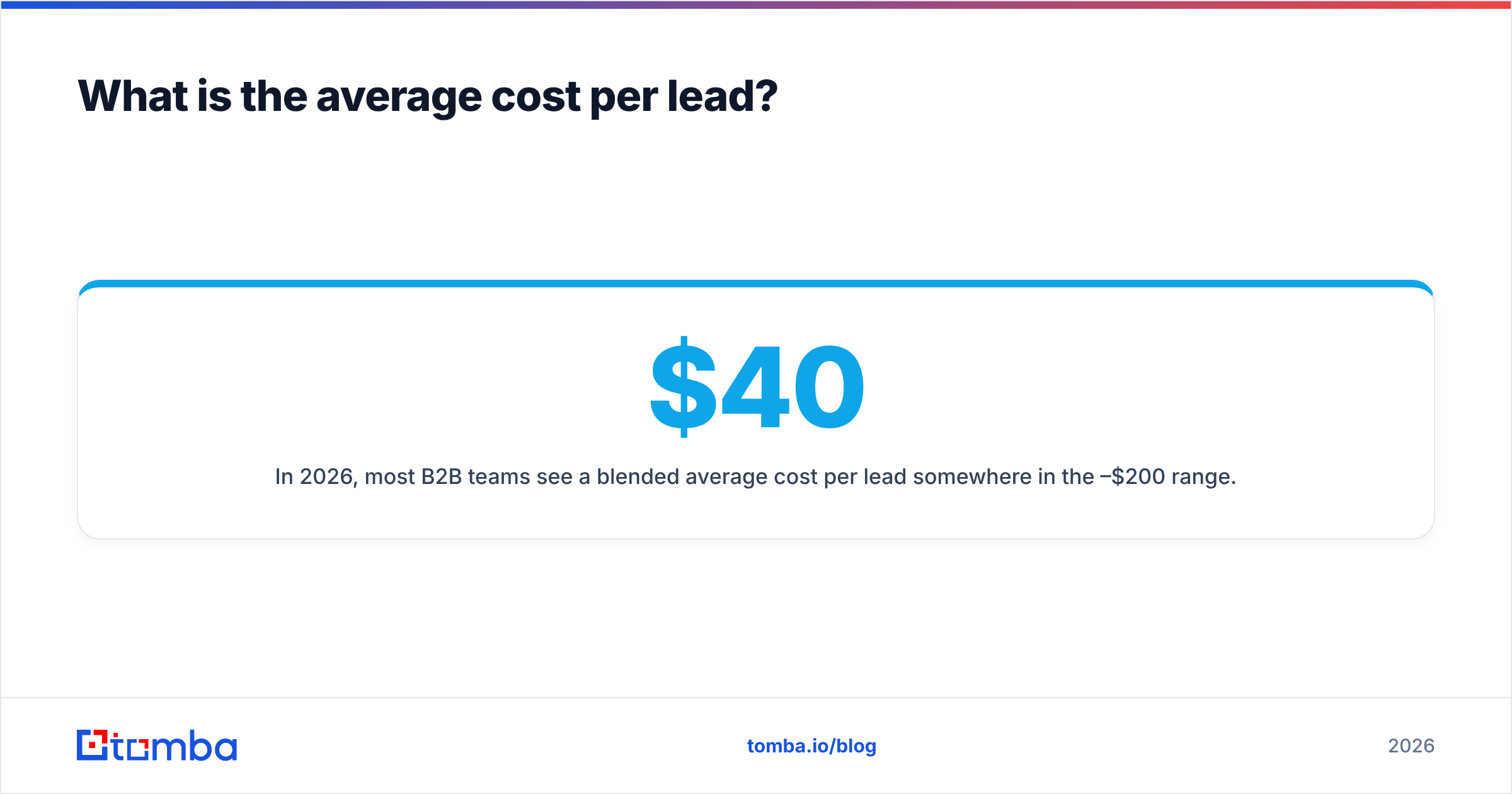
In 2026, most B2B teams see a blended average cost per lead somewhere in the $40–$200 range. But that blended number hides everything useful. A $50 CPL from organic content behaves nothing like a $50 CPL from a cold paid-social campaign — the intent, the close rate, and the sales effort are all different.
How do you calculate cost per lead?#
The formula is short:
CPL = Total campaign spend ÷ Number of leads generated
If you spent $5,000 on a LinkedIn campaign and it produced 100 leads, your CPL is $50. The trap is in the inputs. Here is what disciplined teams include:
- Media spend — the obvious one: ad budget, sponsorship fees, list rentals.
- Tooling and data — your email finder, enrichment, CRM seats, and automation platforms, amortized across the leads they touch.
- Creative and content production — the writer, designer, or agency hours that made the asset.
- Human time — SDR or marketer hours, loaded at a real hourly cost, not ignored.
- Wasted spend — money spent reaching people who bounced or never qualified still counts against you.
Most teams under-count items 2 through 5, which makes their reported CPL look better than reality. If you want a number you can actually act on, count all five. For a deeper primer on related funnel terms, the B2B glossary is a useful reference.
What is a good average cost per lead in 2026?#
A "good" cost per lead is one where the lead's expected lifetime value comfortably exceeds the fully loaded cost to acquire and close it. There is no universal number — but there are useful benchmarks by channel and industry.
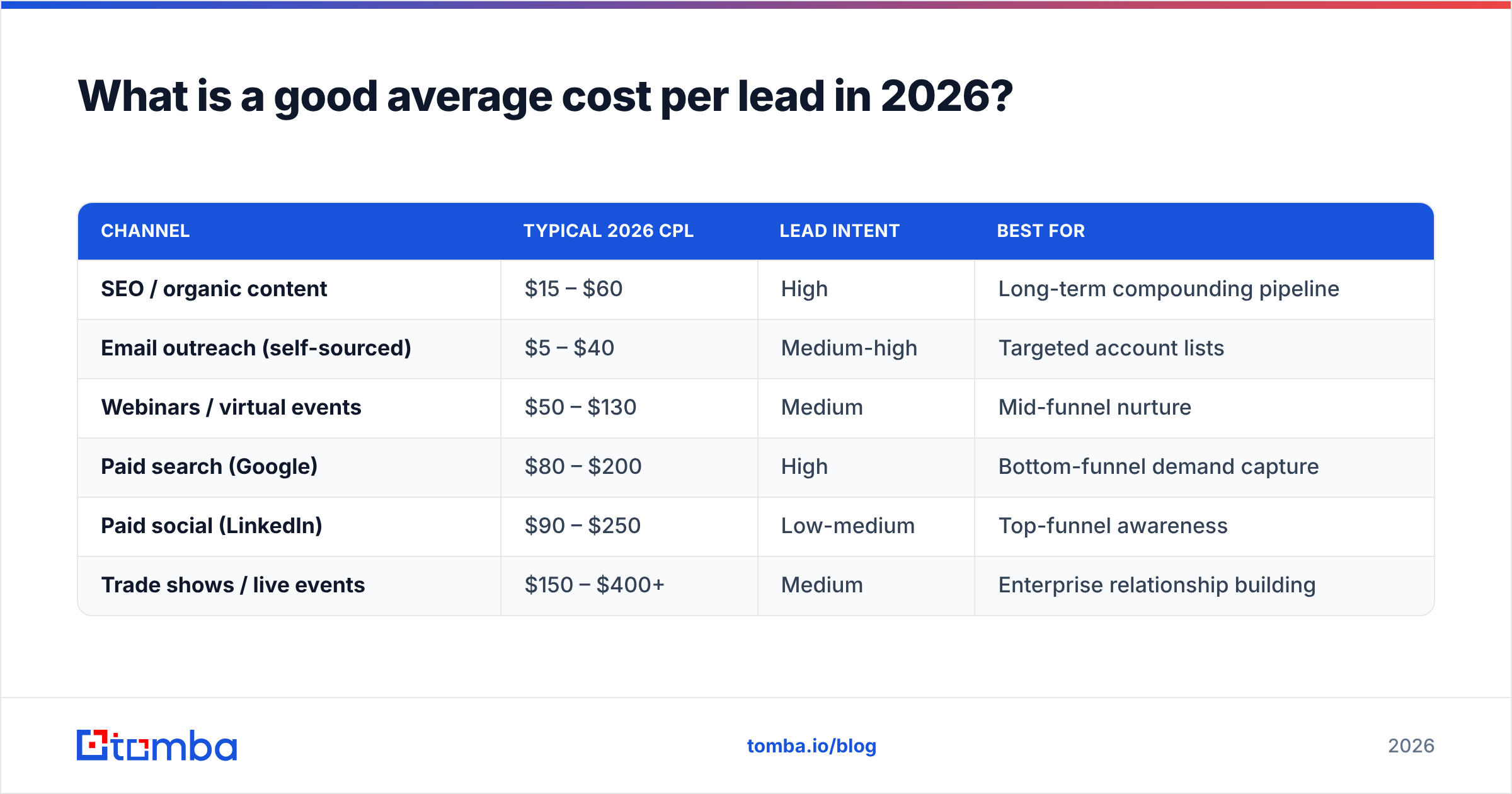
The table below reflects typical 2026 B2B ranges. Treat them as orientation, not gospel; your industry, deal size, and targeting will move you within (or outside) these bands.
| Channel | Typical 2026 CPL | Lead intent | Best for |
|---|---|---|---|
| SEO / organic content | $15 – $60 | High | Long-term compounding pipeline |
| Email outreach (self-sourced) | $5 – $40 | Medium-high | Targeted account lists |
| Webinars / virtual events | $50 – $130 | Medium | Mid-funnel nurture |
| Paid search (Google) | $80 – $200 | High | Bottom-funnel demand capture |
| Paid social (LinkedIn) | $90 – $250 | Low-medium | Top-funnel awareness |
| Trade shows / live events | $150 – $400+ | Medium | Enterprise relationship building |
Notice the pattern: the cheapest, highest-intent channels — organic content and self-sourced outreach — are also the ones you control directly. Paid channels rent attention; owned channels build it. According to HubSpot's research on marketing benchmarks, inbound-driven sources consistently report lower cost per lead than outbound paid media over time.
CPL benchmarks by industry#
Industry changes the math because deal sizes and competition differ. As a rough 2026 guide:
- SaaS / software: $40 – $120 average cost per lead
- Financial services: $90 – $300 (high competition, high LTV)
- Healthcare / medtech: $80 – $200 (regulatory friction)
- Manufacturing / industrial: $30 – $90 (narrow, findable buyers)
- Professional services: $50 – $150
The lesson: don't benchmark against "B2B." Benchmark against your industry, your deal size, and your channel mix.
Why is your cost per lead too high?#
Quick answer: you are almost certainly paying to reach the wrong people. High CPL is rarely a creative or bidding problem first — it is a targeting and data problem first.
Here are the usual culprits, in order of how often they're the real issue:
- Bad-fit targeting. You're casting wide and counting unqualified responses as leads. The denominator looks big, but the usable count is small.
- Stale or wrong contact data. Bounced emails and dead phone numbers mean spend with zero chance of a reply. Decay is brutal — B2B data goes stale at roughly 2–3% per month.
- No verification step. Sending to unverified addresses tanks deliverability, which quietly raises the cost of every subsequent email.
- Channel mismatch. Pouring budget into paid social for a product that sells on high-intent search.
- Ignoring the funnel after the lead. A cheap lead that never converts is not cheap. CPL without downstream conversion data is vanity.
The single highest-leverage fix is data quality. When you stop paying to contact people who don't exist, won't reply, or were never a fit, your effective CPL drops without touching your ad budget at all. This is where an accurate email finder and a real email verifier earn their keep — they shrink the wasted-spend portion of the formula.
How do you lower your average cost per lead?#
The fastest way to lower CPL is to shift mix toward owned, high-intent channels and to clean the data feeding all of them. Concretely:
1. Build a self-sourced outbound motion. Instead of renting leads, define your ideal customer profile and find those exact people. A targeted list of 500 verified, perfect-fit contacts will out-perform 5,000 rented names every time — and the per-lead cost is a fraction of paid media.
2. Verify before you send. Every bounce is wasted spend and a hit to sender reputation. Running addresses through verification before outreach protects deliverability and keeps your real CPL honest.
3. Enrich what you already have. Half-filled CRM records are leads you already paid for but can't act on. Data enrichment fills in titles, companies, and contact details so existing leads become workable — effectively lowering CPL retroactively.
4. Use bulk processing for scale. When you're working account lists, a bulk email finder turns a company list into a verified contact list in minutes, instead of paying per-lead rates to a data broker.
5. Double down on what converts. Track CPL and close rate by channel. Kill the channels with cheap leads that never close; reinvest in the ones with slightly higher CPL but far better conversion.
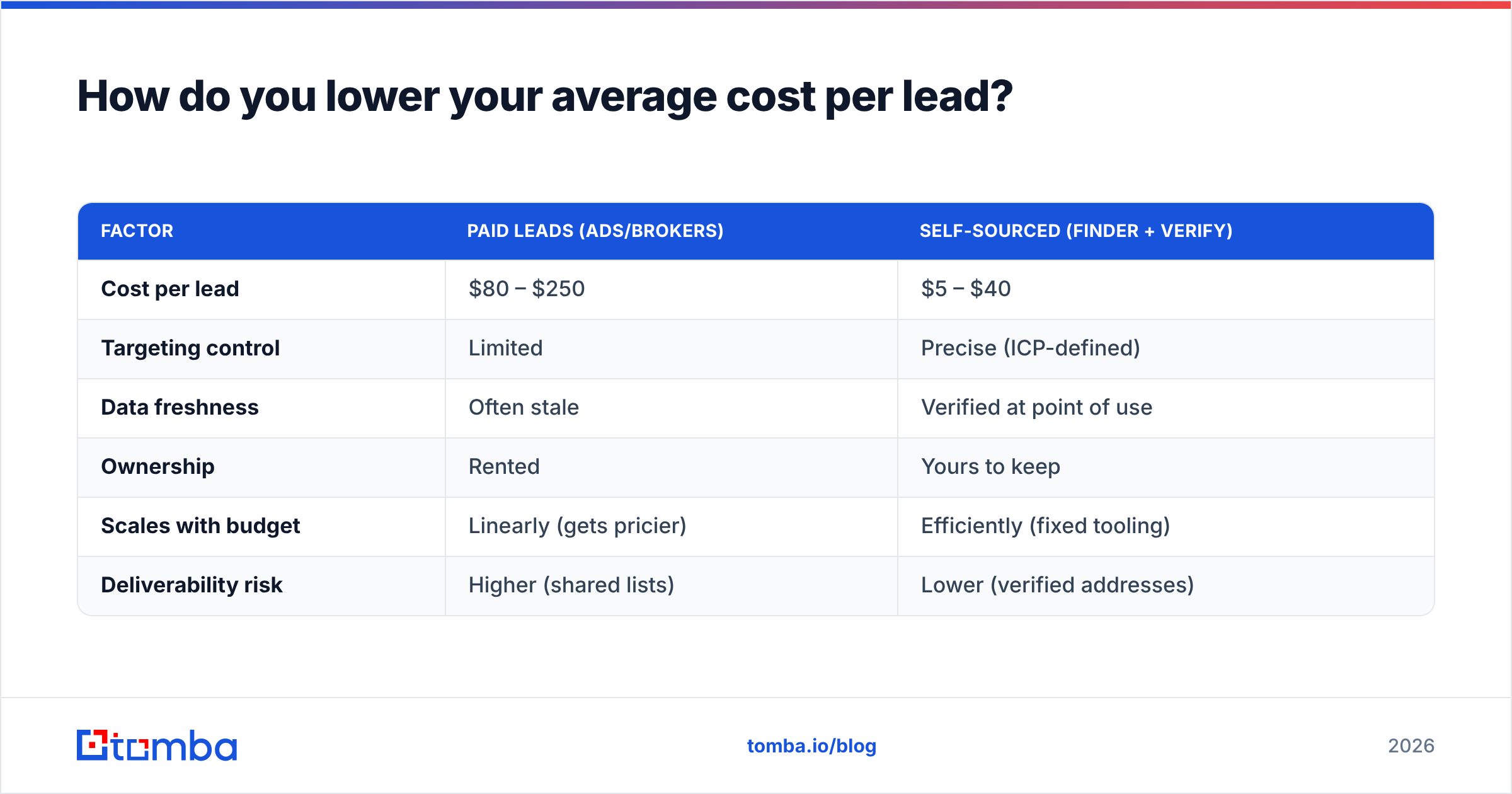
Self-sourced vs. paid leads: the cost comparison#
| Factor | Paid leads (ads/brokers) | Self-sourced (finder + verify) |
|---|---|---|
| Cost per lead | $80 – $250 | $5 – $40 |
| Targeting control | Limited | Precise (ICP-defined) |
| Data freshness | Often stale | Verified at point of use |
| Ownership | Rented | Yours to keep |
| Scales with budget | Linearly (gets pricier) | Efficiently (fixed tooling) |
| Deliverability risk | Higher (shared lists) | Lower (verified addresses) |
The economics favor owned channels at almost every company size. Tools like G2's category data confirm that teams blending outbound with verified data report materially lower acquisition costs than those relying on paid lists alone. Analyst coverage from Gartner makes the same point about first-party data becoming the cost-efficiency lever in 2026.
How does data accuracy change your CPL?#
Data accuracy is the multiplier on every other CPL effort. A 95%-deliverable list versus a 70%-deliverable list isn't a 25-point difference — it's the difference between spend that works and spend that evaporates.
Run the math. Say you build a 1,000-contact list and your outreach tooling costs $99/month. At 95% accuracy, you reach 950 real people; at 70%, you reach 700 — and the 300 bounces actively damage your domain reputation, lowering the inbox rate of the 700 that were valid. The accurate list doesn't just cost less per usable lead; it protects the value of every future send.
That is why teams obsess over data sources and accuracy. It's not a vanity metric — it's the input that decides whether your average cost per lead is calculated on leads that can actually become customers.
Frequently asked questions#
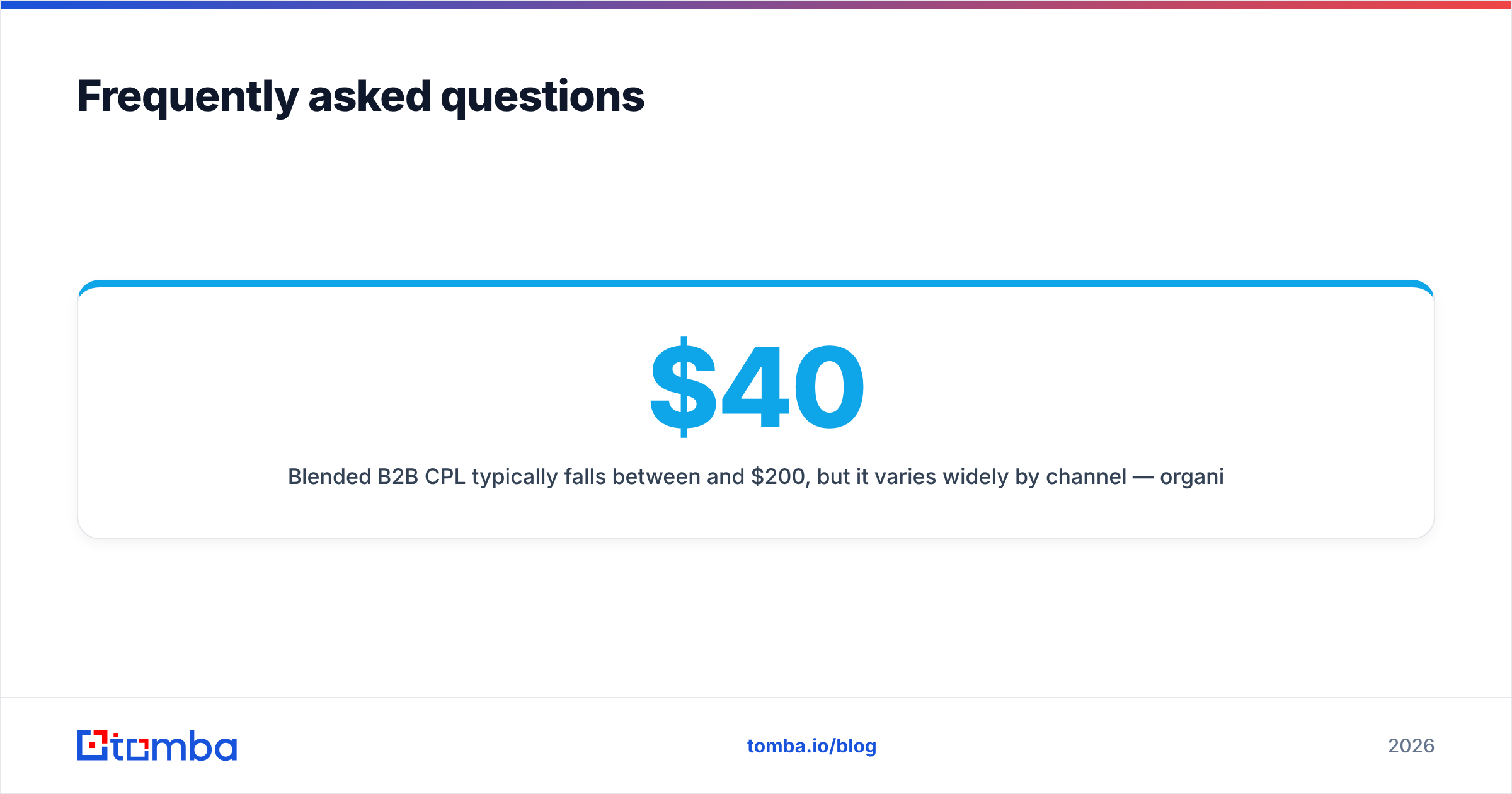
What is the average cost per lead in B2B for 2026? Blended B2B CPL typically falls between $40 and $200, but it varies widely by channel — organic content and self-sourced email can be under $40, while paid search and events run well over $150.
How is cost per lead calculated? Divide total campaign spend by the number of leads generated. For an accurate number, include media, tooling, content production, and human time — not just ad budget.
Is a low cost per lead always good? No. A cheap lead that never converts costs you more than an expensive lead that closes. Always pair CPL with downstream conversion rate before judging a channel.
What's the cheapest way to generate B2B leads? Self-sourced outreach built on verified contact data is consistently the lowest effective CPL, because you control targeting and avoid paying broker or ad-platform markups.
Start lowering your cost per lead#
Your average cost per lead is mostly a story about data. Pay to reach the wrong people and no creative tweak will save the number; reach the right, verified people and CPL falls on its own. The Tomba Email Finder lets you build precise, ICP-matched lists with verified professional emails — so you spend on contacts who can actually become pipeline, not bounces. Pair it with verification and enrichment, check the Tomba pricing plans (a free tier with 25 searches/month, then Starter at $49/mo), and start measuring CPL on leads that convert.
// get started
Find, verify and enrich your first contacts today
Start on the free plan with 25 searches a month, then scale when your team is ready.
Free plan · No credit card required · GDPR & CCPA
// about the author