Average Cost Per Lead By Industry: 2026 Benchmarks
What does a lead actually cost in your industry? Compare 2026 cost-per-lead benchmarks across 12 sectors, channels, and B2B vs B2C — and how to cut your CPL.
TL;DR
- The average cost per lead across all industries sits roughly between $40 and $200 in 2026 — but that range hides enormous variation by sector and channel.
- High-value, low-volume industries (legal, finance, B2B SaaS, healthcare) routinely pay $150–$700+ per lead; high-volume consumer verticals (ecommerce, media) often land under $40.
- Channel matters more than industry: SEO and referral leads can cost a fraction of paid search or trade-show leads in the same vertical.
- A "lead" is not standardized — a newsletter signup and a sales-qualified demo request can both be called leads while differing 50x in cost and value.
- The fastest way to cut your average cost per lead is to stop paying for clicks you can generate yourself: enrich and contact prospects directly instead of buying every introduction.
What is cost per lead (CPL)?#
Cost per lead is the total amount you spend to acquire one new lead, calculated as total campaign spend ÷ number of leads generated. Think of it like the price of an introduction: you can pay a matchmaker a premium for one warm intro, or you can attend a thousand events and meet people for the cost of your time. Both produce contacts — at wildly different unit costs.
Technically, CPL = marketing and sales spend attributed to a channel divided by the leads that channel produced in the same period. The trouble is that "lead" means different things to different teams. One company counts an email capture; another counts only a booked sales call. Before you compare your number to any benchmark, define what you're counting.
A useful frame is the funnel stage:
- Raw lead — any contact who gave you an email or filled a form. Cheapest, lowest intent.
- Marketing qualified lead (MQL) — fits your profile and showed engagement. See our marketing qualified lead definition for the full criteria.
- Sales qualified lead (SQL) — vetted by sales, has budget and a real need.
- Opportunity — an active deal in your pipeline.
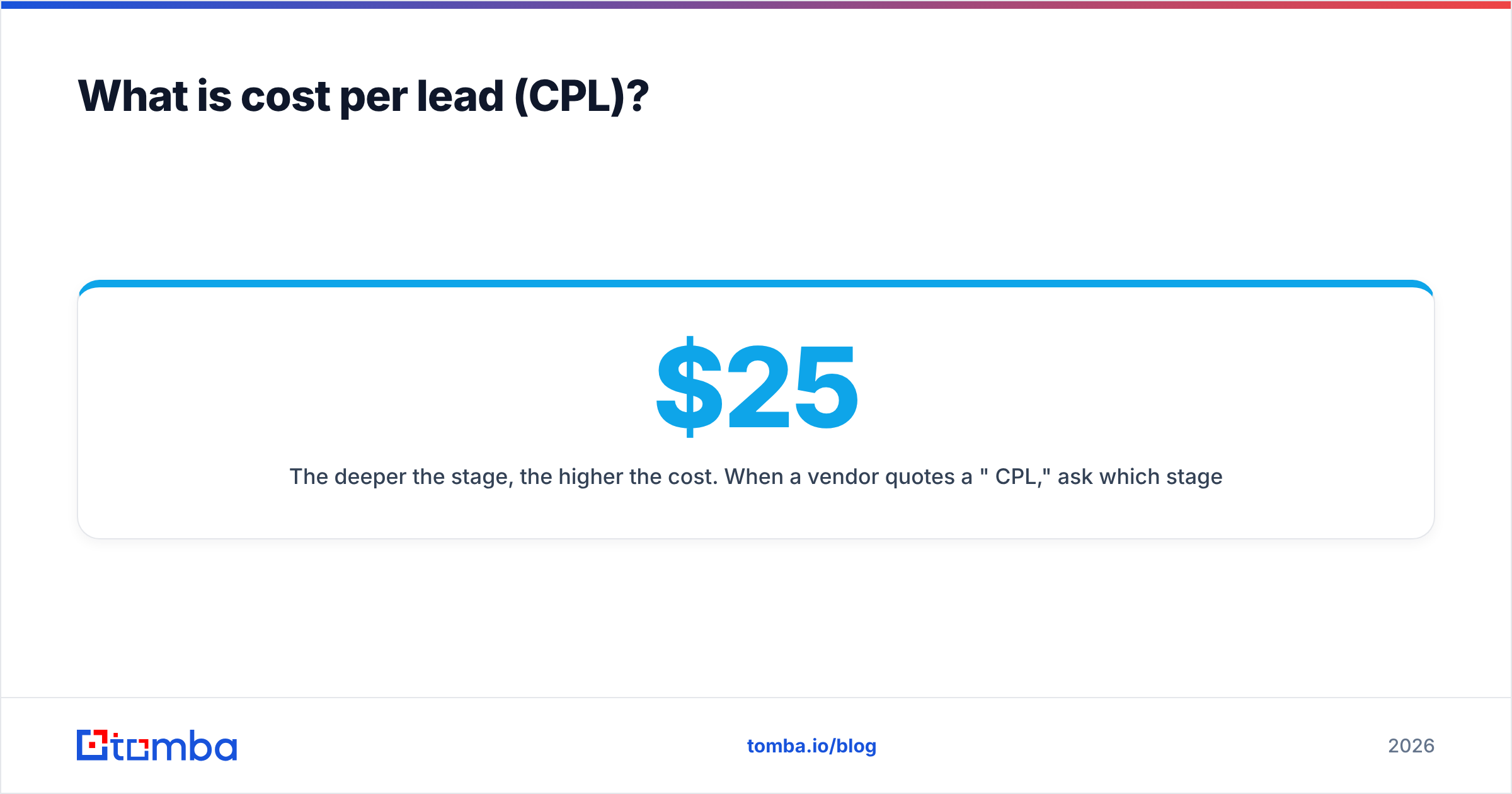
The deeper the stage, the higher the cost. When a vendor quotes a "$25 CPL," ask which stage they mean — a $25 raw lead and a $25 SQL are not the same product.
What is the average cost per lead by industry in 2026?#
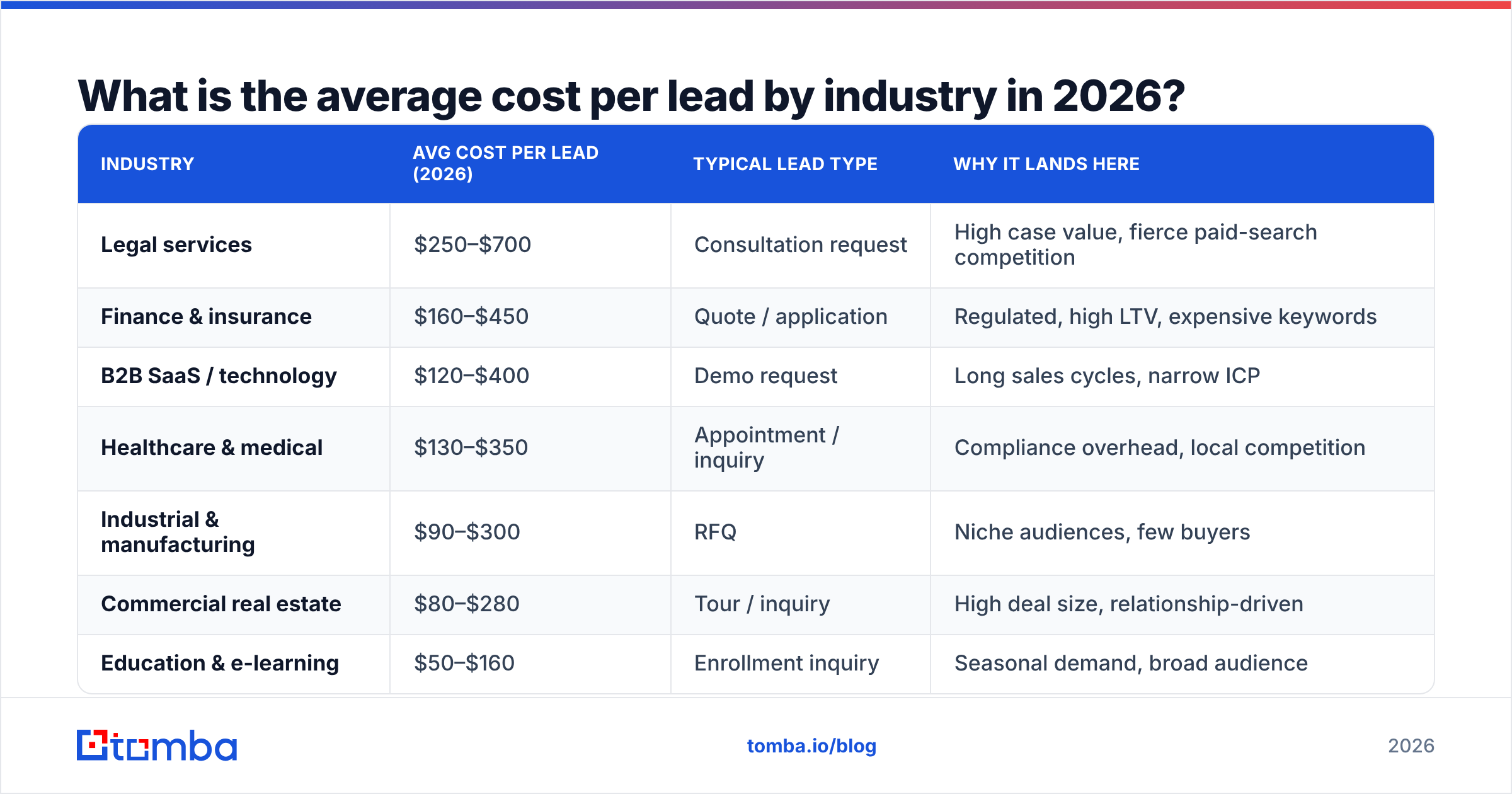
The short answer: most B2B industries pay $100–$400 per qualified lead, while B2C and high-volume verticals pay $20–$120. The table below pulls together 2026 benchmark ranges synthesized from industry reporting and review-platform data. Treat these as directional — your geography, lead definition, and channel mix shift them substantially.
| Industry | Avg cost per lead (2026) | Typical lead type | Why it lands here |
|---|---|---|---|
| Legal services | $250–$700 | Consultation request | High case value, fierce paid-search competition |
| Finance & insurance | $160–$450 | Quote / application | Regulated, high LTV, expensive keywords |
| B2B SaaS / technology | $120–$400 | Demo request | Long sales cycles, narrow ICP |
| Healthcare & medical | $130–$350 | Appointment / inquiry | Compliance overhead, local competition |
| Industrial & manufacturing | $90–$300 | RFQ | Niche audiences, few buyers |
| Commercial real estate | $80–$280 | Tour / inquiry | High deal size, relationship-driven |
| Education & e-learning | $50–$160 | Enrollment inquiry | Seasonal demand, broad audience |
| Home services | $45–$130 | Booking / estimate | Local, high intent, moderate volume |
| Marketing & advertising | $40–$140 | Strategy call | Crowded, self-served buyers |
| Travel & hospitality | $30–$90 | Booking inquiry | High volume, thin margins |
| Ecommerce / retail | $20–$70 | Signup / cart | Massive volume, low intent per lead |
| Media & publishing | $10–$40 | Subscription / signup | Content-driven, scale economics |
Two patterns explain almost everything in this table. First, lifetime value sets the ceiling: a law firm can rationally pay $600 for a lead because one case is worth tens of thousands, while a media site capping out at a few dollars per subscriber cannot. Second, competition sets the floor: industries with expensive paid-search keywords (legal, insurance, SaaS) inherit a high baseline no matter how efficient your funnel is.
Why does cost per lead vary so much between channels?#
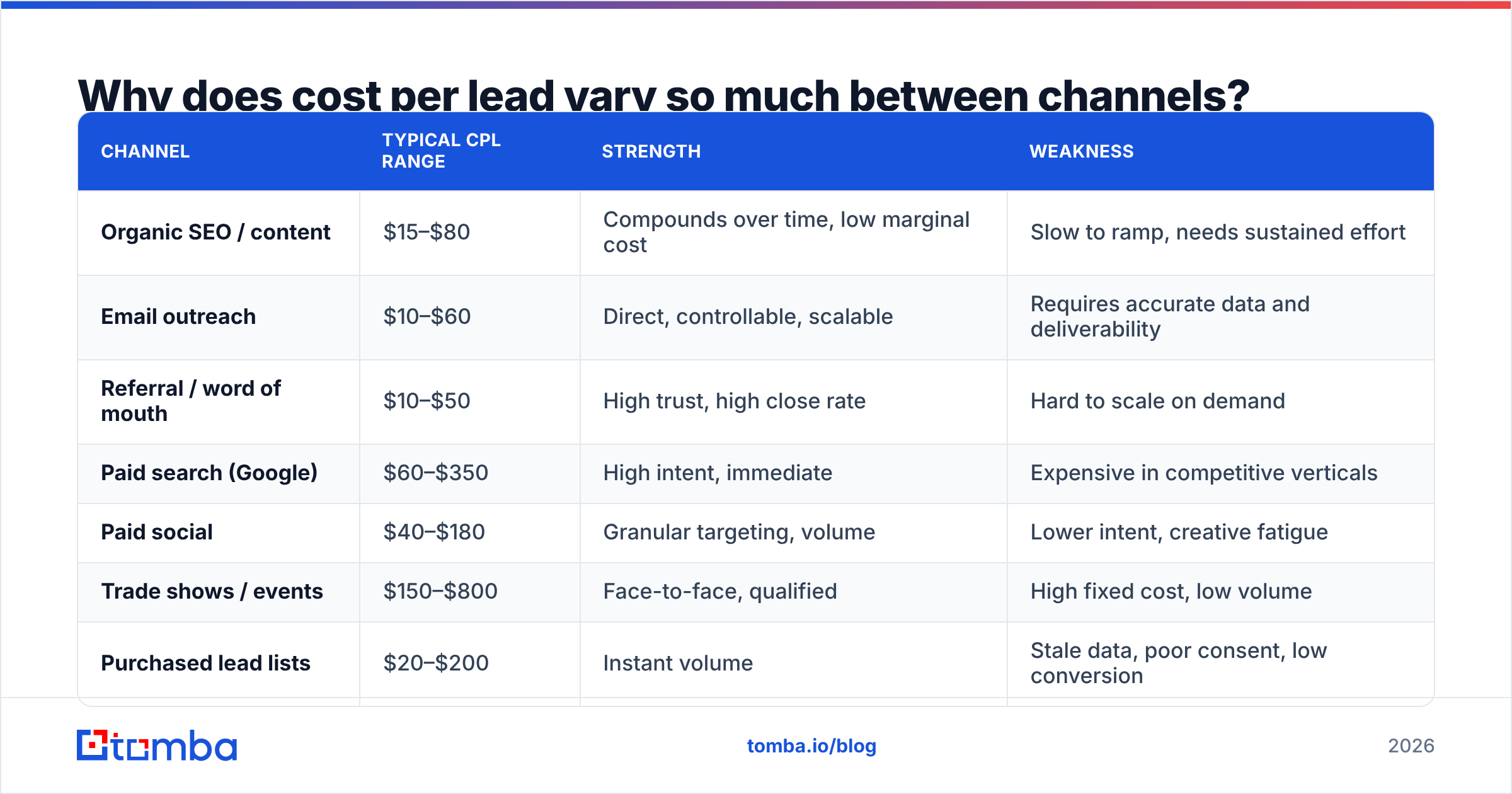
Because each channel sells you a different mix of intent, volume, and exclusivity. Within a single industry, your average cost per lead can swing 10x depending on where the lead comes from.
| Channel | Typical CPL range | Strength | Weakness |
|---|---|---|---|
| Organic SEO / content | $15–$80 | Compounds over time, low marginal cost | Slow to ramp, needs sustained effort |
| Email outreach | $10–$60 | Direct, controllable, scalable | Requires accurate data and deliverability |
| Referral / word of mouth | $10–$50 | High trust, high close rate | Hard to scale on demand |
| Paid search (Google) | $60–$350 | High intent, immediate | Expensive in competitive verticals |
| Paid social | $40–$180 | Granular targeting, volume | Lower intent, creative fatigue |
| Trade shows / events | $150–$800 | Face-to-face, qualified | High fixed cost, low volume |
| Purchased lead lists | $20–$200 | Instant volume | Stale data, poor consent, low conversion |
The strategic takeaway is that owned channels almost always beat rented ones on cost per lead. Paid search rents attention by the click; the moment you stop paying, the leads stop. Content and outbound email build an asset you control. That's why teams under CPL pressure shift budget toward outbound sales strategy and self-sourced prospecting — they trade cash for a repeatable process they own.
Purchased lists deserve a specific warning. A list can look cheap per record, but if 30% of the emails bounce and another 40% never had real intent, your effective CPL on usable leads quietly triples. Cheap bad data is the most expensive lead source there is. Run any list through an email verifier before you judge its true cost.
What's the difference between B2B and B2C cost per lead?#
B2B leads cost more per unit but are worth far more; B2C leads are cheaper and bought in volume. The split comes down to deal size and buying committees.
- Deal value. A B2B contract worth $40,000 justifies a $300 lead; a $50 consumer purchase does not. CPL scales with what a closed deal is worth.
- Buying committee. B2B purchases involve 6–10 stakeholders on average, so you're effectively paying to reach a group, not a person.
- Sales cycle. B2B cycles run weeks to months, adding nurture cost that loads onto each lead.
- Audience size. B2C addresses millions of potential buyers, so volume drives unit cost down; B2B niches may have only a few thousand qualified accounts.
- Intent signals. B2C buyers self-serve and convert fast; B2B buyers research quietly, requiring more touches before they raise their hand.
The practical implication: don't benchmark a B2B SaaS funnel against ecommerce numbers and panic. A $250 SQL in enterprise software can be dramatically more profitable than a $15 retail signup. Always pair CPL with downstream metrics like close rate and customer lifetime value, or you'll optimize for cheap leads that never buy.

How do you calculate your own average cost per lead?#
Use the formula, but be ruthless about what counts as spend and what counts as a lead. The honest version of CPL includes more than ad budget.
Step by step:
- Sum all attributable spend. Ad budget, agency fees, tooling, content production, and the loaded cost of the people running the channel. Leaving out salaries understates CPL by half in many teams.
- Define one lead stage and stick to it. Pick raw lead, MQL, or SQL — and use the same definition across every channel you compare.
- Count leads in the same window as the spend. Don't credit this month's spend with last month's leads.
- Divide and segment. Total spend ÷ total leads gives the blended number; then break it out by channel and campaign to find your winners and losers.
- Track effective CPL. Remove bounced, duplicate, and disqualified leads from the denominator. This is your real number.
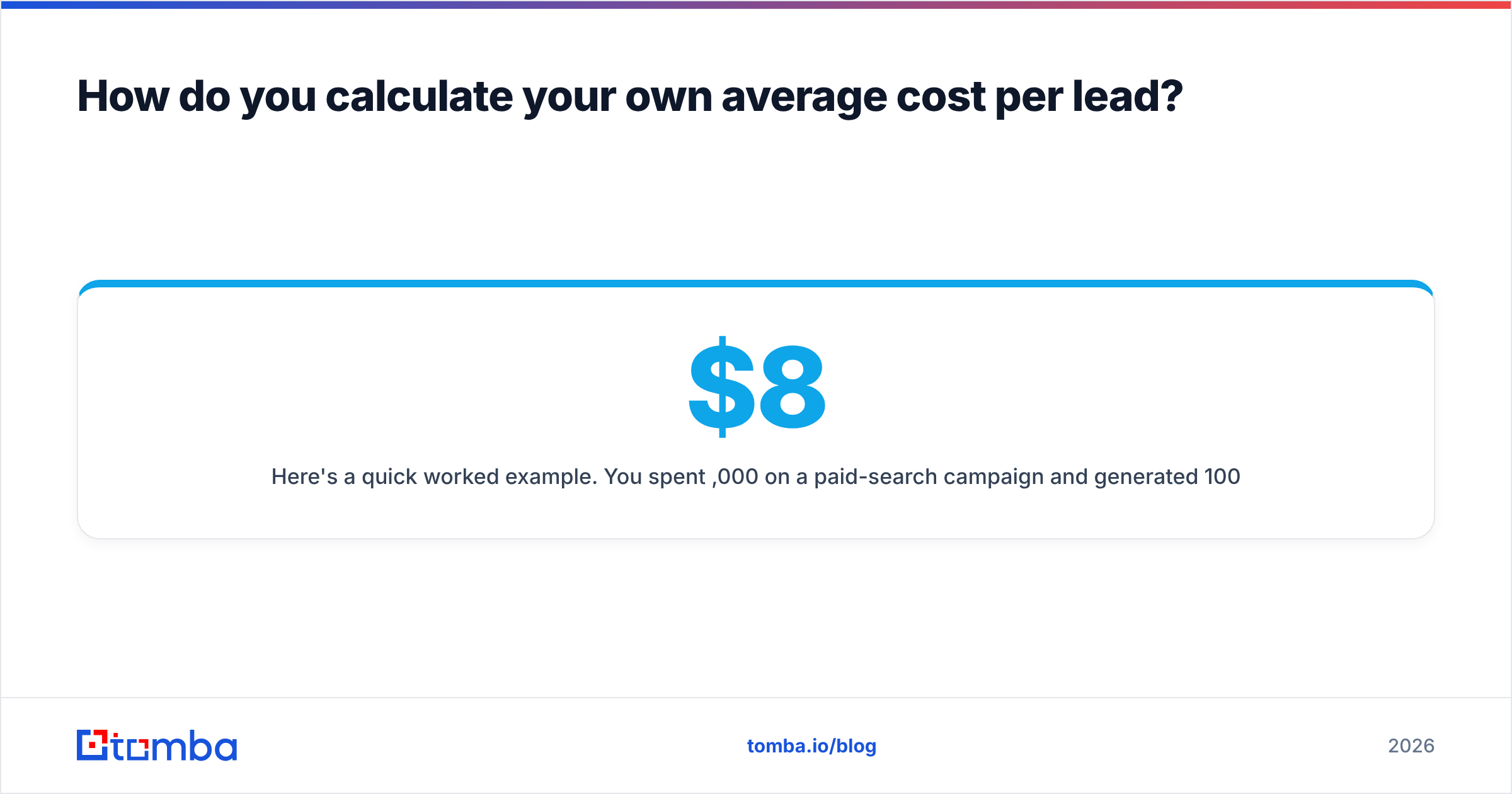
Here's a quick worked example. You spent $8,000 on a paid-search campaign and generated 100 form fills. Blended CPL = $80. But 18 emails bounced and 22 were clearly out of profile. Your effective CPL on usable leads is $8,000 ÷ 60 = $133 — 66% higher than the headline figure. That gap is where most budgets quietly leak.
To keep the denominator clean, dedupe your lists and validate contact data before it enters the CRM. Tools like a bulk email finder and verification step pay for themselves by keeping junk out of the count.
How can you lower your cost per lead?#
Cut the cost of acquiring contacts, raise the quality of the ones you keep, and shift spend toward channels you own. In priority order:
- Self-source instead of buying introductions. Identify your ideal accounts, find the decision-makers, and reach them directly. An email finder plus a domain search lets you build a targeted list for the cost of a subscription rather than paying per click or per purchased record.
- Verify before you spend a single touch. Every message sent to a dead address costs deliverability and skews your CPL math. Clean data lifts your effective CPL more than almost any creative change.
- Double down on intent-rich channels. Reallocate budget from broad paid social to high-intent search terms and warm referral loops, then measure CPL by segment, not in aggregate.
- Improve conversion rate, not just traffic. Halving your landing-page friction halves your CPL with zero extra ad spend. Faster forms, clearer offers, and instant follow-up all compound.
- Enrich what you already have. Data enrichment turns a thin lead into a routable, scorable record, so sales wastes less time and your cost-per-qualified-lead drops.
- Follow up faster. Response rate collapses after the first hour; speed-to-lead is free leverage on money you've already spent. See how it ties to your response rate.
According to analyst guidance from firms like Gartner and benchmarking communities such as G2, the teams with the lowest sustainable CPL are rarely the ones with the biggest ad budgets — they're the ones who own their prospecting motion and protect data quality obsessively. HubSpot's own marketing benchmark research tells the same story: organic and email channels consistently undercut paid acquisition on cost per lead over time.
What's a "good" cost per lead for your industry?#
A good CPL is one where the lead's expected value comfortably exceeds its fully loaded cost — there's no universal number. Use this gut check: if your average lead value is roughly 3–5x your effective CPL after factoring close rate, you're in healthy territory. A legal firm paying $500 per consultation that closes 20% of $15,000 cases is thriving; an ecommerce brand paying $80 for a $40 first order is bleeding.
Benchmarks like the table above are a starting line, not a finish line. The real win is moving your own CPL down quarter over quarter while holding lead quality steady. Pair the numbers here with your win rate and customer lifetime value, and you'll know whether a "high" CPL is a problem or just the price of a very profitable market.
Where Tomba fits#
If your cost per lead is being inflated by paid clicks and stale purchased lists, the cheapest lead is the one you source yourself. Tomba's Email Finder lets you turn a target account list into verified, decision-maker contacts in minutes — by name, company, or domain — so you reach buyers directly instead of renting introductions. Start free with 25 searches a month, then scale on the Starter plan at $49/mo as your outbound engine grows. Pair it with the built-in email verifier to keep dead addresses out of your funnel, and watch your effective cost per lead fall where it should: under your control.
// get started
Find, verify and enrich your first contacts today
Start on the free plan with 25 searches a month, then scale when your team is ready.
Free plan · No credit card required · GDPR & CCPA
// about the author