Average Email Campaign Open Rate in 2026: Real Benchmarks
What counts as a good open rate in 2026? See real benchmarks by industry, why Apple MPP broke the metric, and the fixes that actually lift opens.
TL;DR
- The average email campaign open rate in 2026 lands around 21% across all industries, but the range runs from roughly 15% (retail, daily senders) to 40%+ (nonprofits, government, education).
- Apple's Mail Privacy Protection (MPP) pre-loads images, so a large share of reported "opens" are bot opens — your real human open rate is lower than the dashboard says.
- Benchmarks are a starting line, not a scoreboard. Your list quality, subject line, sender reputation, and send time move the number far more than your industry average does.
- The single biggest lever most teams ignore is list hygiene — sending to dead, mistyped, or spam-trap addresses quietly tanks both opens and deliverability.
- Below: real benchmark tables, the math behind a "good" open rate, and a concrete checklist to lift yours.
What is a good average email campaign open rate in 2026?#
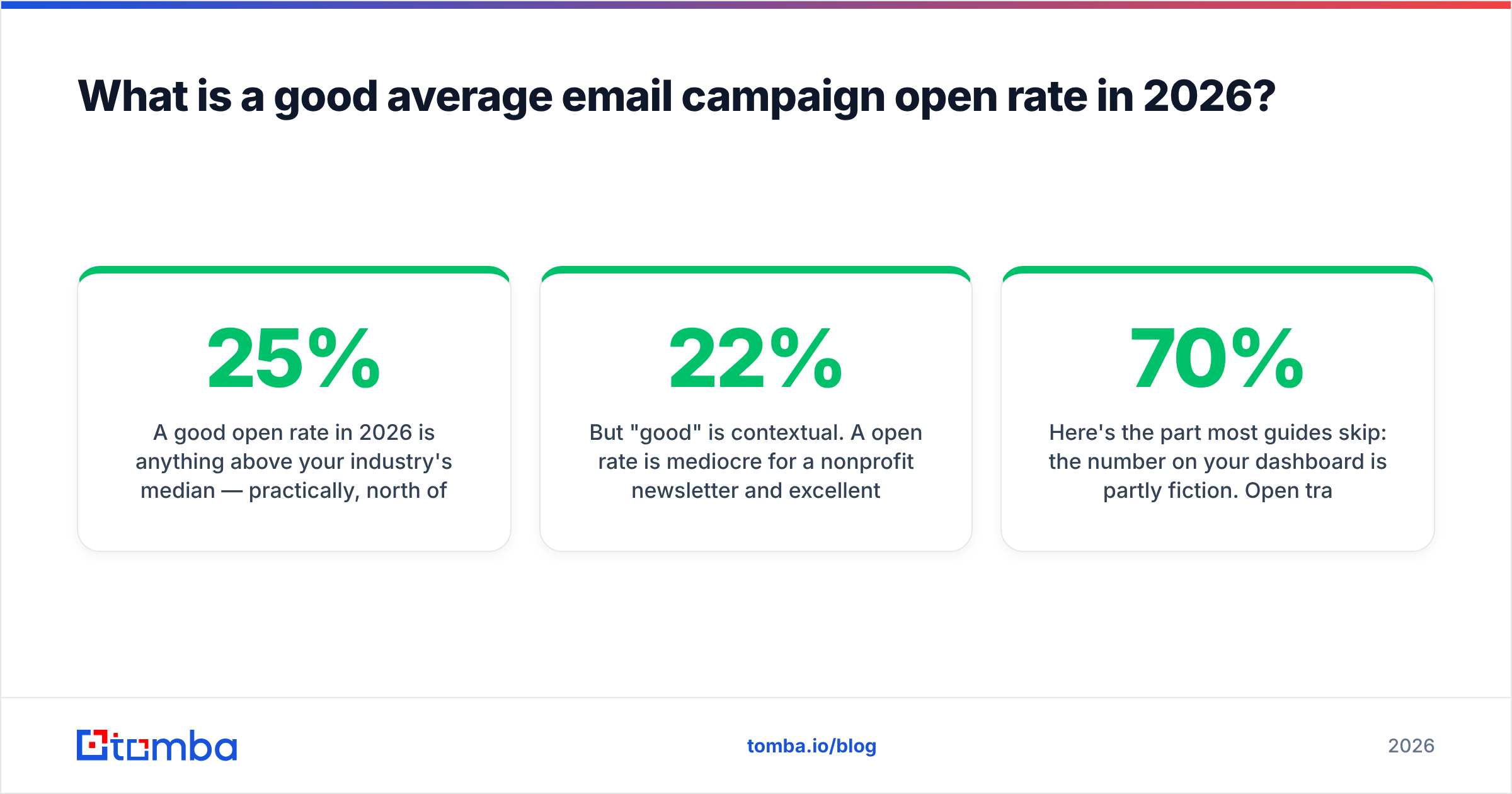
A good open rate in 2026 is anything above your industry's median — practically, north of 25% for most B2B senders. The all-industry average sits near 21%, so clearing that bar means you're doing the fundamentals right: a clean list, a recognizable sender name, and a subject line worth tapping.
But "good" is contextual. A 22% open rate is mediocre for a nonprofit newsletter and excellent for a high-volume retail promo. Think of the average like the speed limit on a highway — useful as a reference, but the car next to you might be a moped or a Ferrari, and the posted number tells you nothing about either.
Here's the part most guides skip: the number on your dashboard is partly fiction. Open tracking works by embedding a tiny invisible image (a "pixel") in the email. When the recipient's client loads that image, the open is recorded. Since 2021, Apple's Mail Privacy Protection loads that pixel automatically — whether or not a human ever saw the message. So your reported open rate is inflated by machine opens, sometimes by 30–70% of total opens depending on your audience's device mix.
That doesn't make the metric useless. It makes it a relative metric: track it against your own baseline and your own segments, not as an absolute truth.

What is the average open rate by industry?#
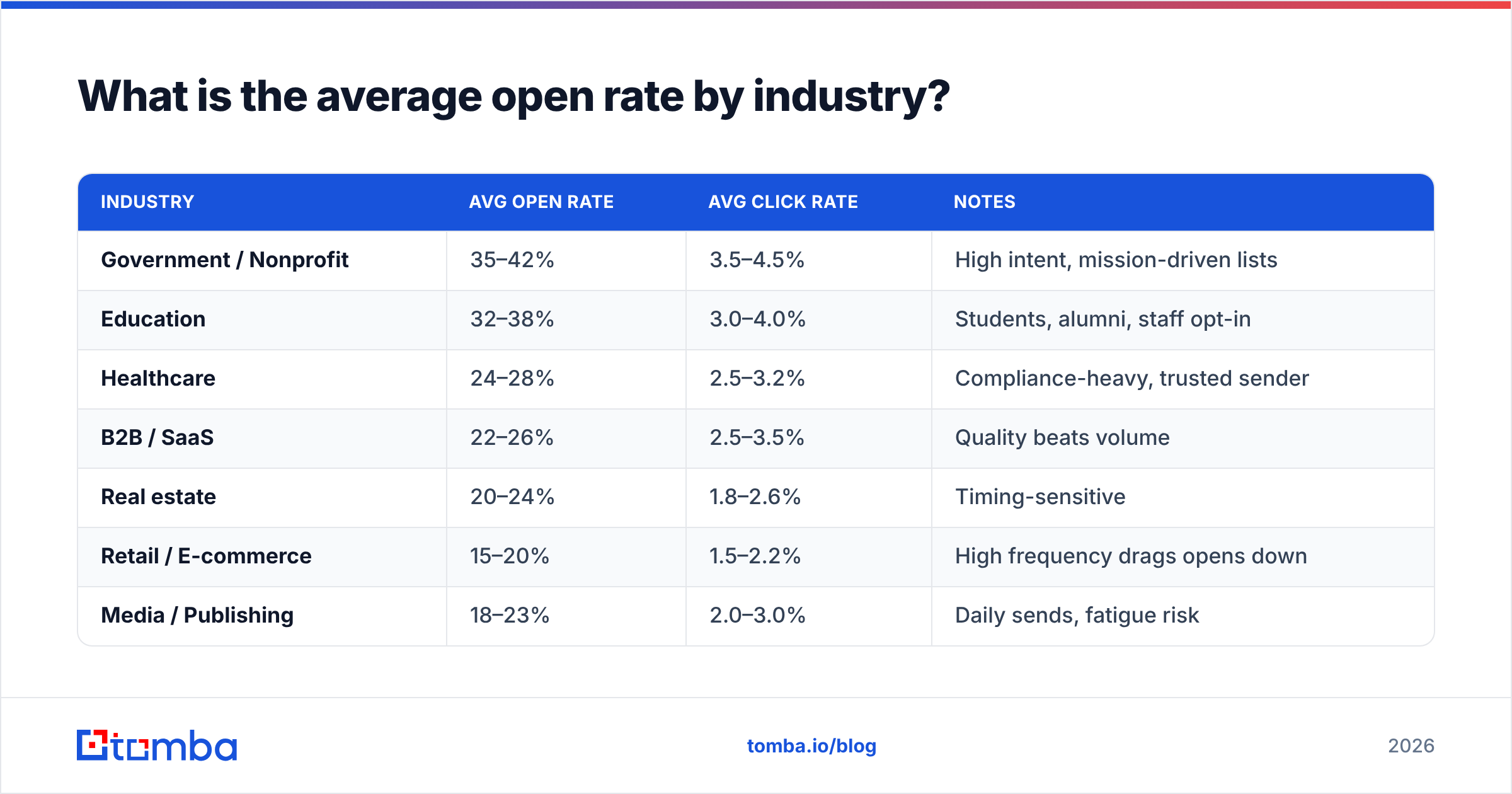
Open rates vary widely by sector, send frequency, and audience intent. The table below blends 2025–2026 benchmark reporting from major ESPs (Mailchimp, Campaign Monitor, HubSpot, GetResponse) into representative ranges. Treat these as ballpark medians, not guarantees.
| Industry | Avg open rate | Avg click rate | Notes |
|---|---|---|---|
| Government / Nonprofit | 35–42% | 3.5–4.5% | High intent, mission-driven lists |
| Education | 32–38% | 3.0–4.0% | Students, alumni, staff opt-in |
| Healthcare | 24–28% | 2.5–3.2% | Compliance-heavy, trusted sender |
| B2B / SaaS | 22–26% | 2.5–3.5% | Quality beats volume |
| Real estate | 20–24% | 1.8–2.6% | Timing-sensitive |
| Retail / E-commerce | 15–20% | 1.5–2.2% | High frequency drags opens down |
| Media / Publishing | 18–23% | 2.0–3.0% | Daily sends, fatigue risk |
Two patterns repeat across every dataset:
- Frequency and open rate are inversely related. Daily senders (retail, media) post lower opens because the audience is saturated. Weekly or triggered senders post higher opens.
- Permission quality beats list size. A nonprofit's 40% open rate isn't magic — it's a list of people who genuinely asked to hear from them. The closer your list is to that standard, the higher your ceiling.
How is open rate actually calculated?#
Open rate is simple arithmetic, but the inputs are where teams go wrong. The standard formula:
Open rate = (Unique opens ÷ Emails delivered) × 100
Note the denominator: delivered, not sent. If you sent 10,000 emails but 1,500 bounced, your delivered base is 8,500. Calculating against the larger "sent" number understates your true engagement and hides a bounce problem.
Here's how the same campaign produces wildly different open rates depending on list quality:
- Scenario A — dirty list: 10,000 sent, 8,000 delivered (20% bounce), 1,400 opens. Reported open rate = 17.5%. Worse, the high bounce rate is actively damaging your sender reputation, which suppresses future inbox placement.
- Scenario B — verified list: 10,000 sent, 9,850 delivered (1.5% bounce), 2,560 opens. Reported open rate = 26%. The clean list both improves the visible metric and protects deliverability for every future send.
Same content, same subject line — the only variable is whether the addresses were verified before sending. That's why list hygiene is the highest-leverage fix available, and why running addresses through an email verifier before a campaign pays for itself in deliverability.
Why is my open rate lower (or higher) than the benchmark?#
If your number is off the benchmark in either direction, one of these is almost always the cause:
- Apple MPP inflation. A consumer audience heavy on iPhone Mail will show artificially high opens. A corporate B2B audience on Outlook shows lower, more "real" opens. You're not failing — you're seeing less bot noise.
- List decay. B2B email lists degrade about 22–30% per year as people change jobs. Last year's clean list is this year's bounce machine unless you re-verify it.
- Sender reputation damage. Past spam complaints, blasts to unengaged contacts, or missing authentication push you toward the spam folder, where nothing gets opened.
- Authentication gaps. Without proper SPF, DKIM, and DMARC, mailbox providers distrust you. Check your records with an SPF checker before blaming the copy.
- Subject line and sender name. The two things visible before a tap. A generic "no-reply@" sender with a vague subject loses to a human name and a specific hook every time.
How do I improve my average email campaign open rate?#
Improving opens is mostly about removing friction and removing junk. Work this list in order — the early items have the highest payoff.
1. Verify the list before every major send. Remove invalid, role-based (info@, sales@), and spam-trap addresses. This is the fastest way to cut bounces, protect reputation, and lift your real open rate. For ongoing acquisition, building the list from verified data in the first place beats cleaning a dirty one later — that's the case for sourcing contacts through a quality email finder rather than scraped or purchased lists.
2. Fix authentication. Make sure SPF, DKIM, and DMARC all pass. This is a one-time setup that affects every future campaign. See Tomba's email deliverability glossary for the plain-English version.
3. Segment by engagement. Stop sending to people who haven't opened in 6+ months. Suppressing dead weight raises both your open rate and your inbox placement, because providers reward lists with high engagement density.
4. Write the subject line for the preview, not the send. Keep it under ~45 characters so it doesn't truncate on mobile. Lead with specificity or curiosity, not hype. Test variants — a subject line tester flags spammy words and length issues before you hit send.
5. Use a real human sender name. "Sarah from Acme" beats "Acme Marketing Team" beats "no-reply@acme.com." Recipients open emails from people.
6. Time it for your audience. B2B opens cluster Tuesday–Thursday mornings; consumer sends often do better evenings and weekends. Test against your own data rather than trusting a universal "best time."
Open rate vs. the metrics that actually matter#
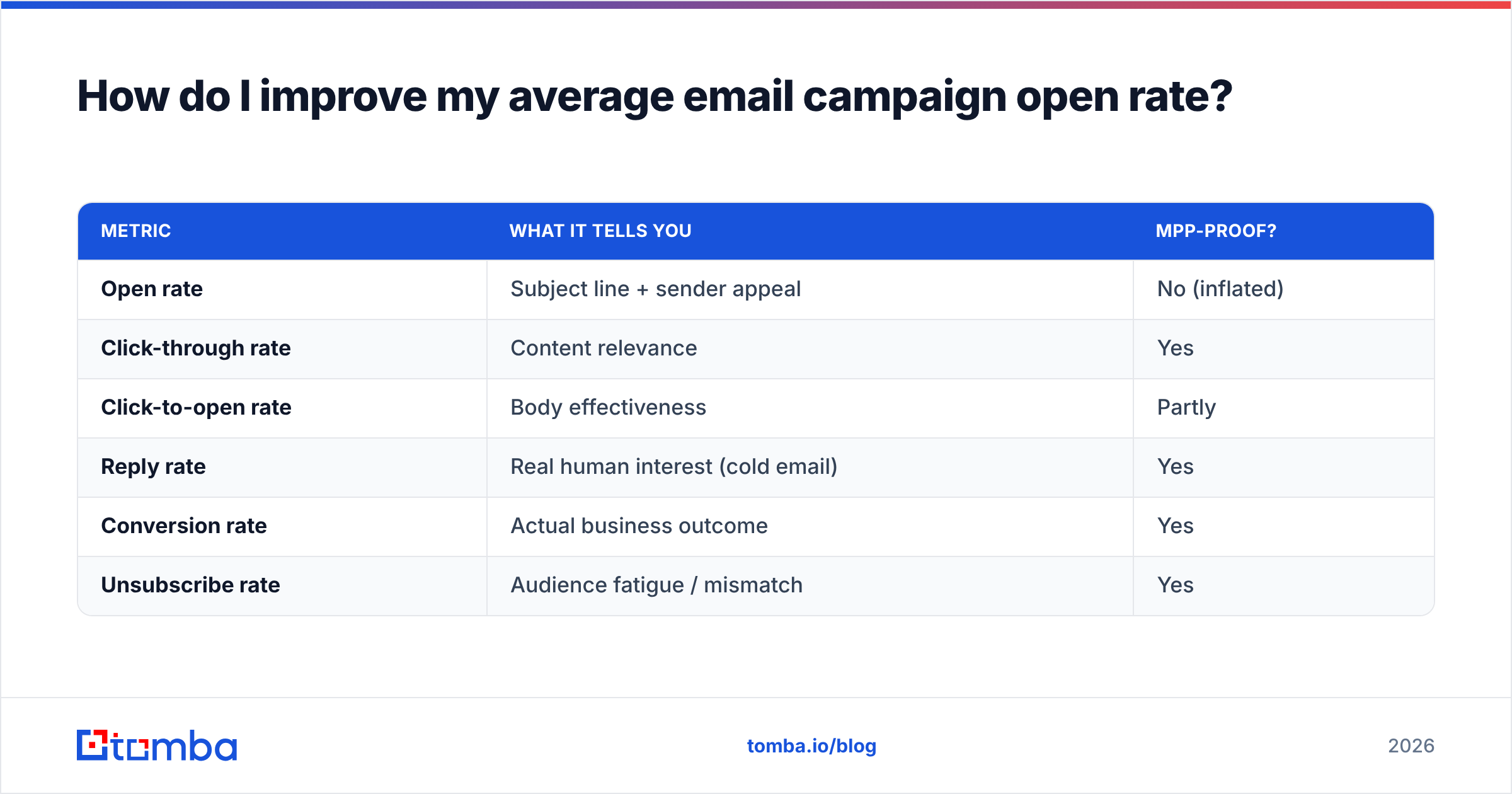
Open rate is a leading indicator, not the goal. Because MPP inflates it, smart teams increasingly anchor on metrics that reflect real intent:
| Metric | What it tells you | MPP-proof? |
|---|---|---|
| Open rate | Subject line + sender appeal | No (inflated) |
| Click-through rate | Content relevance | Yes |
| Click-to-open rate | Body effectiveness | Partly |
| Reply rate | Real human interest (cold email) | Yes |
| Conversion rate | Actual business outcome | Yes |
| Unsubscribe rate | Audience fatigue / mismatch | Yes |
If you run cold outbound, reply rate is your north star — see how it's defined in the response rate glossary entry. For newsletters and nurture, click-through and conversion tell you whether opens are translating into anything that matters. Chasing open rate alone is like judging a restaurant by how many people glance at the menu — the bill at the end is the real number.
What's a realistic open-rate target for a cold email campaign?#
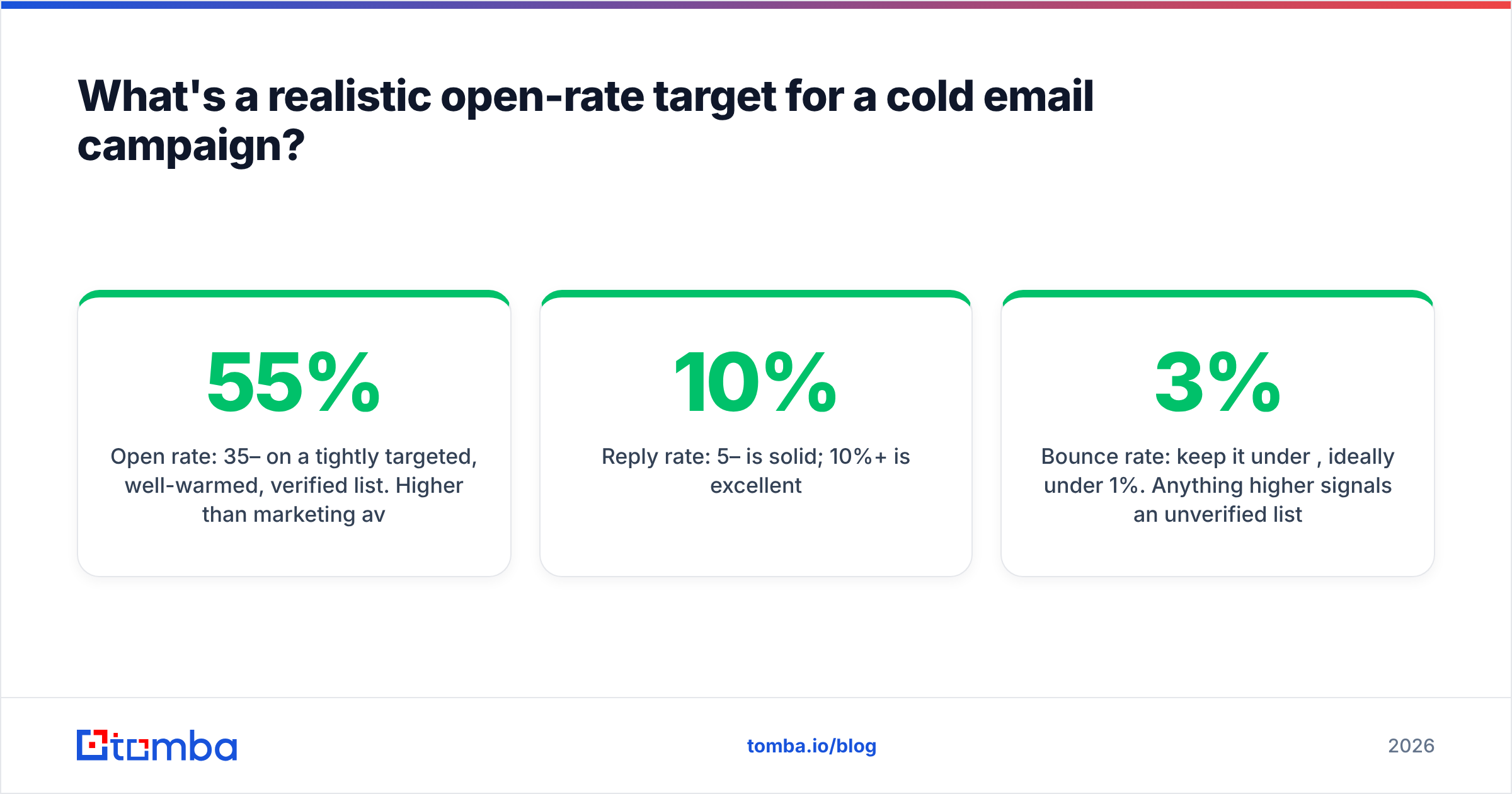
Cold email is a different animal from opt-in marketing. Because recipients never asked to hear from you, expectations are lower and deliverability is harder. Realistic 2026 cold-email targets:
- Open rate: 35–55% on a tightly targeted, well-warmed, verified list. Higher than marketing averages because cold sends are usually plain-text, one-to-one looking, and low-volume.
- Reply rate: 5–10% is solid; 10%+ is excellent.
- Bounce rate: keep it under 3%, ideally under 1%. Anything higher signals an unverified list and risks your domain.
The catch: those cold-email open numbers only hold if your list is genuinely clean and your domain is warmed. Send to unverified addresses and you'll see bounces spike, reputation crater, and opens collapse within a few sends. This is exactly why prospecting workflows should pair address discovery with verification — find the contact, confirm it's deliverable, then send.
For authoritative, vendor-neutral benchmarking beyond this post, Mailchimp's email marketing benchmarks and HubSpot's email marketing statistics are both updated regularly and worth bookmarking. For peer reviews of the tools themselves, G2's email marketing category aggregates real-user ratings.
Frequently asked questions#
Is a 20% open rate good? It's roughly average across all industries. For B2B or a permission-based newsletter, aim higher (25%+). For high-frequency retail, 20% is respectable.
Why did my open rate suddenly jump in late 2021? Apple's Mail Privacy Protection started auto-loading tracking pixels, inflating reported opens. The jump was measurement, not real behavior.
Can I still trust open rate at all? Yes, as a relative metric. Compare segments and campaigns against each other and against your own baseline — just don't treat the absolute number as gospel or compare it across different tracking eras.
What's the fastest way to lift opens? Verify your list to kill bounces and protect reputation, then fix authentication (SPF/DKIM/DMARC). Those two steps move the needle before any copywriting does.
Start with a list that actually opens#
Open rate problems are usually list problems wearing a costume. You can rewrite subject lines all day, but if a third of your contacts are stale, mistyped, or spam traps, the math never works — bounces drag down deliverability, and deliverability drags down opens.
Fix it at the source. Tomba's Email Finder lets you build campaign lists from verified professional addresses by name, company, or domain, with verification baked in so you're not sending into the void. Pair it with the email verifier to clean an existing list before your next send. Start free with 25 searches a month, and check the full Tomba pricing when you're ready to scale — Starter is $49/mo. Clean inputs, higher opens, healthier domain. That's the whole game.
// get started
Find, verify and enrich your first contacts today
Start on the free plan with 25 searches a month, then scale when your team is ready.
Free plan · No credit card required · GDPR & CCPA
// about the author