Average Email Conversion Rate in 2026: Real Benchmarks
What counts as a good email conversion rate in 2026? See benchmarks by industry and email type, plus the levers that actually move the number.
Average Email Conversion Rate in 2026: Real Benchmarks
TL;DR
- The average email conversion rate across B2B and B2C sits between 2% and 5%, depending on how you define a "conversion" and which email type you measure.
- Marketing newsletters convert lower per send (often 1-3%); triggered and transactional emails convert far higher (10%+) because intent is already there.
- Cold outreach is measured differently — a 2-5% positive-reply rate is solid, and 8%+ is excellent when your list is clean and targeted.
- Conversion rate is a chain: deliverability × open × click × landing-page action. A weak link anywhere caps the whole number.
- The fastest lever for most teams is not copy — it's list quality. Bounces and bad data quietly destroy conversion before anyone reads a word.
What is the average email conversion rate in 2026?#
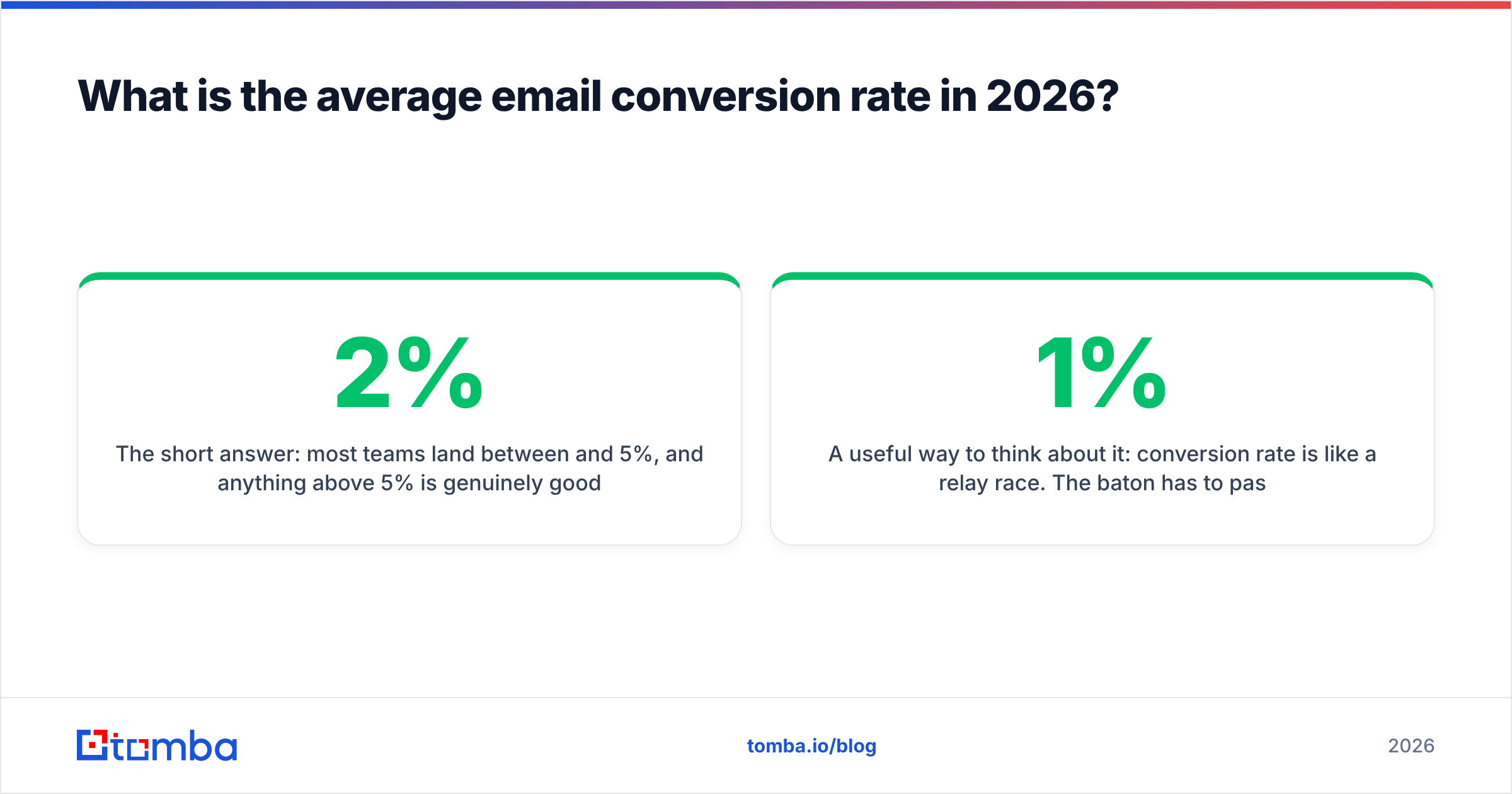
The short answer: most teams land between 2% and 5%, and anything above 5% is genuinely good.
But "conversion rate" is one of the most abused metrics in email. Before you compare yourself to a benchmark, you need to agree on the denominator. Some teams divide conversions by emails delivered. Others divide by emails opened, or by clicks. Each definition produces a wildly different percentage from the exact same campaign.
Here is the formula most analysts mean when they say "email conversion rate":
Email conversion rate = (Number of recipients who completed the goal action ÷ Number of emails delivered) × 100
The goal action is whatever you defined: a purchase, a demo booked, a form filled, a reply that signals interest. If you instead measure against opens, your number will look two to three times higher — flattering, but not comparable to anyone else's.
A useful way to think about it: conversion rate is like a relay race. The baton has to pass cleanly through four runners — inbox placement, the open, the click, and the landing action. The published "average" you see online is the time of the whole team, not any single runner. That is why two companies with identical copy can report 1% and 6%.
)
How is email conversion rate calculated step by step?#
Walk it through with real numbers so the chain is obvious.
Say you send 10,000 emails for a product launch:
- Delivered: 9,400 land (600 bounced or were filtered). Your delivery rate is 94%.
- Opened: 2,350 opens — a 25% open rate against delivered.
- Clicked: 470 clicks — a 5% click-through rate, or 20% of openers.
- Converted: 188 complete the goal (bought, booked, signed up).
Your conversion rate against delivered is 188 ÷ 9,400 = 2.0%. Against opens it would be 8%. Against clicks, 40%. Same campaign, three "rates." Always state the denominator when you report.
Notice where the leak started: 600 emails never arrived. Those recipients had a 0% chance of converting no matter how good the offer was. This is why people who obsess only over subject lines plateau — they are optimizing runner two while runner one trips at the start. Cleaning your list with an email verifier before send is the least glamorous and most reliable fix.
What is a good email conversion rate by industry?#
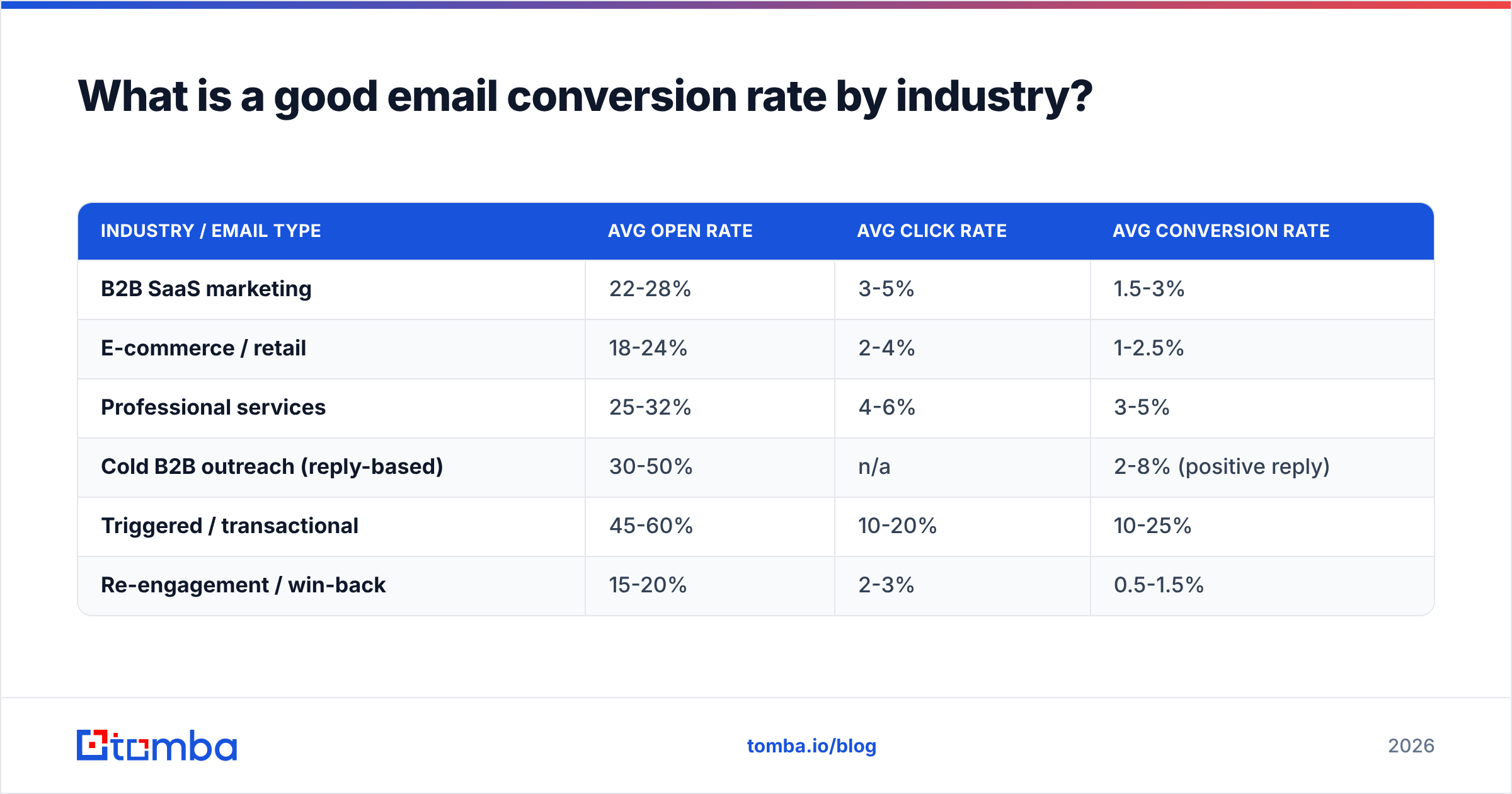
Benchmarks vary by sector because buying cycles, price points, and intent differ. The table below reflects commonly cited 2026 ranges for marketing email conversion measured against delivered messages. Treat these as goalposts, not gospel — your audience and offer move the number more than your industry does.
| Industry / Email type | Avg open rate | Avg click rate | Avg conversion rate |
|---|---|---|---|
| B2B SaaS marketing | 22-28% | 3-5% | 1.5-3% |
| E-commerce / retail | 18-24% | 2-4% | 1-2.5% |
| Professional services | 25-32% | 4-6% | 3-5% |
| Cold B2B outreach (reply-based) | 30-50% | n/a | 2-8% (positive reply) |
| Triggered / transactional | 45-60% | 10-20% | 10-25% |
| Re-engagement / win-back | 15-20% | 2-3% | 0.5-1.5% |
Two patterns jump out. First, transactional and triggered emails crush everything else — a password reset or order confirmation rides on existing intent, so the "conversion" is almost guaranteed. Second, cold outreach is a different animal and should never be benchmarked against newsletter conversion. Its goal is a reply, not an immediate purchase, so a 2-8% positive-reply rate is the realistic target.
For outbound teams, it helps to anchor on the surrounding metrics too — response rate and deliverability are leading indicators that move before conversion does.
Why is your email conversion rate lower than the benchmark?#
If your number is stuck below 2%, the cause is almost always one of these five, roughly in order of how often they're the culprit:
- Dirty list data. Invalid, stale, or catch-all addresses bounce or land in spam, dragging down delivery and sender reputation. This is the single most common silent killer.
- Weak targeting. The right message to the wrong person converts at zero. Spray-and-pray volume inflates your denominator with people who were never going to act.
- Deliverability problems. Missing SPF/DKIM/DMARC, a cold sending domain, or spammy formatting puts you in the promotions tab or junk folder.
- Offer-message mismatch. The email promises one thing; the landing page delivers another. The click happens, the conversion doesn't.
- Friction at the finish line. A slow page, a long form, or a forced login between click and goal. You earned the visit and then lost it.
Most teams reach for fix #4 or #5 first because copy and design feel controllable. But if #1 and #2 are broken, polishing the page is like repainting a car with a flat tire. Verify and target before you redesign.
)
How do you improve your average email conversion rate?#
Work the chain from the top down — fix arrival before you fix persuasion. Here is the order that produces the biggest gains per hour of effort.
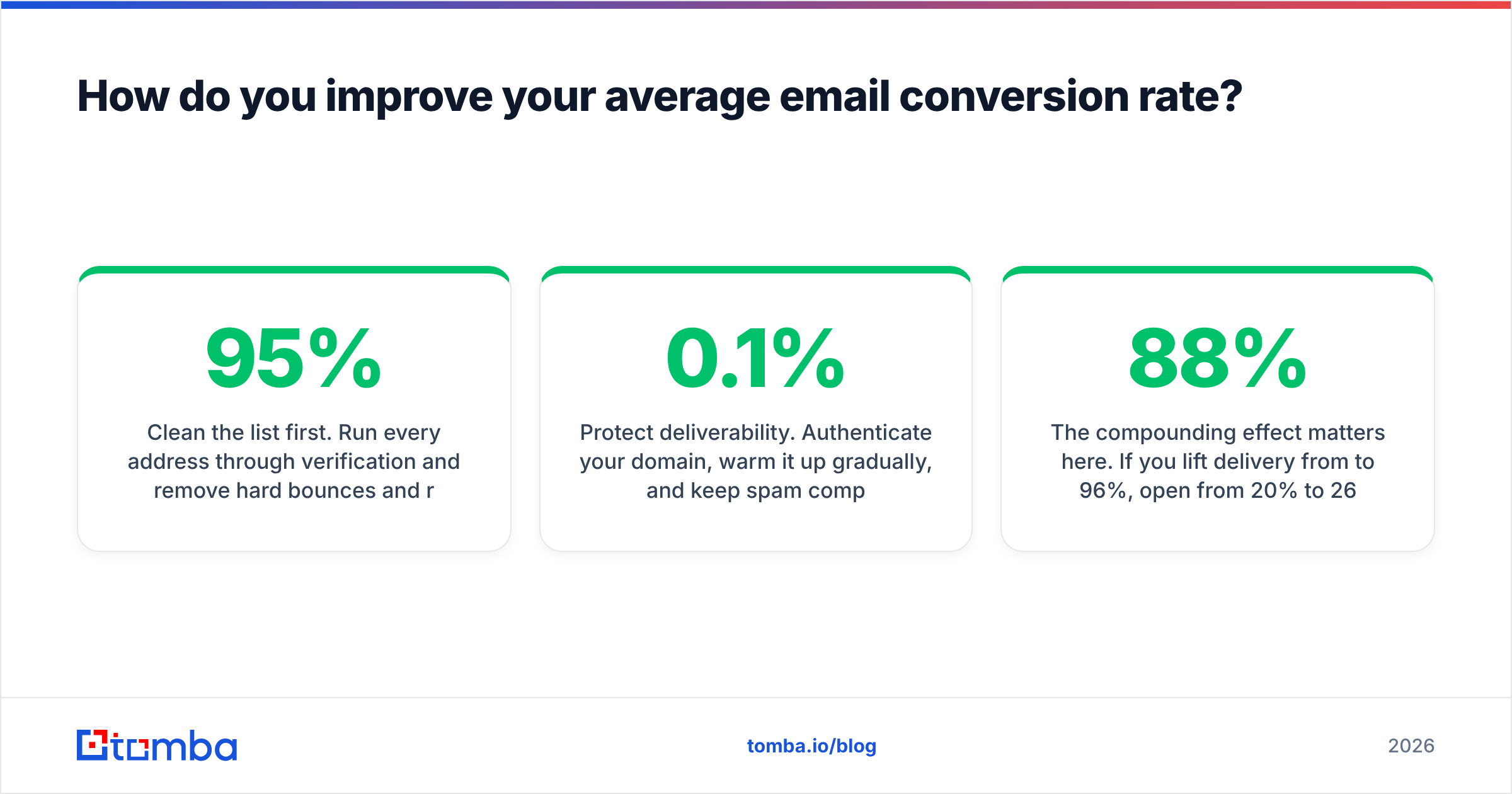
- Clean the list first. Run every address through verification and remove hard bounces and risky catch-alls. A 95%+ delivery rate is the floor for any reliable conversion number. Tomba's email verifier and catch-all verifier handle the two hardest cases.
- Tighten targeting and enrichment. Send to people who match your ICP and personalize with real attributes. Data enrichment lets you swap generic blasts for messages that reference the recipient's role, company, or stack.
- Protect deliverability. Authenticate your domain, warm it up gradually, and keep spam complaints under 0.1%. Tools like Google Postmaster show your reputation trend in near real time.
- Match offer to landing page. The headline a recipient clicks should be the first thing they see after clicking. Remove every step between the click and the goal that isn't strictly necessary.
- Test one variable at a time. Subject line, send time, CTA placement, sender name. Change one, measure against a clean baseline, keep what wins. A/B testing guidance from HubSpot and benchmark data from Mailchimp is a sane place to calibrate expectations.
The compounding effect matters here. If you lift delivery from 88% to 96%, open from 20% to 26%, and landing-page action from 30% to 38%, you haven't tripled any single metric — but the multiplied chain can nearly double your end conversion rate. Small, honest gains at each stage beat one heroic rewrite.
How does cold email conversion differ from marketing email?#
They share a formula and almost nothing else.
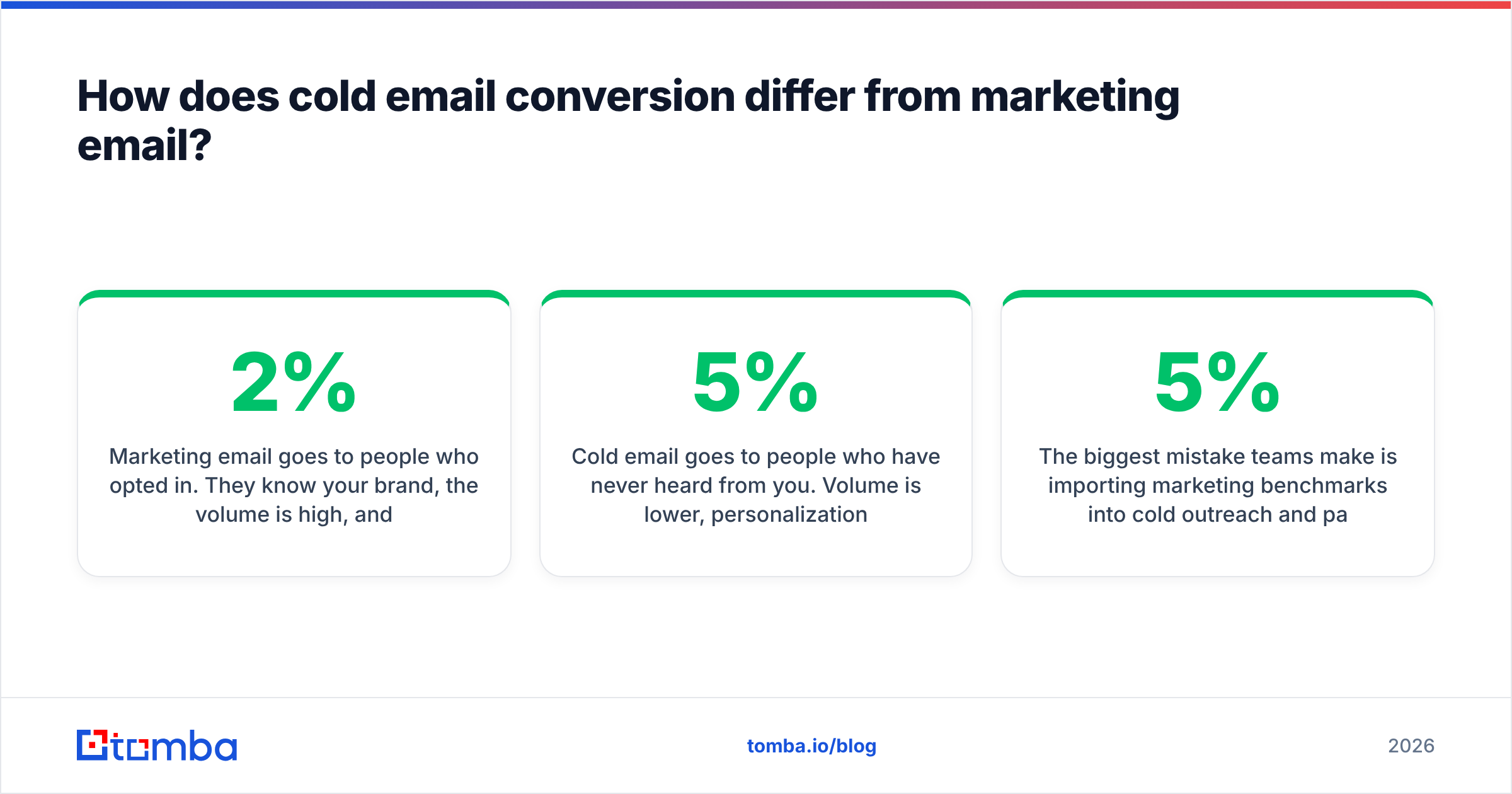
Marketing email goes to people who opted in. They know your brand, the volume is high, and the conversion event is usually a click-to-purchase or a sign-up. Success is measured at scale: a 2% conversion on 50,000 sends is 1,000 actions.
Cold email goes to people who have never heard from you. Volume is lower, personalization is higher, and the conversion event is a reply or a booked meeting — not an instant sale. A cold campaign of 1,000 well-targeted, verified contacts that yields 50 positive replies (5%) is a strong result, even though the raw count is tiny next to a newsletter.
The biggest mistake teams make is importing marketing benchmarks into cold outreach and panicking. A 5% conversion looks "low" against a transactional 20%, but in cold context it's excellent. Judge cold campaigns on reply quality and pipeline created, not on newsletter math. And because every cold send is precious, list accuracy matters even more — one bad address isn't just a lost conversion, it's a reputation hit on a domain you're still warming.
This is exactly where finding the right verified contact upfront pays off. Building a targeted list with an accurate email finder and confirming each address before send turns a guess-heavy channel into a predictable one. For accuracy and sourcing details, Tomba documents its data sources openly.
What conversion rate should you actually aim for?#
Set a target relative to your own baseline, not a stranger's screenshot.
If you're starting fresh, aim for these milestones in order:
- Delivery rate 95%+ — non-negotiable foundation.
- Open rate at or above your industry median (use the table above).
- Conversion rate 2%+ against delivered for marketing; 3%+ positive reply for cold.
- Then push past the benchmark by improving one chain link per cycle.
A realistic 90-day path: month one, fix list hygiene and authentication; month two, improve targeting and personalization; month three, optimize copy and landing pages. Teams that follow that order routinely move from sub-2% to 4-5% without any new tooling magic — just by stopping the leaks first.
Pricing for verification and finding scales with volume, so check Tomba pricing to match a plan to your send volume rather than over-buying credits you won't use.
Frequently asked questions#
Is a 5% email conversion rate good? Yes. For most marketing email measured against delivered messages, 5% is above average and indicates strong list quality and offer-message fit. For cold outreach, a 5% positive-reply rate is also a strong result.
Why is my conversion rate high on opens but low on delivered? Because a chunk of your list never received the email. High open-based conversion with low delivered-based conversion is the signature of a deliverability or list-quality problem. Verify the list and check authentication.
Does open rate still matter in 2026? It's a useful directional signal but less reliable than it was, thanks to privacy features that auto-load images and inflate opens. Weight clicks, replies, and final conversions more heavily.
How often should I clean my email list? Before every major campaign at minimum, and continuously for ongoing sends. Lists decay roughly 2-3% per month as people change jobs, so monthly verification keeps your denominator honest.
Start with a list that actually converts#
Your conversion rate is only as good as the addresses you send to. Before you rewrite a single subject line, make sure every contact is real, reachable, and right for your offer. The Tomba Email Finder sources accurate professional addresses by name, company, or domain — and pairs with Tomba's verifier so the list you build is the list that lands. Start on the free tier (25 searches a month), then scale into a paid plan as your volume grows. Clean data in, higher conversion out.
// get started
Find, verify and enrich your first contacts today
Start on the free plan with 25 searches a month, then scale when your team is ready.
Free plan · No credit card required · GDPR & CCPA
// about the author