Average Email Open Rate in 2026: Benchmarks & Fixes
The average email open rate sat near 20% back in 2020 — here's what changed by 2026, why Apple MPP broke the metric, and the benchmarks that actually matter now.
The "average email open rate" question used to have a tidy answer: somewhere around 18–22%, depending on your industry. Then Apple Mail Privacy Protection landed, deliverability tightened, and the number you see in your dashboard stopped meaning what it used to. If you're still benchmarking your 2026 campaigns against a 2020 number, you're optimizing against a ghost.
TL;DR#
- In 2020, the average email open rate sat near 18–22% across most B2B and B2C verticals — a usable, trustworthy signal.
- Apple Mail Privacy Protection (MPP), launched in late 2021, inflated reported opens by auto-loading tracking pixels, so 2026 "open rates" of 30–40%+ are partly fake.
- By 2026, smart teams treat open rate as a soft signal and lean on click rate, reply rate, and conversions instead.
- Low real opens usually trace back to three things: bad list hygiene, weak deliverability, and forgettable subject lines.
- Cleaning your list with a verifier and finding accurate contacts up front does more for opens than any subject-line trick.
What was the average email open rate in 2020?#
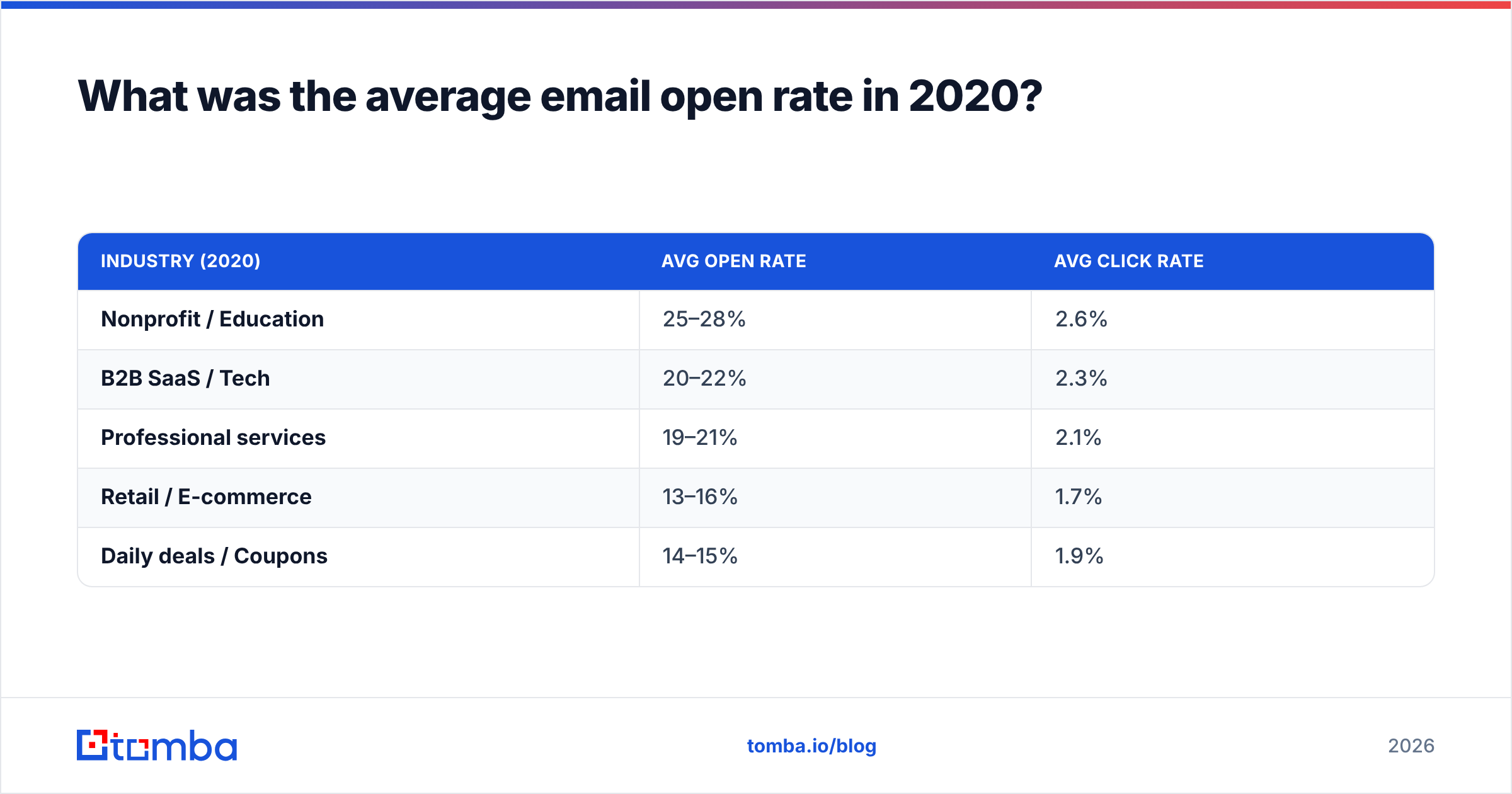
In 2020, the average email open rate across industries landed in the 18% to 22% range. Marketing benchmark reports from major ESPs converged on roughly 20% as the "you're doing fine" line. Some verticals beat it handily — nonprofits, education, and hobby newsletters often saw 25–30% — while crowded spaces like retail and daily deals dragged toward the low teens.
That number was useful because the measurement was honest. An "open" meant a human (or at least that human's mail client at their request) loaded a 1x1 tracking pixel. Pixel loaded, open counted. It wasn't perfect — image blocking and preview panes always introduced noise — but it correlated with real human attention well enough to steer subject-line tests and send-time experiments.
Here's what the 2020 baseline looked like by broad category:
| Industry (2020) | Avg open rate | Avg click rate |
|---|---|---|
| Nonprofit / Education | 25–28% | 2.6% |
| B2B SaaS / Tech | 20–22% | 2.3% |
| Professional services | 19–21% | 2.1% |
| Retail / E-commerce | 13–16% | 1.7% |
| Daily deals / Coupons | 14–15% | 1.9% |
The takeaway from 2020 was simple: hit ~20% and your list, sender reputation, and subject lines were broadly healthy. That clean signal is exactly what got disrupted.
Why did open rates change so much after 2020?#
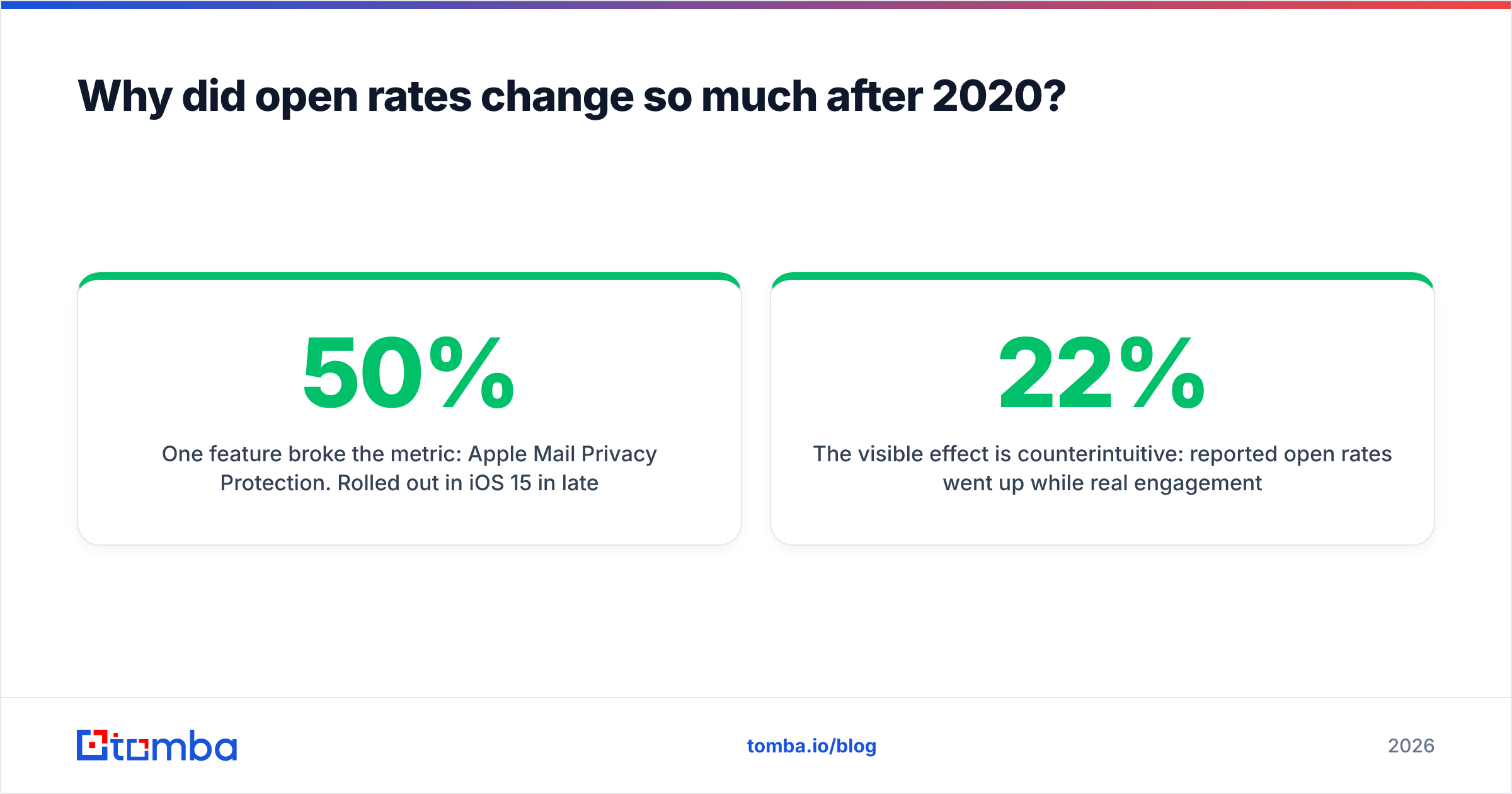
One feature broke the metric: Apple Mail Privacy Protection. Rolled out in iOS 15 in late 2021 and adopted fast, MPP pre-fetches email content — including your tracking pixel — through Apple's proxy servers, whether or not the recipient ever opens the message. If a meaningful slice of your audience uses Apple Mail (and on consumer lists that's often 40–50%), a large chunk of your "opens" are now machines, not people.
The visible effect is counterintuitive: reported open rates went up while real engagement stayed flat or fell. Teams that saw their dashboards jump from 22% to 38% weren't suddenly writing better subject lines. Their tracking just started counting Apple's prefetch as a human open.
A few compounding shifts also landed between 2020 and 2026:
- Stricter inbox-provider filtering. Google and Yahoo's 2024 bulk-sender rules forced authentication (SPF, DKIM, DMARC) and capped spam-complaint rates, pushing borderline senders to spam where opens never happen.
- Privacy-first defaults everywhere. More clients block or proxy images by default, adding noise in both directions.
- Inbox overload. Average recipients get more email than in 2020, so genuine attention per message dropped even as fake opens rose.
- AI-assisted triage. Smart inboxes and summary tools mean some messages get "read" without a classic open event firing at all.
The net result: the 2026 number on your screen is louder and less trustworthy than the 2020 number was. You can read more about the underlying mechanics in our breakdown of email deliverability and sender reputation.
What is a good email open rate in 2026?#
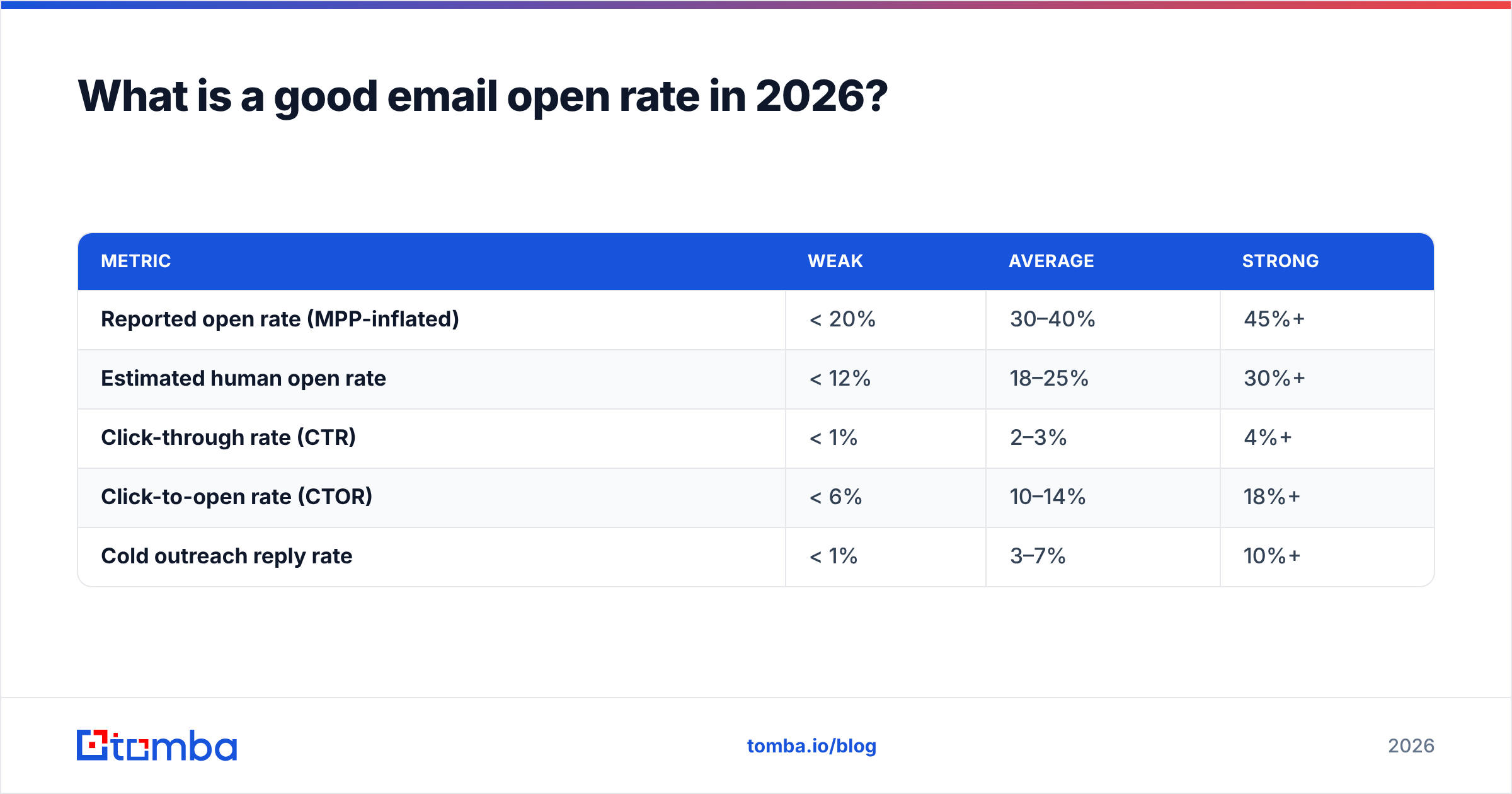
A "good" 2026 open rate depends entirely on whether you're counting MPP-inflated opens or filtered, human opens. Because of that, raw benchmarks are slippery. Still, here's a realistic frame for where campaigns land in 2026:
| Metric | Weak | Average | Strong |
|---|---|---|---|
| Reported open rate (MPP-inflated) | < 20% | 30–40% | 45%+ |
| Estimated human open rate | < 12% | 18–25% | 30%+ |
| Click-through rate (CTR) | < 1% | 2–3% | 4%+ |
| Click-to-open rate (CTOR) | < 6% | 10–14% | 18%+ |
| Cold outreach reply rate | < 1% | 3–7% | 10%+ |
Two practical rules for 2026:
- Stop benchmarking against other companies' open rates. Their Apple-user mix, ESP, and tracking setup differ from yours, so the comparison is apples to oranges. Benchmark against your own 90-day trailing average instead.
- Promote click and reply rates to primary KPIs. A click is a deliberate human action MPP can't fake. For cold outreach, reply rate is the only number that pays your salary. Open rate becomes a directional health check, not a scoreboard.
If you run cold campaigns, pair this with our guidance on response rate to anchor on the metric that actually predicts revenue.
How do you fix a low email open rate?#
Real opens are downstream of three things: list quality, deliverability, and the subject line — in that order. Most teams obsess over subject lines (the cheapest lever) while ignoring list quality (the highest-impact one). Fix them in the right sequence.
1. Clean and verify your list first#
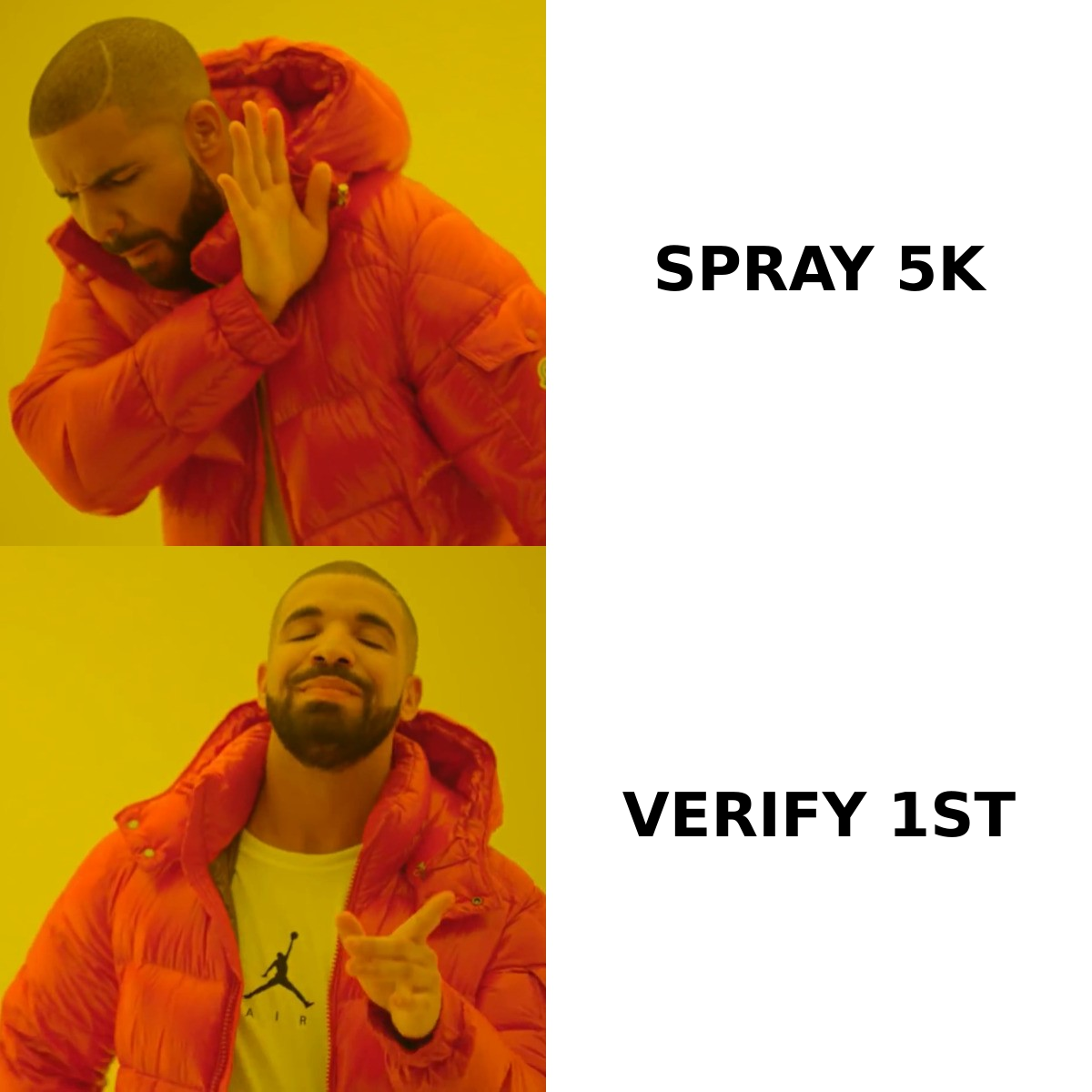
Sending to dead, mistyped, or spam-trap addresses tanks your sender reputation, which lands future mail in spam, which kills opens for everyone on the list — not just the bad addresses. Before any send, run your list through an email verifier to strip invalid and risky addresses. If you buy or scrape lists, this step is non-negotiable.
For ambiguous domains that accept everything, a dedicated catch-all verifier tells you whether a mailbox is likely real before you risk your reputation on it.
2. Build the list from accurate sources, not guesses#
Garbage in, garbage out. If you're permutating "first.last@company.com" and praying, half your sends bounce. Use an email finder that returns verified, sourced addresses tied to real people at real companies, so your list starts clean instead of needing rescue. Accurate contact data at the top of the funnel beats every downstream trick.

3. Authenticate your domain#
Without SPF, DKIM, and DMARC properly configured, Gmail and Yahoo will throttle or junk your mail under their 2024 sender requirements. Check your records with a free SPF checker and confirm your SPF record is valid. This is table stakes in 2026 — skip it and nothing else matters.
4. Warm up and protect sender reputation#
New domains and IPs need gradual volume ramp-up. Sudden spikes look like spam. Keep complaint rates under 0.3% and bounce rates low, and your inbox placement — and therefore opens — stays healthy.
5. Then, and only then, optimize subject lines#
Once the list and deliverability are solid, subject lines become the lever that moves real opens. Keep them short (4–7 words), specific, and curiosity-driven without bait. Test one variable at a time. A subject-line tester or subject line generator speeds up iteration, but remember: a great subject line on a spam-foldered email opens nothing.
Should you still track open rate at all?#
Yes — but as a diagnostic, not a goal. Open rate is like a car's temperature gauge. You don't drive to maximize the temperature; you watch it to catch problems. A sudden open-rate drop is an early warning that deliverability tanked, a segment went stale, or your tracking broke. That signal is genuinely valuable even when the absolute number is noisy.
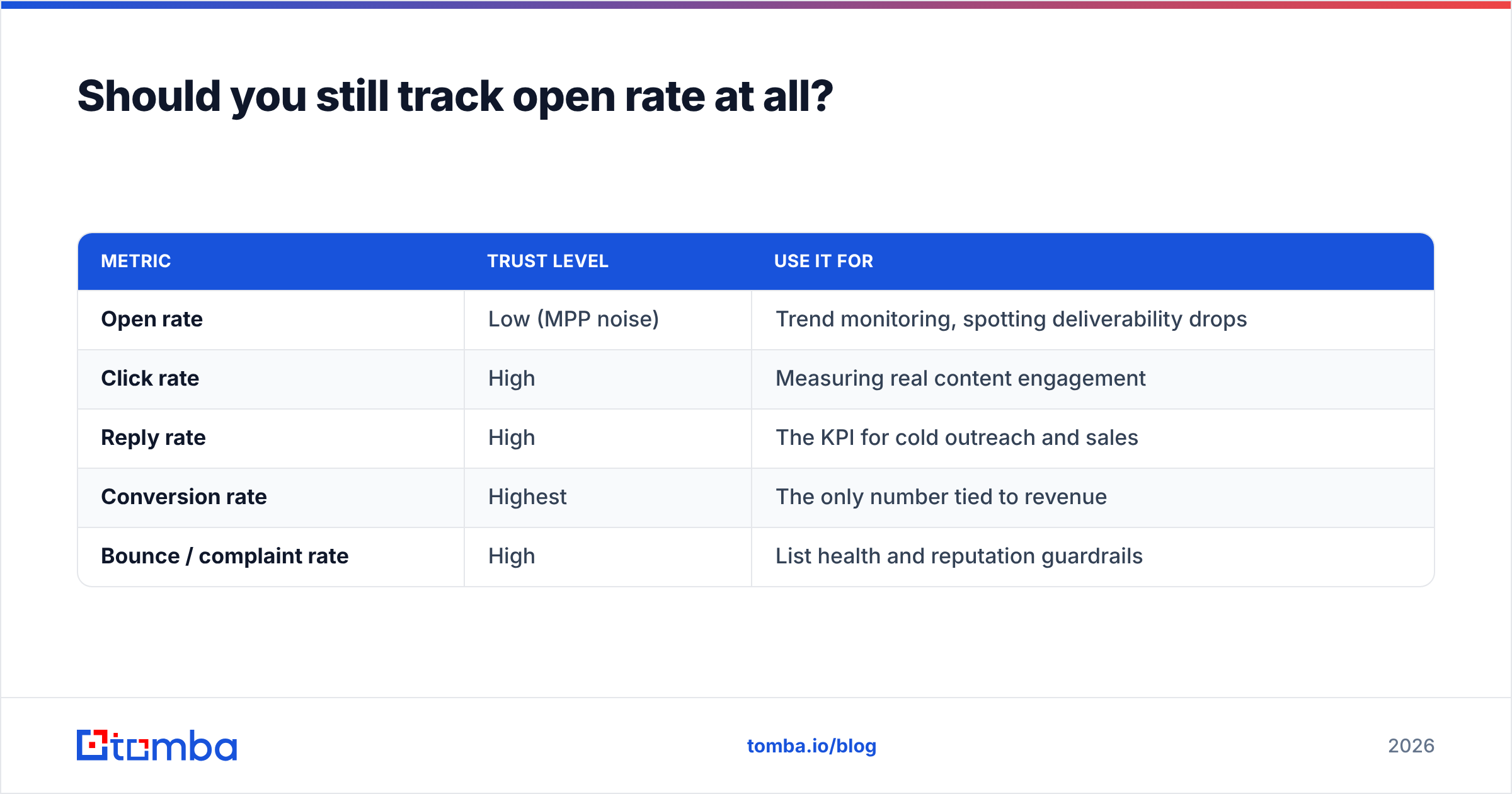
Here's how to use each metric in 2026:
| Metric | Trust level | Use it for |
|---|---|---|
| Open rate | Low (MPP noise) | Trend monitoring, spotting deliverability drops |
| Click rate | High | Measuring real content engagement |
| Reply rate | High | The KPI for cold outreach and sales |
| Conversion rate | Highest | The only number tied to revenue |
| Bounce / complaint rate | High | List health and reputation guardrails |
The smartest 2026 setup: watch open rate for direction, optimize for clicks and replies, and report on conversions. Tracking opens in isolation — the way many teams still do — is how you end up celebrating a 40% "open rate" while your pipeline stays empty.
For a deeper look at where contact data quality fits into all of this, see how data enrichment keeps your records accurate over time, and review the public benchmark data published by ESPs like Mailchimp and HubSpot to sanity-check your own trends. Apple's own Mail Privacy Protection documentation explains exactly what gets prefetched and why your numbers shifted.
What's the bottom line on average email open rate?#
The 2020 average — roughly 20% — was a clean, comparable benchmark. The 2026 number is a louder, MPP-inflated figure that tells you less. If you anchor your strategy to that single metric, you're steering by a broken compass.
The fix isn't a clever subject line. It's the unglamorous work upstream: build your list from accurate, verified contacts; clean it before every send; authenticate your domain; protect your sender reputation; and then test subject lines. Do that, and your real opens — the ones attached to humans who click, reply, and buy — climb on their own.
Open rate measures attention. Attention starts with reaching the right inbox, which starts with the right address.
Start with accurate, verified contacts#
Every open rate problem traces back to who's on your list. Stop sending to guesses. The Tomba Email Finder returns verified professional email addresses sourced from real companies, so your campaigns start with a clean, deliverable list instead of a bounce-prone one. Pair it with the built-in verifier, start free with 25 searches a month, and scale on a plan when you're ready — Starter is $49/mo. Better data in means better opens out. That's the only "subject-line hack" that compounds.
// get started
Find, verify and enrich your first contacts today
Start on the free plan with 25 searches a month, then scale when your team is ready.
Free plan · No credit card required · GDPR & CCPA
// about the author