Average Open Rate Newsletter: 2026 Benchmarks & Fixes
What counts as a good newsletter open rate in 2026, how Apple MPP broke the metric, and the levers that actually move the number.
TL;DR
- The average open rate for a newsletter in 2026 sits around 35–42% as reported by ESPs — but that number is inflated by Apple Mail Privacy Protection auto-opens, so treat it as a ceiling, not the truth.
- A "good" open rate is relative: B2B newsletters average lower (30–38%) than hobby or nonprofit lists (40%+). Benchmark against your own segment, not a global average.
- Opens are now a soft signal. Clicks, reply rate, and unsubscribe rate are the metrics that survive the privacy era.
- The single biggest lever on open rate is list quality — a clean, verified list outperforms clever subject lines almost every time.
- Sender reputation, send time, and from-name consistency move the number more than most marketers expect.
What is the average open rate for a newsletter in 2026?#
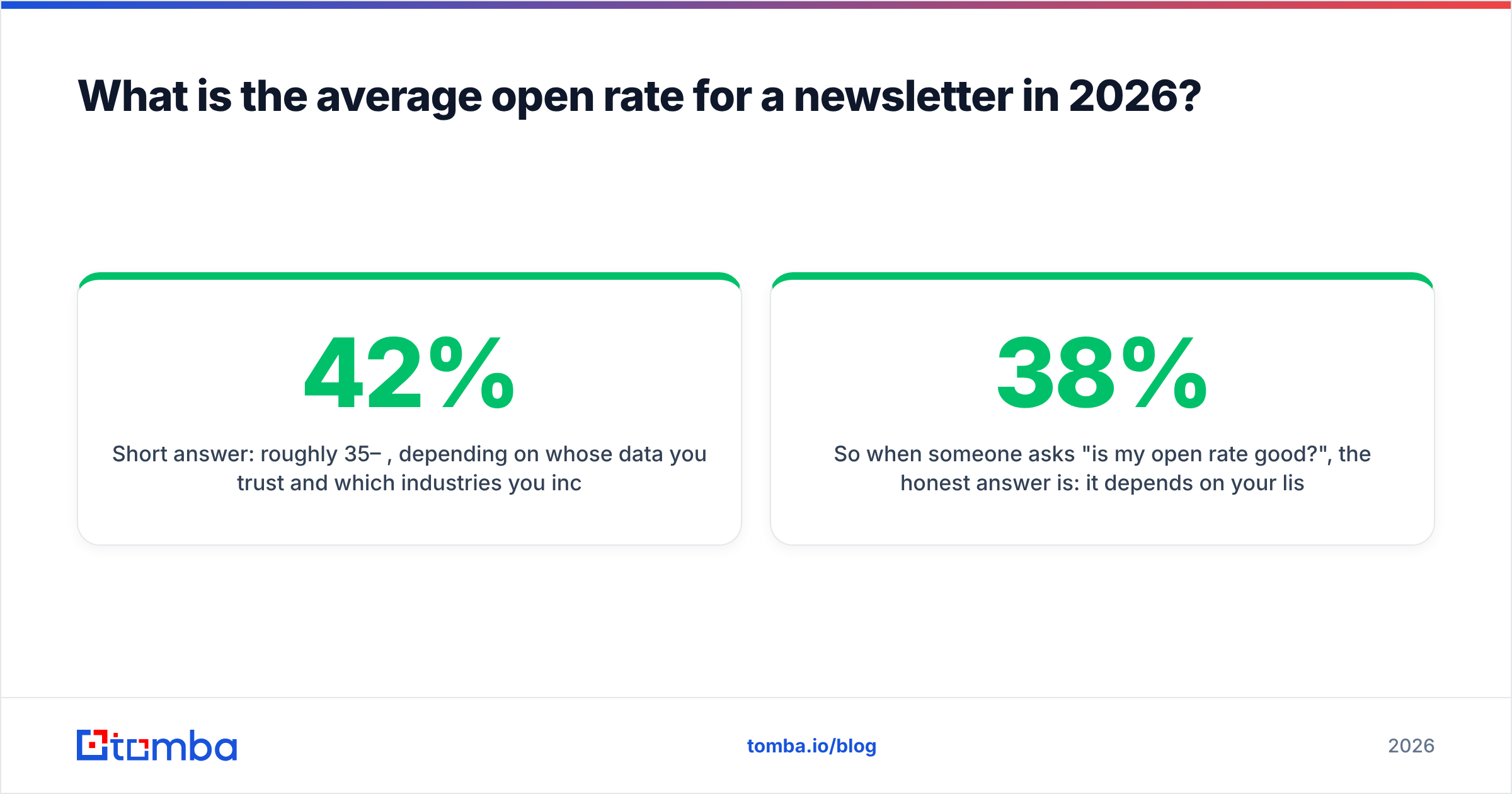
Short answer: roughly 35–42%, depending on whose data you trust and which industries you include. Mailchimp, HubSpot, and Campaign Monitor all publish numbers in that band for 2025–2026, up sharply from the 20–25% that was "normal" before 2021.
That jump is not because newsletters suddenly got more interesting. It's because Apple Mail Privacy Protection (MPP) started pre-fetching tracking pixels in late 2021, registering an "open" whether or not a human ever read the email. Apple Mail accounts for a large share of opens, so the reported average drifted upward without any real change in reader behavior.
Think of open rate like a restaurant's reservation count when the booking system auto-confirms every reservation request. The number looks healthy, but a chunk of those tables are empty. You still need the metric — you just have to read it knowing it's padded.
So when someone asks "is my 38% open rate good?", the honest answer is: it depends on your list, your industry, and how much of your audience is on Apple Mail. The global average is a starting reference, not a verdict.

What is a good newsletter open rate by industry?#
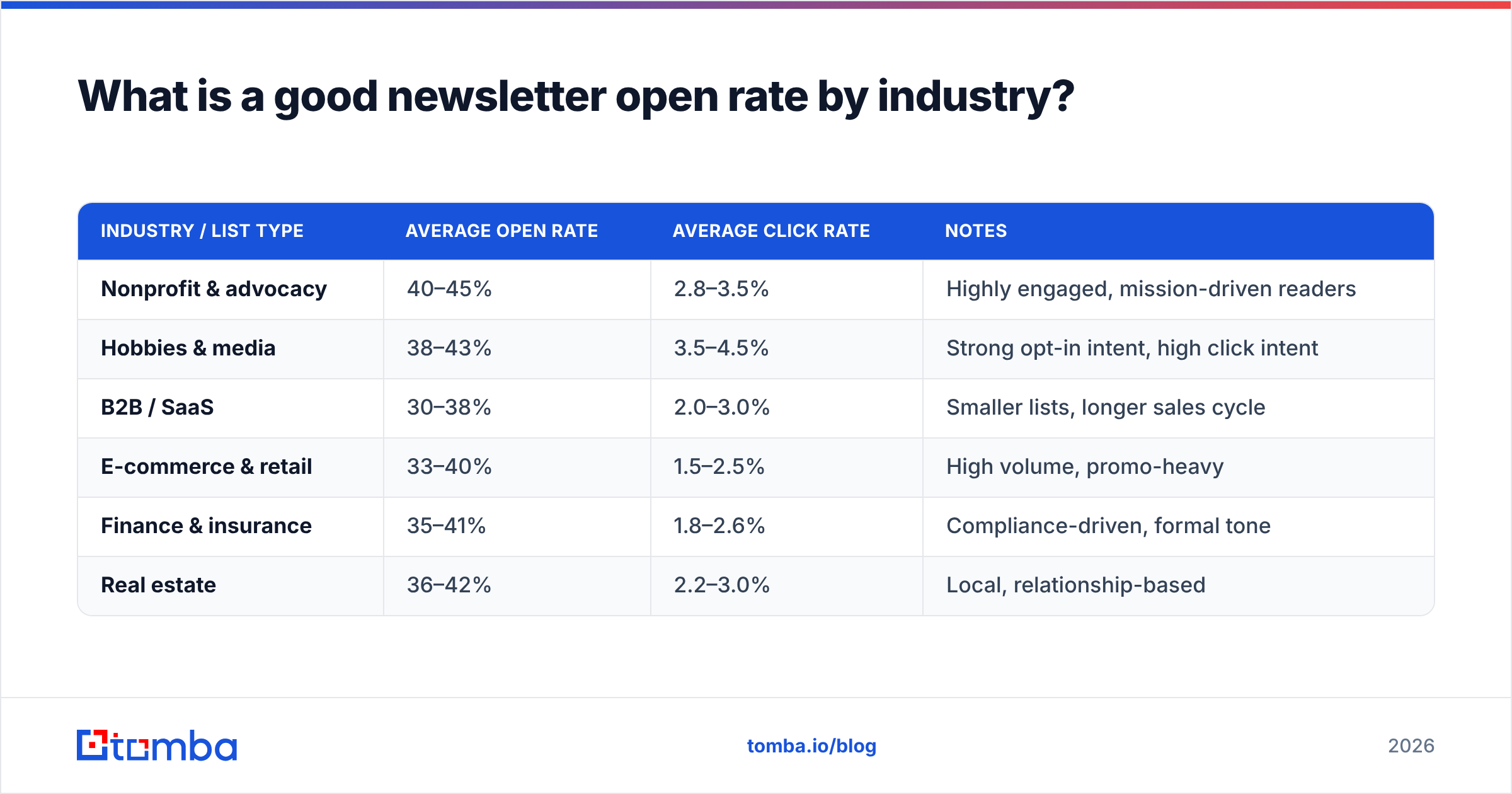
There is no universal "good." A 30% open rate can be excellent for a high-volume retail list and mediocre for a tight, opted-in B2B briefing. Here's how the major benchmarks break down in 2026.
| Industry / list type | Average open rate | Average click rate | Notes |
|---|---|---|---|
| Nonprofit & advocacy | 40–45% | 2.8–3.5% | Highly engaged, mission-driven readers |
| Hobbies & media | 38–43% | 3.5–4.5% | Strong opt-in intent, high click intent |
| B2B / SaaS | 30–38% | 2.0–3.0% | Smaller lists, longer sales cycle |
| E-commerce & retail | 33–40% | 1.5–2.5% | High volume, promo-heavy |
| Finance & insurance | 35–41% | 1.8–2.6% | Compliance-driven, formal tone |
| Real estate | 36–42% | 2.2–3.0% | Local, relationship-based |
A few rules of thumb when reading this table:
- Compare like with like. Your B2B SaaS newsletter should be measured against the 30–38% B2B band, not the 43% media average.
- Watch the click rate column. Because opens are inflated, click-through rate is the more reliable health signal in 2026.
- Track your own trendline. A 3-point drop month-over-month tells you more than any industry average ever will.
- Segment before you judge. Your most engaged 20% might open at 60% while a cold re-engagement segment limps along at 12%.
For the underlying methodology behind these figures, Mailchimp's email benchmark report and HubSpot's marketing statistics are the two most-cited public sources, and both update annually.
Why are open rates unreliable now — and what should you track instead?#
Open rates are unreliable because the open event itself is no longer a clean signal of human attention. Apple MPP pre-loads images, some corporate security gateways do the same, and privacy-focused clients block pixels entirely. The result: opens are simultaneously inflated (bots and pre-fetchers count) and undercounted (pixel blockers don't). You're measuring two kinds of noise at once.
That doesn't make open rate useless — it makes it a directional metric. Use it to spot sudden drops (often a deliverability problem) and relative differences between A/B subject lines. Don't use it as your north star.
The metrics worth promoting to the top of your dashboard:
- Click-through rate (CTR): a click is a deliberate human action. Hard to fake, hard to inflate.
- Click-to-open rate (CTOR): clicks divided by opens — measures whether your content delivered on the subject line's promise.
- Reply rate: the strongest engagement signal there is, especially for B2B and founder-led newsletters.
- Unsubscribe and spam-complaint rate: the early-warning system for email deliverability trouble. Anything above 0.1% spam complaints needs immediate attention.
- List growth net of churn: a rising open rate on a shrinking list is a vanity trap.
If you want the mechanics of how these tie together, Wikipedia's overview of the email open rate metric is a solid neutral primer on what the pixel actually measures.
How does list quality affect your average open rate?#
List quality is the highest-leverage factor in your entire open-rate equation — bigger than subject lines, bigger than send time. The reason is mechanical: every invalid, mistyped, or abandoned address you mail to is a missed open and a hit to your sender reputation, which then suppresses delivery to the good addresses too.
Here's the chain reaction. You import a list with 12% dead addresses. Those bounce. Mailbox providers like Gmail and Outlook read high bounce rates as a spammer signature. Your inbox placement drops. Now even your engaged subscribers start landing in Promotions or Spam, where they never open. Your "open rate" craters — not because your content got worse, but because your list was dirty.
This is why a clean, verified list beats a clever subject line almost every time. Before any send to a new or aged list, run it through an email verifier to strip out:
- Hard bounces and dead mailboxes
- Spam traps and known complainers
- Role-based addresses (info@, sales@) that rarely engage
- Catch-all domains worth flagging for extra scrutiny

And when you're building the list in the first place, sourcing accurate contacts from the start saves you the cleanup later. Tomba's email finder returns verified professional addresses by name or domain, so the list you import is already most of the way to inbox-ready. Garbage in, garbage open rate — the fix starts at acquisition.
What actually moves the newsletter open rate needle?#
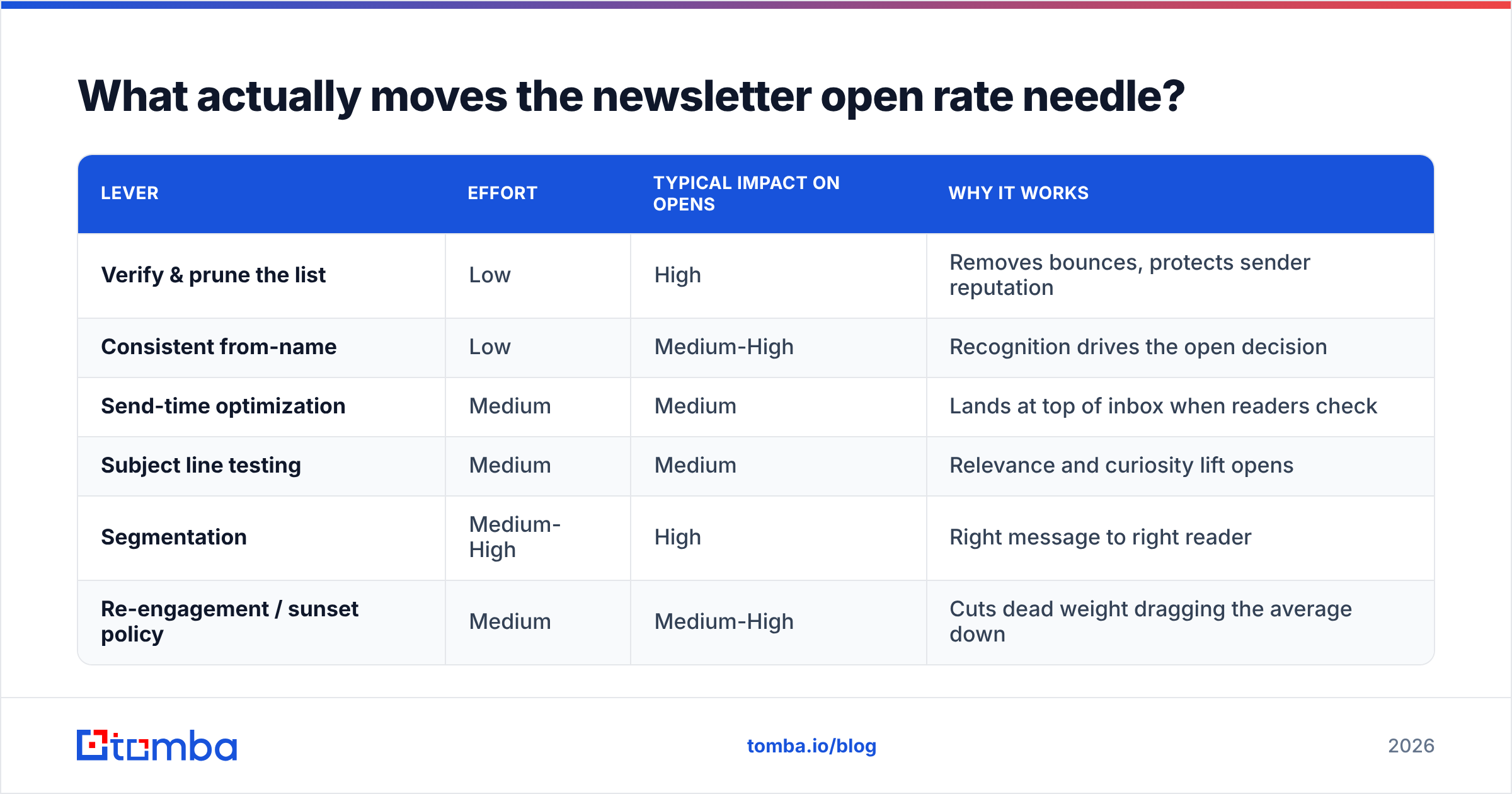
Beyond list hygiene, a handful of levers reliably shift opens. Here they are, ranked by impact for most senders.
| Lever | Effort | Typical impact on opens | Why it works |
|---|---|---|---|
| Verify & prune the list | Low | High | Removes bounces, protects sender reputation |
| Consistent from-name | Low | Medium-High | Recognition drives the open decision |
| Send-time optimization | Medium | Medium | Lands at top of inbox when readers check |
| Subject line testing | Medium | Medium | Relevance and curiosity lift opens |
| Segmentation | Medium-High | High | Right message to right reader |
| Re-engagement / sunset policy | Medium | Medium-High | Cuts dead weight dragging the average down |
A few specifics worth internalizing:
- From-name beats subject line for recognition. Readers decide to open based on who sent it before they finish reading what it's about. Keep your sender name consistent and human ("Sarah at Tomba" outperforms "noreply").
- Segmentation is the quiet multiplier. Splitting a 10,000-person list into engaged / lapsed / cold and mailing each differently often lifts the blended open rate more than any subject-line tweak.
- A sunset policy raises your average by subtraction. Stop mailing people who haven't opened in 6–12 months. They depress your rate and your reputation. Suppress them, run one final win-back, then let them go.
- Authentication is table stakes. Without proper SPF, DKIM, and DMARC, your newsletter may never reach the inbox to be opened. Mailbox providers tightened these requirements in 2024 and haven't loosened them.
- Warm up new sending domains. A brand-new domain blasting 50,000 emails looks exactly like a spammer. Ramp volume gradually — Tomba's email warmup calculator helps you plan the ramp.
If you're sending cold or semi-cold, also run your draft through a spam checker before launch — spammy copy and broken authentication will tank deliverability before open rate even enters the picture.
How do you calculate and benchmark your own open rate correctly?#
Calculate it the standard way, then adjust your interpretation for the privacy era.
The formula:
Open rate = (unique opens / emails delivered) × 100Use delivered, not sent — sending to bounced addresses understates your true rate. Most ESPs do this automatically, but verify yours does.
Benchmark it honestly with these steps:
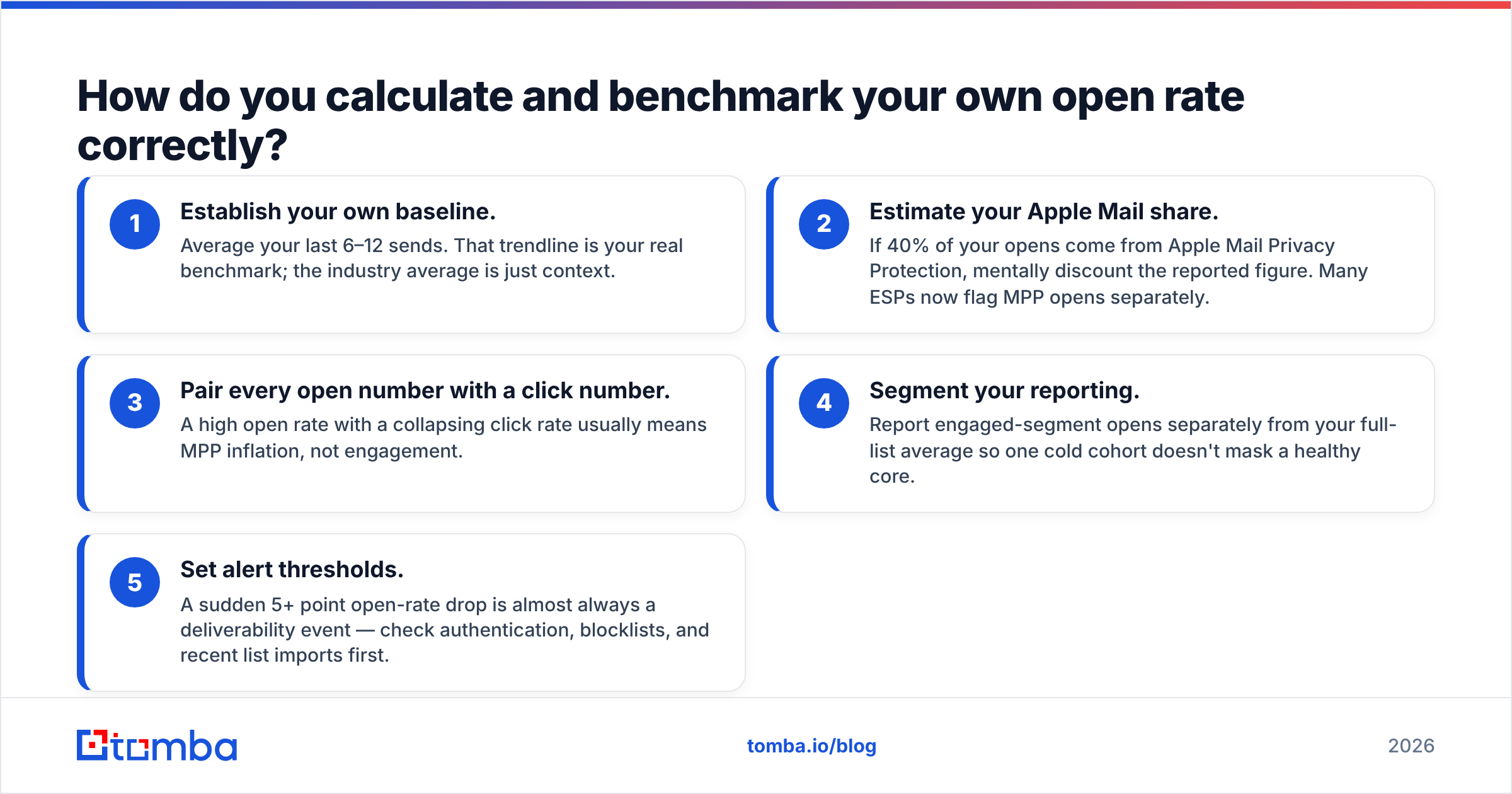
- Establish your own baseline. Average your last 6–12 sends. That trendline is your real benchmark; the industry average is just context.
- Estimate your Apple Mail share. If 40% of your opens come from Apple Mail Privacy Protection, mentally discount the reported figure. Many ESPs now flag MPP opens separately.
- Pair every open number with a click number. A high open rate with a collapsing click rate usually means MPP inflation, not engagement.
- Segment your reporting. Report engaged-segment opens separately from your full-list average so one cold cohort doesn't mask a healthy core.
- Set alert thresholds. A sudden 5+ point open-rate drop is almost always a deliverability event — check authentication, blocklists, and recent list imports first.
For deeper diagnostics when opens fall off a cliff, check whether your sending IP or domain landed on a blacklist and confirm your sender reputation is intact. Nine times out of ten, a mystery open-rate drop traces back to one of those two things — not your copy.
So what should you aim for?#
Aim to beat your own last 90 days, and keep your engaged-segment open rate above 40% while your full-list rate stays north of the 30–38% band for your industry. Chase clicks and replies as your real success metric, and treat opens as the early-warning gauge they've become.
The teams that win the open-rate game in 2026 aren't the ones with the cleverest subject lines. They're the ones mailing clean, verified, well-segmented lists to people who genuinely want to hear from them. Everything else is optimization on the margins.
Build a list that opens — start with verified contacts#
Your open rate is only as good as the addresses behind it. If you're buying or scraping unverified lists, no subject-line trick will save you — bounces and complaints will drag every metric down with them.
Start at the source: use the Tomba Email Finder to build lists from verified professional email addresses by name, company, or domain, then keep them clean with the built-in email verification before every send. The free tier gives you 25 searches a month to test it, and paid plans start at $49/mo — see full Tomba pricing for higher-volume needs. Clean list in, real opens out.
// get started
Find, verify and enrich your first contacts today
Start on the free plan with 25 searches a month, then scale when your team is ready.
Free plan · No credit card required · GDPR & CCPA
// about the author