Avina Pricing, Reviews, Pros and Cons (2026 Guide)
A neutral 2026 breakdown of Avina's pricing model, real-world reviews, and the honest pros and cons before you commit budget to an AI sales platform.
Avina markets itself as an AI-driven sales platform that promises to automate prospecting, research, and outreach. Before you wire a quarter of your sales-tooling budget into it, you want the unglamorous version: what it actually costs, what real buyers say, and where it quietly disappoints. This guide gives you that — neutral, concrete, and useful whether you end up buying Avina or walking away.
TL;DR#
- Avina is an AI sales/outreach platform, not a standalone data vendor — its value depends heavily on the quality of the contact data feeding it.
- Pricing is quote-based and not fully public, which makes side-by-side budgeting harder than with transparent tools like Tomba pricing.
- Biggest strength: automation of repetitive research-and-send workflows. Biggest weakness: you still need accurate, verified emails, or the automation just scales your bounce rate.
- Common reviewer complaint: data accuracy and deliverability gaps — the exact layer where a dedicated email finder and email verifier outperform bundled AI suites.
- Best fit: teams that already have clean data and want orchestration. Poor fit: teams that need the underlying contact data to be right in the first place.
What is Avina and who is it for?#
Think of Avina like a sous-chef who preps and plates fast — but only as good as the ingredients you hand over. It sits in the "AI SDR" category: software that researches accounts, drafts personalized messages, and sequences outreach with minimal human touch. The pitch is speed and headcount savings.
That category has exploded since 2024. Analysts at Gartner and reviewers on G2 now track dozens of "AI sales assistant" tools, and buyers struggle to tell them apart. Avina competes there on automation depth and its agentic workflow features.
Here is the part most vendors gloss over: an AI sales platform is an orchestration layer. It moves data around and writes copy. It is not, primarily, a data provider. If the email addresses, phone numbers, and firmographics it acts on are stale or guessed, the polish on top does not save the campaign. That distinction drives almost every pro and con below.
)
How much does Avina cost in 2026?#
Short answer: Avina uses quote-based pricing, and a fully public per-seat price list is not consistently available. That is common for AI-SDR tools that bundle credits, seats, and usage — but it makes honest comparison hard, because your real cost depends on volume tiers negotiated in a sales call.
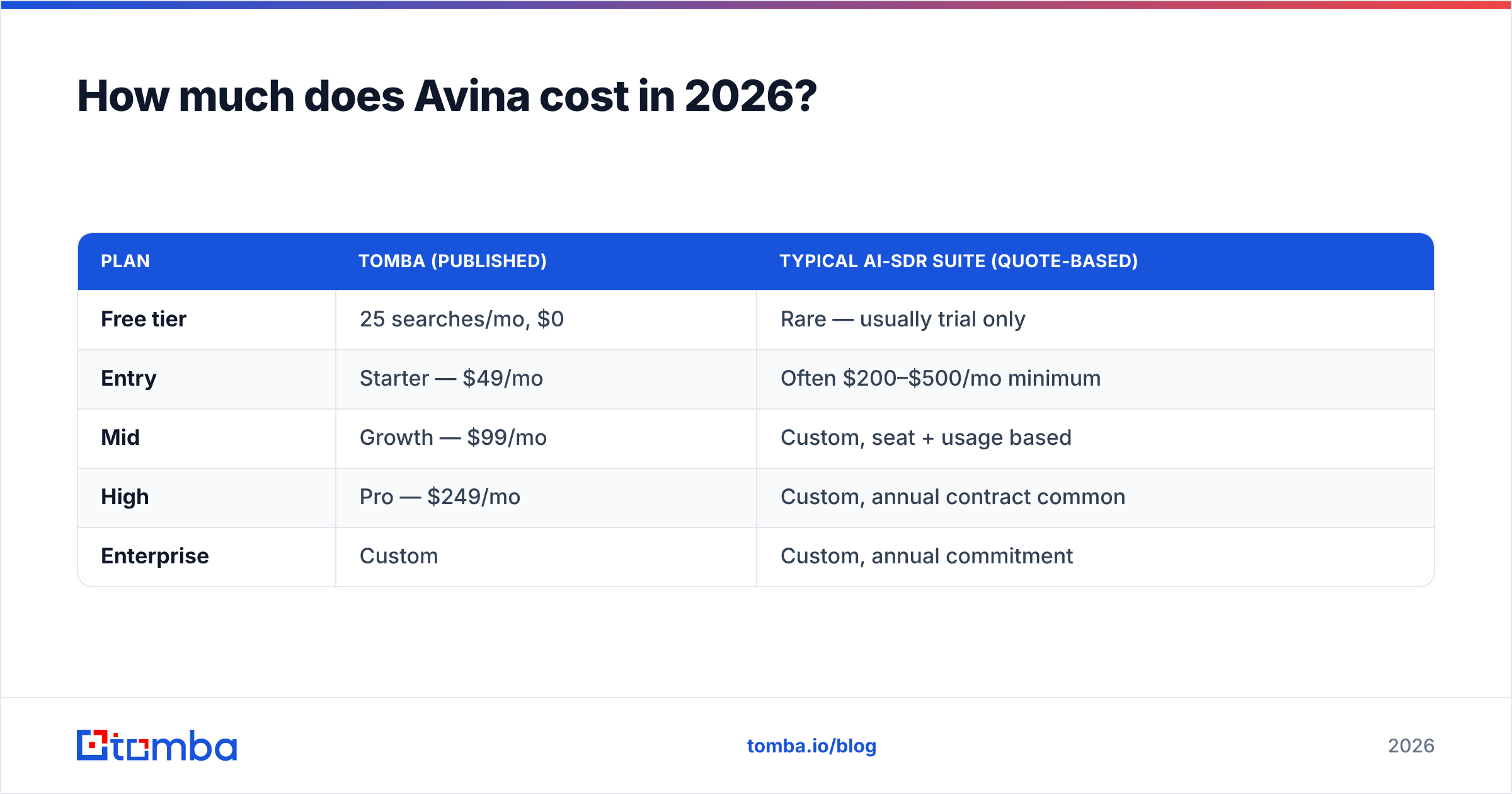
When a tool hides its pricing, the practical move is to model your spend against tools that publish theirs, then ask Avina to beat or match that on a per-outcome basis. Here is a transparent reference point using Tomba's published plans:
| Plan | Tomba (published) | Typical AI-SDR suite (quote-based) |
|---|---|---|
| Free tier | 25 searches/mo, $0 | Rare — usually trial only |
| Entry | Starter — $49/mo | Often $200–$500/mo minimum |
| Mid | Growth — $99/mo | Custom, seat + usage based |
| High | Pro — $249/mo | Custom, annual contract common |
| Enterprise | Custom | Custom, annual commitment |
Two things to take from this table. First, transparent per-credit pricing lets you forecast cost before you commit. Second, bundled AI suites frequently carry annual contracts and minimums that look small per seat but balloon at team scale. Always ask for the all-in annual number, not the headline monthly figure.
Questions to ask before signing#
- What inflates the bill? Per-contact credits, per-seat fees, or per-send usage — find the meter.
- Is data included or metered separately? Many AI suites resell third-party data at a markup.
- What is the contract length? Month-to-month or locked annual?
- What is the overage policy? Running out mid-quarter and paying penalty rates is a classic trap.
- Can you bring your own verified data? If yes, you can pair a cheaper, accurate data enrichment source and cut spend.
What do Avina reviews say — the honest pros and cons?#
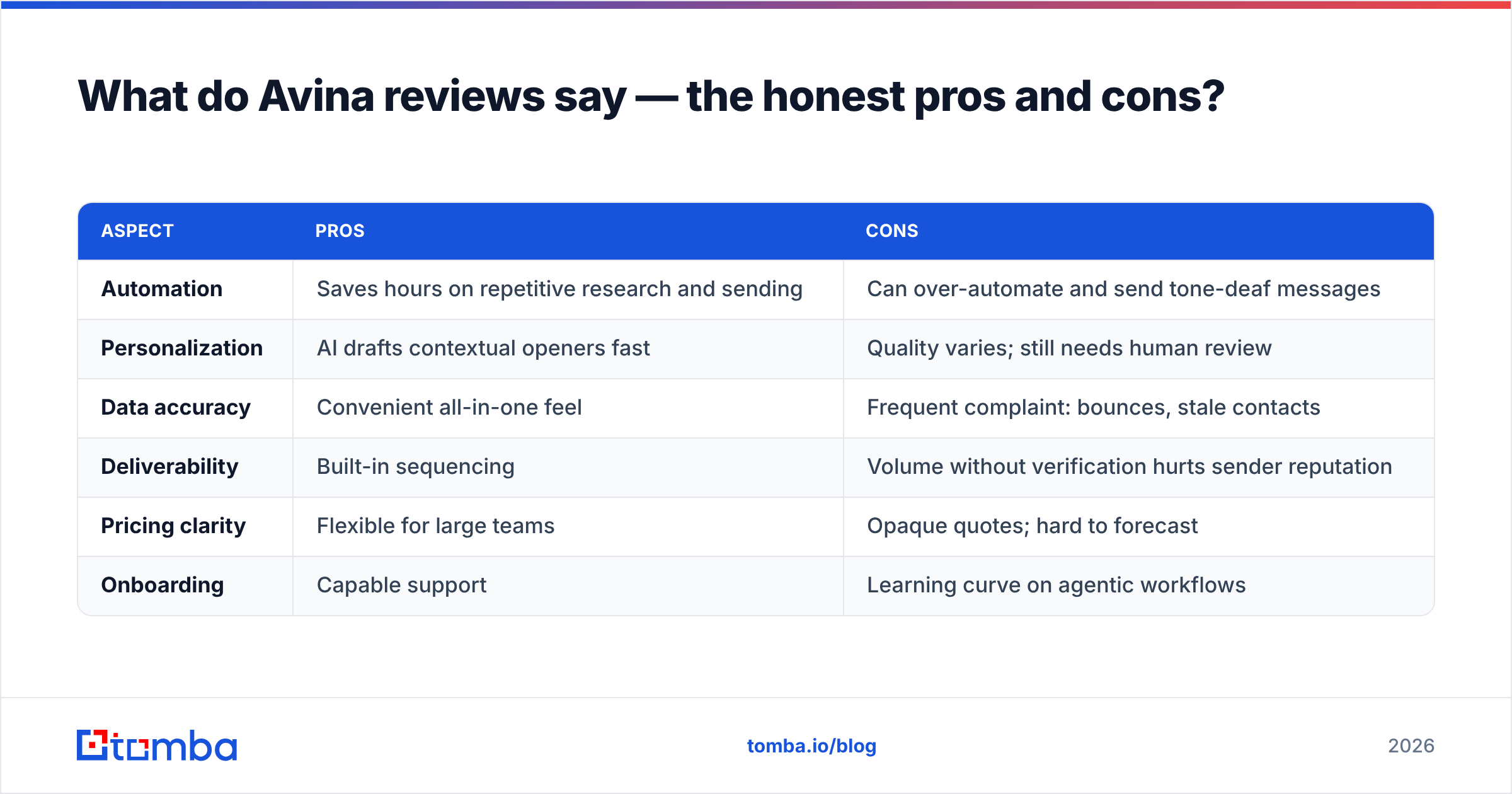
Across public review sites like Capterra and G2, AI-SDR platforms in Avina's class tend to cluster around the same praise and the same gripes. Here is the balanced read.
| Aspect | Pros | Cons |
|---|---|---|
| Automation | Saves hours on repetitive research and sending | Can over-automate and send tone-deaf messages |
| Personalization | AI drafts contextual openers fast | Quality varies; still needs human review |
| Data accuracy | Convenient all-in-one feel | Frequent complaint: bounces, stale contacts |
| Deliverability | Built-in sequencing | Volume without verification hurts sender reputation |
| Pricing clarity | Flexible for large teams | Opaque quotes; hard to forecast |
| Onboarding | Capable support | Learning curve on agentic workflows |
The recurring theme in negative reviews is data. When users report poor results, the root cause is usually that the contacts were wrong before the AI ever touched them. Automation multiplied the error. That is not unique to Avina — it is the structural weakness of every "all-in-one" AI sales tool that treats data as a bundled afterthought rather than a core competency.
The pros, fairly stated#
- Speed at scale. If your data is clean, Avina-style automation genuinely compresses the research-to-send cycle.
- Fewer tabs. Orchestration in one place reduces context-switching for reps.
- Consistent cadence. Sequencing keeps follow-ups from slipping through the cracks.
The cons, fairly stated#
- Garbage in, garbage at scale. Unverified contacts mean automated bounces and a damaged sending domain.
- Opaque cost. Quote-based pricing makes ROI math harder up front.
- Lock-in risk. Annual contracts on a fast-moving category can leave you stuck.
Is Avina better than a dedicated data-first stack?#
It depends on what is actually broken in your funnel. If your problem is "we have great contacts but waste time sending," an orchestration tool helps. If your problem is "half our emails bounce and replies are flat," no amount of AI copywriting fixes that — you have a data problem, and you fix data with data tools.
This is the most common mistake buyers make: they buy an automation suite to solve what is really an accuracy problem. You can verify the failure cheaply. Run a sample of your current list through an email verifier and check the bounce-risk rate. If it is high, your bottleneck is data, not workflow.
)
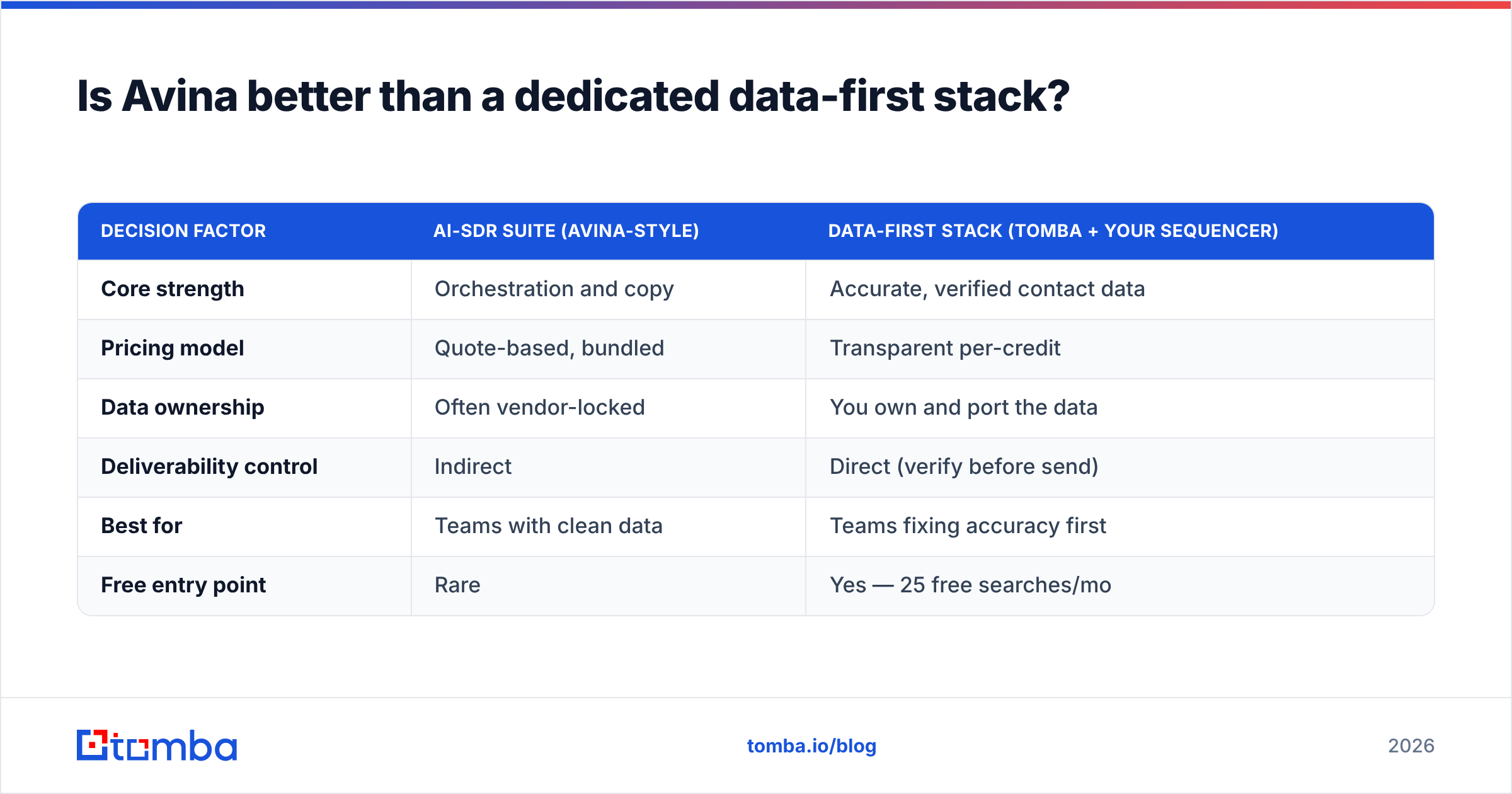
A data-first stack inverts the priority: get the contact right, confirm it is deliverable, then automate. Here is how the two philosophies compare.
| Decision factor | AI-SDR suite (Avina-style) | Data-first stack (Tomba + your sequencer) |
|---|---|---|
| Core strength | Orchestration and copy | Accurate, verified contact data |
| Pricing model | Quote-based, bundled | Transparent per-credit |
| Data ownership | Often vendor-locked | You own and port the data |
| Deliverability control | Indirect | Direct (verify before send) |
| Best for | Teams with clean data | Teams fixing accuracy first |
| Free entry point | Rare | Yes — 25 free searches/mo |
The honest answer for many teams is both, in the right order: source and verify contacts with a specialist tool, then push them into whatever sequencer or AI layer you prefer. You do not have to choose Avina or accurate data — but if you only fix one thing first, fix the data.
How do you find and verify contacts before automating?#
The workflow that actually protects your deliverability is boring and effective. Treat it like checking ingredients before you cook, not after you have served the dish.
- Find the contact. Use a domain search to pull verified emails for a target company, or the email finder to resolve a specific name at a domain.
- Verify deliverability. Run every address through verification to strip bounces and catch-alls before they hit your sequencer.
- Enrich the record. Add role, seniority, and firmographics so your AI personalization has real material to work with.
- Then automate. Only now hand the clean, verified list to Avina or any sequencer. The automation now scales good outcomes instead of bad ones.
This order matters because deliverability is cumulative. A burst of bounces from unverified sends lowers your sender reputation, and that damage follows you into every future campaign — even the well-targeted ones. Verifying first is the cheapest insurance you can buy.
What are the best Avina alternatives in 2026?#
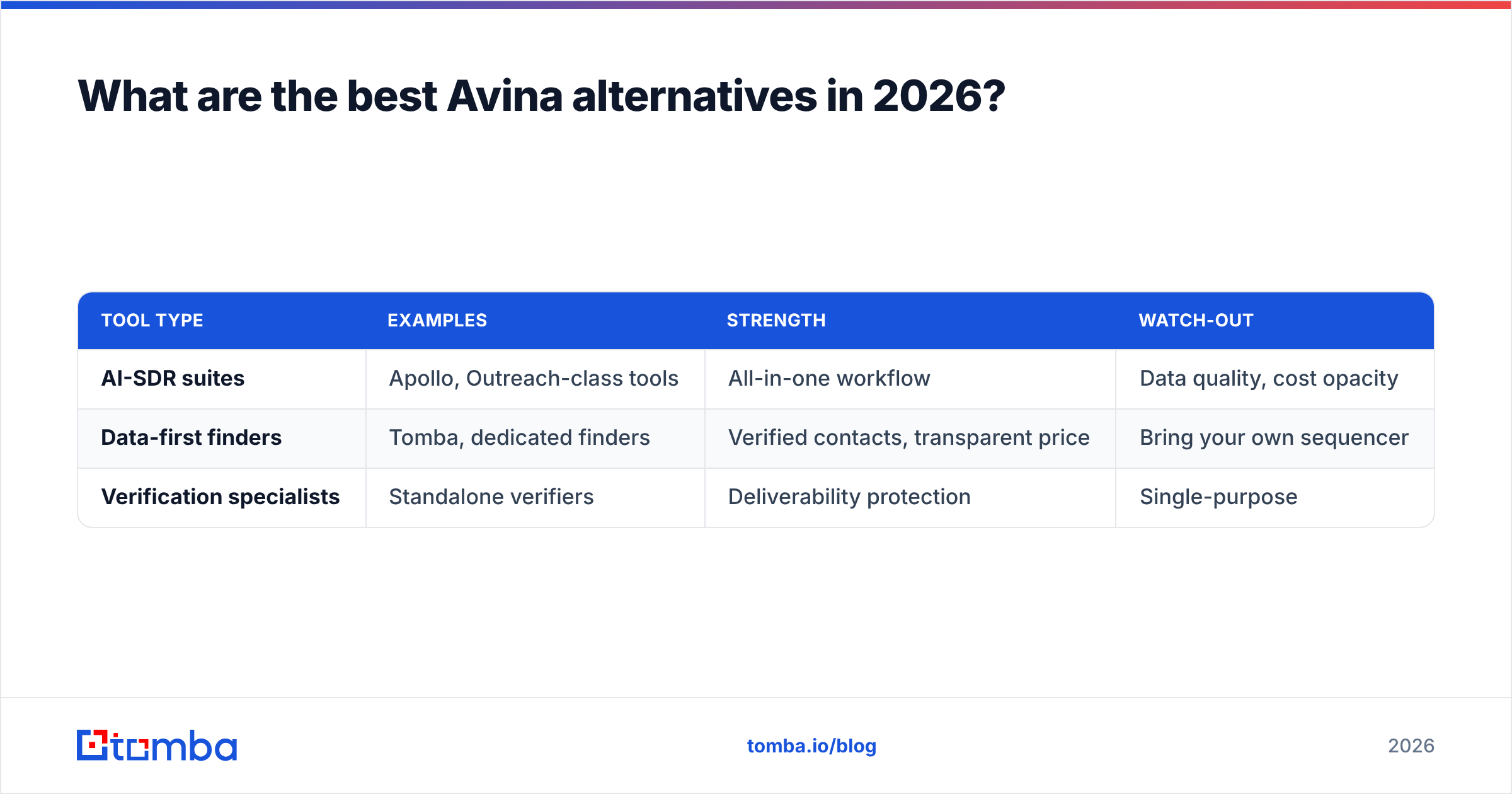
If Avina's opacity or data complaints give you pause, you have options across two camps: other AI-SDR orchestrators, and data-first specialists. Reviewers frequently weigh these against each other.
| Tool type | Examples | Strength | Watch-out |
|---|---|---|---|
| AI-SDR suites | Apollo, Outreach-class tools | All-in-one workflow | Data quality, cost opacity |
| Data-first finders | Tomba, dedicated finders | Verified contacts, transparent price | Bring your own sequencer |
| Verification specialists | Standalone verifiers | Deliverability protection | Single-purpose |
If you are specifically replacing the data layer, a transparent specialist is the cleaner swap. Tomba covers the full contact-acquisition job — find email addresses, verify them, run bulk lead generation, and enrich records — with published pricing and a free tier so you can test accuracy before paying. For broader platform swaps, the comparison guides for an Apollo alternative walk through the trade-offs in detail.
The key is to separate the two purchases in your head. One vendor does not have to own your entire stack. The teams with the best deliverability almost always pair a specialist data tool with a separate orchestration layer, precisely so neither responsibility gets diluted.
Final verdict: should you buy Avina?#
Buy Avina if your contact data is already clean and your real constraint is execution speed — it is built for orchestration and does that job. Be cautious if your reviews-and-results problem traces back to bad data, opaque pricing, or annual lock-in, because an automation layer cannot fix an accuracy problem underneath it.
Whatever platform you land on, the leverage point is the same: verified, accurate contacts feeding the machine. That is the layer Tomba is built for. Start with the free tier — 25 searches a month, no card — and run your toughest target accounts through the Tomba Email Finder to see verified, deliverable addresses before you commit budget anywhere else. Fix the data first, and every dollar you later spend on automation works harder. Compare full Tomba pricing when you are ready to scale.
// get started
Find, verify and enrich your first contacts today
Start on the free plan with 25 searches a month, then scale when your team is ready.
Free plan · No credit card required · GDPR & CCPA
// about the author