What Is B2B? The Complete 2026 Guide to B2B Sales & Growth
B2B is where one business sells to another — longer cycles, more stakeholders, bigger deals. Here's how B2B sales, data, and prospecting actually work in 2026.
TL;DR
- B2B means business-to-business — one company sells products or services to another company, not to individual consumers.
- B2B deals involve longer sales cycles, multiple decision-makers, and higher contract values than B2C, so process and data quality matter more than volume.
- The modern B2B buying committee has grown to 6–10 stakeholders, which means your outreach has to reach more than one inbox to close.
- Accurate contact data is the foundation — bad emails and stale records quietly kill pipeline before a rep ever speaks to a buyer.
- Tools like a reliable email finder and data enrichment turn a list of target accounts into reachable, verified contacts.
What is B2B?#
B2B stands for business-to-business: commercial transactions where the customer is another organization rather than an individual consumer. A company that sells payroll software to other companies is B2B. A company that sells sneakers to shoppers is B2C (business-to-consumer).
Think of it like wholesale versus retail. A bakery selling a single croissant to a walk-in customer is consumer-facing. The flour mill selling 50-kilo sacks to that bakery — on net-30 terms, with a contract and a dedicated account manager — is running a B2B relationship. Same flour, completely different sale.
The distinction matters because it changes almost everything downstream: who you talk to, how long the deal takes, how you price, and how you market. In B2B, the buyer is rarely the end user, the budget belongs to a committee, and the purchase has to be justified with ROI rather than impulse.
How is B2B different from B2C?#
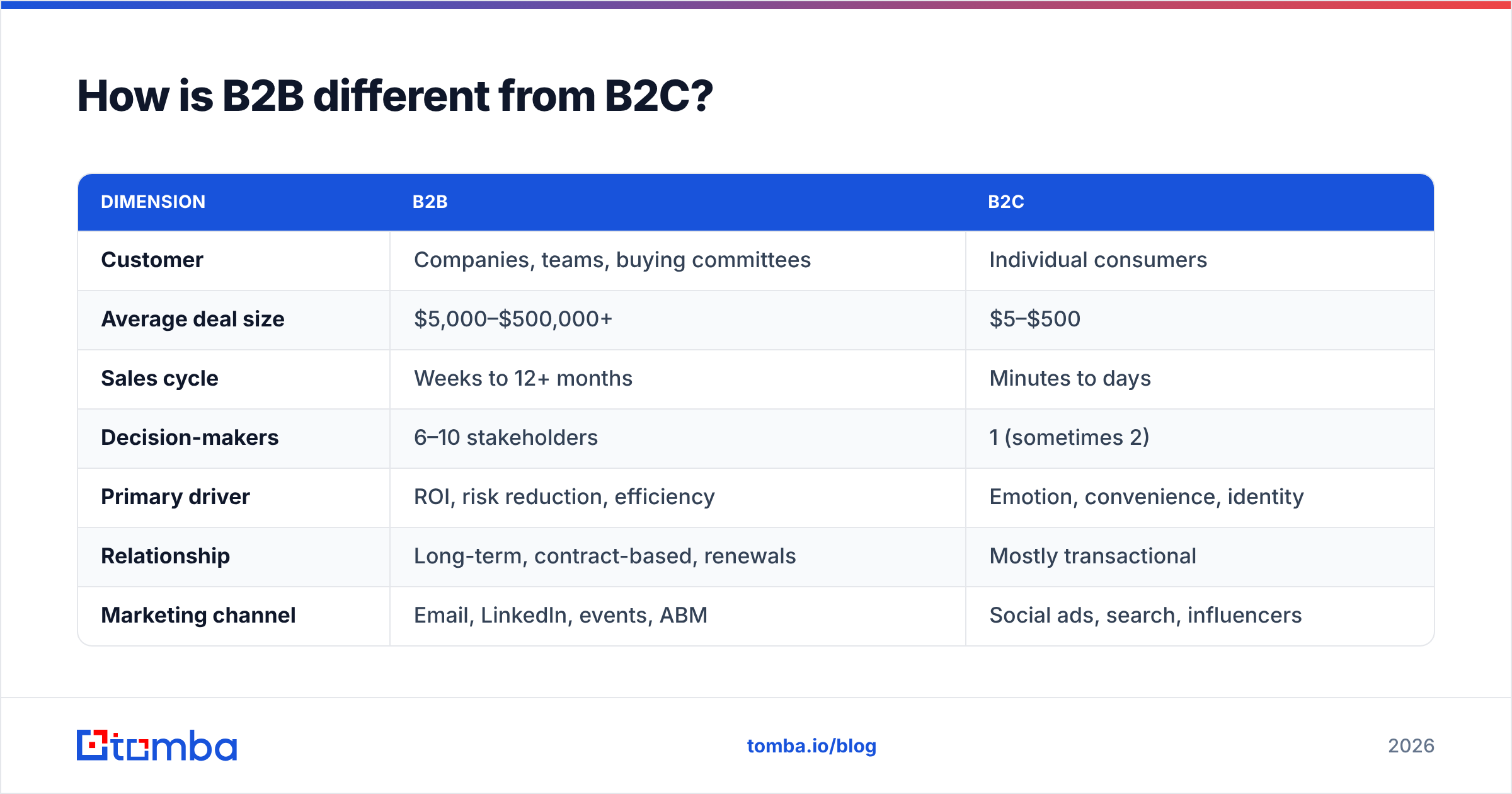
The simplest way to see the gap is side by side. B2B and B2C aren't just different audiences — they run on different economics.
| Dimension | B2B | B2C |
|---|---|---|
| Customer | Companies, teams, buying committees | Individual consumers |
| Average deal size | $5,000–$500,000+ | $5–$500 |
| Sales cycle | Weeks to 12+ months | Minutes to days |
| Decision-makers | 6–10 stakeholders | 1 (sometimes 2) |
| Primary driver | ROI, risk reduction, efficiency | Emotion, convenience, identity |
| Relationship | Long-term, contract-based, renewals | Mostly transactional |
| Marketing channel | Email, LinkedIn, events, ABM | Social ads, search, influencers |
The headline takeaway: B2B trades volume for value. A B2C brand might need a million customers to hit revenue targets; a B2B company can hit the same number with a few hundred well-chosen accounts. That concentration is why precision — knowing exactly who to contact and reaching them reliably — outranks raw reach in B2B.
Who are the players in a B2B sale?#
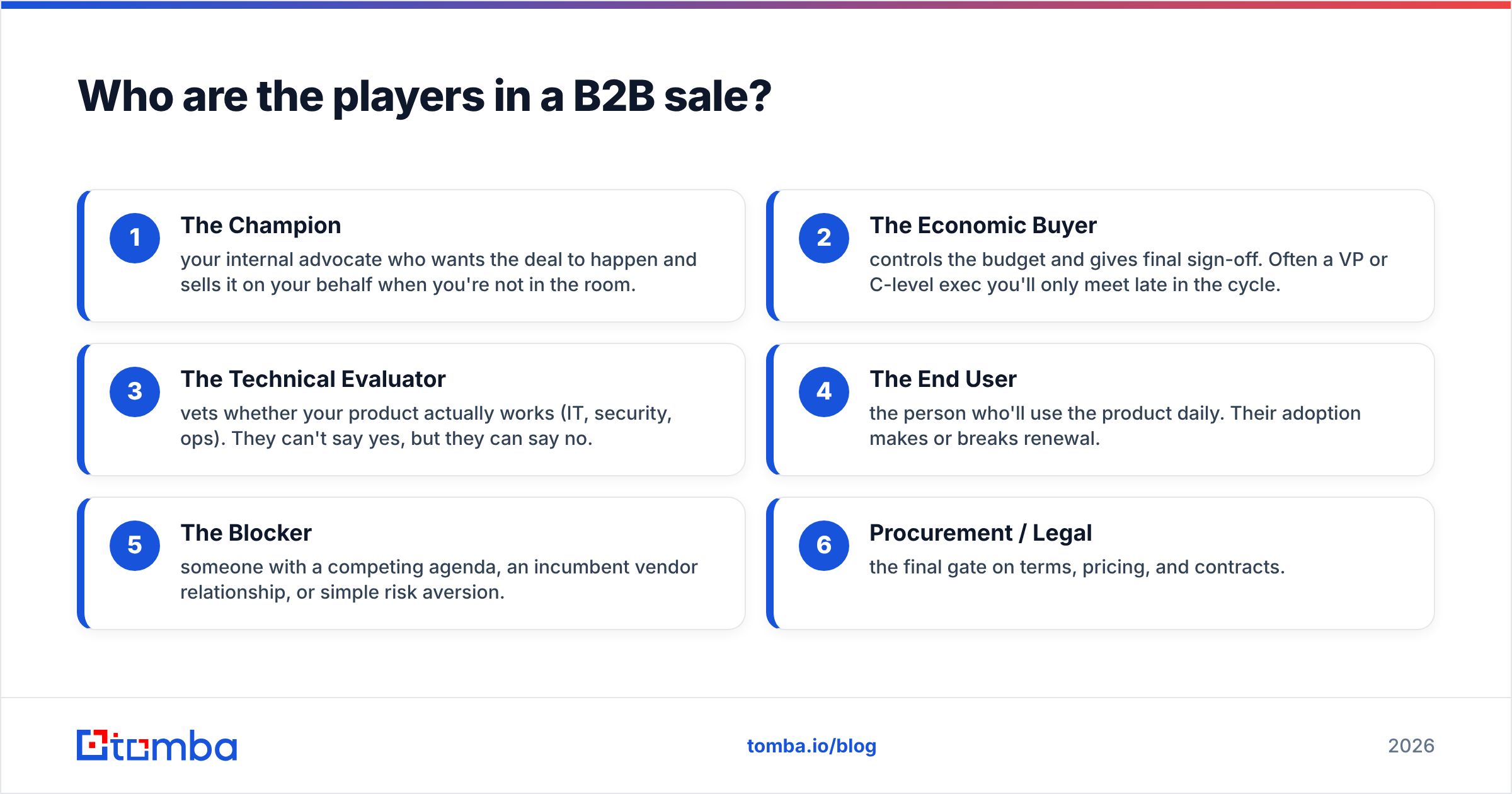
In B2B, you almost never sell to a single person. Research from Gartner has long pegged the typical buying group at six to ten people, each bringing their own priorities and veto power. A deal stalls the moment one of them goes quiet.
Here are the roles you'll repeatedly encounter:
- The Champion — your internal advocate who wants the deal to happen and sells it on your behalf when you're not in the room.
- The Economic Buyer — controls the budget and gives final sign-off. Often a VP or C-level exec you'll only meet late in the cycle.
- The Technical Evaluator — vets whether your product actually works (IT, security, ops). They can't say yes, but they can say no.
- The End User — the person who'll use the product daily. Their adoption makes or breaks renewal.
- The Blocker — someone with a competing agenda, an incumbent vendor relationship, or simple risk aversion.
- Procurement / Legal — the final gate on terms, pricing, and contracts.
Because the committee is distributed, you need contact data for several people inside the same account — not just one. This is where domain search earns its keep: instead of hunting one email at a time, you pull every reachable contact at a target company and map the committee before you start outreach.
What does the B2B sales cycle look like?#
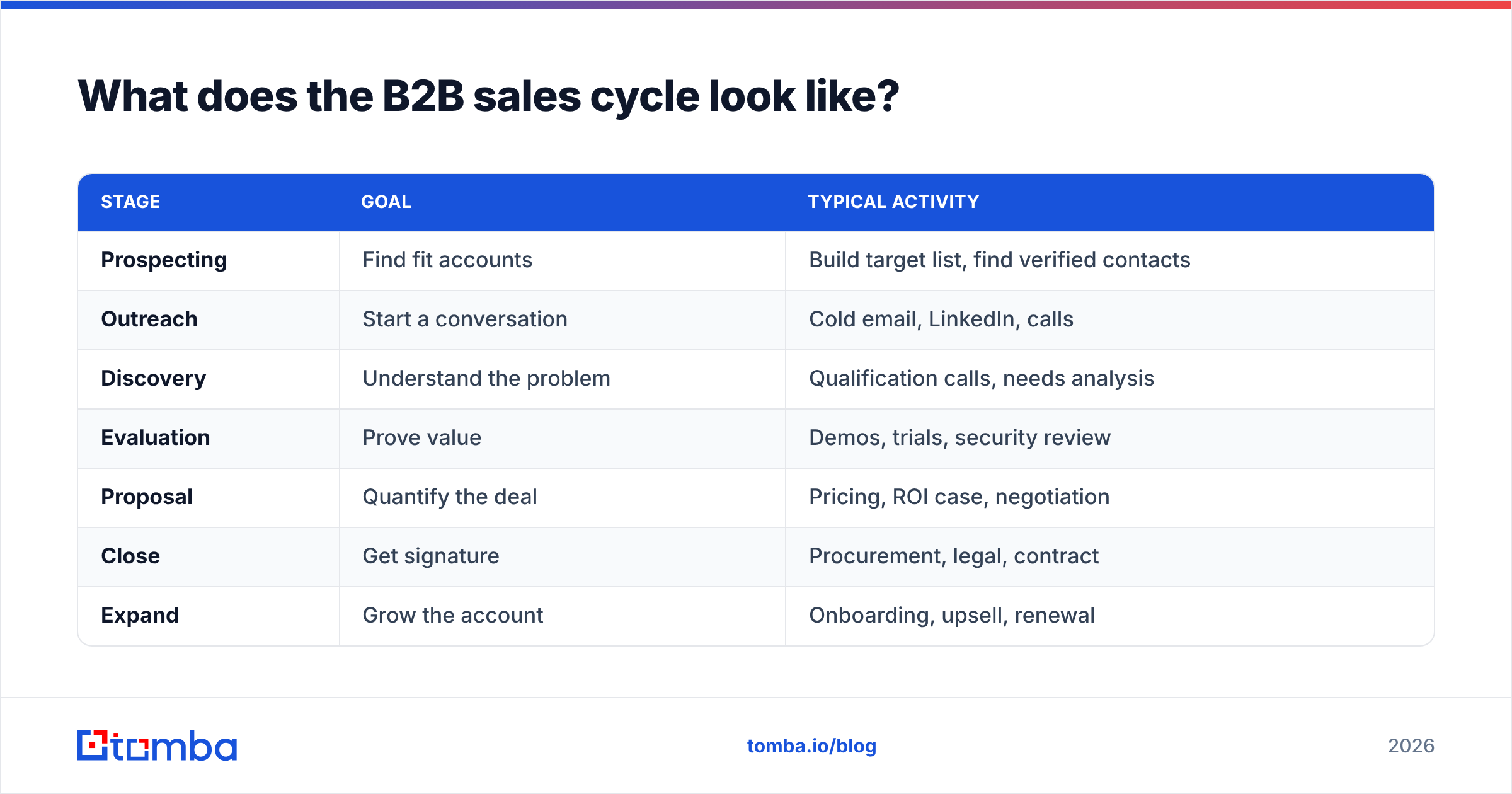
The B2B sales cycle is a multi-stage process that moves a stranger from "never heard of you" to "signed contract." Unlike a B2C checkout, it can't be compressed into a single session because each stakeholder needs their own reasons to commit.
A standard pipeline runs roughly like this:
| Stage | Goal | Typical activity |
|---|---|---|
| Prospecting | Find fit accounts | Build target list, find verified contacts |
| Outreach | Start a conversation | Cold email, LinkedIn, calls |
| Discovery | Understand the problem | Qualification calls, needs analysis |
| Evaluation | Prove value | Demos, trials, security review |
| Proposal | Quantify the deal | Pricing, ROI case, negotiation |
| Close | Get signature | Procurement, legal, contract |
| Expand | Grow the account | Onboarding, upsell, renewal |
Each stage has its own drop-off, but the cheapest leak to fix is at the very top. If your prospecting data is wrong — wrong email, wrong title, person left the company — you waste the entire downstream funnel on contacts who were never reachable. Clean inputs are the highest-leverage investment in the whole cycle.
Why is data quality the foundation of B2B?#
Bad data is the silent tax on every B2B team. You can have a brilliant product, a sharp message, and a motivated rep — and still miss quota because the contact list is rotten.
B2B contact data decays fast. Industry estimates put email and phone data decay at roughly 22–30% per year as people change jobs, companies rebrand, and domains shift. That means a list you bought 12 months ago is already a quarter wrong. Send to it and you'll see:
- Hard bounces that damage your sender reputation and hurt email deliverability across your whole domain.
- Spam complaints from people who were never your buyer.
- Wasted rep hours chasing contacts who left months ago.
The fix is a two-step discipline: find the right contact, then verify it's still valid before you send. A modern email verifier checks deliverability in real time, and pairing it with enrichment fills in the title, company, and seniority you need to personalize. Treat your database as a living asset, not a one-time purchase — the teams that win in B2B are the ones who keep it clean.
How do you find B2B contacts that convert?#
You find them by working backward from your Ideal Customer Profile (ICP), then layering on verified contact data. Volume without targeting is just noise; targeting without reachable data is just a wish list. You need both.
Here's a practical workflow:
- Define your ICP — industry, company size, region, tech stack, and the trigger events (funding, hiring, expansion) that signal a buying window.
- Build the account list — pull companies that match. A B2B database or list-building tool does this in bulk.
- Map the buying committee — for each account, identify the champion, economic buyer, and evaluators by title.
- Find verified emails and phones — use an email finder and phone finder to get reachable contact details, then verify before outreach.
- Enrich and personalize — add context (role, recent news, mutual connections) so the first touch doesn't read like a blast.
- Sequence the outreach — combine email, LinkedIn, and calls across the committee, not just one person.
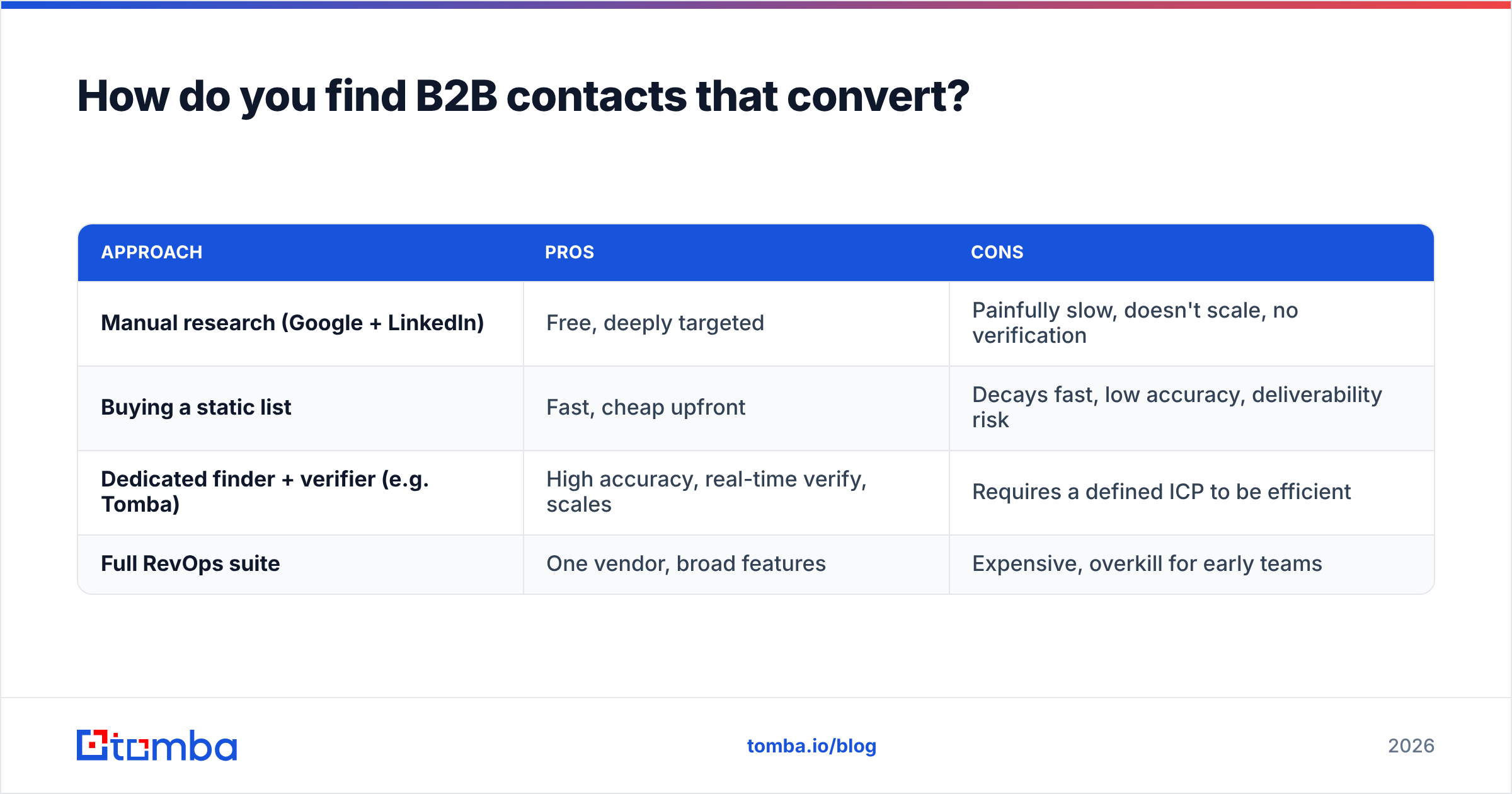
This is exactly where a focused tool beats a sprawling all-in-one platform. You don't need a 40-feature suite to start — you need accurate emails, fast verification, and clean enrichment. Compare the tradeoffs:
| Approach | Pros | Cons |
|---|---|---|
| Manual research (Google + LinkedIn) | Free, deeply targeted | Painfully slow, doesn't scale, no verification |
| Buying a static list | Fast, cheap upfront | Decays fast, low accuracy, deliverability risk |
| Dedicated finder + verifier (e.g. Tomba) | High accuracy, real-time verify, scales | Requires a defined ICP to be efficient |
| Full RevOps suite | One vendor, broad features | Expensive, overkill for early teams |
For most teams, the dedicated-finder lane gives the best ratio of accuracy to cost — and you can always layer it into a bigger stack later through integrations with your CRM.
What does B2B look like in 2026?#
Three shifts define B2B right now, and all of them raise the bar on data and precision.
Buyers self-educate before they talk to you. Most of the B2B buying journey now happens before a buyer ever fills out a form. They read reviews on G2, compare vendors, and build a shortlist in private. By the time they reach out, they're often 60–70% through their decision. Your job is to be reachable and credible before that — which means outbound and content have to work together.
AI raised the floor and the ceiling. AI writes the first draft of every cold email now, which means generic outreach is dead — buyers can smell a template instantly. The differentiator isn't the AI; it's the data you feed it. Personalization at scale only works when the underlying contact and company data is accurate. Garbage in, ignored out.
Multithreading is mandatory. With buying committees of six-plus, single-threaded deals (one rep, one contact) are fragile. The 2026 standard is reaching three to five stakeholders per account from the start. That multiplies your data needs — and rewards tools that pull a whole company's contacts at once rather than one email at a time.
The throughline across all three: B2B success in 2026 is downstream of data quality. The teams that treat accurate, verified, enriched contact data as core infrastructure — not an afterthought — are the ones filling pipeline while everyone else fights the spam folder. For a sense of what reliable sourcing looks like, see how Tomba's data is gathered and validated.
What's the simplest place to start?#
Start with one motion done well: pick 50 target accounts, map the committee, and reach them with verified data. Don't buy a sprawling platform on day one.
The bottleneck for almost every B2B team isn't strategy — it's reachability. You know who you want to sell to; you just can't reliably get the right email in front of the right person. Solve that, and the rest of the funnel has something to work with.
Ready to turn your target accounts into reachable contacts? Tomba's Email Finder finds professional email addresses by name, domain, or company, verifies them in real time, and enriches each contact with the title and company data you need to personalize at scale. Start free with 25 searches a month, then scale up on the Starter plan at $49/mo as your pipeline grows. Stop guessing at email addresses — build your B2B outreach on data you can trust.
// get started
Find, verify and enrich your first contacts today
Start on the free plan with 25 searches a month, then scale when your team is ready.
Free plan · No credit card required · GDPR & CCPA
// about the author