B2B ABM Strategy in 2026: The Complete Playbook for Teams
A practical 2026 playbook for building a B2B ABM strategy: account selection, data, plays, channels, and the metrics that prove pipeline impact.
B2B ABM Strategy in 2026: The Complete Playbook
Account-based marketing stopped being a buzzword years ago. In 2026 it is the default operating model for most B2B revenue teams chasing fewer, larger, harder-to-win accounts. But "doing ABM" and running a real b2b abm strategy are two different things. This playbook walks through the full system: who you target, how you find and enrich them, what plays you run, and how you prove it worked.
TL;DR#
- A b2b abm strategy flips the funnel: you pick the accounts first, then build marketing and sales around them — instead of casting a wide net and hoping fit shows up later.
- The three tiers — one-to-one, one-to-few, one-to-many — let you match effort to account value instead of treating every logo the same.
- Clean, enriched contact data is the foundation. Bad data quietly kills more ABM programs than bad creative ever will.
- Sales and marketing must share one account list, one definition of "engaged," and one pipeline number. No shared list, no ABM.
- Measure account engagement, pipeline influenced, and win rate on target accounts — not vanity clicks or raw MQL counts.
What is a B2B ABM strategy?#
A b2b abm strategy is a go-to-market approach where you treat individual accounts as markets of one. Instead of generating a high volume of leads and filtering for fit later, you define your best-fit accounts up front and then concentrate marketing, sales, and customer success effort on landing and expanding them.
Think of it like the difference between a fishing trawler and a spearfisher. The trawler drags a huge net and keeps whatever it catches — fast, but most of the haul gets thrown back. The spearfisher picks one fish, studies how it moves, and strikes with precision. Traditional demand gen is the trawler. ABM is the spear.
The model matters because B2B buying changed. A typical enterprise deal now involves 6 to 10 stakeholders, long evaluation cycles, and committees that research anonymously before they ever talk to sales. According to Gartner, most of the buying journey happens before a rep is involved. You cannot "lead-form" your way into a buying committee — you have to surround it.
)
How is ABM different from traditional lead generation?#
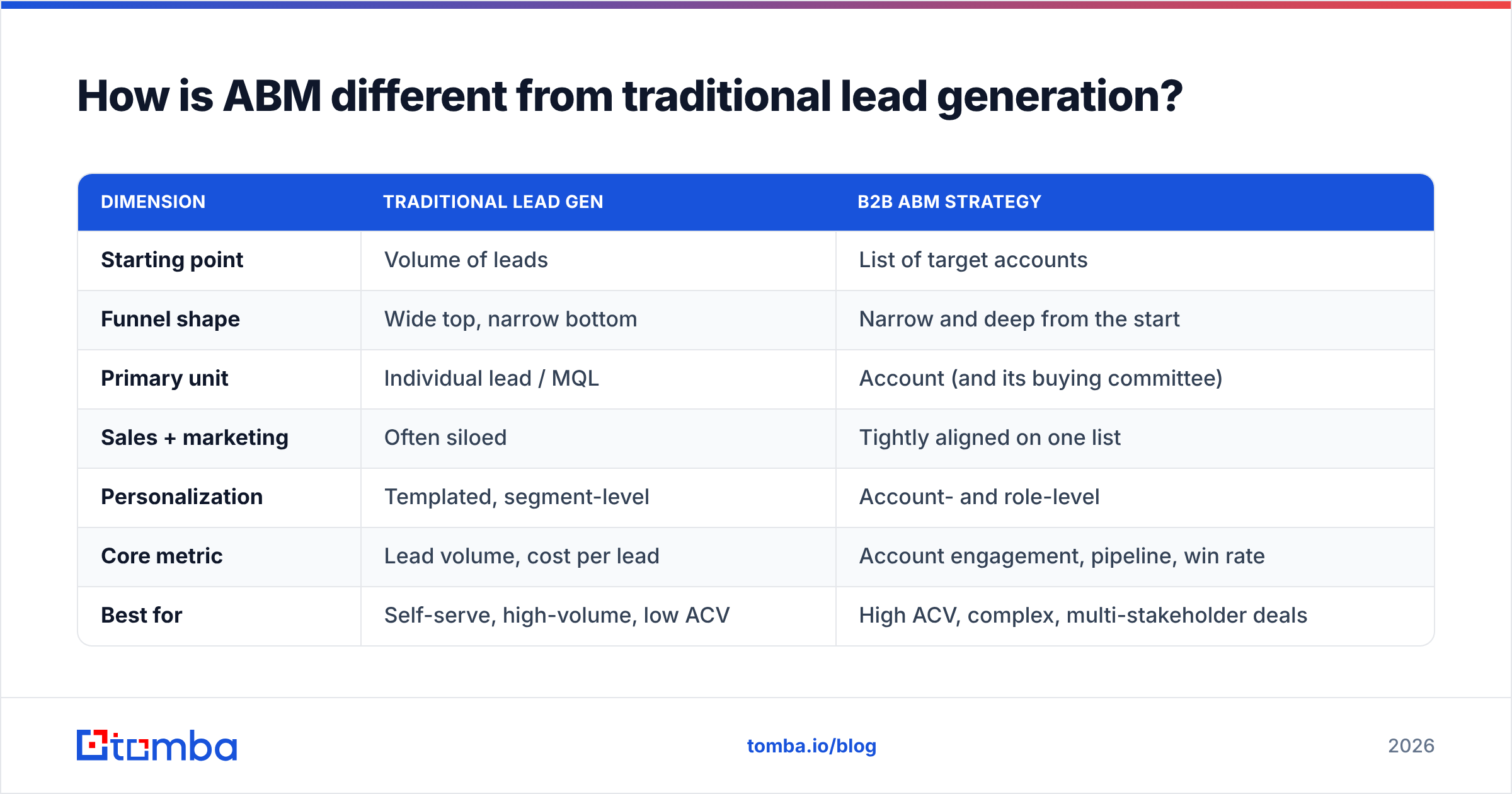
The clearest way to see the shift is side by side. Both approaches still generate pipeline, but they optimize for very different things.
| Dimension | Traditional Lead Gen | B2B ABM Strategy |
|---|---|---|
| Starting point | Volume of leads | List of target accounts |
| Funnel shape | Wide top, narrow bottom | Narrow and deep from the start |
| Primary unit | Individual lead / MQL | Account (and its buying committee) |
| Sales + marketing | Often siloed | Tightly aligned on one list |
| Personalization | Templated, segment-level | Account- and role-level |
| Core metric | Lead volume, cost per lead | Account engagement, pipeline, win rate |
| Best for | Self-serve, high-volume, low ACV | High ACV, complex, multi-stakeholder deals |
Neither model is universally "better." If you sell a $40/month product to a million possible buyers, classic demand gen wins on efficiency. But if you sell six-figure contracts to 800 named accounts, a b2b abm strategy concentrates your budget where revenue actually lives.
What are the three tiers of ABM?#
Not every account deserves a custom microsite. The standard framework splits your program into three tiers so effort scales with potential.
- One-to-one (Strategic ABM). A handful of your highest-value accounts — often 10 to 50. Each gets bespoke research, custom content, executive sponsorship, and tailored plays. This is the most expensive and the highest-converting tier.
- One-to-few (ABM Lite). Clusters of accounts that share an industry, use case, or pain point — usually grouped 5 to 15 per "play." You personalize at the cluster level: a vertical landing page, a role-specific case study, a sequenced campaign.
- One-to-many (Programmatic ABM). Hundreds or thousands of accounts handled with technology — intent data, dynamic ads, and automated personalization. Lower touch per account, but it keeps your full ICP warm and feeds the upper tiers.
The smart move is to run all three at once and promote accounts upward as they show buying signals. An account in your one-to-many tier that suddenly spikes on intent and visits your pricing page is a candidate for one-to-few or even one-to-one treatment.
How do you build the account list?#
Everything downstream depends on getting this right. A weak list means flawless execution against the wrong logos.
Start with your Ideal Customer Profile (ICP): firmographics (industry, size, revenue, geography), technographics (the tools they already run), and behavioral signals (hiring, funding, expansion). Then layer in intent — third-party signals showing an account is actively researching your category.
Score and rank accounts so you can assign tiers. A simple weighted model works:
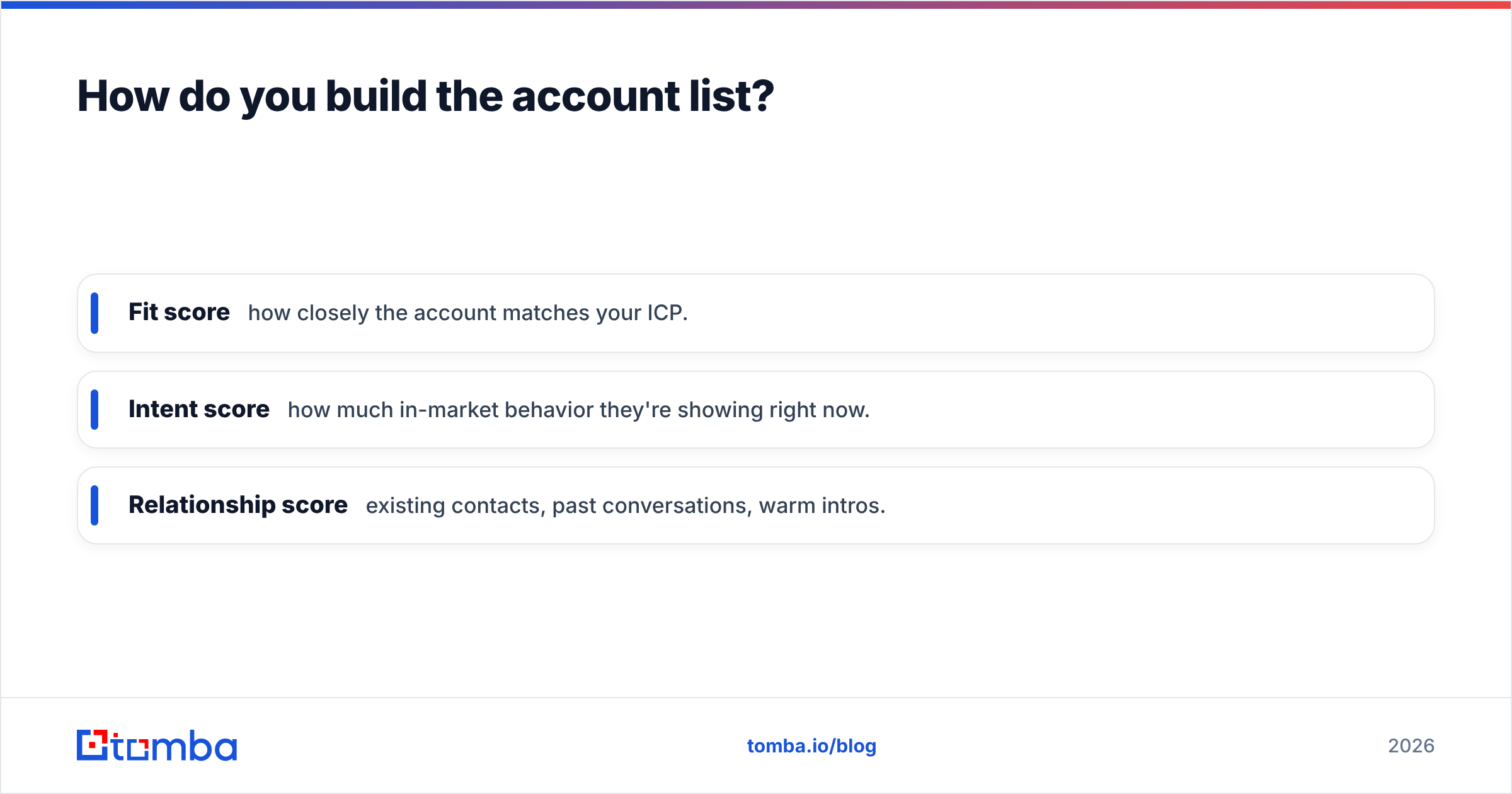
- Fit score — how closely the account matches your ICP.
- Intent score — how much in-market behavior they're showing right now.
- Relationship score — existing contacts, past conversations, warm intros.
Accounts that rank high on all three go into your strategic tier. High-fit but low-intent accounts go programmatic until they heat up. This is where a tight feedback loop with revenue operations pays off — RevOps owns the scoring logic and keeps it honest as data changes.
Once you have the named accounts, you need the people inside them. That means mapping the buying committee — economic buyer, champion, technical evaluator, blockers — and finding accurate contact details for each. A domain search across your target accounts surfaces the right contacts by company, and an email finder fills the gaps for specific decision-makers you've identified by name.
Why does data quality make or break ABM?#
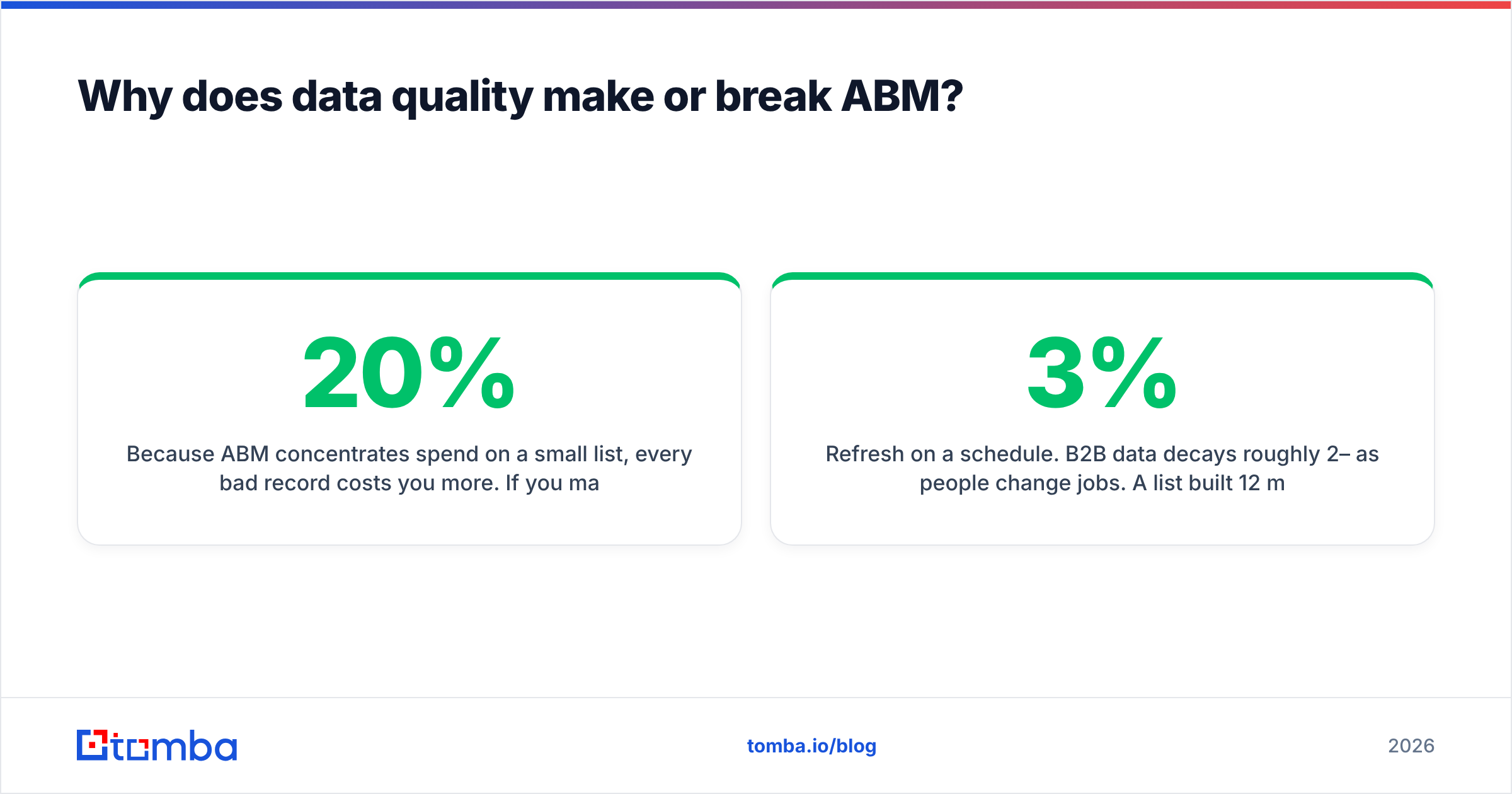
Because ABM concentrates spend on a small list, every bad record costs you more. If you mass-email 50,000 prospects, a 20% bounce rate is annoying. If you've built a one-to-one play around 30 strategic accounts and three of your champion emails bounce, you've just lost 10% of your entire program.
)
Three data disciplines protect an ABM program:
- Verification before send. Run every address through an email verifier so your carefully built sequences actually land. Deliverability is the silent tax on ABM — see this primer on email deliverability for why list hygiene drives inbox placement.
- Enrichment for personalization. You can't personalize what you don't know. Data enrichment adds role, seniority, tech stack, and company context so your messaging speaks to the account's reality, not a generic persona.
- Refresh on a schedule. B2B data decays roughly 2–3% per month as people change jobs. A list built 12 months ago is meaningfully wrong today. Re-verify and re-enrich your strategic tier at least quarterly.
Vendors like HubSpot and review hubs like G2 document the same pattern again and again: data quality, not channel choice, separates ABM programs that scale from ones that stall.
What channels and plays actually work in 2026?#
A b2b abm strategy is multichannel by design — you're surrounding a committee, not pinging one inbox. The plays that consistently produce pipeline:
- Personalized cold email + LinkedIn pairing. Sequenced, role-specific outreach to each committee member. Reference the account's actual situation, not a mail-merge first name. Pair it with social touches for warmth — see this guide to LinkedIn outreach.
- Account-targeted advertising. Serve ads only to your named accounts (by domain or contact list) so your air cover matches your ground game. Same message, same week, same accounts your reps are calling.
- Custom content and landing experiences. A vertical-specific page or a one-pager that names the account's industry pain. For strategic accounts, a personalized microsite is worth the build.
- Executive-to-executive plays. Your VP reaches the prospect's VP. Nothing accelerates a strategic deal like peer-level sponsorship.
- Intent-triggered outreach. When an account spikes on intent or hits a high-value page, fire a fast, relevant play within hours — not next quarter.
The orchestration is the hard part. Each touch should feel like one coordinated conversation across channels, not five disconnected campaigns hitting the same person.
How do you align sales and marketing for ABM?#
ABM dies without alignment. If marketing chases one list and sales works another, you don't have an account-based program — you have two teams with a shared logo wall.
Three commitments make alignment real:
- One account list, jointly owned. Sales and marketing build and approve the target list together. No account enters a tier without sales agreeing it's worth the effort.
- Shared definitions. Agree on what "engaged," "marketing-qualified," and "sales-ready" mean at the account level. Document it. A marketing qualified lead in an ABM model is an account showing committee-level engagement, not a single form fill.
- Shared pipeline number. Both teams are measured on the same target-account pipeline and revenue. When the scoreboard is identical, the finger-pointing stops.
Hold a weekly account review where reps and marketers look at the same engagement dashboard and decide the next play together. That ritual — more than any tool — is what makes ABM work.
How do you measure ABM success?#
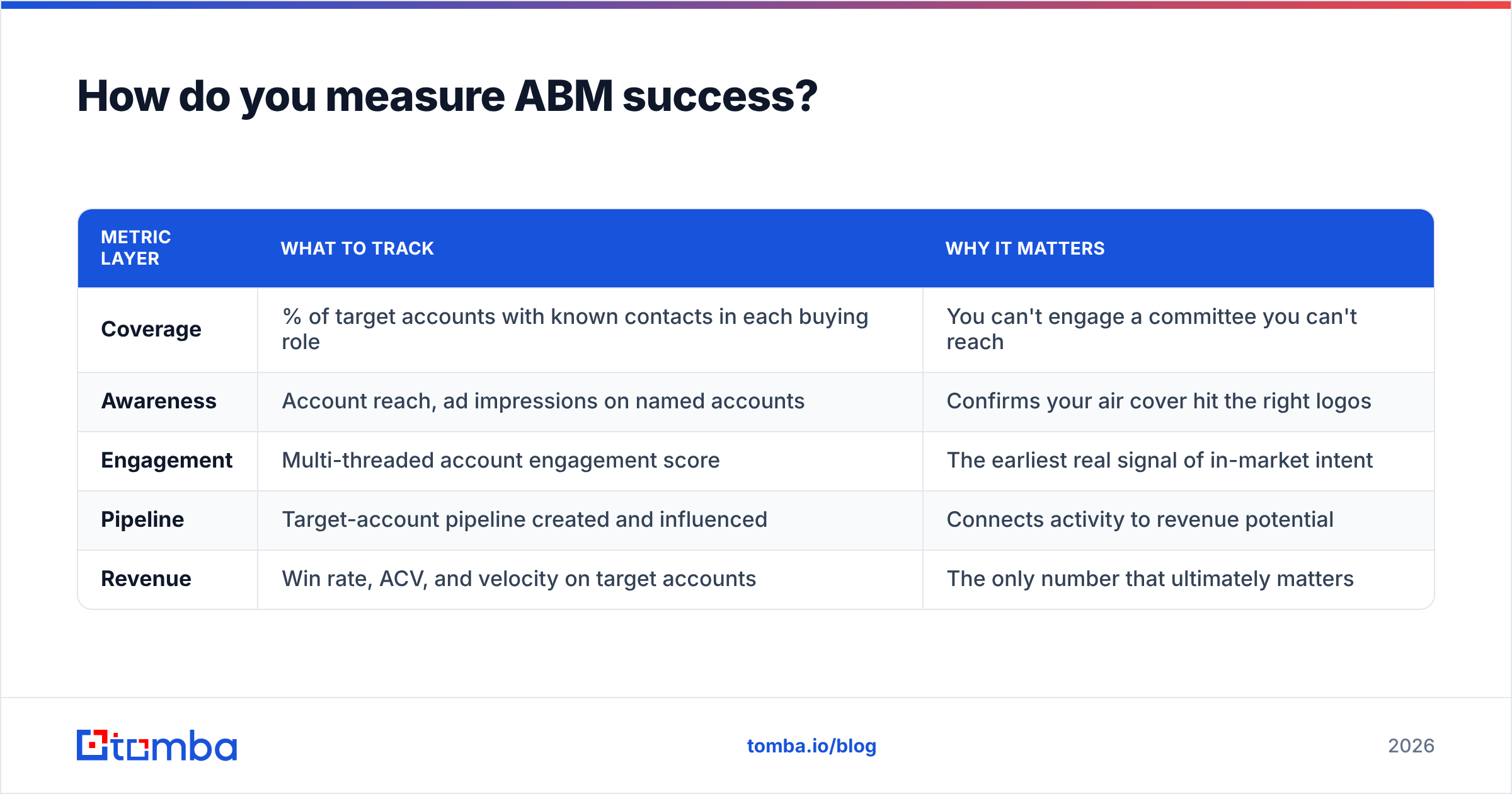
ABM metrics ladder up from engagement to revenue. Watching the wrong layer is how programs get killed before they mature.
| Metric layer | What to track | Why it matters |
|---|---|---|
| Coverage | % of target accounts with known contacts in each buying role | You can't engage a committee you can't reach |
| Awareness | Account reach, ad impressions on named accounts | Confirms your air cover hit the right logos |
| Engagement | Multi-threaded account engagement score | The earliest real signal of in-market intent |
| Pipeline | Target-account pipeline created and influenced | Connects activity to revenue potential |
| Revenue | Win rate, ACV, and velocity on target accounts | The only number that ultimately matters |
Give the program time. ABM compounds — the first quarter builds coverage and engagement; pipeline and revenue show up later. Judging a strategic ABM motion on month-one MQLs is like judging a fruit tree on its first week in the ground.
A practical milestone ladder: hit 90%+ contact coverage on your strategic tier in month one, measurable engagement lift by month three, and influenced pipeline you can defend by month six.
What does a 90-day ABM rollout look like?#
If you're starting from scratch, resist the urge to launch all three tiers at once. A phased rollout earns trust and surfaces data problems early.
- Days 1–30 — Foundation. Define ICP, build and tier the account list, align sales and marketing on shared definitions, and run contact discovery and verification so coverage is solid before any outreach.
- Days 31–60 — Launch. Stand up one-to-few plays for your top clusters, turn on account-targeted ads, and start sequenced outreach. Instrument the engagement dashboard now, not later.
- Days 61–90 — Optimize. Promote heating accounts into one-to-one treatment, kill plays that aren't landing, and report pipeline influenced to leadership with the metrics table above.
By day 90 you should have a repeatable engine: a scored list, clean data, coordinated plays, and a dashboard everyone trusts. Then you scale the tiers that are working.
Start with the data layer#
A b2b abm strategy is only as good as the accounts you choose and the contacts you can actually reach inside them. Before you invest in ads, content, and orchestration, get the foundation right: a sharp ICP, a tiered list, and verified, enriched contact data for every committee member that matters.
That's where Tomba's Email Finder fits your ABM motion — find decision-makers across your entire target-account list by domain or name, then verify and enrich every contact so your carefully built plays land in real inboxes instead of bouncing. You can start on the free tier (25 searches/month) and scale up through the Starter ($49/mo) and Growth ($99/mo) plans as your account list grows; see full Tomba pricing for the details. Build the list right, and every play you run downstream works harder.
Ready to find emails that actually work?
Join 150,000+ professionals who stopped guessing and started sending. Free credits on signup — no credit card required.
Get the Tomba newsletter
Practical outbound tactics and product updates — once every two weeks.
About the author