7 B2B Account Based Marketing Examples That Work in 2026
Real B2B account based marketing examples — 1:1, 1:few, and 1:many ABM plays with the data, tactics, and metrics that actually move pipeline in 2026.
Account-based marketing gets talked about as a strategy, but you learn it by looking at what teams actually run. This post is a tour of concrete B2B account based marketing examples — the real plays, broken down by tier, with the data and metrics behind each one.
TL;DR#
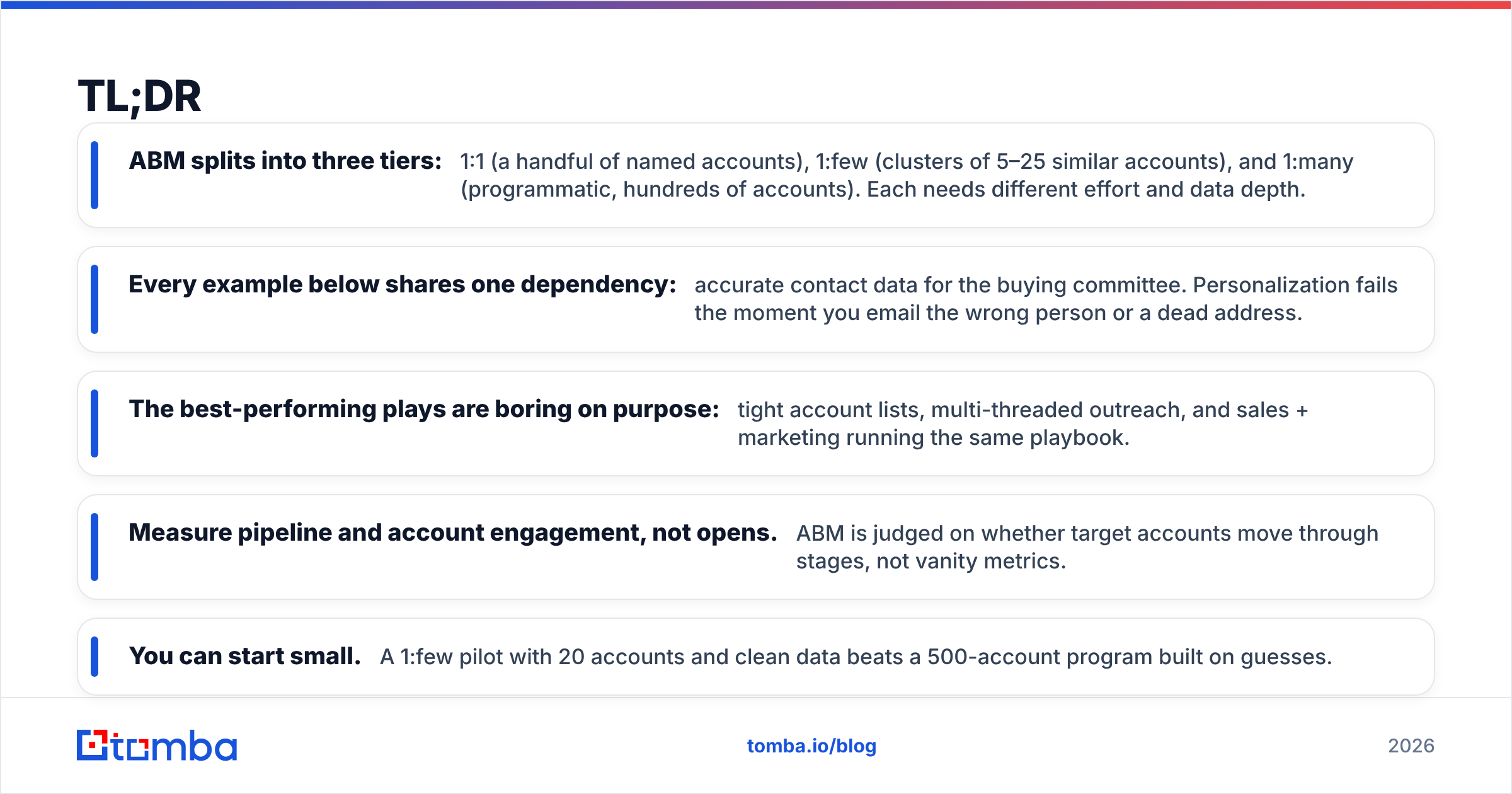
- ABM splits into three tiers: 1:1 (a handful of named accounts), 1:few (clusters of 5–25 similar accounts), and 1:many (programmatic, hundreds of accounts). Each needs different effort and data depth.
- Every example below shares one dependency: accurate contact data for the buying committee. Personalization fails the moment you email the wrong person or a dead address.
- The best-performing plays are boring on purpose: tight account lists, multi-threaded outreach, and sales + marketing running the same playbook.
- Measure pipeline and account engagement, not opens. ABM is judged on whether target accounts move through stages, not vanity metrics.
- You can start small. A 1:few pilot with 20 accounts and clean data beats a 500-account program built on guesses.
What is account-based marketing in B2B?#
Account-based marketing flips the normal funnel. Instead of casting a wide net and filtering leads down, you start by naming the exact companies you want as customers, then market and sell to the people inside them as a coordinated unit.
Think of it like dating versus running a billboard. A billboard (demand gen) shouts at everyone driving past and hopes the right person looks up. ABM is asking a specific person out, knowing their name, where they work, and what they care about. Technically, ABM treats an account — the company plus its buying committee — as the unit of value, not an individual lead.
According to Gartner, B2B buying decisions now involve six to ten stakeholders. That is why ABM exists: you cannot win a $90K deal by converting one form-fill. You win it by reaching the economic buyer, the champion, the technical evaluator, and the blocker — at the same account, with a consistent story.

What are the three types of ABM?#
Before the examples, you need the framework they sit inside. Most programs run all three tiers at once, sized to deal value.
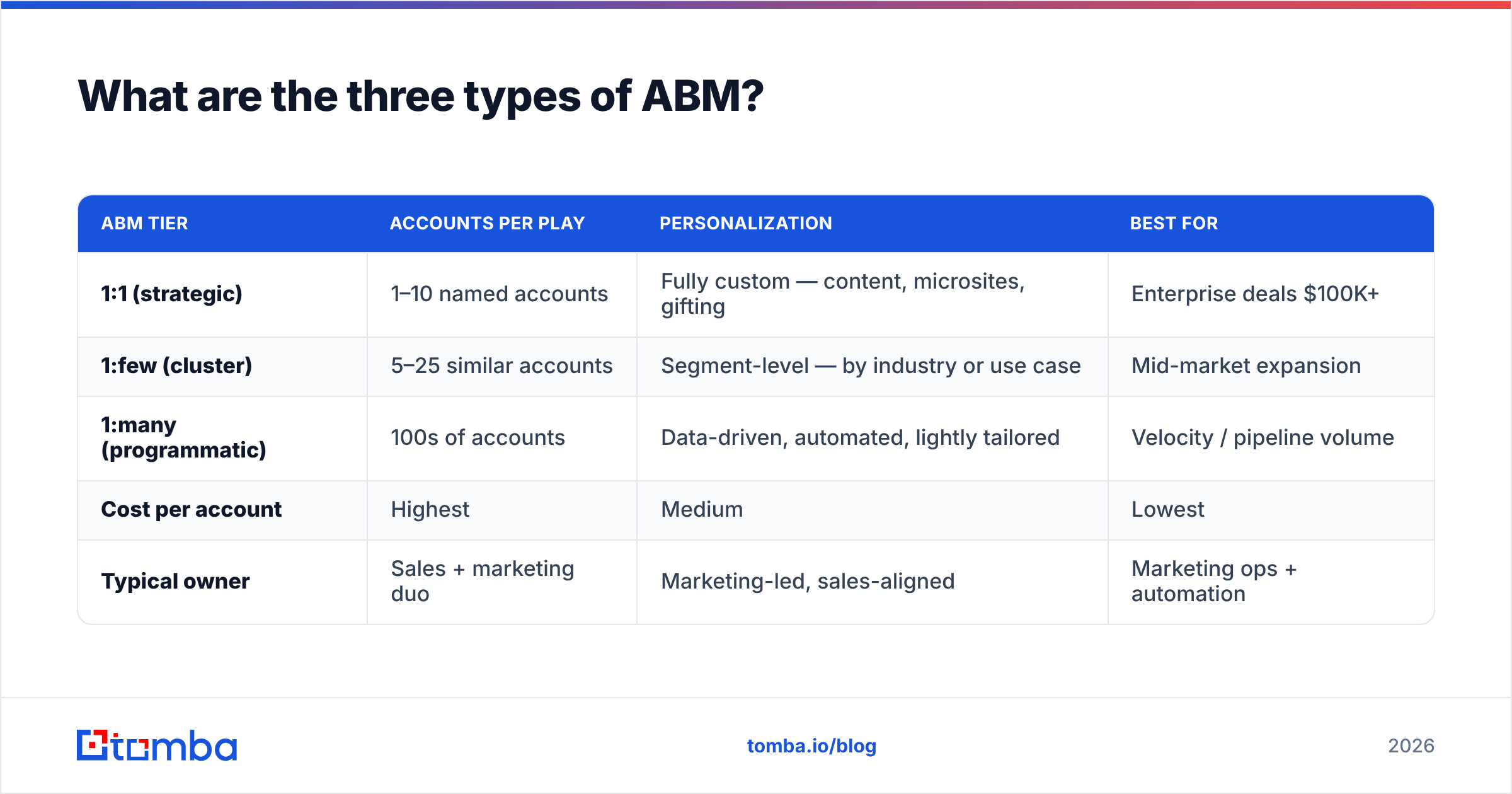
| ABM tier | Accounts per play | Personalization | Best for |
|---|---|---|---|
| 1:1 (strategic) | 1–10 named accounts | Fully custom — content, microsites, gifting | Enterprise deals $100K+ |
| 1:few (cluster) | 5–25 similar accounts | Segment-level — by industry or use case | Mid-market expansion |
| 1:many (programmatic) | 100s of accounts | Data-driven, automated, lightly tailored | Velocity / pipeline volume |
| Cost per account | Highest | Medium | Lowest |
| Typical owner | Sales + marketing duo | Marketing-led, sales-aligned | Marketing ops + automation |
Keep this table in mind as you read. Each example below is tagged with its tier so you can see how effort scales.
What are the best B2B account based marketing examples?#
Here are seven plays, ordered from high-touch to programmatic, with enough detail to copy them.
1. The personalized microsite (1:1)#
What it is: A dedicated landing page built for a single target account, branded with their logo, addressing their specific pain, sometimes with their team's name in the headline.
How it runs: A SaaS vendor chasing a Fortune 500 logistics company builds vendor.com/acme-logistics, populates it with a tailored ROI calculator using the prospect's real shipment volumes, and routes every touch — emails, LinkedIn ads, the SDR's calls — to that one URL. The champion shares it internally, and suddenly the whole buying committee is on a page built for them.
Why it works: Relevance is undeniable. When a VP sees their own numbers, the "is this a fit?" question answers itself.
Data dependency: You need verified emails for 5–8 people across the committee. If you guess j.smith@acme.com and it bounces, the whole sequence stalls. This is where a reliable email finder earns its keep — you map the org, then confirm each address before the campaign launches.
2. Executive gifting and direct mail (1:1)#
What it is: Physical, personalized outreach — a book the CFO mentioned on a podcast, a custom-branded item, a hand-written note tied to a calendar offer.
How it runs: An enterprise security firm sends each of 12 target CISOs a printed threat report scoped to their industry, with a QR code to a private briefing. Response rates on these run far above cold email because the effort signals seriousness.
Why it works: Inboxes are saturated; desks are not. Direct mail cuts through specifically because it is expensive and rare.
Watch the cost: This only pays off on six-figure deals. Running it across 200 accounts will torch your budget — keep it to the 1:1 tier.
3. The industry cluster campaign (1:few)#
What it is: One campaign aimed at 15–20 companies that share a vertical and a pain, with segment-level (not per-account) personalization.
How it runs: A fintech compliance tool targets mid-market crypto exchanges. The team builds one set of assets — a webinar on a new regulation, a case study from a peer exchange, a sequence referencing the specific rule — and runs it across all 20 accounts. The buying committees differ company to company, but the message is shared.
Why it works: You get most of the relevance of 1:1 at a fraction of the cost, because the pain is genuinely common across the cluster.
This is the tier most teams should start with. You can build your account list using domain search to pull every relevant contact at each company, then verify the list before outreach. For more on assembling target lists, see the broader lead generation workflow.
4. Multi-threaded LinkedIn + email sequences (1:few)#
What it is: Coordinated outreach hitting multiple stakeholders at the same account across two channels at once, so the account feels surrounded rather than pestered.
How it runs: For each of 25 target accounts, the SDR connects with the champion on LinkedIn while marketing serves that account ads, and a parallel email sequence reaches the economic buyer. The messages reference each other: "I saw you connected with my colleague on LinkedIn." It feels like one company reaching out, not three randoms.
Why it works: Buying committees talk. When three people independently hear about your company in the same week, internal momentum builds on its own.

5. Intent-triggered programmatic ABM (1:many)#
What it is: Hundreds of accounts enrolled automatically when third-party intent data shows they are researching your category.
How it runs: A marketing automation platform watches intent signals from a provider like Bombora or 6sense. When an account's research activity spikes for "email deliverability tools," it auto-enrolls into a tailored ad + email track. The play runs across 400 accounts but feels timely because it fires on a real signal.
Why it works: Timing. You reach accounts while the problem is top of mind, not three months before or after.
Data dependency: Programmatic ABM lives or dies on enrichment. When an account lights up, you need contacts instantly — so data enrichment fills in the committee from a domain in real time. No enrichment, no one to email.
6. Customer expansion ABM (1:many, post-sale)#
What it is: ABM aimed at existing customers to drive cross-sell, upsell, and renewal — treating each account as a growth target, not a closed deal.
How it runs: A CRM vendor runs an "expansion" program: when a customer hits 80% of seat usage, it triggers a tailored campaign to that account's admin and their boss, pitching the next tier. Same ABM mechanics, applied to your own base — where win rates are highest.
Why it works: Expansion revenue is cheaper than new logos, and you already have the relationship and the data.
7. Reverse-IP website personalization (1:many)#
What it is: Your website detects the visiting company and changes its content live — showing the visitor's industry, logo wall, or case study without them filling out a form.
How it runs: A target account visits the homepage; reverse-IP lookup identifies them as a healthcare provider and swaps the hero to a HIPAA-focused message and a healthcare customer quote. Pair it with website visitor reveal so sales gets alerted the moment a named account browses pricing.
Why it works: It converts anonymous, high-intent traffic you were already paying to attract.
How do you measure ABM success?#
ABM is judged on account movement, not lead volume. If you report opens and clicks to your CRO, you will lose the budget argument. Track these instead:
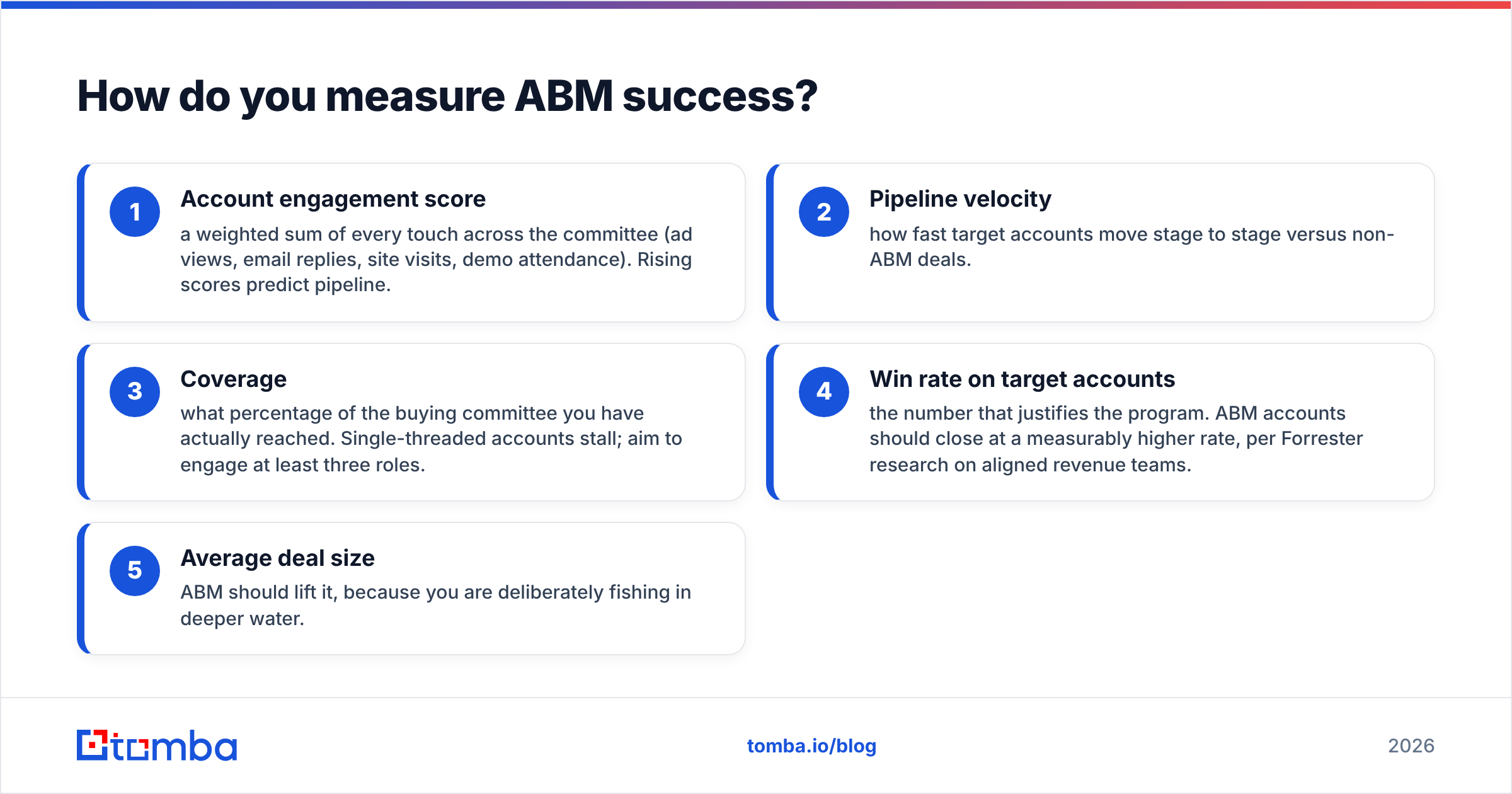
- Account engagement score — a weighted sum of every touch across the committee (ad views, email replies, site visits, demo attendance). Rising scores predict pipeline.
- Pipeline velocity — how fast target accounts move stage to stage versus non-ABM deals.
- Coverage — what percentage of the buying committee you have actually reached. Single-threaded accounts stall; aim to engage at least three roles.
- Win rate on target accounts — the number that justifies the program. ABM accounts should close at a measurably higher rate, per Forrester research on aligned revenue teams.
- Average deal size — ABM should lift it, because you are deliberately fishing in deeper water.
A quick gut check: if you cannot name which accounts moved forward this quarter and why, you are running demand gen with an ABM label.
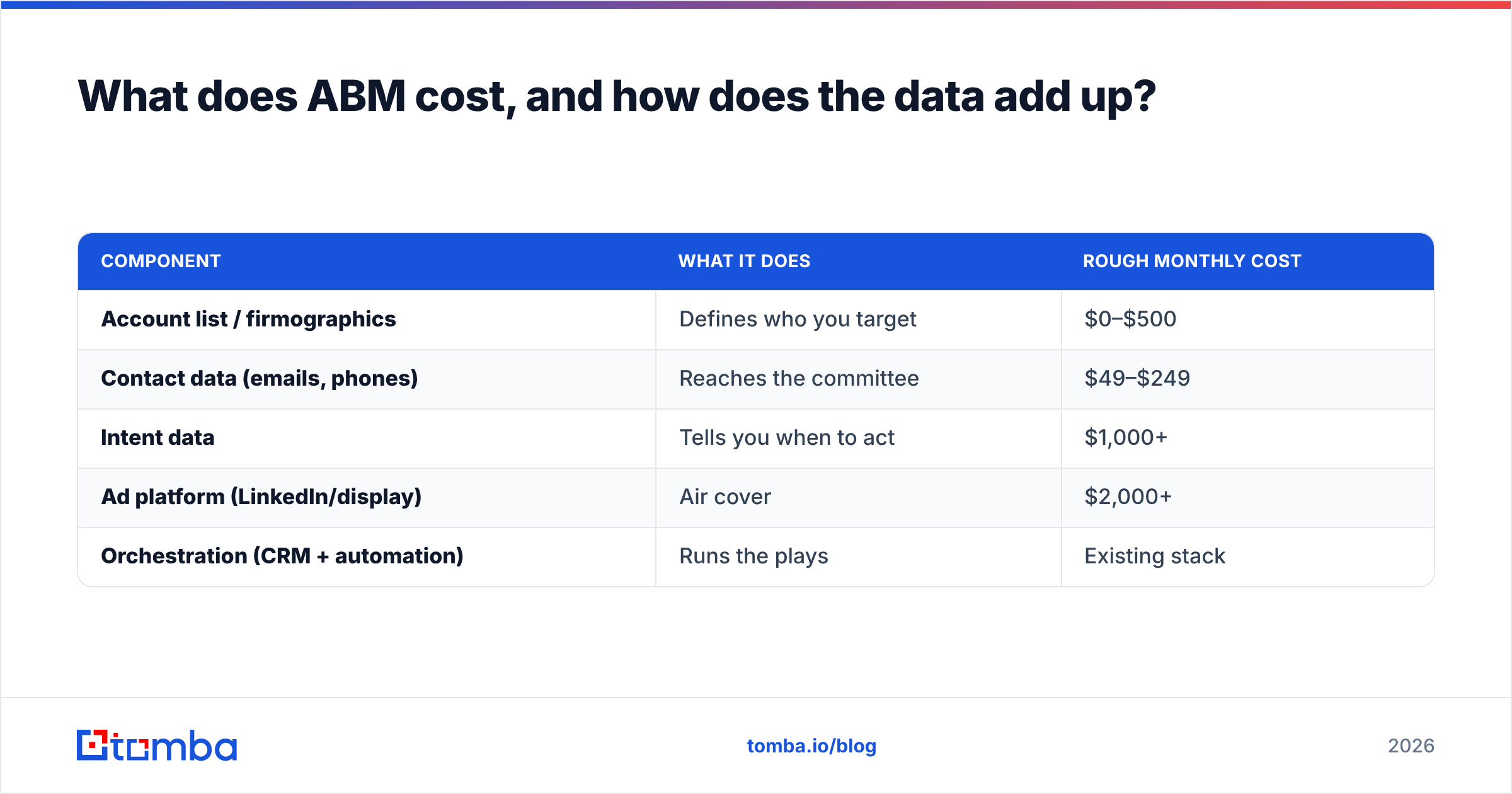
What does ABM cost, and how does the data add up?#
The hidden cost of ABM is not ads or software — it is contact data. Every example above assumes you can reach the right humans. Here is how the data layer maps to your stack and budget.
| Component | What it does | Rough monthly cost |
|---|---|---|
| Account list / firmographics | Defines who you target | $0–$500 |
| Contact data (emails, phones) | Reaches the committee | $49–$249 |
| Intent data | Tells you when to act | $1,000+ |
| Ad platform (LinkedIn/display) | Air cover | $2,000+ |
| Orchestration (CRM + automation) | Runs the plays | Existing stack |
Tomba sits in the contact-data row. Its pricing runs from a Free tier (25 searches/month) to Starter at $49/month, Growth at $99/month, and Pro at $249/month — which covers the email finding, verification, and enrichment that the seven plays above depend on. You do not need every row to start; you need a clean account list and verified contacts, then you layer intent and ads on as the program proves out.
What is the single most common ABM mistake?#
Bad data, every time. A team will spend weeks designing a 1:1 microsite, then blast it to addresses scraped two years ago — and wonder why the committee never engaged. Roughly a third of B2B contact data decays annually as people change jobs, so a list built last quarter is already eroding.
The fix is unglamorous: verify before you send. Run every address through an email verifier so your carefully built sequence actually lands. There is no point personalizing a message to a person who left the company in 2024. ABM rewards precision, and precision starts at the contact layer, not the creative.
The second most common mistake is sales-marketing misalignment — marketing "passes" accounts that sales never touches. Fix it with a shared account list, shared definitions of engagement, and a weekly stand-up where both teams look at the same dashboard. ABM is a team sport; the moment it becomes a marketing-only project, the committee stops feeling surrounded and starts ignoring you.
Which ABM example should you start with?#
Start with the 1:few industry cluster (Example 3). It gives you real ABM mechanics — named accounts, multi-threading, tailored messaging — without the cost of full 1:1 production or the data infrastructure of programmatic. Pick 20 accounts in one vertical, map every buyer, verify the contacts, and run a coordinated email + LinkedIn play for one quarter. Measure account engagement and pipeline, not opens. If it works, scale up a tier; if it doesn't, you have only risked one quarter and a small list.
The thread running through all seven examples is the same: ABM is only as good as the people you can actually reach. Build the strategy, design the creative, buy the intent data — but if the emails bounce, none of it matters.
Start where the plays start: with accurate contacts. Use the Tomba Email Finder to map and verify the buying committee at every target account, so your 1:1 microsites, your cluster campaigns, and your programmatic plays all reach real people on the first try. Spin up the Free tier with 25 searches, build your first 20-account list, and let the data carry the strategy.
Ready to find emails that actually work?
Join 150,000+ professionals who stopped guessing and started sending. Free credits on signup — no credit card required.
Get the Tomba newsletter
Practical outbound tactics and product updates — once every two weeks.
About the author