B2B Acquisition Funnel: Stages, Metrics & Fixes (2026)
A practical 2026 guide to the B2B acquisition funnel: every stage, the metrics that matter, where deals leak, and how to fix each leak fast.
TL;DR
- The B2B acquisition funnel is the staged path a buyer takes from first touch to closed-won — awareness, interest, consideration, intent, evaluation, and purchase — plus the handoffs between marketing and sales.
- Most funnels do not have a "top of funnel" problem; they have a leak problem. One weak stage drags down every metric downstream.
- You cannot fix what you cannot measure per stage. Track conversion rate, velocity, and cost at each step, not just the final close rate.
- Clean contact data is the cheapest funnel upgrade available. Bounced emails and wrong numbers waste spend at every stage at once.
- Below: a stage-by-stage map, a benchmark table, the metrics that matter, and a fix for each common leak.
What is a B2B acquisition funnel?#
A B2B acquisition funnel is the structured journey a business buyer follows from never having heard of you to signing a contract. Think of it like a hospital triage flow: people arrive at the door (awareness), get sorted by urgency (qualification), see the right specialist (sales), and eventually get treated (purchase). Skip a step and the whole system clogs.
The B2B version differs from B2C in three ways that change how you build it:
- Multiple buyers. A typical deal involves 6–10 stakeholders, so the funnel tracks an account, not just a person.
- Longer cycles. Weeks to quarters, which means you measure velocity, not just volume.
- Higher stakes per deal. A single leak costs far more, so per-stage diagnostics pay for themselves.
The funnel is not just a marketing diagram. It is the shared operating model between marketing, sales development, and account executives. When those teams disagree on what counts as a qualified lead, the funnel breaks at the handoff — the most expensive place to lose a deal.
What are the stages of the B2B acquisition funnel?#
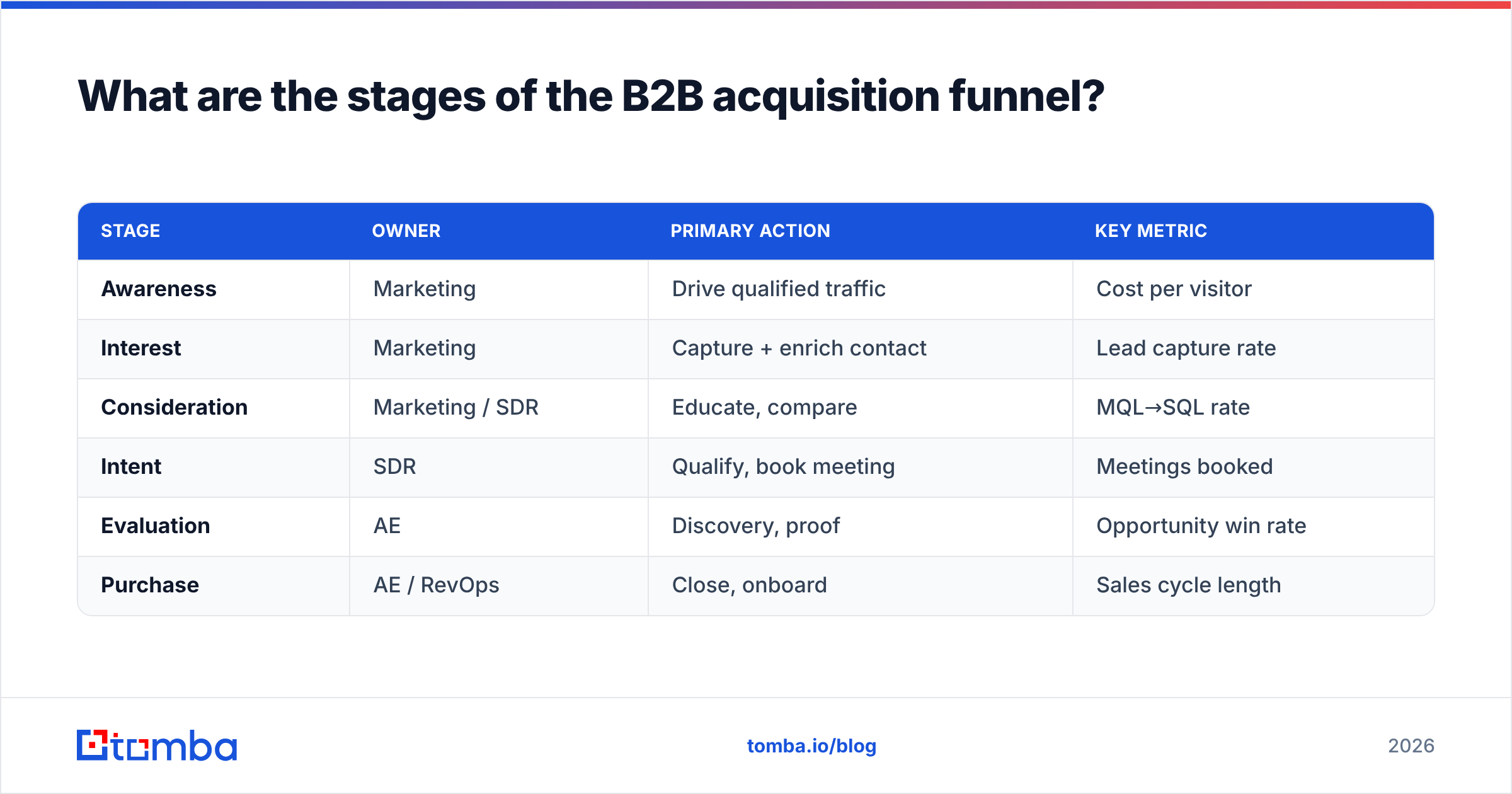
Most teams use a six-stage model. The labels vary, but the buyer's job at each step does not.
- Awareness — The buyer learns a problem exists and that you might solve it. Channels: SEO, paid social, events, content, referrals.
- Interest — They engage: a newsletter signup, a webinar, a returning visit. This is where you capture identity and start enrichment.
- Consideration — They actively compare options. Case studies, comparison pages, and demos do the work here.
- Intent — A buying signal appears: pricing-page visits, a demo request, a high lead score.
- Evaluation — Sales engages directly. Discovery calls, security reviews, and proof-of-concept work.
- Purchase — Negotiation, procurement, signature, onboarding.
Each stage has an entry condition and an exit condition. The discipline is refusing to advance a lead until it meets the exit condition for its current stage. A demo request from a student researching a paper is not "intent" just because they clicked the button — that is where qualification and a clean B2B database of firmographics earn their keep.
How the stages map to teams and metrics#
| Stage | Owner | Primary action | Key metric |
|---|---|---|---|
| Awareness | Marketing | Drive qualified traffic | Cost per visitor |
| Interest | Marketing | Capture + enrich contact | Lead capture rate |
| Consideration | Marketing / SDR | Educate, compare | MQL→SQL rate |
| Intent | SDR | Qualify, book meeting | Meetings booked |
| Evaluation | AE | Discovery, proof | Opportunity win rate |
| Purchase | AE / RevOps | Close, onboard | Sales cycle length |
This table is the single most useful artifact you can put in front of a go-to-market team. It assigns one owner and one number to each stage, which kills the "is this marketing's fault or sales' fault?" argument before it starts.
What metrics matter at each funnel stage?#
Conclusion first: track three numbers per stage — conversion rate, velocity, and cost — and the funnel will tell you exactly where it is failing.
- Conversion rate is the percentage of leads that advance to the next stage. A funnel-wide close rate hides which stage is bleeding. Per-stage rates expose it.
- Velocity is how long a lead sits in a stage before advancing. A stage with a fine conversion rate but a 45-day dwell time is still a problem — it is choking your pipeline coverage.
- Cost is the fully loaded spend to move a lead through that stage. Awareness is usually cheap per unit and expensive in aggregate; evaluation is the reverse.
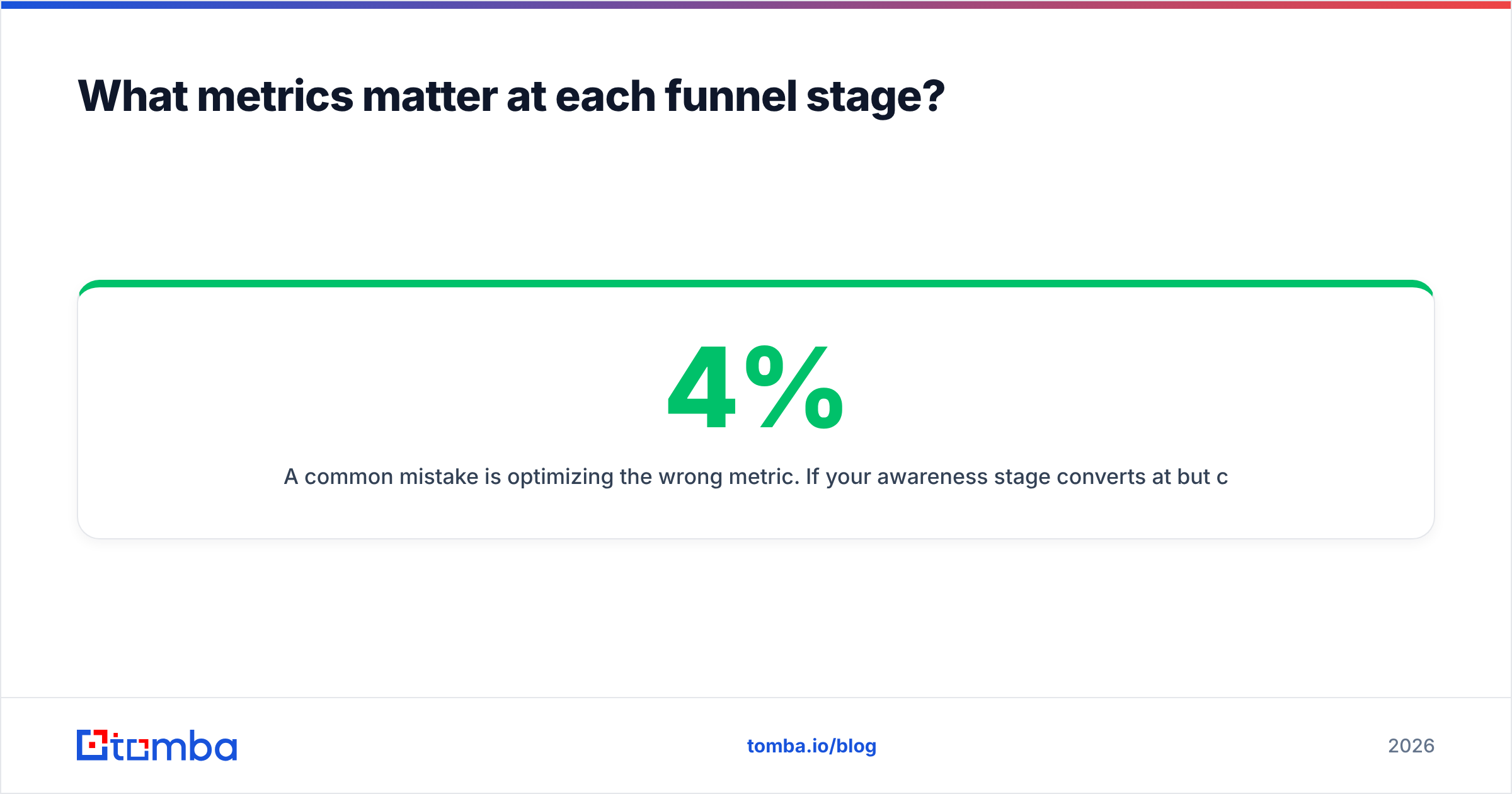
A common mistake is optimizing the wrong metric. If your awareness stage converts at 4% but consideration converts at 12%, pouring more budget into top-of-funnel ads just floods a downstream bottleneck. Fix the narrowest pipe first.
Two derived metrics matter at the executive level:
- CAC (customer acquisition cost) — total acquisition spend divided by customers won. Watch the trend, not the absolute number.
- Pipeline coverage — open pipeline value divided by your quota. Below 3x and you will likely miss; the funnel math does not lie.
For a deeper definition of how revenue teams coordinate these numbers, the concept of revenue operations is worth reading — RevOps exists precisely to keep the funnel's metrics consistent across teams.
Where do B2B funnels leak the most?#
Three places, in order of how often they hurt:
1. The marketing-to-sales handoff. Marketing celebrates 500 MQLs; sales works 40 of them and ignores the rest as junk. The leak is a definition mismatch, not a volume problem. Fix it by agreeing — in writing — on what a marketing qualified lead actually is, then enforcing it with lead scoring.
2. Bad contact data. You cannot move a lead to "intent" if the email bounces and the phone number is dead. Industry estimates put B2B data decay at roughly 30% per year as people change jobs. Every stale record is spend you already paid for, silently wasted. Verifying contacts before outreach is the single highest-ROI maintenance task in the funnel.
3. Slow follow-up. Response time is a conversion multiplier. The classic Harvard Business Review study on lead response found firms that contacted a lead within an hour were far likelier to qualify it than those who waited longer. A perfect funnel with a 24-hour follow-up delay still leaks.
How do you fix each funnel leak?#
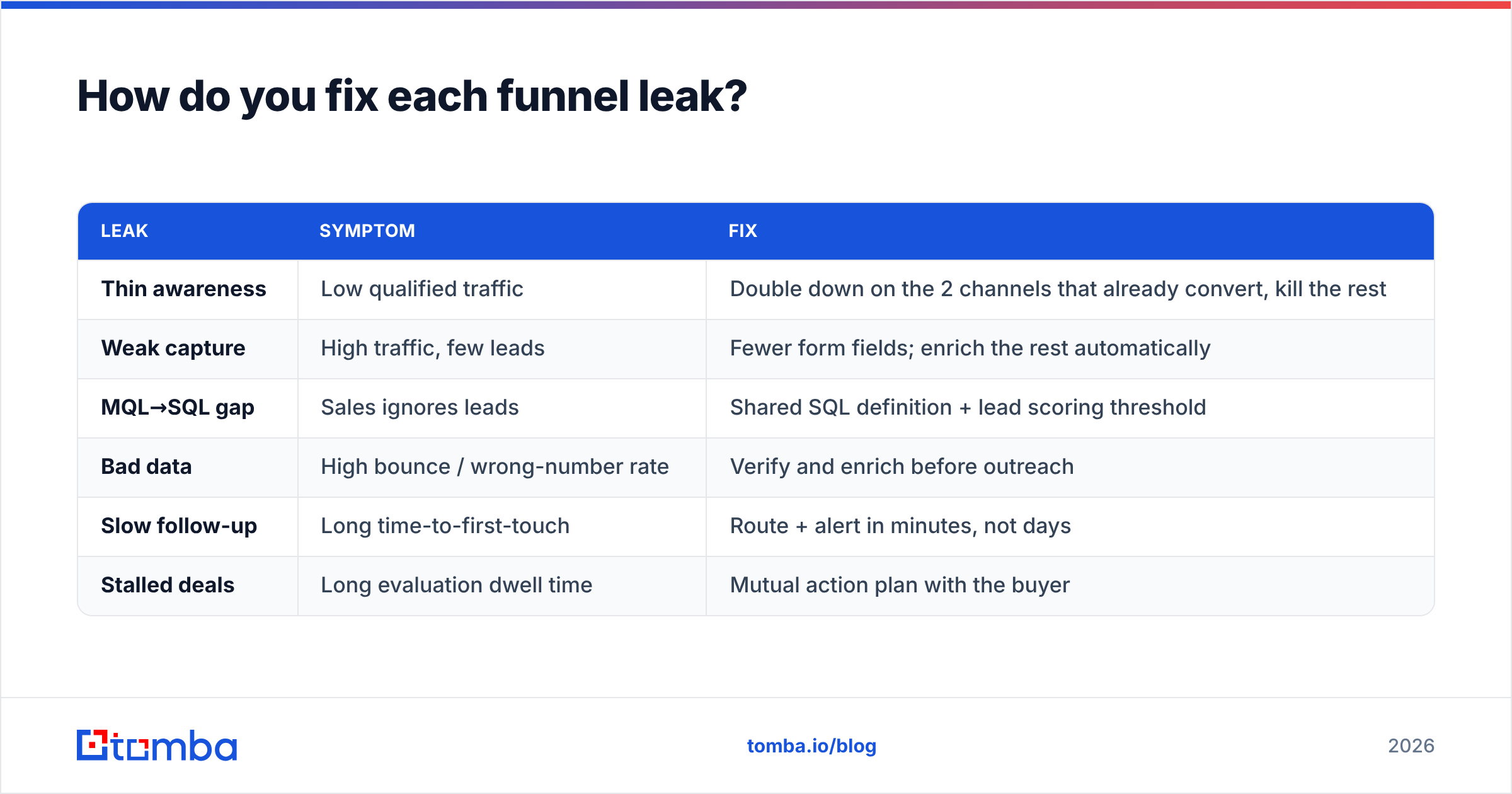
Match the fix to the stage. Generic "do more marketing" advice is why funnels stay broken.
| Leak | Symptom | Fix |
|---|---|---|
| Thin awareness | Low qualified traffic | Double down on the 2 channels that already convert, kill the rest |
| Weak capture | High traffic, few leads | Fewer form fields; enrich the rest automatically |
| MQL→SQL gap | Sales ignores leads | Shared SQL definition + lead scoring threshold |
| Bad data | High bounce / wrong-number rate | Verify and enrich before outreach |
| Slow follow-up | Long time-to-first-touch | Route + alert in minutes, not days |
| Stalled deals | Long evaluation dwell time | Mutual action plan with the buyer |
The capture and data leaks are where tooling moves the needle fastest. Instead of asking a visitor for ten form fields (and watching them bounce), ask for two and fill in the rest. If you have a name and a company domain, an email finder returns the verified work email, and data enrichment appends title, seniority, and firmographics. The lead enters your funnel complete, so scoring and routing actually work.
For the data-decay leak, run lists through an email verifier before any send. It is far cheaper to drop a dead address than to burn sender reputation on it — and protecting email deliverability keeps the rest of your outreach landing in inboxes.
A simple weekly funnel review#
You do not need a dashboard suite to start. Five questions, every Monday:
- Which stage had the lowest conversion rate last week? That is this week's priority.
- Did any stage's velocity get worse? A slowing stage predicts next month's miss.
- What was our bounce / wrong-number rate? Above 5% means a data problem, not a messaging problem.
- How fast did we touch new inbound leads? Measure in minutes.
- Is pipeline coverage above 3x? If not, the top of the funnel needs attention now, not next quarter.
Funnel vs. flywheel: does the funnel still apply in 2026?#
Short answer: yes, but treat it as a loop, not a one-way slide.
Critics — most prominently HubSpot with its flywheel model — argue the funnel ignores retention and advocacy. They have a point. A funnel that ends at "purchase" misses that existing customers are your cheapest source of expansion and referral, which feed straight back into awareness.
The practical reconciliation: keep the funnel for acquisition diagnostics because its stage-by-stage math is unbeatable for finding leaks, and bolt a retention loop onto the end. The funnel tells you where deals die; the loop tells you where customers grow. You need both. Most analysts at firms like Gartner now model the B2B buying journey as nonlinear loops anyway — buyers revisit stages, do parallel evaluation, and pull in new stakeholders mid-cycle. Your measurement model should expect that, not fight it.
What does not change: every loop still needs accurate contact data to function. Whether you draw a funnel, a flywheel, or a tangle of loops, a wrong email address breaks all three.
How do tools fit into the funnel?#
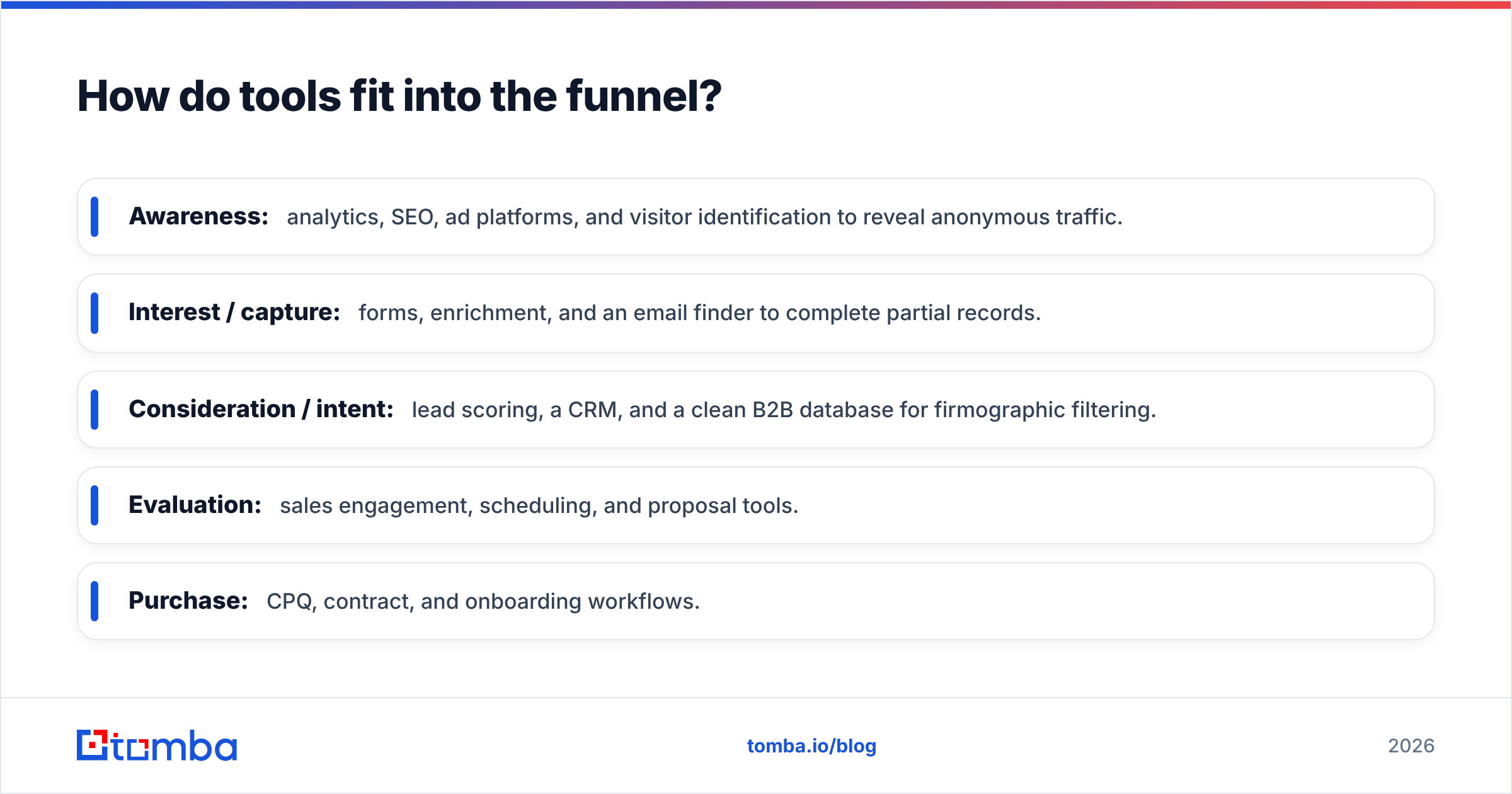
Tooling should map to stages, not pile up as a random stack. A quick reference:
- Awareness: analytics, SEO, ad platforms, and visitor identification to reveal anonymous traffic.
- Interest / capture: forms, enrichment, and an email finder to complete partial records.
- Consideration / intent: lead scoring, a CRM, and a clean B2B database for firmographic filtering.
- Evaluation: sales engagement, scheduling, and proposal tools.
- Purchase: CPQ, contract, and onboarding workflows.
The mistake is buying a tool per stage with no shared data layer. When your enrichment, verification, and finding all draw from the same source, the lead record stays consistent as it moves down the funnel. That is why teams consolidate these jobs — see the full Tomba pricing tiers — rather than stitching three vendors together at every handoff.
If you are evaluating where to start, fix the data layer first. It is the cheapest change with the widest blast radius: better data improves capture, scoring, routing, deliverability, and close rate simultaneously. No single channel optimization touches that many stages at once.
Putting it together: a funnel that compounds#
A healthy 2026 B2B acquisition funnel has four properties. It is measured per stage, so leaks are visible. It is fed clean data, so no stage wastes spend on dead contacts. It has a fast, agreed handoff, so marketing's work survives the jump to sales. And it loops back, so won customers refuel awareness.
Start small. Pick your weakest stage from the weekly review, apply the matching fix from the table above, and measure for two weeks. Then move to the next narrowest pipe. Funnels are not rebuilt in a quarter; they are tuned one stage at a time, and the gains compound because each fixed stage raises the ceiling for every stage below it.
Start with the data layer#
The fastest funnel win you can ship this week is clean, complete contact data at the point of capture. Stop sending to addresses that bounce and stop handing sales records that are missing the work email. Use the Tomba Email Finder to turn a name and domain into a verified professional email, enrich it with title and firmographics, and route a complete lead into your funnel from the first touch. Start free with 25 searches, then scale on the $49/mo Starter plan as your pipeline grows — and watch every downstream conversion rate move with it.
// get started
Find, verify and enrich your first contacts today
Start on the free plan with 25 searches a month, then scale when your team is ready.
Free plan · No credit card required · GDPR & CCPA
// about the author