B2B Acquisition Strategy in 2026: A Practical Playbook
A concrete, channel-by-channel B2B acquisition strategy for 2026 — how to pick channels, model CAC, build a clean data foundation, and scale what works.
TL;DR
- A B2B acquisition strategy is the documented system for turning strangers into paying accounts — it covers channel mix, targeting, message, data, and the CAC math that says whether any of it is worth funding.
- Most teams fail at acquisition not because their tactics are bad, but because their ICP is fuzzy and their contact data is dirty. Fix the foundation first.
- Pick 2–3 channels you can run deeply, not 9 you run shallowly. Depth beats spread in 2026.
- Model CAC and payback before you scale a channel, then double down only on the ones that clear your threshold.
- Clean, verified contact data is the multiplier on every outbound and ABM motion — bad data quietly taxes every other line item.
What is a B2B acquisition strategy?#
A B2B acquisition strategy is the plan and operating system you use to acquire new business customers predictably — at a cost that keeps your unit economics healthy. It answers four questions in order: who you sell to, where you reach them, what you say, and how you measure whether it pays back.
Think of it like fishing commercially rather than with a rod. A hobbyist casts wherever looks nice. A commercial operation studies where the fish actually are, picks the right nets, runs the same route repeatedly, and tracks catch-per-trip so they know which routes to keep. Acquisition is the same: repeatable routes, measured returns, ruthless pruning.
The strategy is not a single channel. "We do cold email" is a tactic. A strategy decides that cold email plus LinkedIn plus a narrow paid-search slice will hit a specific segment, that your data layer feeds all three, and that you'll kill any of them that misses a payback target. The discipline is in the connective tissue, not the individual moves.
Why do most B2B acquisition strategies stall?#
They stall on two things almost every time: a vague ideal customer profile and unreliable data. Everything downstream inherits those errors.
If your ICP is "mid-market SaaS companies," you have not defined an ICP — you've defined a vibe. A usable ICP names the segment, the trigger that makes them a buyer now, the role who feels the pain, the role who signs, and the disqualifiers that waste your reps' time. The tighter the definition, the cheaper every channel gets, because you stop paying to reach people who will never buy.
The second failure is data. You can have a perfect message and the right channel, and still burn the quarter because 30% of your contacts bounce, half your "decision-makers" left the company, and your CRM is full of duplicates. Dirty data doesn't announce itself — it shows up as low reply rates and a sales team that quietly stops trusting the list.

That second point is worth sitting with: before you optimize copy or bid strategy, make sure the names and addresses you're acting on are real. A verified contact base is the difference between a channel that compounds and one that decays.
What channels belong in a 2026 B2B acquisition strategy?#
The honest answer is: fewer than you think. The teams winning in 2026 run two or three channels deeply and instrument them well, rather than spreading effort across everything and mastering nothing.
Here's how the main channels compare on the dimensions that actually decide your mix — speed to pipeline, cost, scalability, and how much they depend on data quality.
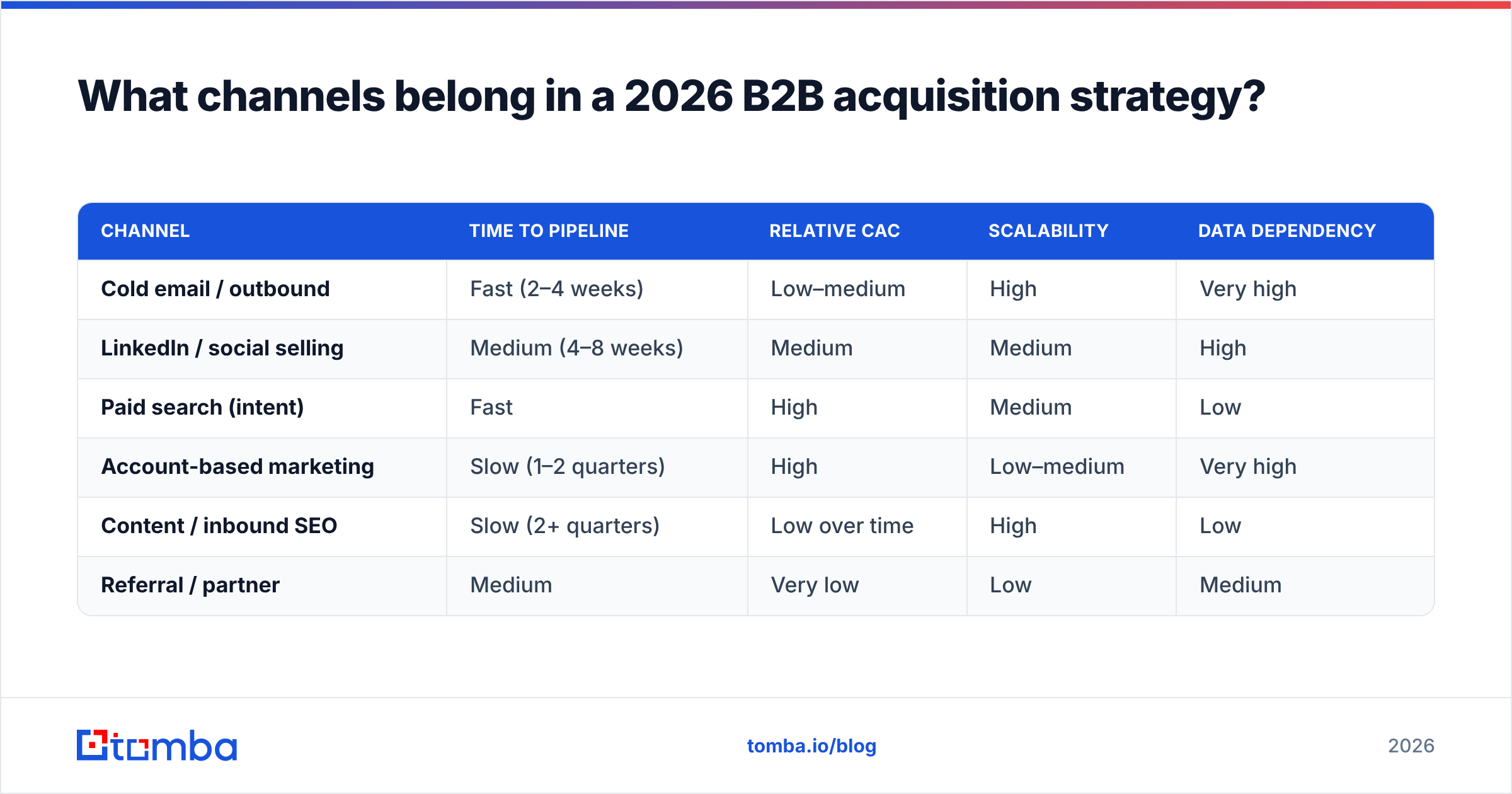
| Channel | Time to pipeline | Relative CAC | Scalability | Data dependency |
|---|---|---|---|---|
| Cold email / outbound | Fast (2–4 weeks) | Low–medium | High | Very high |
| LinkedIn / social selling | Medium (4–8 weeks) | Medium | Medium | High |
| Paid search (intent) | Fast | High | Medium | Low |
| Account-based marketing | Slow (1–2 quarters) | High | Low–medium | Very high |
| Content / inbound SEO | Slow (2+ quarters) | Low over time | High | Low |
| Referral / partner | Medium | Very low | Low | Medium |
A few things fall out of that table. Outbound and ABM give you the most control over who you reach, but they live or die on data quality — which is why they sit at "very high" dependency. Inbound and content are cheap per lead once they compound, but they're slow and you don't choose who shows up. Paid search captures existing intent at a premium. Referral is the cheapest pipeline you'll ever get and the hardest to scale on demand.
The right starting mix for most B2B teams: one fast, controllable channel (outbound) to create pipeline now, one compounding channel (content or social) to lower blended CAC over time, and a referral motion you actively ask for rather than wait on.
How do you build the data foundation underneath it?#
Start by treating contact data as infrastructure, not a one-time purchase. Lists rot at roughly 2–3% per month as people change jobs, so a "fresh" list is stale within a quarter. Your acquisition strategy needs a refresh loop, not a download.
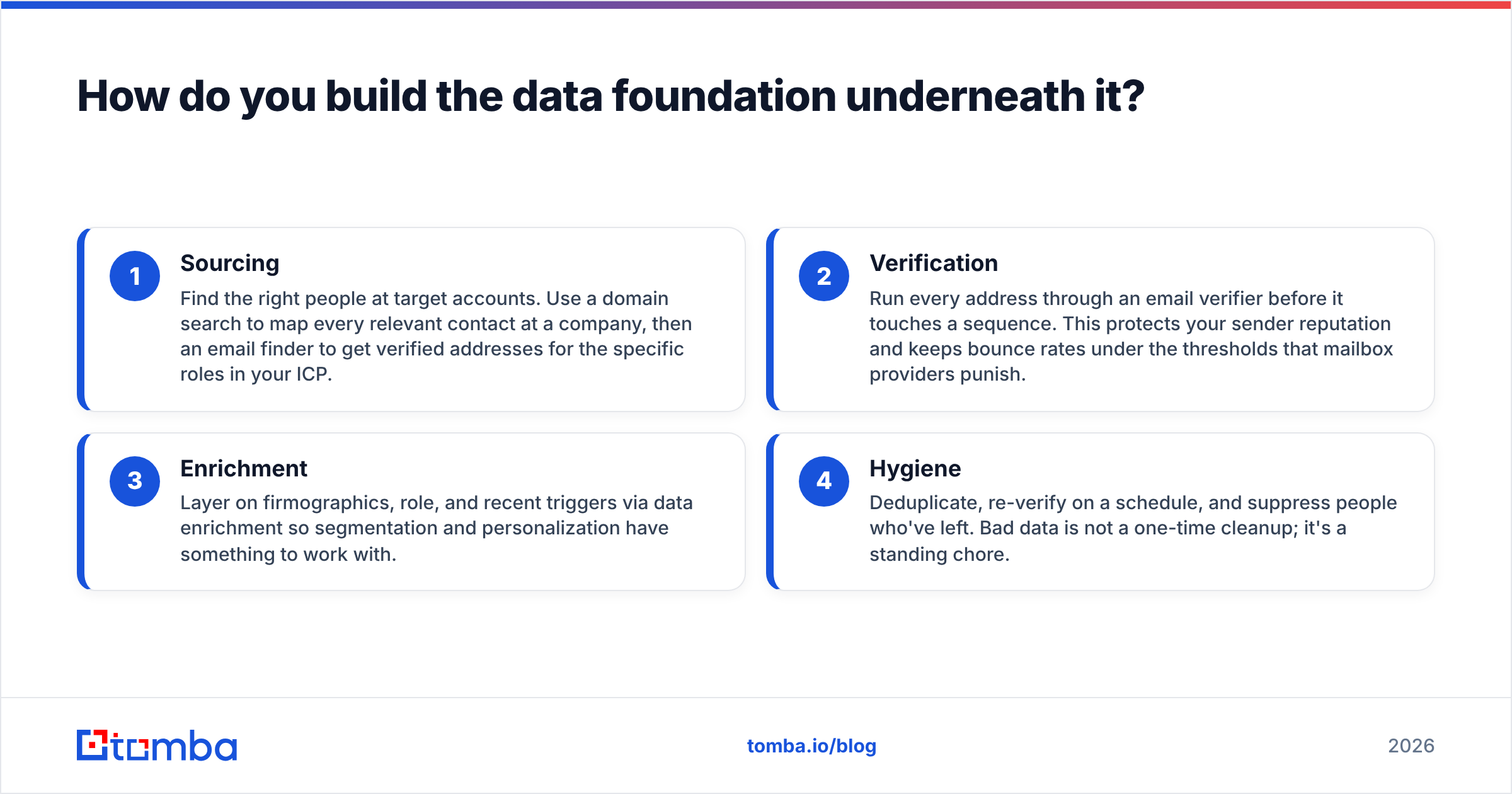
A practical data foundation has four moving parts:
- Sourcing — Find the right people at target accounts. Use a domain search to map every relevant contact at a company, then an email finder to get verified addresses for the specific roles in your ICP.
- Verification — Run every address through an email verifier before it touches a sequence. This protects your sender reputation and keeps bounce rates under the thresholds that mailbox providers punish.
- Enrichment — Layer on firmographics, role, and recent triggers via data enrichment so segmentation and personalization have something to work with.
- Hygiene — Deduplicate, re-verify on a schedule, and suppress people who've left. Bad data is not a one-time cleanup; it's a standing chore.
Get this layer right and every channel above gets cheaper and more effective at the same time. Skip it and you're optimizing copy on top of a list that's quietly broken.

How do you model CAC and payback before scaling?#
Conclusion first: never scale a channel until you know its fully-loaded CAC and payback period. Spending more on a channel that doesn't pay back just loses money faster.
Customer Acquisition Cost is total acquisition spend — tools, ads, headcount, data — divided by new customers won in the period. The number most teams quote is wrong because they leave out salary and tooling. Load it fully. Then compare it to the value you get back.
Two ratios decide everything:
- LTV:CAC — Lifetime value divided by CAC. A healthy B2B SaaS target is roughly 3:1 or better. Below that, you're buying revenue at a loss after support and churn.
- CAC payback — Months of gross margin needed to recover CAC. Under 12 months is strong for most mid-market B2B; under 18 is workable for longer-cycle enterprise.
Run this per channel, not just blended. Blended CAC hides the truth — it can look fine while one channel subsidizes a money-losing one. When you split it out, you usually find one or two channels carrying the whole motion and several quietly draining it. Cut the drains, feed the engines. For benchmark-grade thinking on SaaS unit economics, the analyses on Gartner and the operator data on G2 are worth pressure-testing your own numbers against.
What does a sequenced 90-day rollout look like?#
You don't launch everything at once. You sequence so each phase de-risks the next.
Days 1–30 — Foundation. Lock the ICP to a written definition with disqualifiers. Build and verify your first contact base for one segment. Stand up tracking so you can attribute pipeline to channel. Resist the urge to send anything yet.
Days 31–60 — Prove one channel. Launch your fastest controllable channel — usually outbound — to the verified base. Run enough volume to get statistically real reply and meeting rates. Measure CAC honestly. This phase answers one question: can this segment be acquired profitably at all?
Days 61–90 — Add and compound. If channel one clears payback, add a second channel that reaches the same ICP a different way (social or ABM), and start the slow compounding channel (content) that lowers blended CAC later. Now you're building a system, not running a campaign.
The order matters because each phase produces the evidence that justifies funding the next. Skipping ahead — scaling spend before you've proven payback — is the single most common way acquisition budgets get wasted.
How does Tomba fit into the strategy?#
Tomba is the data layer underneath the controllable channels — outbound and ABM — where contact accuracy decides everything. It's not a sequencer or an ad platform; it's the part that makes those tools work by feeding them real, verified people.
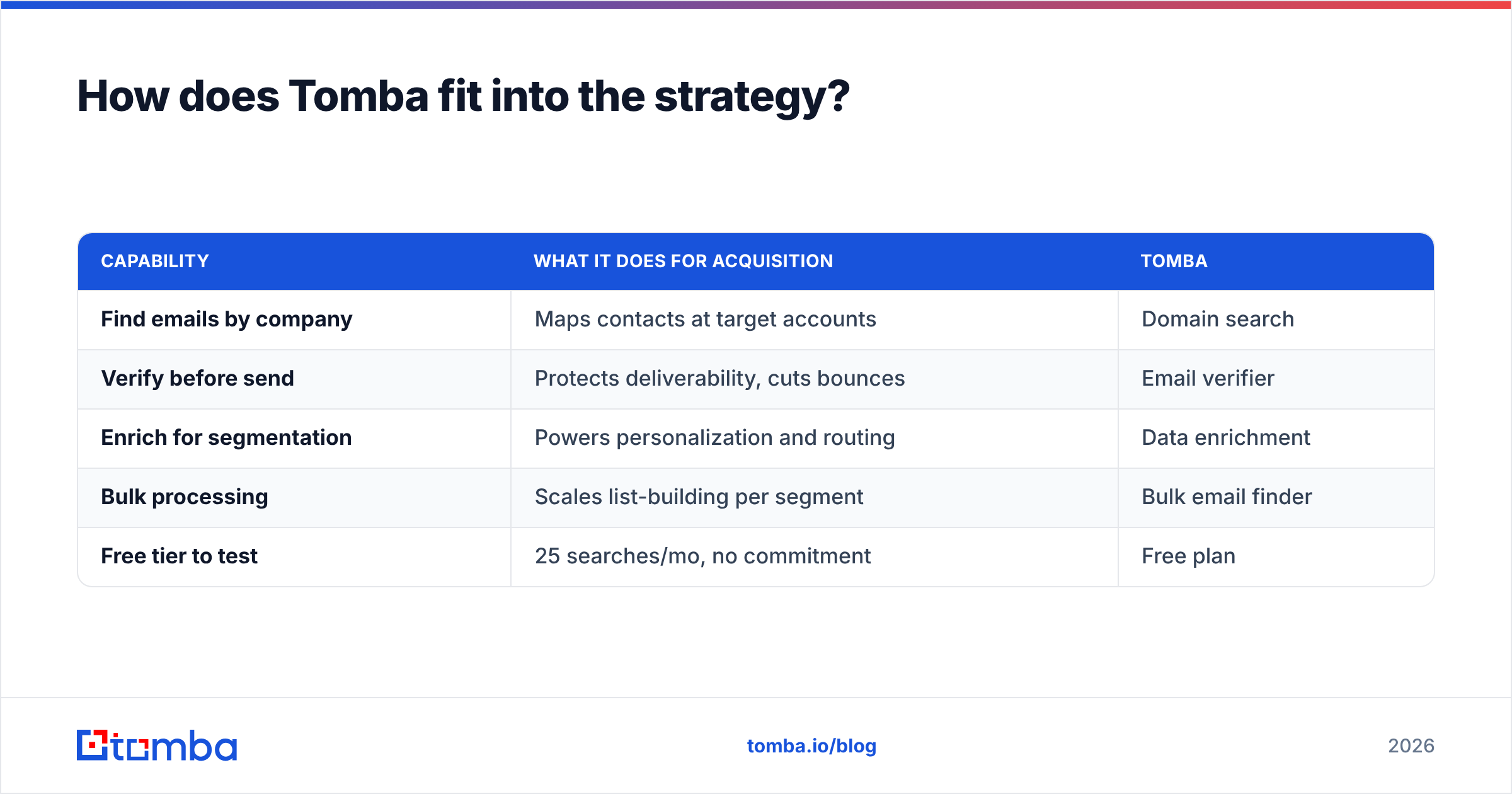
| Capability | What it does for acquisition | Tomba |
|---|---|---|
| Find emails by company | Maps contacts at target accounts | Domain search |
| Verify before send | Protects deliverability, cuts bounces | Email verifier |
| Enrich for segmentation | Powers personalization and routing | Data enrichment |
| Bulk processing | Scales list-building per segment | Bulk email finder |
| Free tier to test | 25 searches/mo, no commitment | Free plan |
On price, Tomba's pricing runs from a free tier (25 searches/month) to Starter at $49/month, Growth at $99/month, and Pro at $249/month — so you can validate the data layer on one segment before committing budget. For teams running outbound at scale, the bulk email finder and the Tomba API let you wire verification directly into your pipeline instead of doing it by hand.
The point isn't that one tool wins your whole strategy. It's that the highest-leverage channels in B2B are the data-dependent ones, and the cheapest way to lift their performance is to stop sending to bad contacts.
What are the most common mistakes to avoid?#
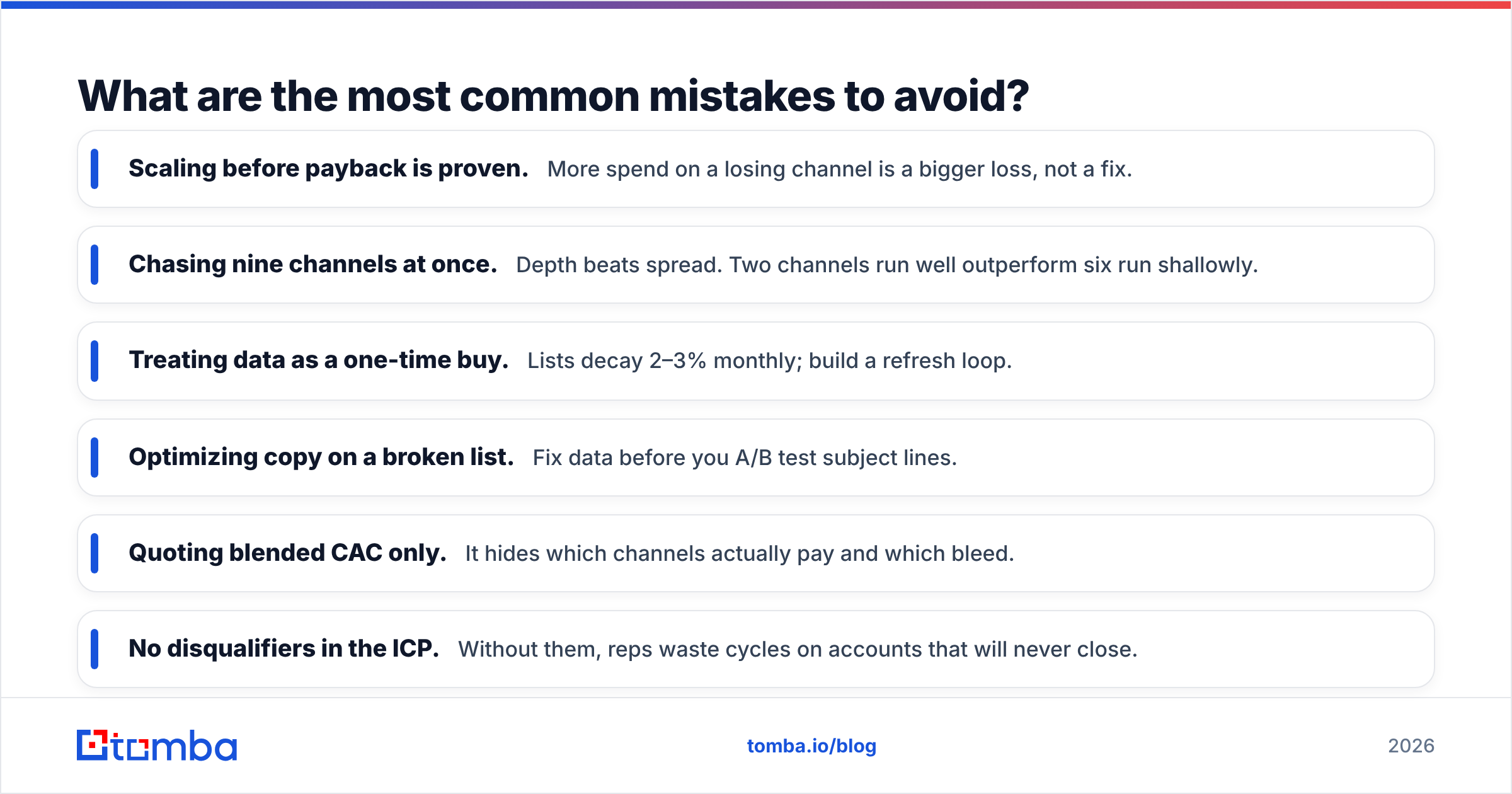
- Scaling before payback is proven. More spend on a losing channel is a bigger loss, not a fix.
- Chasing nine channels at once. Depth beats spread. Two channels run well outperform six run shallowly.
- Treating data as a one-time buy. Lists decay 2–3% monthly; build a refresh loop.
- Optimizing copy on a broken list. Fix data before you A/B test subject lines.
- Quoting blended CAC only. It hides which channels actually pay and which bleed.
- No disqualifiers in the ICP. Without them, reps waste cycles on accounts that will never close.
Avoid those six and you're ahead of most teams, because each one is a quiet tax that doesn't show up in any single dashboard — it shows up as a strategy that feels busy but doesn't compound.
The bottom line#
A B2B acquisition strategy is a system, not a stack of tactics: a tight ICP, two or three deeply-run channels, a clean data foundation feeding the controllable ones, and honest per-channel CAC math telling you what to scale and what to kill. Build it in that order and acquisition becomes a predictable engine instead of a quarterly scramble.
The fastest lever most teams haven't pulled is the data layer. If your outbound and ABM motions are running on contacts you haven't verified, you're paying full price for every channel and getting a fraction of the return. Start there: use the Tomba Email Finder to build a verified, accurate contact base for your top segment, test it on the free tier, and watch every downstream channel get cheaper and sharper at the same time.
Ready to find emails that actually work?
Join 150,000+ professionals who stopped guessing and started sending. Free credits on signup — no credit card required.
Get the Tomba newsletter
Practical outbound tactics and product updates — once every two weeks.
About the author